Trump’s Affront to the Founding
The president besmirches the highest principles of the Declaration of Independence while embodying the tyrannical rule it sought to overthrow.
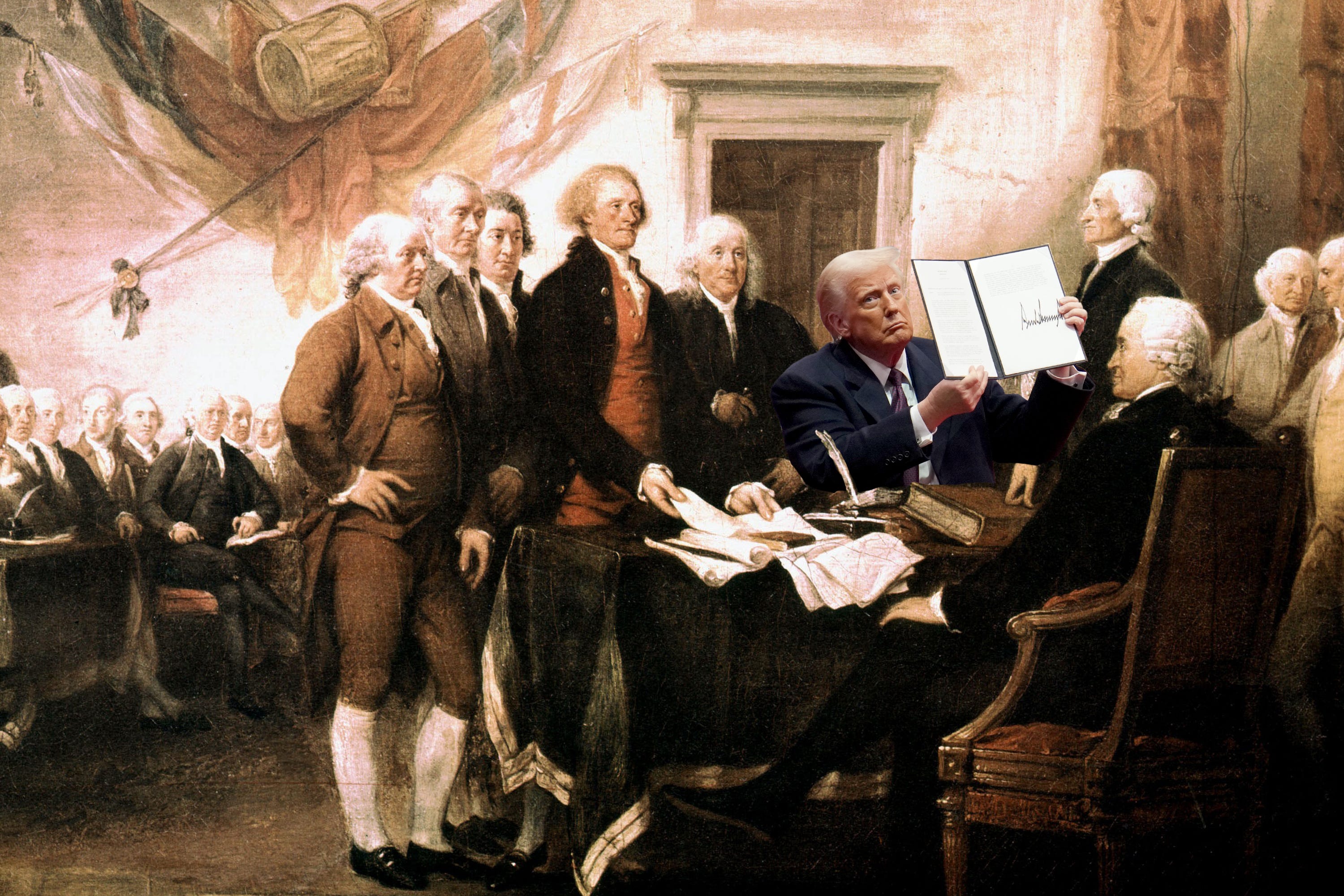
DONALD TRUMP IS PUTTING ON a celebration of something he doesn’t believe in. “America 250” is supposedly about the Declaration of Independence, the anniversary of which we celebrate on every July Fourth. But through his words and actions, Trump has turned his back on the principles enshrined in the Declaration.
The most famous of those principles is that “all men are created equal.” In 2004, Trump told Wolf Blitzer: “But the phrase that ‘all men are created equal’ is a wonderful phrase, but unfortunately it doesn’t work that way. All men are not created equal. Some are born with a genius and some are born without.”
Five years later, he made substantially the same point in an interview with the New York Times: “They say all men are created equal. It’s not true. Some people are born very smart, some people are born not so smart.”
Once he began running for president, Trump’s speechwriters decorated his public remarks with occasional references to equality. And his defenders might claim that his earlier remarks referred to individual differences and he never meant that some groups are superior to others. Or they made tortuous interpretations of his character and worldview.
His public statements suggest otherwise. One clear sign is his repeated praise for immigration from mostly white countries and his disparagement of immigration from mostly black and brown ones. “Why can’t we have some people from Norway, Sweden—just a few—let us have a few. From Denmark,” he said last year. “But we always take people from Somalia, places that are a disaster, right? Filthy, dirty, disgusting, ridden with crime. The only thing they’re good at is going after ships.”
If this were not explicit enough about Trump’s belief in Somalian inferiority, consider his remarks about alleged Medicaid fraud in Minnesota: “Somalians, can you imagine? And they don’t do it. A lot of very low IQ people, they don’t do it. Other people work it out, and they get them money, and they go out and buy Mercedes-Benzes.”
Just as he rejects equality, Trump also denies that there should be limits on his power. In remarks to reporters last year, he said: “I have the right to do anything I want to do . . . I’m the president of the United States.” And when Marc Caputo of Axios recently asked him what the Iran war had taught him about the limits to his power, he said: “There are no limits.”
This view would have stunned the Declaration’s signers. They urged rebellion against the king precisely because of his “long train of abuses and usurpations.”
Near the top of their list were royal efforts to block or bypass the actions of colonial legislatures. Trump has sought to sideline Congress through executive orders and emergency powers. The worst examples involve his unilateral imposition of tariffs, which amount to regressive taxes on American consumers. In the Declaration’s words, his moves are an effort at “cutting off our Trade with all parts of the world” and “imposing Taxes on us without our Consent.”
One of the Declaration’s grievances was that George III had “obstructed the Administration of Justice.” So much of the second Trump administration is summed up in that short phrase. Trump granted mass clemency to the people who attacked the Capitol, and then backed an abortive plan to pay them. He has stocked the Justice Department with loyalists who have investigated people he sees as enemies. And he has issued executive orders against law firms that fought him in court, restricting their access to government buildings. Fortunately, the courts have pushed back.
The Declaration also accused the King of “transporting us beyond Seas to be tried for pretended offences” and “depriving us, in many Cases, of the Benefits of Trial by Jury.” The Trump administration has sent migrants to El Salvador’s infamous CECOT mega-prison. Federal judges have ruled that a number of those deportations took place without adequate due process. Perhaps more perniciously, Trump reportedly gave serious consideration to suspending the writ of habeas corpus, which would have given the government broad powers to detain people without meaningful judicial review.
The signers of the Declaration did not always live up to their own ideals. Thomas Jefferson, the primary drafter of the Declaration, owned slaves, as did most of the signatories. Bowing to pressure from the Southern colonies, Congress deleted Jefferson’s passage denouncing the slave trade. Years later, John Adams signed the infamous Alien and Sedition Acts, which expanded government authority and undercut civil liberties.
The gap between principle and practice posed a challenge to subsequent generations. Martin Luther King put it best in 1963, when he called on the nation to “rise up and live out the true meaning of its creed.”
Trump rejects this project of fulfilling our nation’s principles out of hand. When we hold his conduct up against the charges brought forth 250 years ago, it is clear that he aspires to the type of tyrannical rule this country rejected. He wants to restore Confederate monuments, honoring the insurrection that would have toppled everything that the Declaration represented. His administration removed Martin Luther King Jr. Day and Juneteenth from the national parks’ 2026 fee-free calendar and replaced them with “Flag Day/President Trump’s Birthday.” He has vulgarized and politicized the semiquincentennial at every turn, treating it as a celebration of himself more than of the United States.
The Declaration asks Americans to measure their leaders against enduring principles. Trump measures everything against himself.
John J. Pitney, Jr. is a professor of government at Claremont McKenna College.