When the Deployment Doesn’t End
Angry and worried military families don’t need platitudes or pep talks. They need someone to listen.

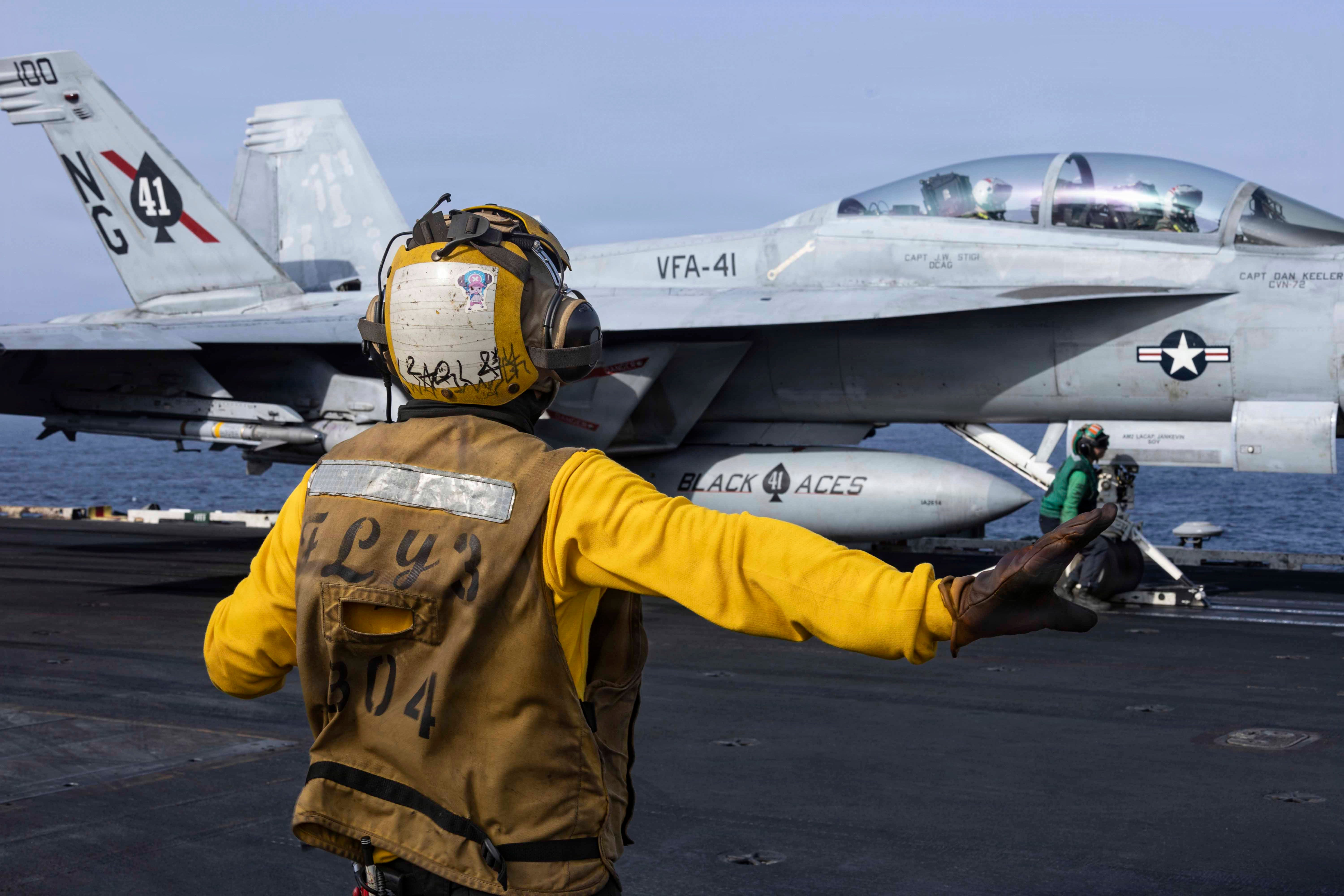
ACTING SECRETARY OF THE NAVY HUNG CAO traveled to San Diego to meet with families of sailors who are part of the USS Abraham Lincoln Carrier Strike Group. On Thursday night, he walked into a room filled with people who were angry, exhausted, frightened, and looking for answers about when their loved ones were coming home.
I know something about walking into that room.
In April 2004, the 1st Armored Division was preparing to return to Germany after a year in Iraq. Families had been counting the days; ribbons and ‘Welcome Home’ banners decorated our bases in Europe. The lucky soldiers who would be the first to leave were packing their gear and helicopters were receiving shrink-wrap. Then, by the time some of our troops had already been home a few days, came word that we would be extended in Iraq for an indeterminate number of months to counter the uprising of Muqtada al-Sadr’s militia. His group’s uprising was spreading across Baghdad and central Iraq, the security we had fought for over the last year was rapidly deteriorating, and the Pentagon believed we should stay to provide additional combat power.
Our twelve-month deployment would become fifteen months. Worse, because some units had already begun returning home, we had to recall back to Iraq roughly a third of our 20,000-person force that had already been reunited with their families in Germany.
In announcing the extension to our team, our division commander, Maj. Gen. Marty Dempsey, gathered his commanders. He told us something I have never forgotten. We could be disappointed, he said. We could even be angry. But we were leaders, and we had been given a new mission by the secretary of defense. Our responsibility was to explain that mission to our soldiers, prepare them for it, and lead them through it.
Then Marty gave me another mission that night: “We need to send a senior leader back to Germany to talk to the families. I want you to do it.” He kidded that it would likely be tougher than combat. To a degree, he was right.
Over three days, I traveled to the seven communities where our soldiers and families lived. At every stop, I walked into an auditorium filled with spouses and children who had expected their soldiers to be home within days or weeks. Instead, they had just been told that husbands, wives, fathers, and mothers would remain in combat for another few months.
When I arrived at the Ramstein airport, my wife was there to meet me. We hadn’t seen each other since the deployment began. After a hug, she gave me the best advice I ever received when talking to families.
Don’t tell them the mission demands their soldiers stay. They already know their soldiers have a mission.
Don’t tell them to be strong. They’ve already been strong for a year.
Don’t brief them on what the division is doing. They really don’t care about that.
Instead, listen to them and answer their questions until they don’t have any more questions to ask, and answer them honestly with what you know and don’t know.
So that’s what I did in all seven of those meetings. And the statements and questions began to flow.
One mother told me that she and her children had filled a jar with M&Ms—one for every day remaining in the deployment. Each night, the children removed one. The jar was almost empty. Now, she asked, what was she supposed to tell them? What was she supposed to do?
A young teenage girl told me she had been waiting for her father to come home because she wanted him to take her to the father-daughter dance at her high school. He wasn’t going to make it, so who would take her?
A 19-year-old Army wife stood up and, with a mixture of anger and confusion, simply said she had married her soldier right before they came to Germany, and he left for Iraq right after they arrived. She’d been making her way so far with the help of the other wives, but now she didn’t understand what was happening. She wasn’t interested in hearing about operational requirements in Baghdad or the strategic implications of the Sadr uprising. She wanted someone to explain why the Army had changed the bargain she thought it had made with her family, and she wanted her new husband home.
There were dozens of questions like those. Some were angry. Some were heartbreaking. A few couldn’t really be answered.
But something happened in those auditoriums. The anger didn’t disappear—nor should it have. Instead, it gradually changed into understanding and, finally, a reluctant acceptance of what their soldiers had been asked to do, and in turn what they had been asked to do. Not because I gave them a brilliant briefing. I didn’t. It happened because someone had come to listen to them, stood in front of them, and treated their fears as legitimate.
I THOUGHT ABOUT THOSE FAMILIES when I heard about the acting secretary of the Navy visiting the families of the Abraham Lincoln.
Their situation is, in many ways, much tougher than what faced us. The Lincoln left San Diego late last year for what was expected to be a normal deployment and was subsequently diverted to the Middle East and combat operations against Iran. Its crew eventually endured 208 consecutive days at sea without a port visit—a modern carrier record—and families now describe sailors dealing with broken toilets and laundry facilities, moldy showers, food shortages, limited supplies, and the grinding physical and psychological effects of months aboard a warship conducting never-ending combat operations.
An aircraft carrier may be one of the most impressive machines ever built, but it is still operated by human beings. Flight decks are extraordinarily dangerous workplaces even under normal conditions. Sailors work long shifts around jet engines, fuel, weapons, heavy machinery, electrical systems, nuclear propulsion, and aircraft launching and recovering day and night. Fatigue accumulates. Attention wanders. Judgment deteriorates. Small mistakes in that environment can become catastrophic ones. This is the human side of war.
That is what some Lincoln families now fear. They aren’t merely complaining that their sailors are tired. They are worried that prolonged stress, exhaustion, and enemy activity could eventually get their loved ones killed.
Cao, himself a retired Navy captain and combat veteran, deserves credit for going to face those families. But showing up is only the first requirement of leadership. The more important requirement is understanding what those families need when you get there.
They don’t need to be told their sailors are heroes. They already know that. They don’t need to be told the mission is important. They understand that better than most Americans. And they certainly don’t need to be told to be strong.
They need leaders to listen. They need honest answers about what the deployment is all about, why the deployment continues, what is being done to reduce the strain on the crew, and—if no one can tell them when their sailors are coming home—an honest explanation of why no one can tell them. Military families accept extraordinary burdens. But accepting those burdens doesn’t mean surrendering the right to ask hard questions of the people who impose them.
Twenty-two years ago, I learned that lesson in seven auditoriums across Germany. Sometimes the most important thing a senior military leader can do isn’t explain the mission. It’s stand in front of the people paying the price for it—and listen.
Thank you General, for so many reasons.
I didn't expect to find myself weeping on this Saturday morning!
God bless these heroic families.
" my wife was there to meet me. We hadn’t seen each other since the deployment began. After a hug, she gave me the best advice I ever received when talking to families."
General, your wife has a million times more smarts, judgment, empathy, and commonsense than the incompetent leadership of the Pentagon. Trump, the SecDrunk, and the clowns they have at the top running the debacle in Iran have no plans, no strategy, no organization whatsoever.
They use the sailors and army members like little plastic toy soldiers with no consideration of their wellbeing, safety, or ability to do the mission. Because the dopes in charge have no clue what the mission is.
So Trump puts the ships on station without a thought of what they should do or how long they should do it. It's a failure of leadership and it's a betrayal of our men and women in uniform.