A Blistering Critique of the Roberts Court, From Hawaii’s Supreme Court
In an extraordinary opinion, the state justices accuse the SCOTUS majority of undermining democracy.

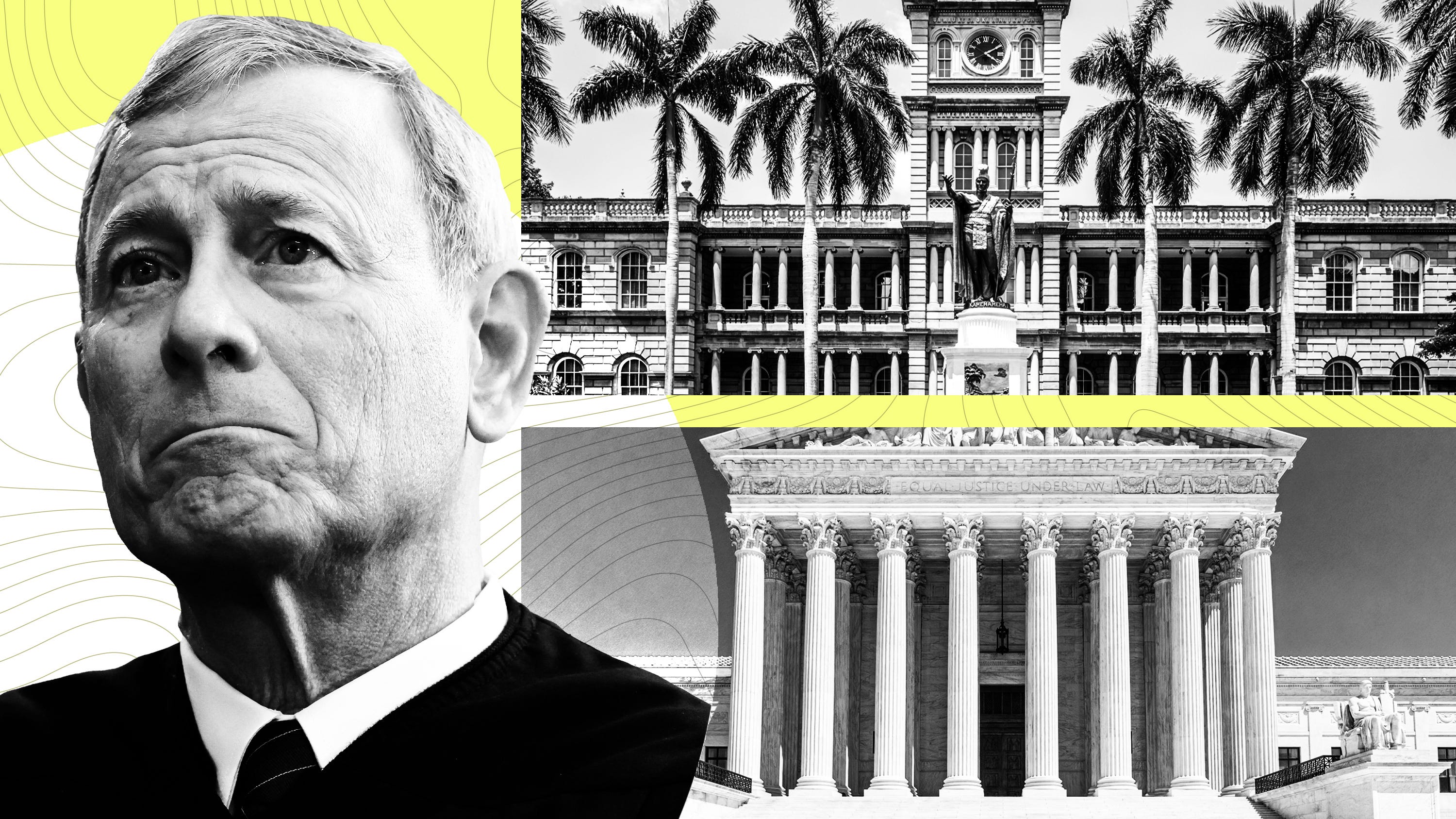
THE HAWAII SUPREME COURT issued a stunning opinion last month that said explicitly something that many other judges across the country have been thinking: Donald Trump is not the only snake in the garden. The justices in the majority on the United States Supreme Court are a danger to democracy too.
Anyone worried about the future of American democracy should take some time to read the opinion.
The case, Granillo v. State of Hawaii, involved a Maui man’s motion for a new trial following his 1990 conviction on charges of kidnapping and sexual assault. He was sentenced to forty years in prison. On appeal, the Hawaii Supreme Court found that “the prosecution used hair and fiber evidence” that “science has since proven . . . false,” so “his right to a fair trial was violated.” The decision to grant him a new trial was unanimous.
The argument I want to call your attention to is buried deep in the 91-page majority opinion—starting on page 72, where Associate Justice Todd Eddins turns his sights on the nation’s highest court.
U.S. Supreme Court precedent holds that the government’s unknowing use of false evidence doesn’t violate a defendant’s constitutional rights. That precedent would seem to apply in the case of the wrongly accused Maui man. But should it apply? Justice Eddins writes that the relevance of U.S. Supreme Court cases “ultimately depends on the premise that the federal constitutional doctrine controls this court’s interpretation of [the Hawaii Constitution]. It does not.”
Had Eddins stopped there, his opinion would have amounted to an unremarkable affirmation of a basic principle of federalism—of the idea that the due process clause in the state’s constitution can be more expansive than “the United States Supreme Court’s construction of the federal Due Process Clause.” But what comes next is nothing short of astonishing: a damning indictment of the U.S. Supreme Court’s right-wing majority.
Eddins begins by quietly invoking the history of racial discrimination in this country: “The Court that now defines federal due process does not honor the work of 1954,” he wrote. “It revives the work of 1857. The work of 1896.”
In case your memory of what you learned in high school history is rusty, let me remind you about each of those years. In 1857, the Supreme Court handed down its infamous Dred Scott ruling, holding that no black American descended from slaves could ever be a U.S. citizen. In 1896, the Court constitutionalized racial discrimination in Plessy v. Ferguson, an opinion affirming the use of whites-only railroad cars. And in 1954, the Court overturned Plessy with Brown v. Board of Education, banning the “separate-but-equal” construction of the Fourteenth Amendment that tolerated racial segregation in education.
Original reporting.
Sharp analysis.
Honest commentary.
Keep up with all our work—sign up for a Bulwark+ membership and get your first two weeks free.
Eddins notes that Dred Scott relied on notions of originalism—that “the Constitution must be interpreted ‘according to its true intent and meaning when it was adopted’”—and charges that “today’s hubristic originalists use the same method to control modern life.” “The Court overrides what Congress passed,” he wrote. “It overrides what the people chose. All to serve its own ends.”
“We take no guidance on the meaning of due process from a court that gutted due process protections in Dobbs v. Jackson Women’s Health Org.,” Eddins writes, which “erased a ‘generations-long constitutional right, stripping autonomy from half of the population, and empowering states to force birth.’” (He is here quoting a decision he wrote in another case last year.)
And now, he writes, “the same jurisprudence has cratered democracy itself.”
“The Roberts Court did what Congress never would. It rewrote the Voting Rights Act of 1965, a cornerstone of American civil rights, democratically enacted and repeatedly reauthorized.” This “judicial demolition” began in 2013 with Shelby County v. Holder, in which the Court “invent[ed] a textually unsupported equal-sovereignty fiction and str[uck] down preclearance on a hunch that the law worked too well.” In 2021, the Court “fabricated ‘guideposts’ nowhere in Section 2 [of the Voting Rights Act] to greenlight racial discrimination in voting.” And this past June, in Louisiana v. Callais, the Court “buried what remained of the crown jewel of the civil rights movement. Pretend law for a real statute.”
And the right-wing majority didn’t stop there, Eddins writes. “The Court then ditched its own thirty-two day default for releasing decisions and hustled out its judgment mid-primary, a favor granted over objection only twice in twenty-five years.” “Weeks later, on its shadow docket, the Court tossed an eleven-day trial record built on fifty-one witnesses, 790 exhibits, 2,600 pages of testimony, and a 270-page opinion by a three-judge court.” In throwing out that case, which involved a Voting Rights Act challenge to Alabama’s congressional districts, the Court “resurrected a tainted congressional map the three-judge factfinders found deliberately entrenched racial bias against Black voters.”1
Eddins then ticks through a series of other cases in which the Roberts Court has remade the face of American politics by rewriting the law itself: Citizens United, in which the Court in 2010 “claimed fidelity to text, history, and tradition while invalidating yet another democratically vetted law, handing corporations the same speech rights as flesh-and-blood Americans and letting dollars talk louder than voters”; Rucho v. Common Cause, in which it “abandoned partisan gerrymandering to the gerrymanderers, refusing for the first time to remedy a constitutional violation because it believed the task beyond judicial competence”; Trump v. United States, in which “it placed a president above the law”; and this year’s NRSC v. FEC, which “made Citizens United look quaint, shredding coordinated spending limits . . . and ensuring that those who bankroll elections drown out the ordinary person. Billionaires spend to be repaid. Everyone else just votes. The Roberts Court has made sure one’s wealth counts more than another’s vote.”
“Rulings run in one direction, time after time,” Eddins concludes. “Weakening protections for those with less power. Fortifying those with more. The pattern speaks for itself. A court that systematically dismantles democratic safeguards, steamrolls constitutional liberties, and tramples human dignity” is one “driven by agenda and intent on swiping power that belongs to the people.”
THE CASE BEFORE the Hawaii Supreme Court did not warrant such an impassioned condemnation of the U.S. Supreme Court. But Eddins and his colleagues wanted to send a message to the country. While the world frets over Trump’s incompetence, corruption, and carnage, the justices of the U.S. Supreme Court enjoy a deference that obscures their role in causing permanent damage. Presidents come and go. The Constitution is enduring, amended only through supermajorities in both Houses of Congress and state legislatures. Or by radical ideologues in robes.
In another passage worth noting, Eddins critiques the Roberts Court’s use of the language of “colorblindness.” As a judicial concept it can be traced back at least to Justice John Marshall Harlan’s famous dissent in Plessy (“Our Constitution is color-blind, and neither knows nor tolerates classes among citizens”). Harlan used the language of colorblindness to dispute the majority’s pretense that racial segregation favoring whites is tolerable under an amendment designed to remedy hundreds of years of enslaving people on the basis of race.
Now, though, colorblindness has become the distorted rationale that the Roberts Court has used to kill consideration of race in college applications and, just this past term, what remained of the landmark Voting Rights Act of 1965. Any consideration of race, the justices have declared, is unconstitutionally discriminatory—even if it’s designed to remedy systemic racial discrimination.
Eddins puts it this way:
The Roberts Court sees only white. It refuses to acknowledge who the Equal Protection Clause was written to protect. The freed people, their descendants, and all others denied equal citizenship. It turns its back on what is in plain sight. The Fourteenth Amendment is not colorblind. It never was. The Court calls the Constitution colorblind while engineering the dilution of Black votes, the unraveling of hard-fought civil rights remedies, and the erasure of Black history. That is not blindness. That is white sight, by design.
A Constitution interpreted this way is not colorblind. It is whatever the Court needs it to be. A way to advance its partisan project.
 | A guest post by
|
Excellent reporting Kim!
Supreme Court aside, the Judiciary seems to be our only functional branch of government these days. Thank you for this important historical context. And good on Hawaii!
I just saw a headline that Cornyn and Blanche have worked out a deal. Glad I chose to read your uplifting article instead...
Wow! Good for them. Thanks for this post!