A High-Stakes Primary in Wisconsin’s Race for Governor
Will the Democrat who wins the party’s gubernatorial nomination August 11 be too progressive to beat a sycophantic Trump crony?

IN HIS NEW BOOK, This Is the Plan: How to End America’s Meltdown and Save Democracy, former Wisconsin Democratic Party Chair Ben Wikler puts his finger on his state’s national political importance, at one point declaring:
What our country is going through now—a soul-ripping, mind-rending nightmare of corrupt authoritarianism in which a far-right candidate takes power on the back of economic discontent and culture wars and then uses his victory to claim a mandate for a sweeping, lawless assault on democracy itself—happened first in Wisconsin.
Wikler’s book, now awash in national attention, draws parallels between Wisconsin’s experience under Governor Scott Walker and the United States under President Donald Trump. Walker, swept into office with the Republican tsunami of 2010 that put both houses of the state legislature under GOP domination, demonized public employee unions, especially teachers, as part of a “divide and conquer” strategy. Trump, similarly, has demonized immigrants who are not members of his immediate family.
Both Walker and Trump used the levers of power to redraw voter district boundaries to their party’s advantage, while doctrinaire conservative justices on the Wisconsin Supreme Court and U.S. Supreme Court nodded in approval. Wisconsin was left as what was often labeled the most heavily gerrymandered state in the nation. Republicans were able to maintain huge majorities in both houses of the state legislature despite Wisconsin being almost equally politically divided between the two major parties.
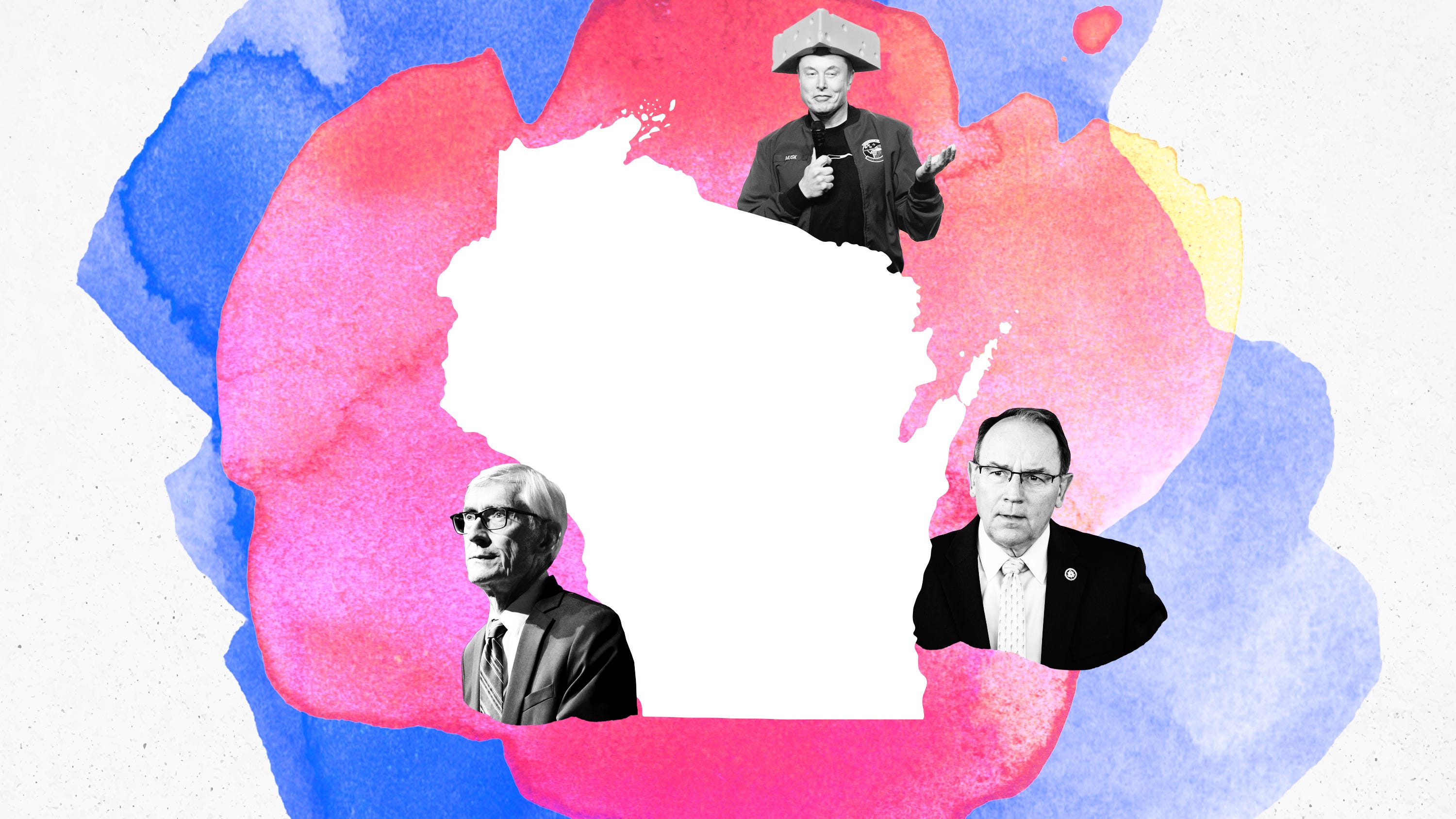
Walker served two terms before being ousted in 2018 by Democrat Tony Evers, who now, at age 74, has decided not to seek re-election after serving two terms himself. That sets up an eventual contest between the presumptive Republican nominee, U.S. Rep. Tom Tiffany, and whoever emerges victorious from a pack of five Democrats competing for their party’s nomination in the August 11 primary.
What happened in Wisconsin, thanks in large part to Wikler’s capable leadership, is that, beginning in 2023, the Democrats were able to leverage a series of wins for liberals on the officially nonpartisan state Supreme Court, putting the state’s rigged voting districts in the crosshairs. Republican legislative leaders ultimately agreed to accept maps drawn by Evers—mainly to avoid having the court, now controlled by liberals, redraw maps that would go even further in eroding the Republicans’ deliberately unfair advantage.
Heading into the fall elections, Wisconsin Democrats have a good chance of reclaiming the state senate and at least a fighting chance of winning control of the assembly for the first time since 2011. Tiffany, a shameless election denier who in January 2021 voted against certifying Joe Biden’s victory over Trump in two swing states and even signed on to a legal brief that sought to overturn the election result, could emerge victorious. Like most members of his party, Tiffany refuses to acknowledge that Biden won the race fair and square, citing an ongoing need to investigate “the improprieties that happened.”
ALL FIVE OF THE RACE’S Democratic primary contenders, culled from an initial field of nine, have a reasonable shot at garnering the most votes and advancing to the general election in November. They are: former Lieutenant Gov. Mandela Barnes, former state Department of Administration secretary Joel Brennan, Milwaukee County executive David Crowley, state Rep. Francesca Hong, and state Sen. Kelda Roys.
Crowley dropped out of the race on July 8 only to jump back in less than two weeks later when the state’s current lieutenant governor, Sara Rodriguez, whom he had endorsed, ended her campaign amid a scandal that erupted over her campaign manager’s filing of significantly incorrect financial reports. Evers, who had previously not endorsed any of his potential successors, promptly came out in support of Crowley, much to the annoyance of the other candidates and their supporters.
“This Hail Mary serves no purpose other than playing spoiler and handing our state to Trump’s handpicked candidate in Tom Tiffany,” groused Barnes’s campaign manager, Darby O’Connor. Barnes was Evers’s lieutenant governor during his first term.
Barnes and others have speculated that Evers’s endorsement of Crowley is meant to undermine the candidacies of more progressive candidates, prominently including Hong, who identifies as a democratic socialist.
Even Paul Fanlund, publisher and president of the once–proudly progressive Capital Times newspaper, has sounded an alarm about Hong’s support “from a narrow but hard-core far left” that holds little sway “beyond the sanctimonious, progressive bubble of Madison.” As Fanlund sees it, “Tiffany appears to be a weak, extremist candidate in what looks like a Democratic wave election cycle, but Democrats appear capable of screwing this up.”
According to a Marquette Law School Poll released July 22, Hong leads the field with 26 percent support, with Barnes following at 15 percent. The poll, conducted during the brief period between Crowley’s exit and re-entry into the race, found that nearly half (45 percent) of likely Democratic primary voters remain undecided. Another finding: “Two-thirds of Democratic voters say having a candidate who can win in November is ‘extremely important.’”
Hong, in a statement, crowed about the poll results. “Our working-class movement is leading this race,” she said. “Even our opponents’ own polling confirms that Wisconsinites are responding to our positive campaign and our vision of permanent affordability.”
Anthony Chergosky, a political science professor at the University of Wisconsin-La Crosse, has come up with campaign nicknames for the Democratic contenders to highlight points of distinction between them, as he discussed with a reporter for an article in the Capital Times.
Brennan, a straitlaced former state bureaucrat (and incidentally the only white male in the race, which is remarkable given that Wisconsin has never elected a nonwhite or female governor), could call his campaign “Evers 2.0.” Hong, who has dubbed herself “The Wild Card,” might also latch on to “The Surprise Frontrunner.” Crowley could be “The Local Executive” on account of his experience in local government. Roys, who has served in the state legislature for nine years and ran for governor once before, could be “The Experienced Madisonian.” And Barnes, who won election to statewide office as lieutenant governor only to lose a race against Ron Johnson for U.S. Senate, could be “The Comeback Candidate.”
WIKLER, IN HIS BOOK, observes that it’s not just Democrats who see Wisconsin as playing an oversized role in shaping the nation’s—perhaps even the world’s—political fortunes. This was also the position adopted by billionaire-on-his-way-to-briefly-becoming-a-trillionaire Elon Musk in March 2025, just before a state Supreme Court election that would determine whether liberals or conservatives controlled the court for years to come.
Musk, at a rally in Green Bay, expressed his belief that this race would “affect the entire destiny of humanity.” He put his big money where his big mouth was, pumping at least $20 million (Wikler puts the total at $56 million) into what was far and away the most expensive judicial election in U.S. history. This he did on behalf of conservative candidate Brad Schimel, formerly the state’s Republican attorney general.
To gin up interest in the race, Musk handed out two $1 million checks to rallygoers in exchange for their votes. The state’s Democratic attorney general, Josh Kaul, sued to stop this “blatant attempt” to secure votes through bribery. But the liberal-dominated Wisconsin Supreme Court—being dominated by, you know, liberals—refused to take action to block this giveaway.
Schimel lost to liberal Susan Crawford by a 10-point margin.
And now Musk stands to come out a loser in more ways than one. Earlier this month, the Wisconsin Elections Commission, on a bipartisan vote of 5–1, found probable cause to believe that Musk’s $1 million checks violated state election-bribery laws. It referred the case to the district attorney’s office in Brown County, which includes Green Bay, to determine if criminal charges are warranted. The Brown County prosecutors have forty days to report their findings back to the commission.
Democratic lawmakers are now urging Brown County DA David Lasee, a Republican, to bring charges. “With just four months to go before the midterms, we must send a message, loud and clear, that Wisconsin’s votes are not for sale,” said state Rep. Lee Snodgrass. Musk is also being sued by a government watchdog group that seeks to bar him from ever again offering cash payments in Wisconsin, lest the state’s elections “become an open auction.”
In fact, there is a good chance that Wisconsin will not only beat a Trump acolyte amid the president’s raging unpopularity, but also deliver real-world consequences for the equally disliked Elon Musk. I propose a working campaign nickname: “Wisconsin’s Time to Shine.”
 | A guest post by
|