

A New Hungary Is a Huge Opportunity for Europe
Once the problem area, Central Europe could become the engine of reform the continent needs.

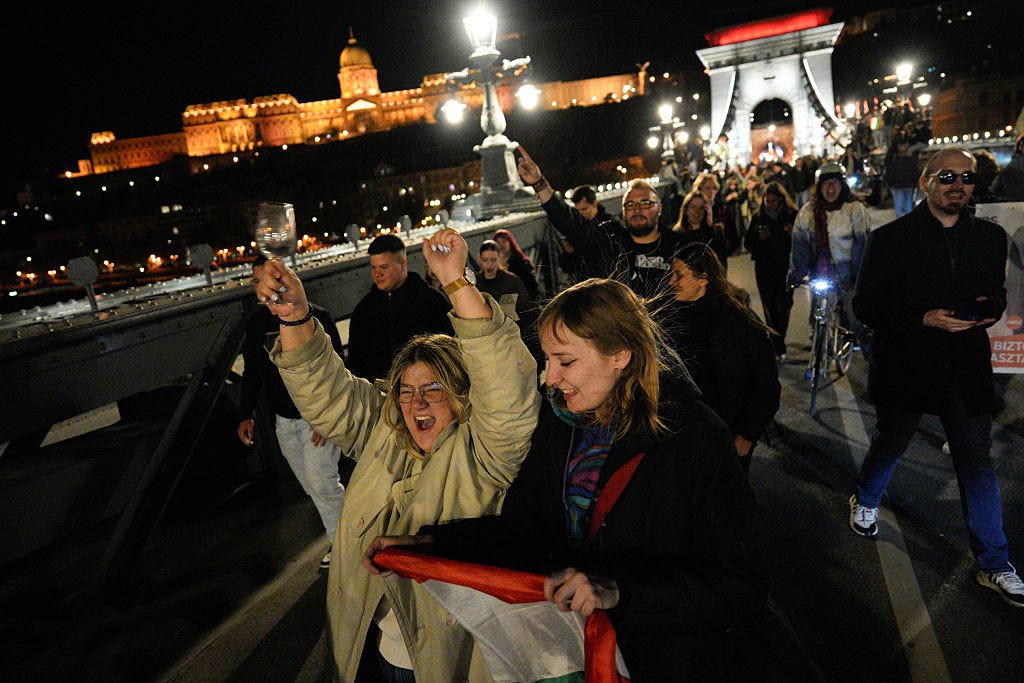
“CENTRAL EUROPE IS SOOO BACK,” a Polish friend and government official commented on her private Instagram profile upon learning the results of Hungary’s parliamentary election on Sunday. In an ironic twist of fate, the election puts on its head the prediction famously made in 2011 by Jarosław Kaczyński, the leader of Poland’s populist Law and Justice Party (PiS). Looking at the success of Viktor Orbán’s political project in Hungary, he said he was “deeply convinced that one day we will have Budapest in Warsaw.”
Kaczyński got his way in the 2015 election, and for the 8 years that followed PiS sought to emulate Orbán’s program of consolidation of power: court packing, media capture, and perpetual obstruction in the European Council. Yet, today, Budapest and Warsaw are no longer the twin pillars of European illiberalism. With luck, they can become the twin engines of constructive, forward-looking policy on defense, the EU neighborhood, and economic reform that Europe sorely needs.
Despite the affinities that united Kaczyński and Orbán, the partnership soured after Russia’s full-scale invasion of Ukraine in February 2022. Poland’s PiS, like the rest of the country, saw Russia’s threat as existential and decided to stand firmly with Ukraine. Poles famously opened their homes to hundreds of thousands of Ukrainian refugees, and the government promptly shipped massive amounts of defense materiel to Kyiv. Orbán, facing an election in the spring of 2022, chose to demagogue the issue and doubled down on his pre-existing ties to Russia—especially by stubbornly refusing to curtail Hungary’s purchases of Russian natural gas, even as Russia attacked the pipelines carrying that gas from Russia to Hungary across Ukraine.
The war dealt a heavy blow to the so-called Visegrád Four, which brought together Poles, Czechs, Hungarians, and Slovaks in the 1990s in their common quest to join NATO and the EU. After those two goals were accomplished in 2004, the four countries often differed on domestic and international policy, including concerning Russia and Ukraine, defense spending, and economics. (Of the four economies, only Slovakia is a Eurozone country, for example.) In Poland, whose economic weight and political importance far outweighed those of its landlocked neighbors, and whose natural interests gravitated toward the Baltic Sea, Visegrád became more of liability that an effective tool for diplomacy.
Four years into Russia’s full-scale invasion of Ukraine, “Ruszkik haza!” (“Russians go home”) became a rallying cry of Hungary’s opposition. The incoming prime minister, Péter Magyar, had to tread carefully around the issue during the campaign—Ukraine’s eventual EU accession is far from an uncontroversial issue in Hungary—but his commitment to defeating Russia in Ukraine is clear and its first-order effect is that the promised package of European assistance to Ukraine, held back by Orbán, will move ahead, giving Kyiv a necessary lifeline.
But more broadly, a partnership between Poland’s prime minister, Donald Tusk, and Magyar has the chance of bringing Visegrád cooperation back from the dead. In Prague, Andrej Babiš has occasionally borrowed from Orbán’s (and MAGA’s) playbook, but he is also a pragmatist—and someone with little ambition to be Europe’s pariah.
Slovakia’s leader, Robert Fico, meanwhile, is a genuine Soviet nostalgist who worked in tandem with Orbán in the past, including to weaken sanctions against Russia and harm Ukraine. But Fico, who has been in and out of power for the better part of two decades, survived an attempted assassination less than two years ago, and appears more than a little burnt out, is facing an election next year against the background of rising public discontent with his record. Unlike Orbán, he is also parochial in his outlook, lacking the ambition to be a consequential European figure—and certainly not willing to attract the ire of the European Commission or large member states without the backing of his savvier, more talented partner in Budapest.
Magyar and Tusk do face a real opportunity to reshape Central European politics in a way that will accelerate both Ukraine’s victory and its path to the EU, and that will help turn the region into a more reliable bloc within the European Union and the Western alliance. There are also some practical considerations, most importantly the need for north-south connectivity in the region.
Defense-industrial cooperation provides further opportunities. Poland’s procurement drive has been massive in recent years. Hungary has partnered with Rheinmetall to produce its Lynx infantry fighting vehicles. Czechs and Slovaks are living through a revival of their long-dormant munitions industries. Taken together, the four countries could anchor a real regional defense-industrial base underpinning Europe’s military build-up.
Of course, all of this requires a renewal of trust. Under Orbán, Budapest was the EU’s and NATO’s leakiest capital, working closely with Moscow. But Europe’s weakest link could become its strongest. Poland and Czechia have strong counter-disinformation experience that could help Hungary and all of Europe. The process of cleaning up and reconstructing Hungary’s Orbánist information environment—as well as its foreign ministry and intelligence services—could both hone European tools and techniques at fighting Russian political warfare and turn Hungary itself into a test case for reversing state capture, foreign political interference, and weaponized corruption.
“Pole and Hungarian brothers be,” the old proverb goes, “good for fight and good for party.” Magyar’s victory isn’t just a triumph for him and for Hungary. It’s an opportunity to work with Tusk and other European leaders to transform Europe’s problem area into one of its leading regions and to inflict a defeat on authoritarianism, corruption, and Vladimir Putin. Americans should root for their success.
 | A guest post by
|