Against Heteropessimism
Accounting for the nature of straight women’s desire is hard. What to do about it?

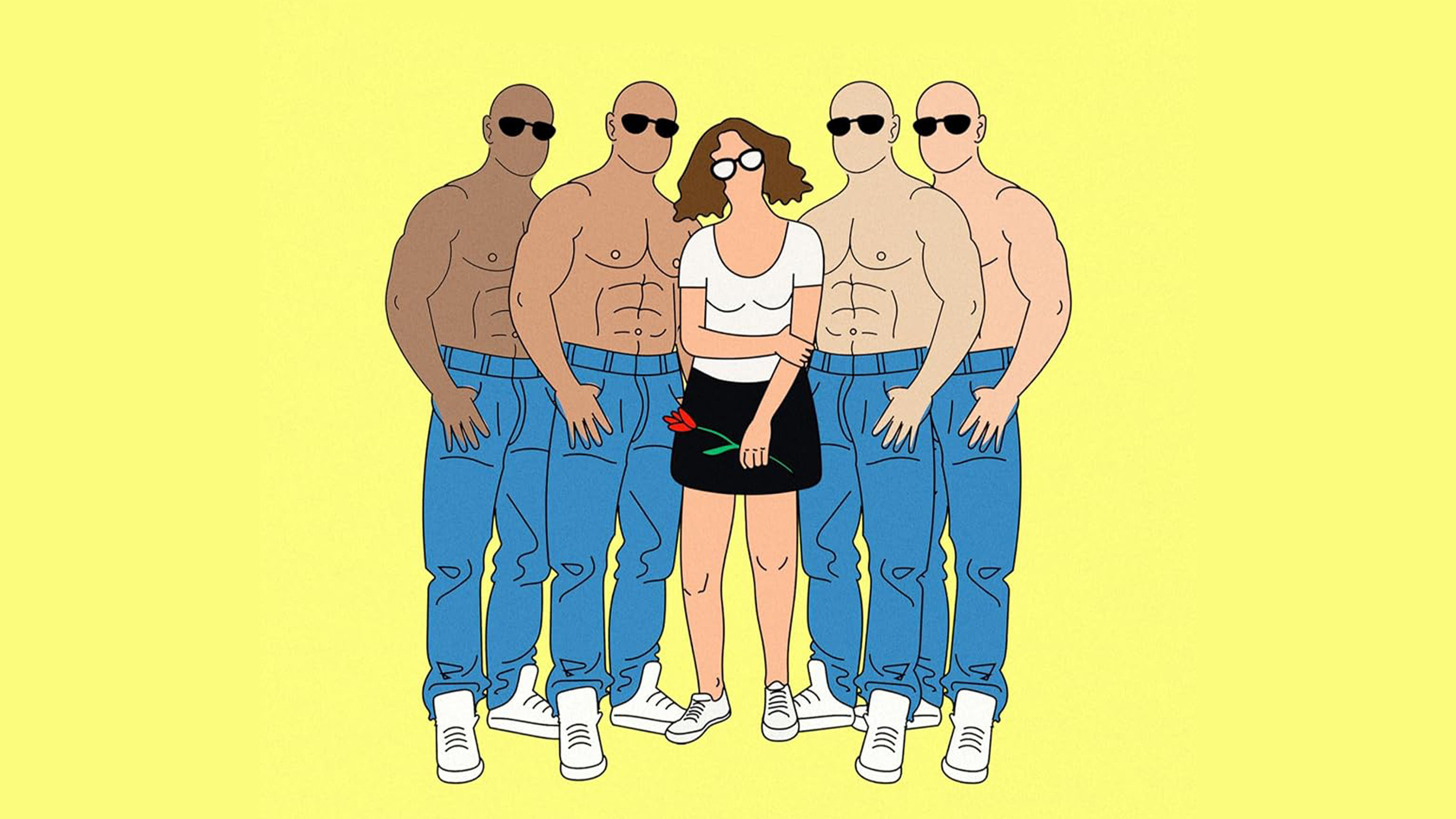
The Last Straight Woman
On Desiring Men
by Phoebe Maltz Bovy
Signal, 288 pp., $26
ONCE, UPON THE ARRIVAL of an unusually handsome man in town and all the ensuing flustrations, I proposed a business idea to my friend: We would found a residential program for women who wanted to learn to cope with handsome men. Our clients, by residing at a remote wilderness work camp with a bevy of male models, would learn to act normal no matter what species of jaw and brow and forearm confronted them. After, these women would return to their everyday lives immunized against the possibility of spilt coffees, logorrhea, elaborate pratfalls, and other farcical hazards. There would be nothing untoward, nothing creepy. (Possibly, we were already overoptimistic on this front.) It would be exposure therapy only. We would call it the Dude Ranch.
Little did I know that in the course of these conversations, not only was I exercising my spectacularly ill-advised entrepreneurial instincts—I was also participating in an instance of what Phoebe Maltz Bovy calls “the himbo plot.”
In the sixth chapter of The Last Straight Woman, she explains:
The himbo, a dim (or just chill) and good-looking man, is himself a trope, but the himbo plot is something more. It’s a narrative structure based around the effect a spectacular-looking man has on the women around him. Everything’s going along the way it normally does, the regular characters doing their usual thing, when suddenly there is a handsomeness situation afoot. A man’s beauty, and nothing else about him, sets forth plot developments, romantic or otherwise.
The Last Straight Woman is several things: a tour of the last ten years of internet gender discourse; an attempt to dispel a vaporous sense that there is something inherently cringey—or worse, retrograde—about the mere fact of wanting a man; a vindication of the rights of the much-overlooked female schlub; an attempt to articulate a feminist account of straight female desire; an argument against the premise that desire needs a political justification in the first place. All these different threads come together in a loose sprang weave, with each chapter addressing a different clutch of phenomena pulled from the spools of straight womanhood.
The himbo plot is one of these concepts, and it is key to The Last Straight Woman’s project in two ways.
First: Insofar as The Last Straight Woman has a unified thesis, rather than a bundle of related questions and observations, it is that the current most salient problem with female heterosexual desire is not its failure to be something other than heterosexual desire—or, really, a problem with female heterosexual desire itself at all. Instead, the problem is a larger cultural refusal to treat women by default as desirers rather than as desirees.
Second: The Last Straight Woman is as much an appreciation of British sitcoms, and an ode to the blue-haired, polyester-clad matrons who inhabit them, as it is anything else. And the himbo plot, as it turns out, is fertile ground for exploring the quirks and nuances of Maltz Bovy’s favorite forms of media. There is no getting around this aspect of the book: It will either work for you or it will not. I found it delightful.
There are, however, downsides to using television as a lens to explore female heterosexuality. Sometimes it seems to land Maltz Bovy in what is often called “heteropessimism.” In the introduction, she writes “Life expectancy for Canadian women is over eighty. This means of approximately seventy man-liking years, a woman may spend ten of them in love-interest mode herself.” Perhaps this is true for those dealing with casting agents, but for the rest of us, surely it overstates the case. I cannot be the only one who witnessed her grandparents, in the midst of all the vicissitudes of old age and all the typical domestic squabbles over misplaced bills and expired milk, spend their declining years in a passionate romance. Beyond any question of whether women should lead interesting romantic lives—including romantic lives as objects of desire—past the first blush of nubility, the observable fact is that, without fanfare, glamor, or pretension to the role of permanent universal ingénue, women regularly do lead such lives.
Again in this heteropessimistic strain, she writes, “Everyone gets that a man does not lose his pre-existing sexual orientation upon making a commitment, and that the most that can be asked of him is that he not be too careless with his web browser.” Is it, really?
Maltz Bovy is correct that the most direct and object-oriented form of straight female desire is real, and often ignored. But I am skeptical that designating this direct and object-oriented mode—the mode of straight women’s desire that most symmetrically corresponds to the way straight men tend to desire—as the real, legitimate form of hetero female sexuality will cure straight womanhood of its indignities and embarrassments.
Men and women usually want the same things in different ways, and sex is no different. If we think for a moment in terms of desired outcomes rather than desired persons, a straight woman’s desired sexual outcome often might look something like melting in the enfolding embrace of the werewolf with a heart of gold, or what have you. Enfolding the werewolf, however willing he may be, is less likely to make the cut.
Part of the problem for straight women is accessing a cultural imaginary—or, absent something ready to hand, building one—wherein desire from the receptive end of the heterosexual seduction structure is not considered the absence of sexuality; or an indiscriminate and mechanical response; or a mandate for a publicly owned and scrutinized sexual attractiveness (by which, one way or another, they can always be humiliated); or mere passivity.
Ultimately, this surprisingly evasive positive account of desire is one that figures straight women as agents who actively shape their own romantic and sexual destinies, including when specific content of their desires might still be read as receptive. This presents a challenge Maltz Bovy doesn’t consistently meet.
For instance, Maltz Bovy asks “And if female sexuality is responsive, what even is a no, anyway?” Perhaps this is true for the most extreme imaginable version of what “responsive” means. But why would “responsive” mean “non-desiring,” let alone “non-consenting”? Why would it be the case that, simply because a hypothetical woman’s strongest sexual arousal tends to occur with a man’s initiation rather than spontaneously, she should be presumed incapable of deciding whether this particular man, and the particular woo he’s pitching, is working for her?
For that matter, I do not think the fact that many straight men feel confirmed in their potency only upon seeing it manifest as a woman’s pleasure—with all the psychological vulnerability that this entails—is evidence of some kind of abject disassociation from their own sexuality. The hard categories of active and passive, subject and object, doer and done, probably better describe violent or unpleasant sex than the entangled, mutable, and somewhat mysterious dynamism of reciprocally pleasurable heterosexuality.
UNFORTUNATELY, VIOLENT and unpleasant sex is as much a part of the heterosexual story as the reciprocally pleasurable, and gets its due in The Last Straight Woman with a chapter on #MeToo. It is a mixed bag.
On one hand, Maltz Bovy teases out something I have not seen anyone else get at. When reporting allegations of abuse, harassment, and assault, journalists often present those actions within a context of everything the perpetrator ever did that might conceivably have been a red flag. The intent, I imagine, is to narrate the interior trajectory that often corresponds to these kinds of violations: Something seems a little off about a guy in a way you can’t put your finger on, so you ignore it, until you can’t. But for the person reading the article, the effect is that the real, substantial allegations come to visibility midway through the narrative, and then disappear again into a background haze of bad vibes.
On the other hand, though, Maltz Bovy has her own somewhat distracting way of blending the weighty with the trivial: making a serious claim, then coyly retreating into Britcoms. She writes:
There can also be—and here’s where things get really awkward—a wishful-thinking element to women’s discussion of men’s forwardness. . . . I don’t dare bring up real-life instances of this but will do the discreet thing of pointing you instead to a 1991 episode of Britcom Waiting for God (“Young People”).
Nodding along in faux-agreement while your friends bewail the plenitude and overexcitement of their suitors, as Maltz Bovy cops to doing in a very funny anecdote, is one thing. But if she is accusing women of actually confabulating instances of male sexual aggression in order to be thought pretty, she should name names and share on what grounds she believes that they are telling falsehoods.
In general, the chapter suffers from a tendency to treat #MeToo violations as a referendum on desirability:
I have been in elevators once or twice in my life but, barring other cues, have never reacted this way to sharing one with a strange man. A man would need motive, not just opportunity, and for reasons doubtless as particular to myself as Kwon’s are to hers, I do not assume a man would find proximity to me a source of such temptation.
I believe the reason that most women are not especially afraid of elevators—certainly the reason I am not especially afraid of elevators—is that even among rapists, the man who will assault a total stranger in a well-trafficked semi-public place is a minority. I calibrate my perceived threat level according to the low probability of sharing any given elevator with a particularly extreme sub-type of rapist, not according to whether or not I think I look rapeable today. I do not dispute the claim that, in general, gorgeous twentysomethings experience more street harassment than little old ladies, but it would be a mistake to use trends that occur at an aggregate level to adjudicate likelihood or unlikelihood in any specific given case, especially when so many other more dispositive factors are almost certainly in play. Maltz Bovy’s own street harassment story occurs when she is a pre-teen; many women experience their highest incidence of predatory behavior from men around this time, probably due to some mix of visible vulnerability combined with the coinciding of aggression and deviance in predatory men. Presumably we can all agree that it is not because 11-year-olds are hot stuff.
But I found myself less outraged than confused by passages like the one containing her elevator musings above. It is hard to know what the end game is here. I cannot imagine that what Maltz Bovy wants is for reporting harassment to be equated with calling yourself hot; or for some sort of plausibility test to be applied to women’s looks, some sort of social tribunal to decide whether she was really pretty enough to be groped on the subway. I cannot imagine how this could be construed as a victory for the vast majority of women who are not Emily Ratajkowski–type supermodels.
What is the alternative, then? How do we address the fact that some women receive large amounts of hostile and negative attention, while some receive very little? I do not think the desire to be desired, the desire to be seen as beautiful, is trivial. But I also do not think there is a good answer to this specific tension, except the same one women must learn, again and again, vis-à-vis the fashion and entertainment industries, vis-à-vis the purveyors of eating disorders, vis-à-vis middle school cliques, vis-à-vis men who reduce you to a numbered scale, who solicit images of your nude body and use them to demean you: Resist the perverse instinct to treat as the authority on your beauty the people who want you dead.
But The Last Straight Woman is probably better conceived as an exploration of tensions than an attempt to resolve them, which is why, despite this long and incomplete list of disputes, I thoroughly enjoyed it. A book that is comfortable with ambivalence, that is a pleasure to quarrel with, that channels a kind of Ephronesque spirit of plainspoken inquiry into everyday absurdities—this is a rare gift. You never know exactly what Maltz Bovy is going to think about something until you read her: in the world of opinion journalism, a rarer gift still.
 | A guest post by
|