Canceling Military Exercises Hurts Us, Not Our Enemies
Will U.S. forces in South Korea still be ready to ‘fight tonight’?

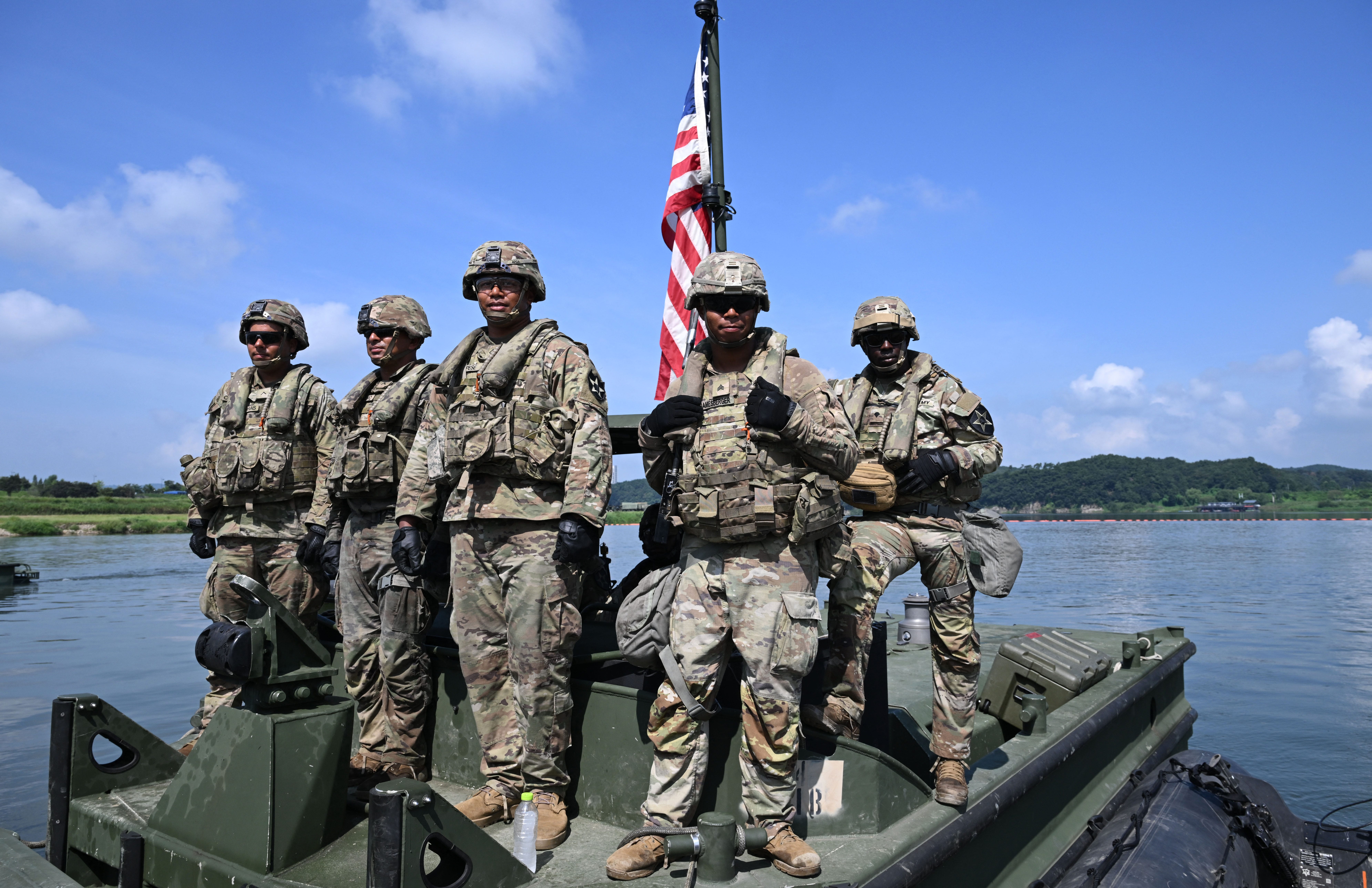
PRESIDENT DONALD TRUMP announced Sunday that he had instructed Defense Secretary Pete Hegseth to substantially reduce U.S. military exercises with South Korea, just as American and South Korean forces were preparing to begin one of their most important annual training events. Trump complained about the cost, suggested the exercises were unnecessarily provocative toward North Korea, and, astonishingly, connected his decision to South Korea’s refusal to support his administration’s effort to denuclearize Iran.
It is difficult to imagine a more thorough misunderstanding of the purpose of a military exercise—or an alliance.
The annual Ulchi Freedom Shield exercise begins Monday—otherwise Trump suggested he might have canceled this year’s event. But his direction raises questions about future exercises and, more importantly, about his understanding of why American forces train with allies. These exercises aren’t diplomatic favors Washington grants. They are part of the preparation required to deter—and, if necessary, defeat—an attack by North Korea.
The Korean Peninsula remains one of the most dangerous military environments in the world. About 28,500 American troops are stationed in South Korea, facing a North Korean regime with a massive conventional military, nuclear weapons, sophisticated ballistic missiles, and forces that have gained recent battlefield experience alongside Russia in Ukraine. North Korea continues testing missiles and improving its nuclear capabilities while repeatedly threatening South Korea and the United States. That’s why generations of American soldiers have trained in Korea—including me.
IN THE LATE 1990s, I commanded an Army brigade at Fort Lewis, Washington, now Joint Base Lewis-McChord. Our brigade was part of the reinforcement plan for the 2nd Infantry Division in case war broke out on the Korean Peninsula. That mission meant much more than putting soldiers and equipment on airplanes and ships and deploying them west across the Pacific. We had to understand how we would get there, what we would do when we arrived, and how we would fight alongside the South Korean forces already defending their country.
We repeatedly rehearsed the enormously complicated logistical undertaking of moving an armored brigade 5,000 miles across the Pacific and unloading our equipment at the ports, and we practiced gunnery and maneuver on Korean ranges and training areas. We designed our missions around the Korean terrain—dominated by mountains with tight maneuver corridors, speckled with dense population centers, connected by limited road networks—and even the extremes of Korean weather.
But some of the most valuable training involved something harder to measure on a readiness chart: learning how to operate with our Korean allies.
American and Korean soldiers have different languages, military traditions, equipment, procedures, and ways of approaching problems. Those differences don’t disappear when governments sign a treaty. They must be worked through on training fields, in command posts, during planning sessions, and through repeated exercises. We learned how Korean commanders operated, and they learned how we operated. We developed relationships that allowed soldiers and leaders to understand one another before people were shooting at them.
The Korean Augmentation to the United States Army program was particularly important. Korean soldiers (“KATUSAs”) served inside American formations, providing capabilities and cultural understanding while strengthening the bonds between the two armies. To Americans who served in Korea or trained with Korean forces, KATUSAs were fellow soldiers and part of our team, just as we were part of theirs.
That experience taught me something applicable to every military alliance: Interoperability doesn’t happen because politicians announce it. It must be practiced.
Exercises and training expose what doesn’t work. Communications systems fail to connect. Logistics plans prove unrealistic. Units arrive late. Intelligence doesn’t move quickly enough between headquarters. Ammunition, fuel, maintenance, medical support, and transportation become bottlenecks. Commanders discover that assumptions made while looking at maps don’t hold up when they meet actual terrain. It’s far better to discover those problems during an exercise than under a North Korean artillery barrage.
Today’s American–South Korean military relationship is even more integrated than it was when my brigade trained for Korea. The 2nd Infantry Division is now the 2nd Infantry Division/ROK-U.S. Combined Division, the Army’s only multinational division. American and Korean forces operate through command arrangements refined over decades, and their mission is captured in the phrase familiar to virtually every American soldier who has served on the peninsula: “Fight Tonight.”
That’s not just a slogan. North Korean artillery, missiles, special operations forces, cyber capabilities, and nuclear weapons don’t allow for the luxury of spending several weeks figuring out command relationships after a crisis begins.
That is why exercises such as Ulchi Freedom Shield matter. They rehearse command and control, intelligence, logistics, maneuver, air and missile defense, medical support, cyber operations, and reinforcement. Increasingly, they also address drones, GPS jamming, electronic warfare, and other aspects of a rapidly changing battlefield.
TRUMP HAS LONG VIEWED these exercises differently, describing them as expensive and provocative. Following his 2018 Singapore summit with Kim Jong Un, his administration suspended the old exercise, Ulchi Freedom Guardian, and curtailed other exercises in hopes that reducing American military activity would encourage progress toward denuclearization. It didn’t. North Korea continued developing nuclear weapons and increasingly sophisticated missiles.
Sometimes modifying an exercise makes strategic sense. Military exercises send signals, and presidents can adjust those signals as part of diplomacy. If reducing or postponing an exercise produces a meaningful and verifiable security concession from an adversary, that is legitimate statecraft.
But that isn’t what Trump announced Sunday. Instead, he connected military readiness on the Korean Peninsula to South Korea’s unwillingness to support an American policy toward Iran. That transforms an important military exercise from an instrument of deterrence into a political bargaining chip.
South Korea is an ally, not an American subcontractor. Allies share interests, but they don’t always share policies. Seoul has its own political considerations, regional security concerns, and responsibilities to its citizens. Washington can disagree with a South Korean decision concerning Iran without threatening military cooperation necessary to deter North Korea.
The danger extends beyond Seoul. Japan, Australia, and all our allies around the world will watch how the United States treats South Korea. China and Russia will watch, too. And Kim Jong Un will watch most carefully of all, because deterrence depends not simply on American military capability but on an adversary’s belief that the alliance confronting him is capable, prepared, and politically cohesive.
Trump often says America has the greatest military in the world, and in many respects he is right. What he doesn’t seem to understand is how that military became so capable.
Military effectiveness comes from people knowing how to fight under extraordinary pressure. It comes from commanders and staffs practicing difficult missions, pilots flying complex sorties, sailors providing a logistics lifeline to an ally’s peninsula, soldiers conducting gunnery and maneuver training, maintenance crews keeping equipment functioning, and logisticians figuring out how to move fuel, ammunition, spare parts, and medical supplies across oceans. When America expects to fight alongside allies, it trains with those allies until cooperation becomes routine.
That was what our brigade was doing more than twenty-five years ago when we practiced deploying from Fort Lewis to Korea. We weren’t preparing because we wanted a war with North Korea. We were preparing because being ready was one of the best ways to prevent a war. We wanted North Korean commanders to understand that if they attacked south, American reinforcements would be standing strong next to their Korean counterparts. We would arrive knowing the mission, understanding the command structure, and prepared to fight alongside an ally with whom we had already trained.
America does have an extraordinarily capable military. But military excellence isn’t an inheritance that automatically passes from one administration to another. It must be rebuilt every day through training, maintenance, logistics, discipline, leadership, and exercises that cost money and inevitably create friction with potential adversaries.
The purpose of Ulchi Freedom Shield isn’t to make Kim Jong Un comfortable; it is to convince him that starting a war would be a catastrophic mistake. If Trump wants to keep boasting that America has the best military in the world, he needs to understand what made it that way.
I wish Mark Hertling was Secretary of Defense. I have tremendous respect for his experience and intellect. The Fox news weekend host is a disaster for US.
Such a helpful article for those of us who never served, and before this regime, didn’t need to know exactly who was in charge or how and why things were done. Now I do only due to their baffling lack of qualifications, sheer incompetence and genuine fear for our country. I always appreciate Hertling’s takes. I wish we had men of experience, competence and character in charge.