Debunking MAGA’s Puppy-Killer Smear Against Abdul El-Sayed
This sick attack is a preview of what he faces—and a case study in how lies become part of our political debate.

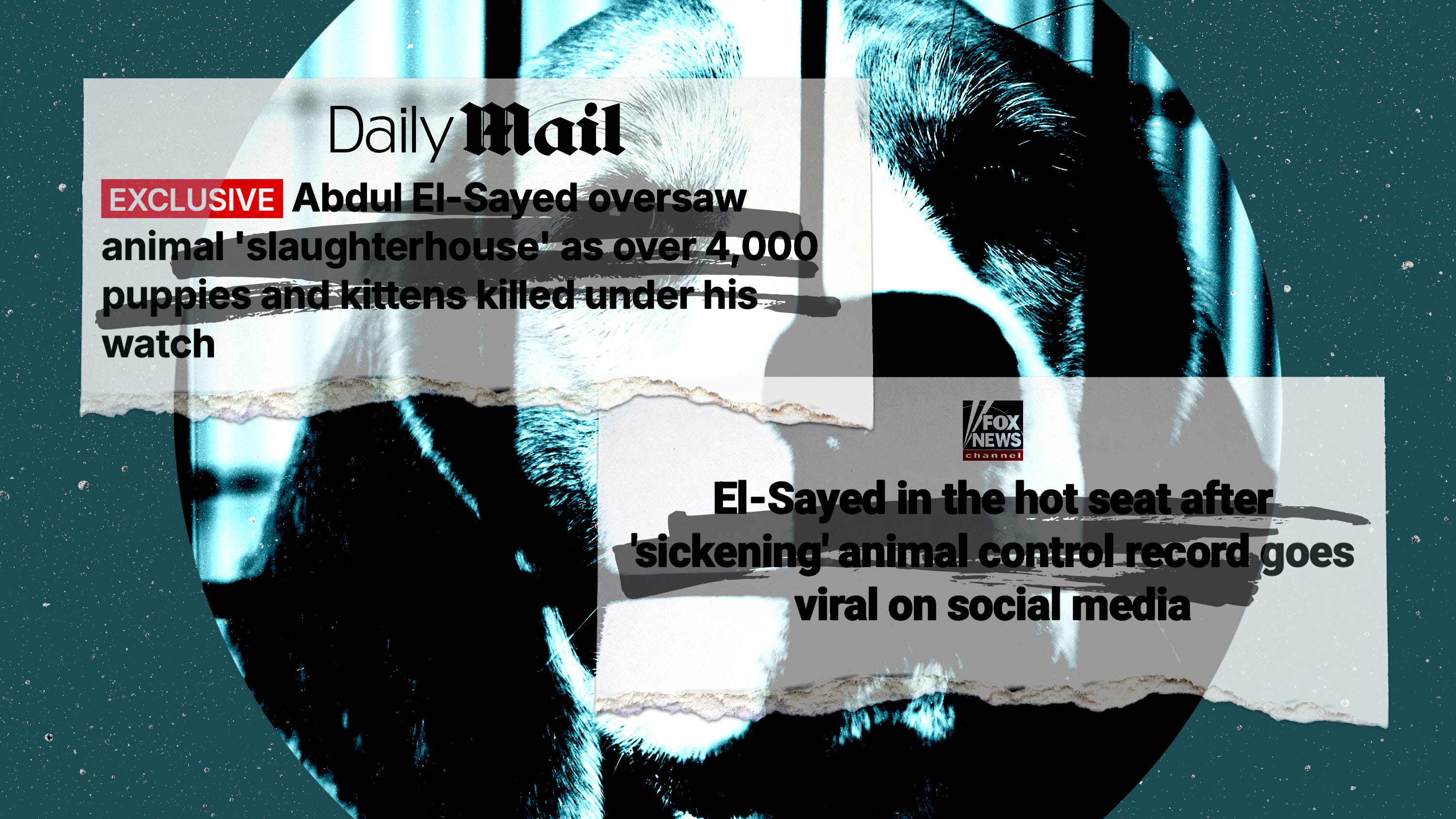
A NEW MAGA ATTACK on Abdul El-Sayed is making the rounds. This one is about his tenure as public health director in Detroit, and how he supposedly oversaw an animal control unit that was rife with abuse and cruelty. The unit was a “slaughterhouse,” according to a Thursday Daily Mail headline that by now has almost certainly landed in millions of social media feeds, thanks to retweets from prominent right-wing influencers and Republican politicians.
But the attack appears to be nonsense.
Not spin. Not shading of the truth. Total, utter nonsense—the kind that tells the very opposite of the actual story.
As it happens, that actual story is politically relevant. There really were big problems with animal control in Detroit. But El-Sayed didn’t create them. He inherited them when he became Detroit’s public health director. And according to every source I could find on Friday, as this controversy was ricocheting across the internet, El-Sayed’s efforts helped to make those problems better.
A single set of figures illustrates the progress during his sixteen-month tenure. The “save” rate—meaning, the percentage of animals not euthanized—was no higher than 26 percent when he took over in 2015, and probably lower. (The exact figure is unclear because of some data issues back then.1)
In 2016, the first full year animal control was under his management, the save rate was up to around 60 percent. By the time he left in 2017, in order to run for governor, it was approaching 70 percent.2
Those numbers come from Melissa Miller, the animal rights advocate and expert whom El-Sayed had put in charge of animal control—and who told me during a phone interview Friday that she was furious about the stories circulating on social media, because they were so off-base. Miller described El-Sayed as “transformational,” explaining that “he inherited an extremely dysfunctional and inhumane department” and yet managed to bring in new management and start changing the culture within a few weeks.3
“I think that’s pretty impressive,” she said.
Tracking down Miller was not difficult: It took just one call. But even that small effort was not necessary to understand the truth. The two news clips now making the rounds on social media—that article in the Daily Mail, another on the Fox News website—contain exonerating information. But it’s buried in the text, below headlines and framing making it seem as if the animal control unit’s problems were El-Sayed’s doing.
That’s what makes the smear of El-Sayed more than just another instance of dishonest propaganda. It’s a case study in how easily misinformation can metastasize in our national political debates. And it’s best understood by looking back at what was actually happening in Detroit’s animal control when El-Sayed first took his post in city government.
CONDITIONS AND PRACTICES in Detroit’s animal control department were bleak in 2015, according to media reports from the time. Drains in the nearly century-old building backed up regularly, creating pools of raw sewage. Maggots fed on dead rats.
Owners who came to reclaim their pets frequently discovered they were injured or had infections, Miller told me. And for those that weren’t claimed? “There were no adoptions,” Miller said. “Basically, if an owner did not reclaim a dog or cat, they did not leave. Everything was euthanized.”
At the time, Mayor Mike Duggan was less than two years into his tenure, and still in the early stages of a project to rebuild government infrastructure after years of downsizing and then a full municipal bankruptcy. In late August, Duggan appointed El-Sayed with a mission to reconstitute the public health department, which had shrunk to just five employees and was outsourcing most of its work to contractors. Less than two months later, in mid-October, Duggan formally announced that he was giving El-Sayed oversight of the animal control unit, which previously had been under the police department’s management.
It’s not clear whether the idea was Duggan’s or El-Sayed’s, or how long before that announcement El-Sayed had begun to prepare for his new responsibilities. Either way, El-Sayed had to quickly learn about both the state of the unit and the basics of animal control, which is not something doctors or epidemiologists (El-Sayed is both) typically learn in school.
“Abdul did something that we had long hoped for within the animal welfare community,” Miller told me, “which is to meet with professionals, go see some shelters that are doing it right, talk to subject matter professionals and get an understanding of why everyone was saying like, no, this isn’t right.”
Almost immediately, Miller said, El-Sayed initiated a program to make a limited number of animals available for adoption every week. But that was a prelude to a bigger change: The appointment of Miller as the unit’s new director. That happened in December, about six weeks after El-Sayed had taken charge, in what the Detroit News described as his “first major act.”
“The facility was in terrible shape and some of the practices were, frankly, inappropriate,” El-Sayed told the News. “Our system was, in many ways, broken. Both in terms of the way that we brought dogs in, we sheltered dogs, we paid and took care of the dogs with us. . . . All of those things needed to be rethought and they are being rethought actively.”
Shortly afterwards, he met with some activists who were protesting conditions at the shelter. “In the coming year the face of animal control will look very different than it has in the past,” he promised them.
El-Sayed followed through on those vows, Miller told me, pointing to the rapid drop in the euthanasia rate that began one month after she took over. And while she said El-Sayed mostly delegated management to her, she credits him with teaching her the ins and outs of department administration—and with responding quickly to time-sensitive matters, like finding contractors to clear the drains that were backing up fetid water into the kennels, even though he had his hands full trying to rebuild the health department.
“He gets when the decisions need to be made that day, and he was very responsive to that,” Miller said.
Could there be some hitherto unreported and unpublicized animal control problems from the time when El-Sayed had oversight? Sure. But El-Sayed has talked about this part of his biography for years and publicly he’s gotten praise for it, including from the mayor who put him in charge.
“He (El-Sayed) took it over, got us into the interim facility, lowered the euthanasia rate and wanted the permanent facility,” Duggan said in 2021, when announcing plans for a new shelter. “This is the culmination of what he had hoped for.”
THE DAILY MAIL STORY STARTS with a menacing headline:
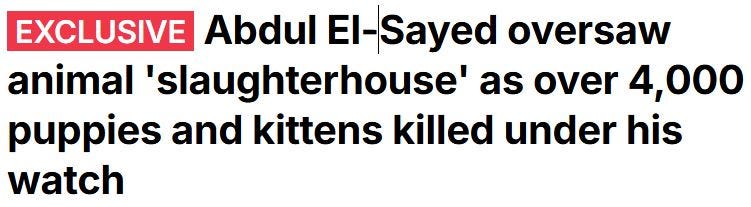
As the article explains in the text, the word “slaughterhouse” comes from a whistleblower lawsuit, by an employee who had reported poor conditions and abusive behavior to supervisors.4 But all of the incidents in the lawsuit are from before El-Sayed was in charge of the animal control unit, or even before he started as health commissioner.
The lawsuit never mentions him or the city health department. Instead, it mentions the police department, which was the agency that had overseen animal control before Duggan moved it over to El-Sayed’s portfolio.
Likewise, the Daily Mail article cites “particularly stark” euthanasia figures from 2015 as proof of what El-Sayed oversaw during some of the animal unit’s “darkest days.” Then, as an aside, it notes that the figures improved afterwards. But this is just another version of what Miller told me: That the unit had a high euthanasia rate until late 2015, when El-Sayed came in and started making changes.
The Fox News story on the controversy actually notes this fact explicitly:
Detroit Animal Care and Control’s (DACC) live-release rate was roughly 20% to 26% when El-Sayed inherited the operation in late 2015 but climbed to about 61% to 62% by late 2016—an improvement his campaign points to in arguing that the raw number of animals euthanized during his tenure obscures a turnaround from the dire conditions and euthanasia rates he inherited.
But the headline on the article says:

Somebody who saw only the headline would assume the stories were real, especially if they also saw tweets by the likes of Mike Rogers, the Republican former congressman running against El-Sayed for Senate.
On Thursday, Rogers tweeted:
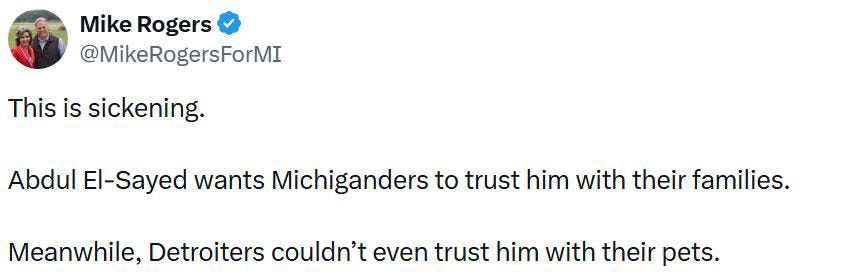
Rogers was hardly alone:
Lisa McClain, a Michigan Republican who is chair of the House Republican Conference, tweeted that El-Sayed “literally ran a puppy slaughterhouse.”
The Republican National Committee tweeted that “Abdul is a puppy killer.”
The National Republican Senatorial Committee announced it was forming a group called “Dogs Against Abdul.”
The newly formed “Democrats for Mike Rogers” tweeted “PURE EVIL” and warned the election posed a choice between “Abdul El-Sayed and your pets.”
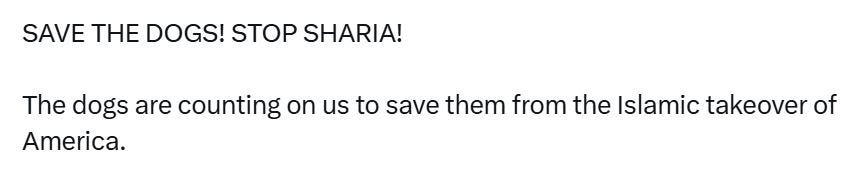
Right-wing influencers like LibsOfTikTok and Laura Loomer also made big impressions—the latter by linking up the alleged animal abuse (which she’d actually tweeted about before the Daily Mail article) to her feelings about Muslims:
Just how much political impact any of this will have remains to be seen. El-Sayed is on the receiving end of an absolute torrent of attacks right now, many of them straight-up appeals to anti-Muslim and anti-Arab sentiments. And it’s likely just a taste of what’s to come. The animal control unit story might barely register by the time the campaign is done.
But stories about pet abuse, real or imagined, can break through to the public in ways that few other controversies can. Just ask Mitt Romney or Kristi Noem. That might help explain why attacks involving animal abuse have become a weapon of choice for Republicans, whether they’re lies about Haitian immigrants eating people’s pets or distortions of Anthony Fauci’s record on animal experimentation.
Republicans and their allies don’t have to do this, obviously. El-Sayed has provided plenty of material for honest critics to attack. But going after his actual record would leave open the possibility voters might agree with him. Calling him a puppy killer is more likely to work and easier to spread, thanks to social media where even the most baseless, malicious rumors can count on credulous amplification.
Animal control units have many responsibilities, including protecting the public from violent animals. But the save/non-euthanasia rate is the metric that’s at the heart of this controversy. And in 2016 the animal control department announced that dog bites citywide were down 30 percent, attributing the improvement to outreach and education efforts.
For context, the national save rate is around 82 percent, according to the nonprofit organization Best Friends.
Miller went on to serve as animal control director in nearby St. Clair County, resigning earlier this summer in protest of a policy local officials had adopted. She is now a private consultant on animal welfare issues.
Detroit eventually settled the lawsuit for $63,000.
"[target of right wing nut jobs] are eating/hurting/killing the dogs, the cats, your pets". It's amazing how consistently an electorally significant number of voters fall for this crap again and again. Even after being debunked. I talked with someone who admits Trump lies but still took his accusations about the reflecting pool being vandalized seriously. Carl Sagan coined the phrase 'glorification of stupidity' years ago. It's now our cultural norm. Are we doomed?
We should enact some of the reforms JVL talked about in recent Triads and make these kind of false statements prosecutable.