Trump’s Incredibly Misleading, Downright Outrageous Case for Medicaid Cuts
A new report has left economists flabbergasted.

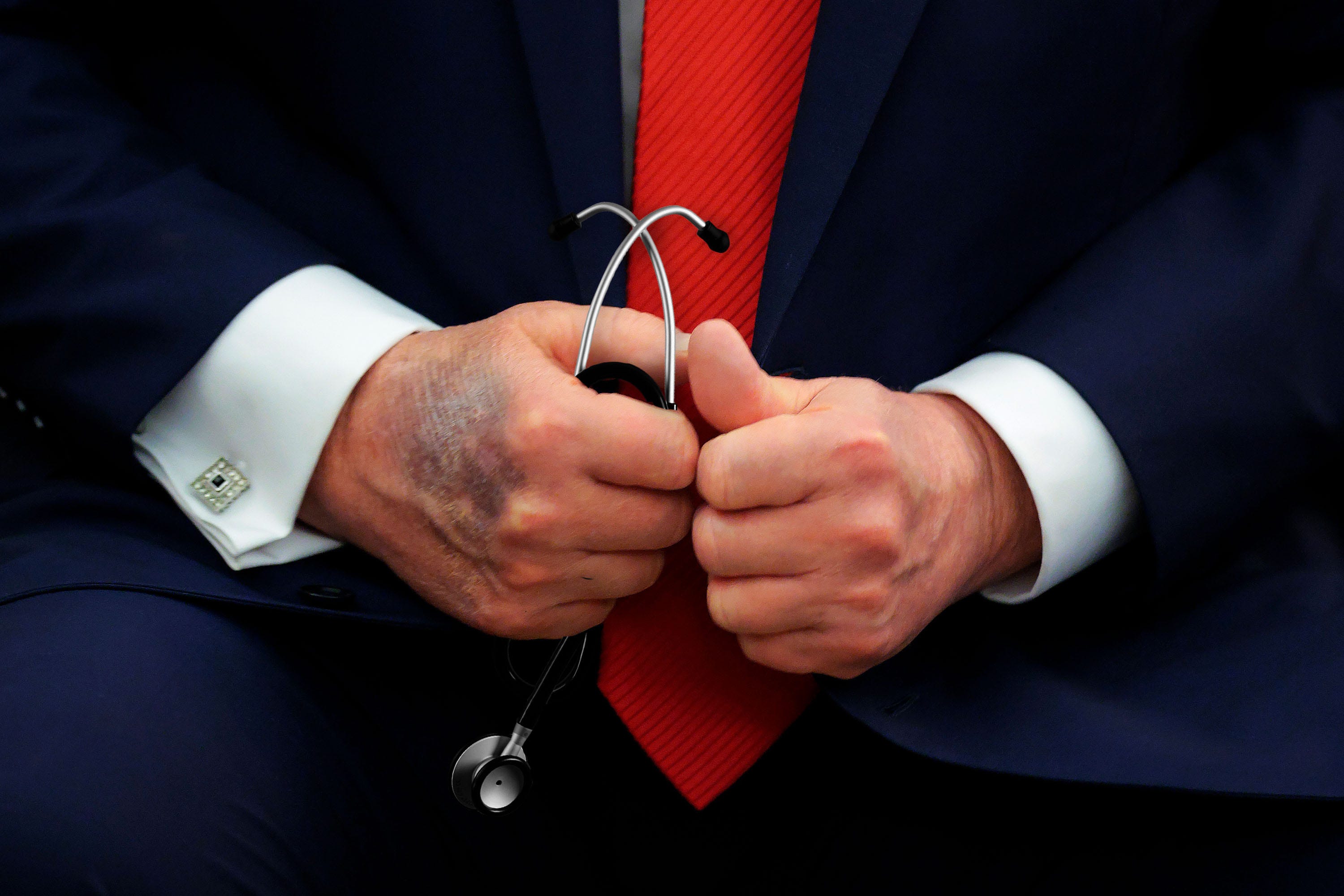
THE TRUMP ADMINISTRATION published a piece of brazenly dishonest propaganda last week.
Actually, I’m not even sure “brazenly” does it justice.
Because while misinformation from Trump is nothing new, this most recent case involves a very important debate around health care coverage for some of the most vulnerable people in America—and because it risks sullying the reputation of the highly respected office that published it.
The propaganda came in the form of a Department of Health and Human Services report about coming changes to Medicaid, the insurance program that pays medical bills for more than 70 million mostly low-income Americans and legal residents. As you probably remember, last year Trump and the Republican Congress imposed a “work requirement” on certain Medicaid recipients, as part of a broader set of cuts that will reduce projected spending by roughly $1 trillion over ten years.
As many as 10 million people a year could become uninsured by 2034, with a little more than half of the losses from the work requirements, according to the Congressional Budget Office. And the cuts as a whole appear to be highly unpopular—in part, because they reinforce the perception of Trump and the Republicans as indifferent to the needs of Americans struggling with health care bills. That’s not a great image to carry into the midterms.
The administration’s report purports to provide a winning counterargument. It says that the changes to Medicaid will have a positive effect, because they “could reduce poverty by as much as 1.6 to 2.9 million people.”
Wow! A win-win!
But wait, you might wonder. If all those millions of people are going to lose health insurance—a loss that is widely understood to cause medical and financial hardship—how is it possible that millions are simultaneously going to emerge from poverty?
The answer is that it is almost certainly not possible. The administration’s claim is hot, steaming garbage, intellectually speaking. And so is the report behind it.
You don’t have to take my word for this. Chloe East and Adrianna McIntyre, two highly respected policy scholars from the University of Colorado Boulder and Harvard University respectively, have published a thorough debunking at the “Can We Still Govern” Substack.1 And Richard G. Frank and Sherry Glied, widely cited health economists from Harvard and New York University, have written a (not yet published) critique of their own that they have shared with me.
In today’s newsletter, I’m going to walk you through the administration’s logic, such that it is, by drawing on those two analyses as well as phone interviews with Glied, McIntyre, and University of Michigan professor Tom Buchmueller, another top-notch health economist.
Don’t let all the Ph.D.s and fancypants institutional affiliations worry you. This explanation won’t be particularly technical. It will require no regressions.
That’s actually part of what makes the report so remarkable. The logical flaws are basic, the kind of stuff that would get you marked down in an undergraduate class. But the report came from the office of the Assistant Secretary for Planning and Evaluation, which traditionally serves as a sort of in-house think tank for HHS.
That office is supposed to be a source of reliable, dispassionate analysis. And while it has always promoted the priorities of whatever administration is in power—Buchmueller, Frank, and Glied all did stints there under Democrats—it has a reputation for producing intellectually defensible material.
This report doesn’t live up to that standard. And it’s emblematic of what’s been happening elsewhere in the federal government, as the Trump administration has purged veteran, senior leaders and in some cases large numbers of lower-ranking career analysts as well. The HHS planning and evaluation office is a perfect example: It lost two-thirds of its staff during the DOGE purges last year, going from about 150 to fewer than 50 employees, according to STAT News.
The result across government agencies has been predictably shoddy work, like with this January’s thinly referenced HHS report supposedly showing the United States childhood vaccine schedule was an international outlier—or last August’s highly selective reading of climate research by the Environmental Protection Agency, allegedly demonstrating that warming temperatures did not endanger human health.
This assault on the integrity of government information threatens to do more than skew political debates. It undermines a key pillar of a functioning democracy.
But more on that in a moment. Let’s talk about this report first.
Join Bulwark+ to unlock the rest
Become a paying member of The Bulwark to get access to this post and other subscriber-only content. A subscription gets you:
- Unlimited access to articles and newsletters including The Triad by JVL and Receipts by Catherine Rampell.
- Ad-free editions of our shows (with transcripts) and member-only shows like The Secret Podcast.
- Plus community chats and commenting features. Your support helps keep our work sustainable and available to those who cannot afford a membership. Cancel anytime.