Elbridge Colby and the Art of Defending the Indefensible
Trump’s impulsive foreign policy of grudges, threats, and contempt for allies is a self-defeating mess. His suave sophist struggles to spin it as strategically sound.

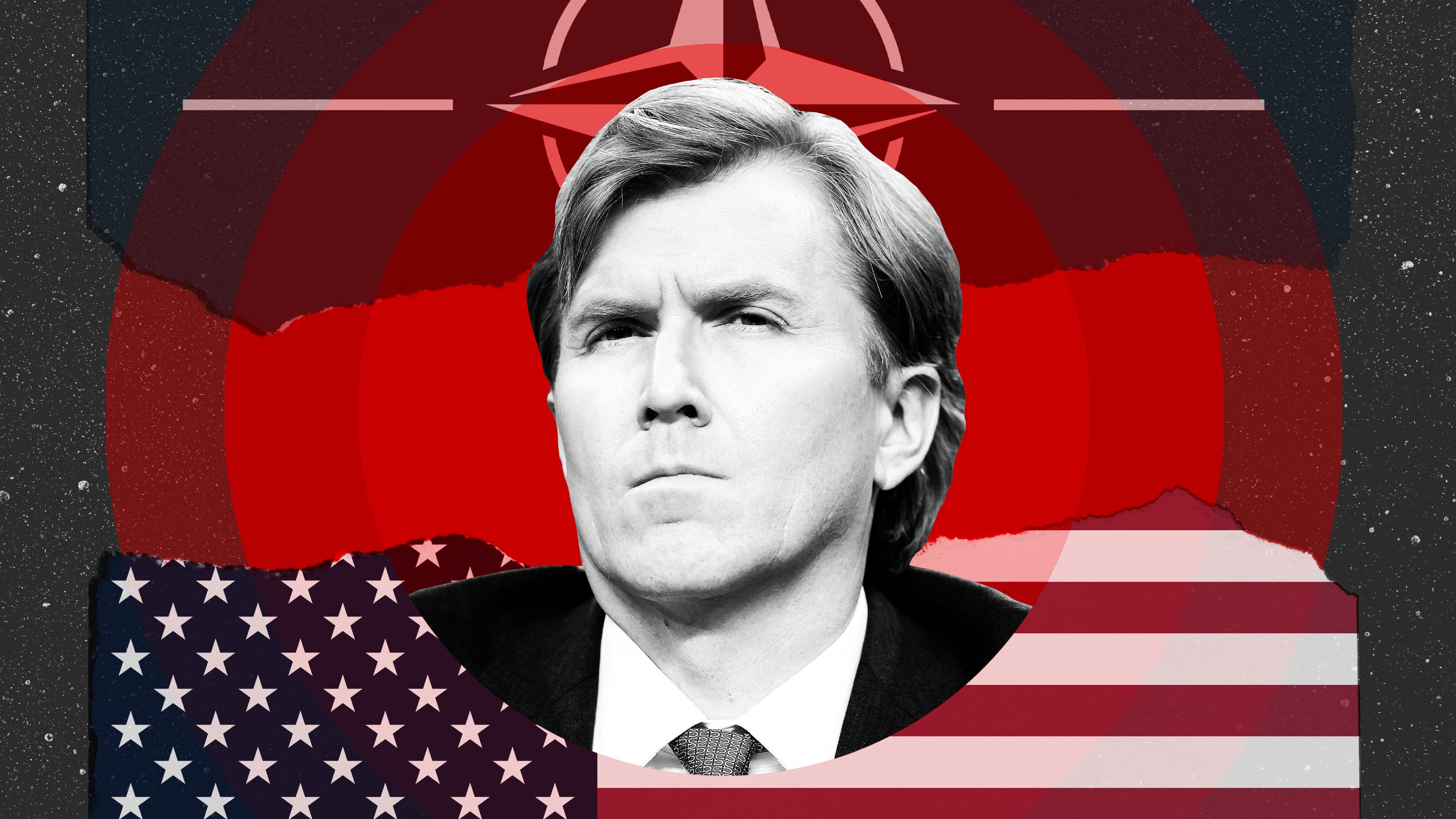
IT’S ONE OF THE WORST JOBS IN WASHINGTON: Elbridge Colby, the under secretary of defense for policy, is tasked with explaining Donald Trump’s erratic foreign policy to the public. But you could just as easily say he volunteered to launder Trump’s bellicose, bizarre acts by finding an intellectual coherence that isn’t there.
The 46-year-old grandson of former CIA Director William Colby and graduate of Harvard and Yale is a born-and-bred courtier to the powerful. He boosted lies about the 2020 election and spent the subsequent four years angling for a position in the next Republican administration. He seems to have convinced himself that Trump would be a vehicle for executing his grand vision of focusing American foreign policy on China while distancing the United States from, in his view, parasitic European allies and a hopelessly troubled Middle East.
Within right-wing foreign policy circles, Colby, a so-called “flexible realist,” is not beloved. Before taking up his role in the Defense Department, Colby drew the ire of many Republican Iran hawks by downplaying the severity of the threat posed by Iran obtaining a nuclear weapon. He asked, rightly, how they proposed to “launch major strikes on Iran” and avoid a protracted war, “especially if Iran retaliates against U.S. forces and other allies and partners?” (He issued that challenge about two and a half years before Operation Midnight Hammer, in which the administration in which he serves launched a major bombing campaign against Iran’s nuclear weapons program, causing severe damage without provoking a major response.) In a now-comical set of tweets designed to grab Trump’s attention in December 2024, he declared that “the new GOP led by @realDonaldTrump is focused on: ending wars and avoiding new ones.”
Despite these projections, Trump has initiated a major campaign against the Houthis in the spring of 2025, the snatch-and-grab of Venezuela’s Nicolás Maduro in January 2026, and the Iran war that is now in its fifth month. And now he is now gazing hungrily at Cuba—all while paying little attention to China. Trump has landed Colby in the uncomfortable position of having to publicly defend a war that contradicts virtually everything he has written or said in his career.
Even so, we shouldn’t see Colby as an outlier in MAGA foreign policy. He fits comfortably within many of the America First precepts and performs a valuable function for the administration: crafting intellectual scaffolding for Trump’s instinct-driven approach to the world. Colby represents the America First foreign policy impulse gone legit. But however you gussy it up, that impulse remains unilateralist, nationalistic, militaristic, and utterly shortsighted.
Trump keeps finding new ways to lose friends and alienate allies. Don’t miss any of our coverage of the chaos and craziness: Join Bulwark+ today with two weeks on us.
Colby’s views on U.S. alliances illustrate the dangerous shallowness of his intellectualized Trumpism. In a recent interview with Ross Douthat, his Harvard pal and later Washington, D.C. roommate, Colby squirmed his way through a defense of Trump’s unprecedented hostility to American allies. Along with the requisite sycophancies (“the president is a master negotiator—he comes from New York”), Colby claimed that our allies had come to “take the United States for granted.” It was time to “keep them sufficiently on their toes so that they do their part” by, for instance, reducing U.S. commitments to the defense of Ukraine. Indeed, behind the scenes, Colby drove the decision to withhold arms shipments to Ukraine in 2025.
Douthat pressed Colby on the gap between a theoretical burden-sharing strategy—essentially blustering to make European allies pony up—and Trump’s actual behavior, pointing to Trump’s jokes about making Canada the 51st state and his repeated threats to seize Greenland from Denmark. Colby dodged, saying that Trump intended to reassert the Monroe Doctrine by prodding allies to spend more on defense. Such a strained claim reveals Colby’s assertion that “President Trump . . . is the savior of NATO” to be utterly risible.
COLBY’S MAIN MOVE IS TO dress up hostility to allies in the guise of common sense. “Is it cruel to ask the Germans or the Japanese or the French to spend as much as the Americans spend?” he asked. “I don’t think that’s cruel, I think that’s fair.” (Denmark, for its part, spent a slightly higher percentage of its GDP on defense than the United States did last year.) He claims merely to be trying to “price the partnership and relationship with the United States” in a more transactional way on the assumption that allies have been free-riding on U.S. power for decades.
But the fact is, Colby’s hostility to European allies goes beyond free-riding; the America Firster depicts a unified Europe as a threat to the United States, possibly a greater threat than Russia. As he wrote in his 2021 book on great power conflict, “the most plausible alternative to Russia as an aspiring hegemon in Europe is likely the European Union,” so “the United States is therefore better off if Europe is not a highly unified superstate.” The 2025 National Security Strategy, which Colby had a role in producing, is overtly hostile to the European Union, describing the EU as one of many “transnational bodies that undermine political liberty and sovereignty” and leading Europe into “civilizational erasure.”
Colby dubiously points to the recent spike in European defense spending as a result of tough love from Trump. Obviously, the rearmament drive of these countries is driven by Russia’s invasion of Ukraine. NATO members’ military spending jumped between 2022 and 2024 because these nations realized the gravity of the Russian threat. (If the Trump administration were serious about NATO spending commitments, it would hold the harangues and committing to actively resisting Russian aggression as NATO members take on greater responsibility for defense.)
Military spending aside, Colby’s thinking on alliances is myopic and counterproductive. The worst of all worlds, he combines a bean-counter’s stinginess (likening U.S. alliances to “an accounting firm” in his interview with Douthat), populist resentment about getting “ripped off,” and a nationalistic hostility to cooperation.
Colby and Trump are heedlessly shredding our alliances, but the United States invests in allies precisely because it makes strategic sense to do so. Faith in liberal democracy has turned many U.S. alliances into genuine friendships. But the main reason the United States backs treaty allies like the thirty-one other members of NATO as well as Japan, South Korea, Australia, and others is because it has essential interests in these parts of the world that are best served by alliance cooperation. This investment began with the deepening integration of the U.S. economy with Europe and East Asia in the aftermath of World War II (and the imperative of resisting Soviet expansionism) and has remained tied to these places even after the collapse of the Soviet Union, if not more so in the age of globalization.
For more than eight decades now, the United States has guaranteed the freedom of trade at sea, deterred aggressive powers like China and Russia, and encouraged the security and economic integration of its allies. We have done these things primarily because it is in our interest to do so. The United States simply cannot protect its essential interests without allies and partners who trust its intentions and are willing to, say, host tens of thousands of U.S. soldiers on their soil along with nuclear weapons and air and naval bases. As a so-called flexible realist, Colby claims to be concerned with power, yet he cannot see that U.S. investment in alliances has magnified its economic and military power well beyond what it can achieve through a miserly “America First” approach.
Trump, Colby, and Vice President JD Vance are all obsessed with the idea that America’s allies are “ripping us off.” If anything, the opposite is often true. While the United States has taken the lead in crises like the Gulf War and Bosnia, it has also pulled NATO allies into ill-considered wars. This includes over a thousand soldiers from allied countries who died in Afghanistan. These dead included forty-three soldiers from Denmark, a country that Trump has repeatedly threatened and denigrated since retaking office.
“We’ve never needed them,” said Trump about NATO at the World Economic Forum. Colby may be able to defend U.S. retrenchment from some areas of the world, but he simply cannot defend poisoning the well so recklessly with allies who have sacrificed for us.
HOW DO WE MAKE SENSE of Colby’s efforts to saw off any United States relationship with Europe? It derives from the flawed way he sees America and its place in the world.
Colby wants the United States to remain a superpower, but he fundamentally misunderstands the foundations of our power. Addressing the Conference of Defense Ministers in Peru in early July, he asserted that the United States is unlike “most historical empires” in that it does not need “colonies and dependencies to be a great power,” waving away centuries of U.S. interference in Latin America and the half-century in which the United States governed the Philippines as a colony. The United States is “an empire of liberty unto ourselves,” he boasted—“an enormous country, by far the world’s most powerful state.”
This combination of arrogance and faulty history suggests Colby is an isolationist, but this isn’t right. Rather, he’s a fervent believer in great power competition (especially with China, against whom he wants to build an “anti-hegemonic coalition” of Asian nations). In the brutal struggle between nations, Colby insists the United States pursue only its purest national interests; anything less would be suicidal. What he misses, though, is that competing with strategic rivals is best done through robust alliances, not alone. There are two primary reasons for this: China, for one, does not really have allies, besides the erratic despotism of North Korea. While it has close relationships with nations like Pakistan, and has been aligning more with Russia of late, it lacks anything like America’s robust alliance networks. America’s partnerships, most of which are based in both interest and real affinity, are a massive advantage for the United States that the current administration is squandering.
Second, Colby fails to grasp that alliances do more than simply add to America’s power: they legitimize it. A little international relations theory is helpful here. Academics debate whether countries respond primarily to power or to threat. Power is a raw metric compiled by measurements of GDP, population size, military capabilities, and so on. Power might say how many tanks and missiles a state is able to field, of what quality, and how much money it can put behind producing more. Threat, however, is a more interpretive concept, combining these objective measurements with subjective assessments of intent and character to tell other nations how a mighty state is likely to use its power. A perennial challenge for the world’s strongest nations has been how to augment their power without appearing so threatening to other nations that they rally together to stop them. Napoleon, Kaiser Wilhelm, Hitler, Hirohito, and the Soviet Union were all in various ways undone by this dilemma.
As the United States emerged from World War II as a genuine superpower, it resolved—or at least mitigated—this problem by binding itself to allies through institutions like NATO, the United Nations, the General Agreement on Tariffs and Trade, and various human rights conventions. Unlike the coercive empire of the Soviets, American statesmen pulled off the astounding accomplishment of attracting allies and trade partners in a consensual manner. It bolstered this success, for a time, after the Cold War when many of the nations of Eastern Europe flocked to join NATO and/or the EU as well as other global economic bodies. In fact, the strategy was so successful that many of NATO’s post–Cold War members had to overcome American reluctance before they could join the alliance.
These institutions, as well as meaningful American rhetoric about liberty and democracy, gave less powerful nations reassurance about U.S. intentions, as well as a say in how the United States used its immense power. Despite being the undisputed global superpower after the Cold War, for a time the United States defied the historical trend, gaining friends and allies rather than sparking fear and resistance.
This legitimacy generated relative good faith internationally about American use of force. So, when the United States flexed its might in the Persian Gulf in 1990 and 1991, in Bosnia during the mid-1990s, and in Afghanistan after September 11th, it did so with a strong claim to the legitimacy of its actions. Of course, the United States did not do this consistently, especially in the ill-fated Iraq War.
As we’ve seen in Iran and Venezuela, Trump consciously rejects the concepts of consultation and reassurance. He made no effort to consult U.S. allies and instead Leeroy-Jenkinsed his way into a failure in Iran. Thanks to the caprice of Trump and the eagerness of hangers-on like Colby to devalue U.S. alliances, the world now has good reason to see U.S. power as threatening. The end result is an overall delegitimizing of the United States as a global actor.
Colby is blasé about this meaningful decline in American legitimacy and power. As he told Douthat, “I think it’s an idle claim to say that countries are going to go elsewhere. Where are they going to go?” Colby’s question, illustrative of his reductive understanding of power, misses the real benefits of alliances. Yes, it’s unlikely NATO members, Japan, Australia, and other U.S. partners will flock to Russia or China, but there is a high risk that they will simply de-invest in the alliance with the United States (becoming less likely to help America out on anything) and instead form other, more stable blocs and networks. In a moment of remarkable obliviousness about the Iran War, Colby says to Douthat: “I’ve seen international leaders complain about the economic consequences. Well, A, you can help out, or B, take it up with Tehran.” The question he doesn’t ask is: Why should they assist an administration that berates them and burns every bridge on a problem it created?
It’s tempting to look at Colby with his pedigree and education and treat him as someone who “knows better.” But this is a comforting illusion. Colby has glommed onto Trump because he is pathologically resentful of U.S. allies, indifferent to the fate of democracy, and eager to dismantle the pillars of U.S. global influence that were painstakingly erected by bipartisan leaders over eight decades. He and Trump deserve each other.
Joseph Stieb is an assistant professor of U.S. military and diplomatic history at the University of North Carolina at Chapel Hill. He is the author of The Regime Change Consensus: Iraq in American Politics, 1990-2003 and a forthcoming book titled Root Causes: Terrorism and the American Right from the ’60s to Trump.
 | A guest post by
|
Excellent , Colby is a person who despises the idea of being an American and is happily trying to install a dictatorship and doesn't mind twisting himself into a pretzel to accomplish it .
I do not disagree with the author's last paragraph, but Colby (and like many others in this administration) still comes across as an opportunist. His strategic thinking seems to bend with the political winds, changing to fit the priorities of those in power rather than reflecting a consistent set of principles. Putting himself first makes sense given his background and social circle, but it is not something to dismiss either. The consequences of our deteriorating alliances are real, and I'm afraid we won't feel many of those for many years yet.