

George Washington’s Woke Vaccines
What the Founders would have thought about Pete Hegseth lifting the requirement that service members get the flu vaccine.

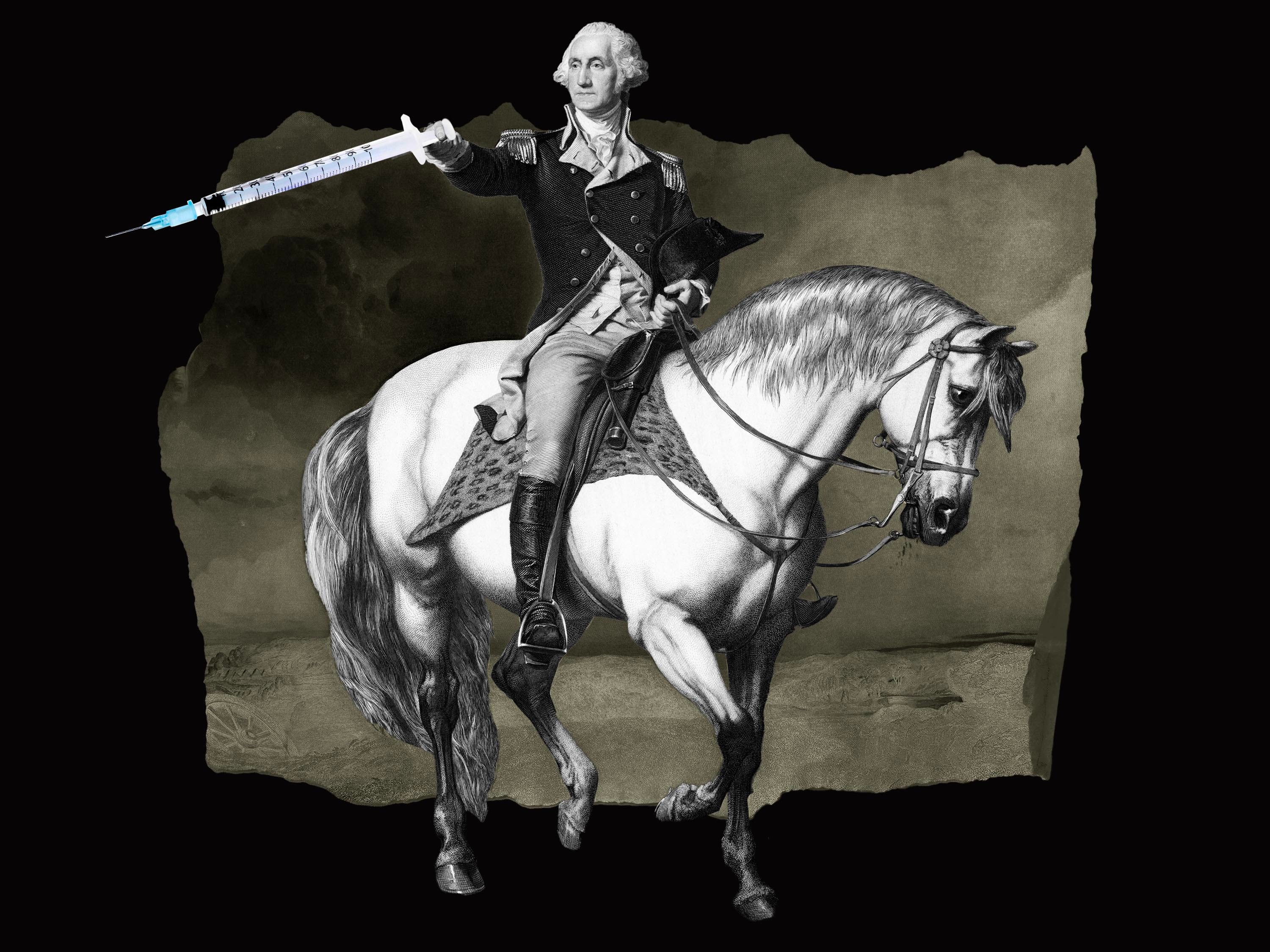
SECRETARY OF DEFENSE PETE HEGSETH yesterday took time out of his busy schedule of committing war crimes and firing generals to focus on the real enemy: vaccination.
The Defense Department is “is once again restoring freedom to our Joint Force,” he tweeted. “We are discarding the mandatory flu vaccine requirement, effective immediately.” In a video, he explained the reasoning, if that’s the right word, behind the move:
Under the disastrous Biden administration, this Pentagon waged an unrelenting war on our warriors on many fronts, including when it came to denying them simple medical autonomy and the freedom to express their religious convictions. . . . You know what I’m talking about, what happened: COVID-19 and the vaccine. No more. That era of betrayal is over. . . . We’re seizing this moment to discard any absurd overreaching mandates that only weaken our warfighting capabilities. In this case this includes the universal flu vaccine and the mandate behind it. . . . Our new policy is simple: If you, an American warrior entrusted to defend this nation, believe that the flu vaccine is in your best interest, then you are free to take it; you should. But we will not force you. Because your body, your faith, and your convictions are not negotiable, your health.1
I will leave it to others to weigh Hegseth’s claim in the video that letting service members skip the vaccine “pose[s] no threat to our military readiness”; I instead want to focus on his assertion that mandatory vaccination violates service members’ “freedom to express their religious convictions” and represents an “era of betrayal.”
A decade into the age of Trump, there are all kinds of things we can say about the way MAGA and MAHA have infected branches of evangelical Christianity in the United States. It can be difficult to know where QAnon bullshit ends and the church begins—as I’ve written over and over and over again. So this time, I want to try to explain just how stupid Hegseth’s decision is in terms even he can understand, by putting it in the context of the American founding, especially in this 250th anniversary year. Because if vaccine mandates truly represent an “era of betrayal,” then I guess George Washington’s woke vaccines are the root of it.
Before we get to Washington, let’s set the stage with a look at the decade before he was born. Hegseth’s religious claim simply doesn’t pass the smell test in the context of people who keep trying to claim the mantle of the Founding Fathers. In the 1720s in Boston, a smallpox epidemic led to a widespread debate over variolation—an inoculation technique that is a precursor to today’s vaccines, introducing small doses of live smallpox to people so that they might have a mild infection and then develop protective immunity. The debate played in press and pulpit, because variolation could indeed cause fatal cases of smallpox.2
And in 1720s Boston, the person with the loudest voice from the pulpit was Cotton Mather. If his name rings a bell, it might be of his association with witch hunting and apocalypticism—but that doesn’t mean he was anti-inoculation. In fact, he was the strongest advocate for inoculation in Boston.
That’s right. Cotton Mather—Puritan luminary, proponent of hunting witches—was a big believer in inoculation. Mather inoculated his own son after learning about the procedure from the Philosophical Transactions of the Royal Society and the testimony of his enslaved servant Onesimus, who had been inoculated in West Africa before he was kidnapped. With Mather’s support, Dr. Zabdiel Boylston experimented on Mather’s son, Mather’s enslaved servant Jack, and Jack’s son, and when none of them developed full cases of smallpox, began continuing with other people. There was intense pushback—a bomb was thrown into Cotton Mather’s house on November 14, 1721, because of his advocacy—but the campaign moved forward.
A half-century later, smallpox was enough of a problem—and inoculation had become enough of a proven technique—that this was not just a matter for individual cities and individual clergy to debate but a matter of urgency for the war for independence. Smallpox broke out in the Quebec campaign, ravaging the Continental Army in 1775 and 1776. As John Adams3 wrote to his wife, Abigail, in June 1776,
Our Misfortunes in Canada, are enough to melt an Heart of Stone. The Small Pox is ten times more terrible than Britons, Canadians and Indians together. This was the Cause of our precipitate Retreat from Quebec, this the Cause of our Disgraces at the Cedars.—I dont mean that this was all. There has been Want, approaching to Famine, as well as Pestilence.
Smallpox was a fundamental threat. And while quarantines were an important part of the solution, quarantines during an active military campaign were far from ideal. So in February 1777, George Washington, the commander-in-chief of the Continental Army, wrote a letter to William Shippen, Jr., director general of the hospitals for the army:
Finding the Small pox to be spreading much and fearing that no precaution can prevent it from running through the whole of our Army, I have determined that the troops shall be inoculated. This Expedient may be attended with some inconveniences and some disadvantages, but yet I trust in its consequences will have the most happy effects. Necessity not only authorizes but seems to require the measure, for should the disorder infect the Army in the natural way and rage with its usual virulence we should have more to dread from it than from the Sword of the Enemy.
The general ordered “without delay” the immediate inoculation of “All the Continental Troops that are in philadelphia and those that shall come in as fast as they arrive.”
Now skip ahead a generation to when smallpox vaccination came to America. (The word “vaccination” comes from the Latin for cow, since the English physician Edward Jenner proved in the 1790s that intentionally infecting someone with cowpox could confer immunity to smallpox.) The Founding Fathers welcomed vaccination. On Christmas Day in 1800, Thomas Jefferson wrote to Benjamin Waterhouse, the physician who brought the technique to America, that “every friend of humanity must look with pleasure on this discovery.”
I COULD OFFER OTHER EXAMPLES of the Founding Fathers and their contemporaries expressing gratitude for these disease-preventing techniques, and celebrating the decision to require the troops be inoculated during the Revolution. Likewise, I could point to other examples of eighteenth-century religious figures who, like Mather, embraced these measures.4
The point, though, is that Hegseth’s claim—that requiring the vaccination of service members violates their religious freedom and is part of a “war on our warriors”—doesn’t hold water. The Founders appreciated the importance of the mandate.
Pete Hegseth and the broader Trump administration are concerned with a brand of anti-wokeism that is divorced from our shared reality. In the context of all the other things Hegseth and the administration have been doing, it seems like the ending of vaccination mandates is a small thing to get mad about.
But vaccines work. They are safe. They save lives. And mandating them in the military is a tradition that dates back to the Founding era whose 250th anniversary we are marking this year.
One last point, a question for Secretary Hegseth: If you really believe that mandatory vaccination violates “medical autonomy” and “the freedom to express . . . religious convictions,” then why stop with lifting the requirement for the flu vaccine? Why not do away with the requirements that service members be vaccinated against polio, measles, hepatitis, and the other diseases for which vaccinations are now mandatory? No? So much for the “era of betrayal.”
Hegseth did not mention that service members could already file requests to be exempted from vaccines on religious grounds.
Today’s vaccines, which use weakened or dead viral material, or bits of genetic code that can prod the immune system into action, are much safer.
John Adams and much of Boston had been inoculated by Dr. Joseph Warren, Son of Liberty and major general in the Continental Army, who had run a smallpox inoculation clinic in the 1760s. Abigail Adams had herself and her children inoculated in 1776.
Here’s another example—a contemporary of the Founders, a Dutch Reformed pastor in Albany, New York, Eilardus Westerlo. In a November 1782 diary entry, he wrote:
This day my daughter Catharine and other children in my family are to be inoculated with the smallpox that have been and are at present in town and country. I desire to wait on the Lord for a blessing. Oh, may the Lord in His infinite mercy bless this approved experiment and give us new matter of praises unto Him, who remembers mercy. . . .
 | A guest post by
|