

Growing Fears That Hungary’s Orbán May Cancel Next Month’s Election
As polling shows the opposition widening its lead, observers worry the prime minister is preparing a drastic step to retain power.

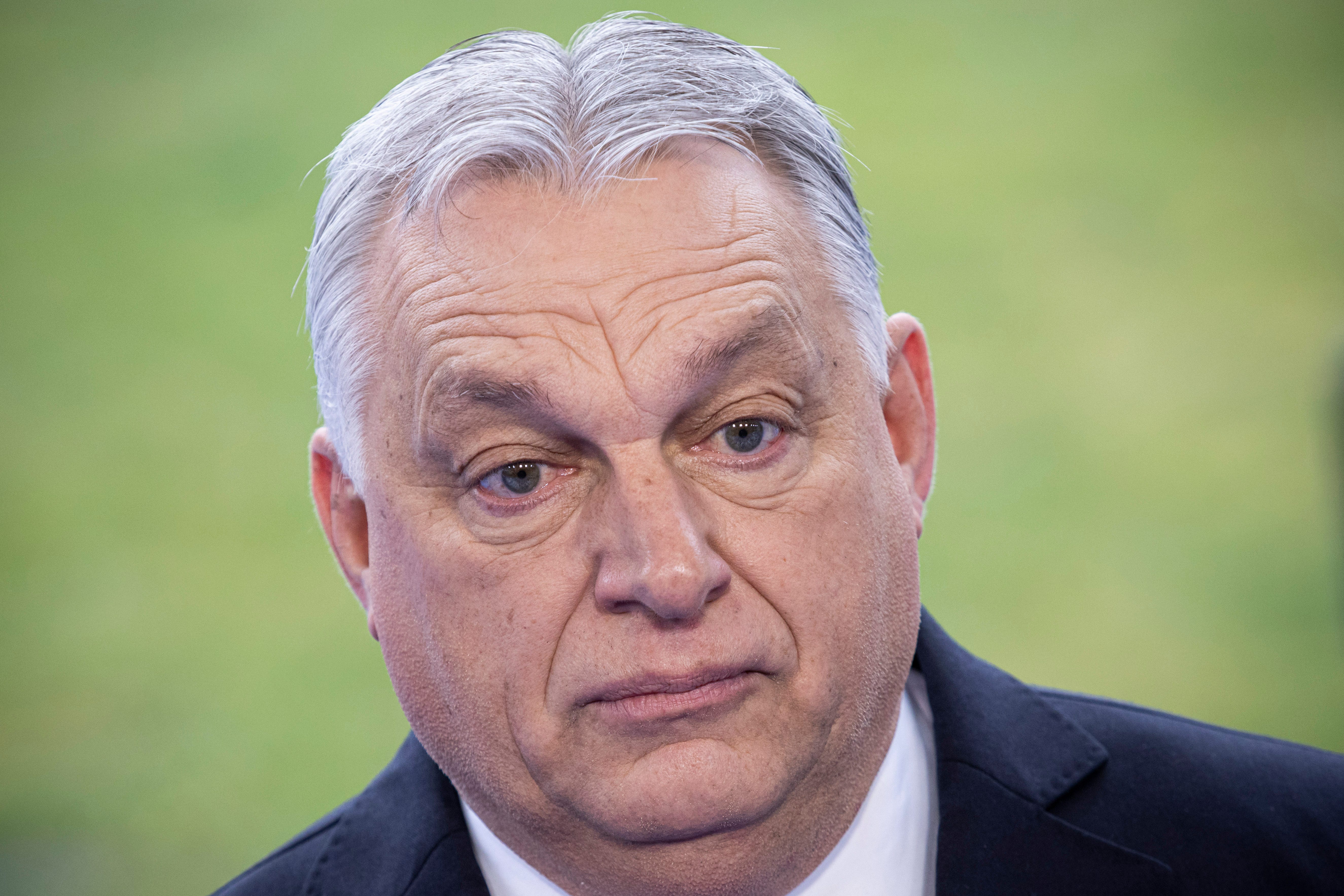
HUNGARIANS PLAN TO VOTE in parliamentary elections in six weeks, and if the polls are correct, not only will Fidesz, the party of Prime Minister Viktor Orbán, lose, it could easily get clobbered. Over the last few months, independent research firms have consistently shown Péter Magyar’s opposition party, Tisza, leading Fidesz by around 10 points among likely voters. But an eye-popping poll conducted in mid-February and released last week by Medián, one of Hungary’s most respected pollsters, appears to be pushing Orbán toward the brink. According to Medián, Tisza has jumped ahead of Fidesz by 20 points, a lead so large it would almost certainly deliver Péter Magyar a parliamentary supermajority. That would allow him to change the constitution and dismantle the kleptocratic mafia state Orbán has built up over the last sixteen years.
A single outlier poll, of course, should be taken with a grain of salt. Still, the Medián poll was enough of a shock that Orbán, who likes to fashion himself a statesman above the political fray, reacted by calling the head of Medián a “great comedian.” Within hours after the poll’s release, a government-sponsored research firm named Nézőpont produced its own poll showing Fidesz ahead of Tisza by 5 points—a result best interpreted as state-sponsored propaganda.
Faced with the very real prospect of losing an election, Orbán’s campaign tactics have evolved from the ugly to the dangerous to the deeply sinister. Now—much as critics of Donald Trump speculate about what, after his attempt to steal the 2020 election, the U.S. president might try in 2026 or 2028—observers of Hungarian politics worry that the Trump-supported Orbán will try something desperate to stay in power. Some commentators have suggested that he is laying the predicates to either cancel the election or invalidate its results. The pretext would be allegations of a Ukrainian attack on Hungarian sovereignty.
In late January, Russian drones damaged the Druzhba pipeline in Ukraine, disrupting the flow of oil to Hungary and Slovakia. As of today, according to the Ukrainians, the pipeline is not operational. But Orbán alleges that the Ukrainians have shut down the pipeline deliberately in order to block Hungary and Slovakia from getting oil. In response to this alleged act of sabotage, Orbán recently vetoed a European aid package to Ukraine and also blocked (with Slovakia) a new round of European sanctions against Russia. Additionally, Orbán has deployed soldiers throughout Hungary to protect important energy facilities, claiming that “Ukraine is preparing to take further steps against Hungary’s energy infrastructure.” Last Friday, Orbán declared that the Ukrainians “have attacked us. . . . not yet our people, or our cities, but they’ve targeted our economy.” The Ukrainians, he said, “are capable of anything,” including “state terrorism.” They have also “infiltrated Hungarian politics” and are “financing the Tisza party.” Orbán even went so far as to allege that Péter Magyar has worked closely with a Ukrainian spy.
For anyone familiar with Eastern European history, Orbán’s manufactured international crisis coupled with his efforts to generate public hysteria look a lot like an aspiring dictator preparing the ground for a false flag operation. Hungary’s constitution prohibits elections from being held during a “state of emergency” (szükségállapot). According to Orbán, Hungary is under attack from a neighboring country that is “preparing to take further steps.” A mysterious explosion at a Hungarian power plant or a clash with unidentified drones in Hungarian airspace coupled with a cyberattack on Hungary’s critical infrastructure might be all Orbán needs to have Parliament declare a state of emergency and suspend the election.
OTHER CONSIDERATIONS point away from this worst-case scenario. Successful dictators generally seize power on the way up, but Orbán, old, tired, and morbidly obese, is clearly losing his hold over the country. Were he to cancel the election, the trick would be seen for what it is—a desperate attempt to keep power against the will of the Hungarian people. Péter Magyar would decry the move as a coup. The opposition, which has grown into a significant social movement, would take to the streets. People would call for a general strike. Many Hungarians, especially the young, would emigrate en masse, fearing that Hungary was converting to full-fledged Putinism. The European Union, forced to react, might finally implement Article 7 of the Treaty on European Union, suspending Hungary’s membership rights. The chaos would negatively impact Hungary’s fragile economy, discouraging foreign investment and driving down the Hungarian forint. The country would enter a period of protracted social unrest, buffeted by crises that no politician could hope to master. Even Orbán, one has to think, would shrink away from such a frightening scenario.
Many Hungarians I know believe Orbán will never voluntarily relinquish power. When I present them with a scenario like the one above, they reply by pointing to the existential stakes at play in this election. This election is about more than a change of government, it’s about a change of system (rendszerváltás). The Hungarian term is exactly that used to describe the change of system that took place in 1989 when communism collapsed. Except today, the system Hungarians are trying to overturn is what the sociologist Bálint Magyar1 calls a “mafia state.”
Magyar uses this term in a technical sense. The mafia state shares characteristics with other types of autocratic systems, but Magyar believes labels like dictatorship, fascist, illiberal, or hybrid-regime do not capture its essence. The mafia state functions like an organized crime syndicate for the primary purpose of acquiring personal wealth. It’s a form of complete state capture, one in which the godfather gains control of all the levers of state power to enrich the family. Unlike other authoritarian regimes, which subordinate wealth to power by, for example, nationalizing private assets, the mafia state subordinates power to wealth by privatizing public assets.
According to Magyar, Fidesz at its core is a crime syndicate whose leadership has been pillaging the country for sixteen years. They’ve camouflaged their corruption in the garb of conservative Christian nationalism in ways that have managed to enamor American conservatives (many of whom have their own weakness for grift), but greed and theft is what Orbán’s system is fundamentally about. Should the Hungarian Cosa Nostra ever lose the protection of the state, should the levers of power that Hungary’s constitutional system have placed informally in Orbán’s hands ever collapse or be overturned, people close to Orbán, members of the famiglia, will flee the country or land in jail. Given these stakes, it’s no surprise that observers worry that Orbán will cling to power—perhaps even to his dying breath.
Then again, this possibly overstates the danger. If Orbán loses the election, he could always seek asylum in the United States. Indeed, his daughter and son-in-law (one of the richest and most corrupt Hungarian oligarchs) have already taken up residence in the land of the free. On a recent visit to Budapest, Secretary of State Rubio affirmed the Trump administration’s close relationship with Viktor Orbán. Perhaps, then, if Hungary’s election unfolds in a way that is disastrous for Orbán, he can still find a path of escape in Donald Trump’s America.
No relation to Péter Magyar.
 | A guest post by
|