The Libertarian Party Is Trying to De-MAGAfy Itself
Could Republicans ever follow suit?

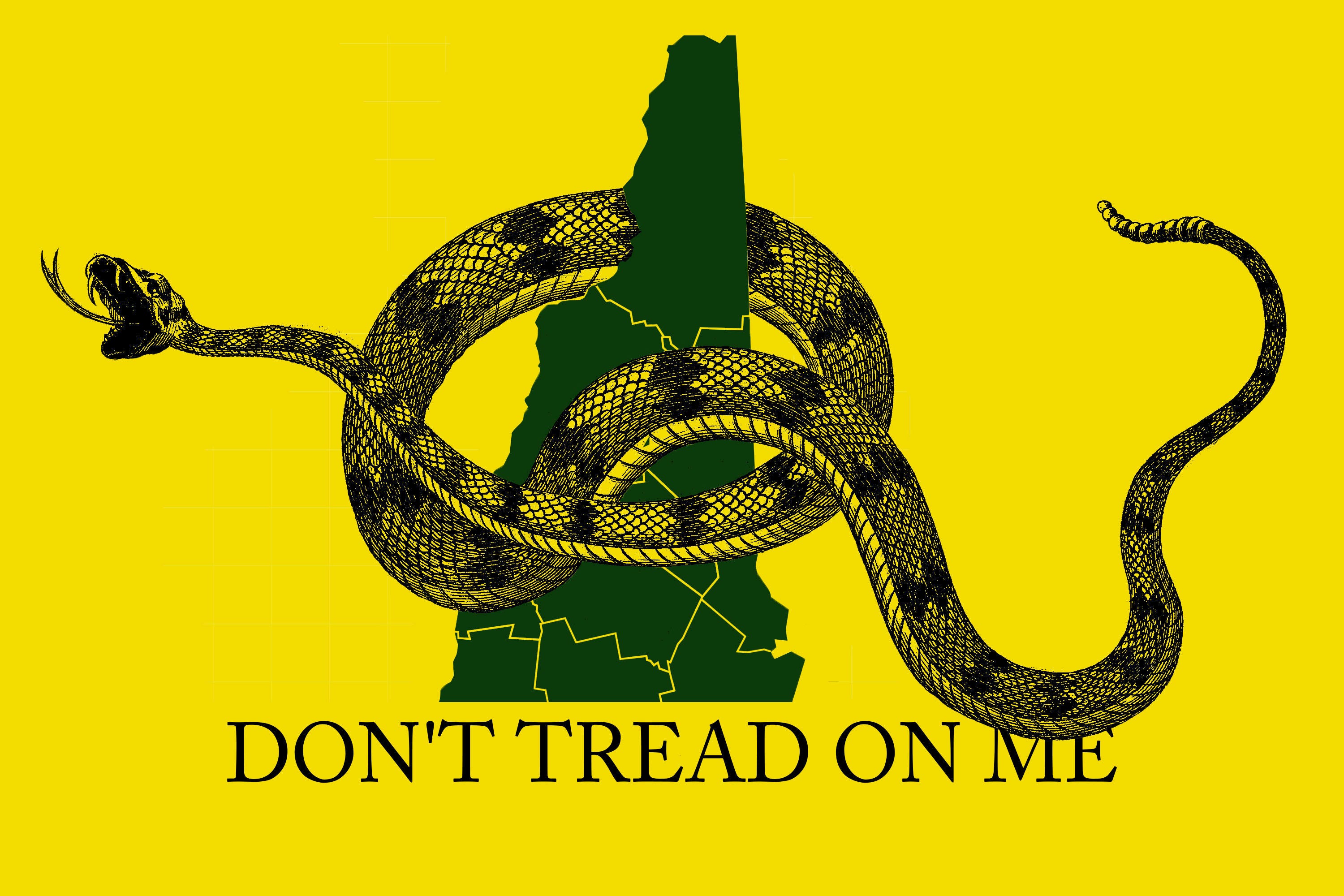
THE LIBERTARIAN PARTY LAST MONTH expelled its New Hampshire chapter from the national party. For years, the Libertarian Party of New Hampshire (LPNH) has prided itself on being the radical vanguard of the liberty movement and made itself a public relations nightmare for the wider libertarian movement. Its chair, Jeremy Kauffman, became notorious for tweets he posted from the New Hampshire chapter’s account, including implying that historically black colleges and universities were “chimp factories” and declaring that “Anyone who murders Kamala Harris would be an American hero.” Faithless to the wider party, the LPNH endorsed and campaigned for Donald Trump over the Libertarian Party’s own presidential nominee, Chase Oliver, in 2024. When the vote by the Libertarian National Committee to eject the LPNH finally came during the party’s national conference, it was swift and decisive.
The story here is bigger than a racist, right-wing group being removed from a party apparatus. Many political scientists, including me, believe that having only two competitive political parties hurts American democracy. And if we cannot have several different parties represented in Congress, the next best option is to have third parties that can force the major parties to make changes by undermining, or threatening to undermine, their candidates. But third parties are far weaker today than they were over a century ago, when they were able to discipline both the Republican and Democratic parties whenever either moved too far beyond the public will.
Until the current catastrophe, the Libertarian Party was the strongest extant third party. The conflict with the New Hampshire branch was part of an internal crisis that nearly destroyed it. The LPNH’s ouster suggests the Libertarian Party has survived; but the underlying problem it (and other third parties) face still remains.
The Third-Party Problem
The Libertarian Party was bullish going into 2024. They regularly garnered three times as many votes as the other significant third party, the Greens, in both presidential and House elections. American dissatisfaction with both major parties continued to grow in the years after the COVID-19 pandemic. And while Trump continued to have a stranglehold on his base, many moderate Republicans and traditional conservatives seemed wary of putting him back into power. The Libertarians hoped they could capitalize on this generalized disenchantment in the political system.
But, like all American third parties, the Libertarians face two structural problems. First, they lack resources. While better-funded than the Green Party, LP candidates cannot match Democrats and Republicans in raising money. In federal elections, the Libertarian candidate always loses. Second, like all national third parties, the Libertarian Party has a decentralized structure, which is ripe for hostile takeover.
The resource problem goes beyond preventing Libertarian candidates from running television ads. It creates a self-fulfilling prophecy: Since no one believes third parties can win elections, few donors are willing to fund those campaigns. So, lacking funds and other resources, third parties rarely win elected office. This feedback loop also shapes the party at an operational level. Because third parties rarely win, they don’t typically attract seasoned, professional politicians or operatives. Instead, third parties are populated by ideological activists who lack not only campaign experience but also training in strategic politics. Tactical maneuvering during campaigns becomes incredibly difficult, since party members often interpret any deviation from doctrine as a betrayal of core ideals. This sort of push and pull is present in all parties, but the structural factors underlying third parties turn intraparty competitions into a perpetual war between pragmatists in a party who want to win elections and idealists who want to preserve philosophical purity.
All of this is exacerbated by a second structural issue. The United States has a federalist system. All parties must establish a party organization in each state they want to compete in separately. From this institutional patchwork, a party then builds a national organization that is, technically, a federation of state parties. The federalist structure is a primary reason third parties are so decentralized. And because third parties are grassroots organizations built on enthusiastic membership, decentralization leaves them vulnerable to hostile takeovers. Take, for instance, the case of the Reform Party, founded by Ross Perot in 1995 as a vehicle for his populist campaigns. It collapsed as a going enterprise in 2000 because, to gain access to the Reform Party’s resources, the conservative firebrand Pat Buchanan led a hostile takeover of it by packing local Reform branches with new members who voted Buchanan’s people in charge. The Buchananites pushed out the old leadership and used Reform’s organization and place on the ballot to aid their leader’s presidential campaign.
Caucus Crisis
In 2024, the Libertarian Party faced a crisis similar to the one that all but destroyed the Reform Party. But for the Libertarians, the attack came from inside the house. A group of radical right-wingers calling themselves the Mises Caucus sought control of the party.
Named after Austrian-school economist and libertarian icon Ludwig von Mises, who died in 1973, the Mises faction promoted “radical anarcho-capitalism,” or the complete elimination of government involvement in the economy, fused with MAGA-style cultural policies. Founded in 2017, the Mises Caucus contended that the Libertarian Party had been taken over by temporizing pragmatists and moderates, whom they often derided as “Beltway libertarians.” Their desire to drive the Libertarian Party in a more radical direction led them to Trump.
Initially only a fringe group in the party, the Mises Caucus gained substantial internal support during the COVID-19 crisis. While the party leadership displayed a more moderate stance on President Biden’s pandemic policies, the Mises Caucus were fiercely and uncompromisingly opposed to lockdowns, mask mandates, and vaccine requirements—all of which they saw as anathema to libertarian first principles. Combined with their aggressive social media presence, the Mises Caucus’s stridency enabled them to recruit thousands of new Libertarian Party members whose sentiments and loyalties aligned with the group. By flooding the local and state Libertarian parties with new delegates, the Mises Caucus was able to vote themselves into control of many state-level parties. Having gained control over enough affiliated organizations, the faction then wielded that power at the party’s 2022 national convention in Reno, voting itself complete control of the national committee and electing one of its members the national chair.
Once empowered, the Mises Caucus flexed its culture-war muscles, removing parts of the party platform it considered “woke,” including an explicit condemnation of bigotry that had stood for fifty years. The Mises gang also jettisoned the party’s neutrality on the question of abortion, asserting instead that a fetus is a person with property rights. But the caucus’s most controversial move was inviting Trump to speak at the Libertarian Party National Convention in 2024, even though Trump was the nominee of another party and a rival of the Libertarian Party. Unable to resist, Trump came, and spent the majority of his speech cajoling the Libertarians to nominate him instead of continuing to be “losers.” The convention descended into near chaos, with delegates booing Trump, shouting at each other, and, at one point nearly coming to fisticuffs over seating arrangements. When the dust settled, the Mises candidate for the presidential nomination (not Trump) lost to Chase Oliver, a more traditional libertarian.
Throughout the Mises debacle, the greatest problem faced by (relative) normies in the Libertarian Party was the New Hampshire party. The Live Free or Die State has an interesting place in the libertarian firmament. It’s home to the Free State Project, a nearly twenty-five-year-old effort to draw libertarian migrants to the state and transform it into a freewheeling paradise. With links to the Free State Project, the Libertarian Party of New Hampshire was essentially the Mises Caucus completely unchained. It cranked the faction’s right-wing populist, provocative strategy up to an extreme. Its X account explicitly blamed Jews for the attacks on September 11th, openly minimized and mocked the Holocaust, and argued that child labor should be legalized.
The LPNH refused to accept Oliver’s nomination on the Libertarian ticket as legitimate, openly endorsed Trump for president, and sniped at Oliver, often with homophobic slurs. (In truth, much of the Mises Caucus—not just the LPNH—refused to accept Oliver’s nomination and many rooted for his defeat.)
But, as with cranks everywhere, the Mises Caucus overplayed its hand. Three factors worked against it: As COVID declined as a motivating issue and Trump became the Republican nominee, the Mises Caucus had trouble attracting new members, and its older supporters often shifted their support to the GOP. For their part, traditional Libertarian Party activists were mostly aghast at the Mises Caucus and united against it. The caucus also horrified Libertarian Party donors, who pulled their funding of the party. Under Mises Caucus leadership, the party fell into a financial crisis, adding to the pressure to expel it from power.
These factors all came to a head at the Libertarian National Convention in Grand Rapids, Michigan, last month. The caucus lost elections for all the top national party positions, getting reduced to a minority role in the national committee.
Kauffman, the head of the NHLP (and a vocal Free State Project enthusiast), captured headlines by running for national committee chair while pledging to dismantle the committee itself. On the stump, Kauffman called the delegates, who were about to vote on his candidacy, “loser apes,” and asked them, “Are you guys stupid? Genuinely, like, are you dumb?” Un-swayed, the delegates overwhelmingly rejected his candidacy. The newly elected national committee then voted 15–2 to disaffiliate the New Hampshire branch, effectively kicking Kauffman out of the party.
Where to From Here?
The Libertarian Party may have survived an existential crisis similar to the one that destroyed the Reform Party. But it still faces the structural problems that plague all third parties in the United States. As political scientist Christopher J. Devine has demonstrated, the conflict in the Libertarian Party between pragmatists and idealists long antedates the Mises Caucus. And while radicalism may sometimes alienate mainstream voters, pragmatism doesn’t necessarily bring political success.
For American democracy to survive long-term, one of two things needs to happen. Either the Republican party will need to return to its more moderate, traditional conservative roots, or the American political environment needs to become more hospitable alternatives, so that no party, especially a radicalized GOP, can govern without being forced to compromise. Third parties can play a role in producing either of these outcomes.
Despite the Founders’ intentions, the United States has always had a two-party system—even when third parties were at their strongest more than a century ago. But although they never won major offices, those third parties played an important role. Their real game isn’t governance—it’s disruption with a purpose. The historian Richard Hofstadter suggested that third parties are like a bee sting: They flare up in response to public discontent. A third party hijacks enough voters to cost a major party an election, like the Populists undercutting the Democrats in 1896 or the Progressive “Bull Moose” Party splitting Republican voters in 1912. That’s the sting. The losing major party has no choice but to absorb the third party’s ideas and steal its rhetoric to win back lost voters. The third party then typically dies. But that’s the point: Third parties disappear when they force their agenda into the political mainstream. They’ve changed the political landscape.
The threat is the key. In our current moment, Trump would not be able to dismantle democratic guardrails as much as he has without the near-lockstep acquiescence of congressional Republicans. These Republicans need to fear losing their seats. And at the moment, their greatest fear is not losing to a Democrat, but being primaried by someone more beloved by the MAGA base. Consider Sens. John Cornyn and Bill Cassidy, who recently lost their re-election bids because Trump endorsed their main primary election competitors. Their defeats send a clear message to Republican politicians of the dangers of resisting the authoritarian shift within their party.
What would a third-party sting-like-a-bee countermove to the current GOP look like? The target audience would be “double-haters,” moderate and traditional conservative voters who may hate Trump, but are equally reluctant to vote Democratic. The goal would not necessarily be to win congressional seats, but to threaten GOP candidates by siphoning off supporters so they risk electoral defeat.
For all its faults, the Libertarian Party is well positioned for such a strategy. Since the Republican party has moved far to the right on cultural issues, promoted big-government policies like high tariffs, and been complicit in Trump’s blatant corruption, the Libertarians could pick up the baton left by Ronald Reagan and use it to bludgeon the GOP’s electoral prospects.
But doing so would require the Libertarian Party to change. It must professionalize and develop strategies befitting its position as America’s largest third party. Its approach cannot be a carbon copy of the major parties. Like the leaders of the civil rights movement, they need to test tactics, recalibrate, and pivot. But it’s an open question whether the Libertarians can change their ways.
The Mises Caucus crisis should have been a lesson. After the disaster Pat Buchanan inflicted on the Reform Party a quarter of a century ago, the Libertarian Party could have shored up its membership requirements and voting procedures to defend against similar potential threats—and they still can. If they’re capable of making those changes now that their party has survived a near implosion, they might just be the party we need—even if a majority of Americans will not vote for them.
Bernard Tamas is Professor of Political Science at Valdosta State University and the author of The Demise and Rebirth of American Third Parties. He was a postdoctoral fellow at Harvard University, visiting research scholar at Columbia University, and a Fulbright Scholar to the Central European University in Budapest, Hungary.
 | A guest post by
|