How to Save the Smithsonian
The institution was born of debate and chance. Surviving today’s culture wars requires grounding its mission in open inquiry, shared inheritance, and the objects in its collection.

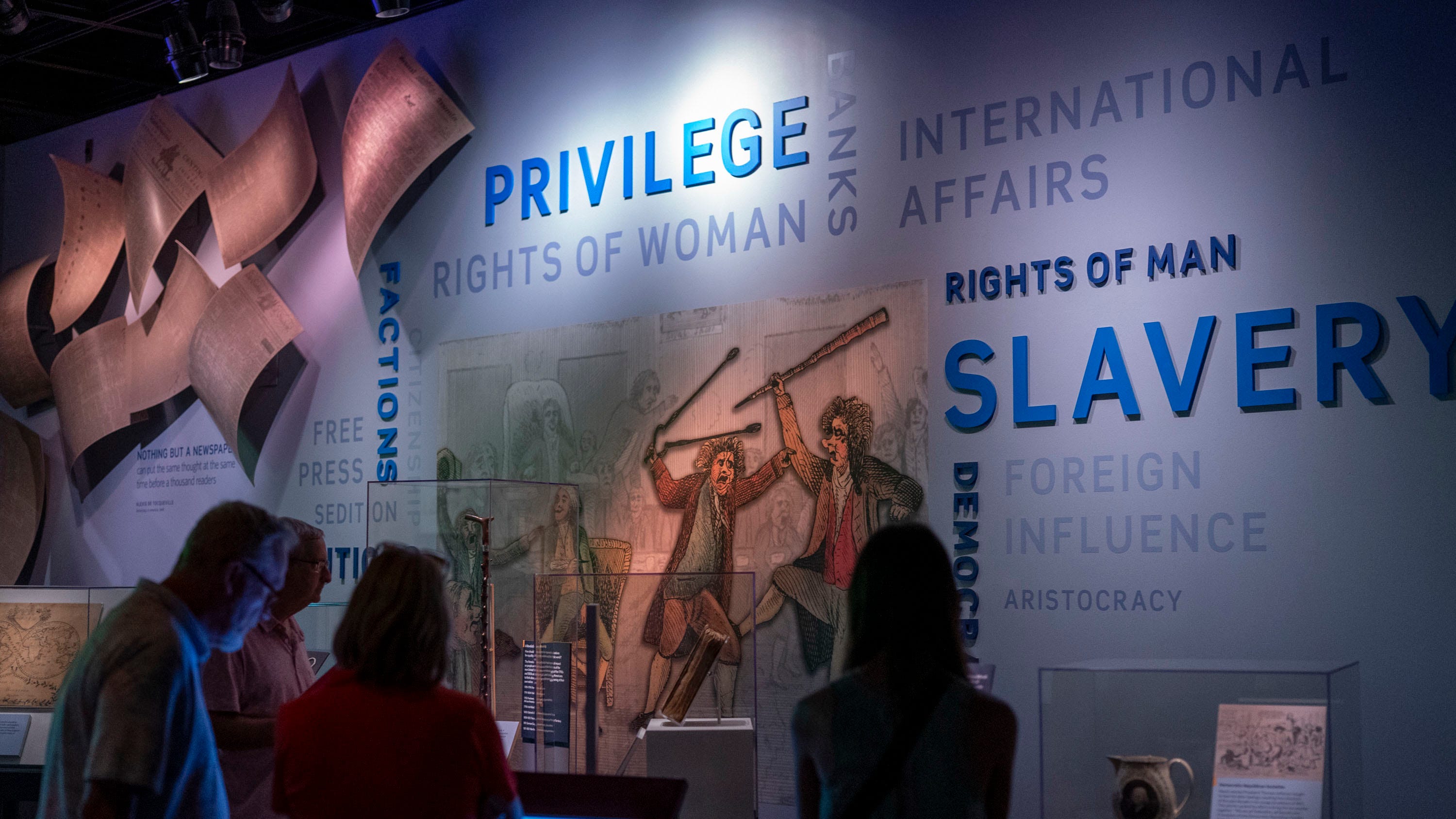
THE SMITHSONIAN IS AN IMPROBABLE INSTITUTION. Its founding traces back to James Smithson, a wealthy Englishman who never set foot in America. Only after his sole heir died childless was Smithson’s fortune bequeathed to the United States, as specified in his will, to fund an institution dedicated to the “increase and diffusion of knowledge.” In 1846, James K. Polk signed the law establishing it, but before that moment Congress and the scientific community had fiercely debated how to carry out Smithson’s vision. Even the Smithsonian’s first secretary argued against a “brick-and-mortar” museum, favoring instead a center devoted to research. The sprawling, multifaceted institution we know today was born of debate and chance.
I love the Smithsonian. It is truly public—free and open nearly every day of the year, preserving the many complex stories of our pluralistic country. I count myself deeply fortunate to have benefited from the Smithsonian’s intellectual, social, and cultural riches, as a former fellow at the Smithsonian American Art Museum, and as a researcher at the Renwick Gallery, where I had the privilege of working on the major exhibition State Fairs: Growing American Craft.
This wonderful, improbable institution faces a new challenge it must carefully confront. Last March, the Trump administration issued an executive order directing the organization to restore “Truth and Sanity to American History.” The order called for a sweeping audit targeting the Smithsonian’s exhibitions and collections strategy, governance structure, grant agreements, educational materials, public-facing content, and more. In April, the White House proposed an 11 percent cut to the Smithsonian’s federal budget along with staffing reductions. Then, on Independence Day, the White House issued a report condemning the Smithsonian’s National Museum of American History (NMAH) for purportedly abandoning an honest, unifying story of American history in favor of an ideologically driven program focused on race, gender, and immigration. The report calls on the vice president, along with the chief justice1 and speaker of the House, to help “restore the integrity” of the museum. A few weeks later, NMAH director Anthea Hartig testified before Congress.
It is easy to fixate on the particularities of the situation: the theatrics of Hartig’s congressional hearings, the public firing of a member of the Smithsonian’s leadership team, outdoor signage disclaiming “inaccurate information” at the NMAH, the heated rhetoric of politicians and museum advocates alike. But we must step back and take a broad view of the situation, one that puts the fracas at the Smithsonian within a broader, and arguably more concerning, context.
American museums are in trouble. The signs of that trouble are everywhere. Museum attendance is down, funding is increasingly competitive and scarce, and institutions are struggling to maintain their physical infrastructure. The Philadelphia Museum of Art is facing a formidable deficit, and the Art Institute of Chicago recently eliminated its entire custodial staff. For museums attached to academic institutions, the situation is especially dire. The DePaul Art Museum shuttered its doors in June in an effort to address DePaul University’s financial woes.
The American Alliance of Museums, a leading advocacy and professional organization for U.S. museums, attributes the turbulence to a set of external pressures: the impacts of the COVID-19 pandemic, shifts in philanthropy, inflation, market instability, weakened tourism, and the cancellation of grants and contracts from federal funding bodies.
Real as they may be, these broader trends do not fully account for something even more corrosive: a steady loss of social trust in our museums. This corresponds with a broader collapse of public confidence in institutions of all kinds, and although museums have, by the numbers, fared better than other types of institutions, they have earned their share of skepticism. And that skepticism does not come from conservative politicians alone. From the left, particularly in the wake of the social justice reckoning of the past decade, there have been sustained calls for museums to dismantle entrenched systems of power, decolonize collections, and repair historical trauma. Museums have responded—sometimes thoughtfully, sometimes convulsively—by publicly examining their own histories, structural biases, and donor relationships. In its more destructive manifestations, this form of institutional critique has amounted to a shift away from trusting the museumgoer to make judgments, forge connections, and discover meaning without being told what to think.
In a democratic civil society, museums belong to the public—a plural body made up of humans who see, experience, and think about the world differently from one another. That plurality is the museum’s challenge and its salvation. Today, what we need more than anything are institutions that trust that public, and a public that trusts them back. A museum in thrall to any orthodoxy, whether from the right or the left, forfeits that possibility.
BUT HOW DO WE BUILD TRUST among a divided people? By turning to the things we all share in common, despite our differences. In the context of the museum, that is the “museological object” itself—a painting, a sculpture, Dorothy’s ruby slippers, a past president’s top hat, and yes, even the diary of a young transgender person. Members of the museumgoing public will, undoubtedly, have wildly different views on the works of art and objects that we inherit from the past. But no one can deny the fact that someone made, wore, wrote, and put those objects into the world. These are human artifacts that we are left to contend with, together, in one way or another.
Neither our politicians nor our museums can ignore these physical residues of human thought and action. But neither should they be expected to agree on the appropriateness, historical relevance, aesthetic value, or meaning that these objects carry. Rather, lawmakers must refuse to censor what museums collect and exhibit, and museums must develop interpretive strategies that endow the viewer with the freedom to think for themselves. Slipping into self-righteous didacticism betrays both the public trust and the museum’s mission.
This is not a recipe for comfort. It means bringing conflicting views into conversation and leaving room for complexity, contradiction, and even irresolution. Imagine, for instance, one of the Smithsonian’s museums is preparing an exhibition on the latest in wind energy technology. The museum might develop a curatorial framework based on conversations not only with environmentalists who see wind as a pathway to a sustainable future, but also a worker in the oil and gas industry anxious about losing his job in the face of decarbonization, a biologist concerned about the impact of turbines on migratory birds, and community members fretting about disruptions to the country’s scenic landscapes as a result of the massive infrastructure required to produce wind energy at scale.
It is not up to our politicians or even the museum’s curators to deliver a “correct” story here, but rather, to honestly embrace the reality that there are many competing, and sometimes irreconcilable, ways of tackling a historical or political problem. Museums cannot ignore contemporary events and a history as it is being made. A curatorial framework that presents that history as something that has yet, and may not be, fully resolved safeguards the institution against claims of ideological capture. The museum can never wholly account for every voice in a plural society, and it must avoid the trap of overexplanation, but it can ground its work in open-ended questions and leave judgment about the possibilities and perils of renewable energy, and other contested subjects, to the museumgoing public.
Some objects are not contested historically—no one disputes what a plantation whip was for—but their display is politically fraught. These objects must be allowed to speak for themselves. This need not amount to a total eschewal of interpretive material, but instead an approach to public engagement that gives museumgoers the tools for close and careful looking. When we are invited to exercise our observational skills, we are also asked to stop and think about the world as we find it. Thoughtfulness is a path to finding meaning in and making judgments about that world.
Simple questions, presented alongside an object such as an 1850s snake whip, can be powerful. “What materials are used in the construction of this artifact from a plantation in antebellum Georgia? Why might those materials have been selected?” Through close looking, the viewer might note a smooth round metal handle designed to fit comfortably in the palm of a slave owner’s hand at one end, and a braid of stiff leather intended to lacerate human flesh on the other. Out of the contrast between the whip’s metal and worn leather parts emerges a relationship between the human subjects that once occupied opposite ends of the object. It is up to the viewer to think through the nature of that relationship. Another viewer might instead note the raised stitching that binds the leather whip together. This evidence of skilled handwork raises a different question: whose hands made this object and under what conditions was it made?
There are those, the president of the United States included, who might contend that the mere appearance of the snake whip within the Smithsonian’s collections and exhibitions is the symptom of “wokeness” and anti-patriotism, a disavowal of a collective sense of national identity and pride.
But the snake whip is our shared inheritance. Like the Declaration of Independence, with its faded, curlicued script on now-yellowed parchment, or Emanuel Leutze’s luminous, heroic oil-on-canvas Washington Crossing the Delaware, it persists into the present and therefore belongs to a past that all Americans hold in common. The collection, preservation, and display of historical objects is a core function of museums. To suppress those activities, to deny the whip, or any historical object, its place in the museum on the grounds of protecting our national self-image, is to reject a truth, and that is dangerous business, not least because it undermines history, the foundation upon which a people’s collective identity is forged.
Museums are not passive repositories. They originate images and words—wall texts, publications, graphics, photographs, films, and more. Like historical objects, these things have staying power, a kind of worldly durability. An infographic diagnosing the “aspects and assumptions of whiteness” and published by the Smithsonian’s National Museum of African American History and Culture in 2020 continues to circulate in the public realm, and stir controversy, years after the museum retracted it. Because these things last, museums must take great care in developing scholarship that they can defend and which will outlive the moment. The best place to begin is in rethinking the way curators interface with the public.
Curating is an act of judgment, one that rests on the curator’s scholarly expertise, personal taste, and even their politics. That judgment is likewise influenced by an institution’s collection strengths, audience, physical constraints, conservation limitations, donor expectations, and more. Curatorial judgment is indispensable, but it should also be shaped through structured engagement with a broad and representative body of people who see and think about the world differently from one another. Rather than concentrating authority over object selection and acquisitions among a narrow set of like-minded specialists, museums should find ways to draw the public into these decisions so that what gets collected, preserved, and written about for the edification of future generations is not determined by a self-selected few. This is not a challenge to curatorial authority, but a way of strengthening it. It is a means of informing curatorial decision-making up front rather than subjecting finished work to ex post facto referendums.
In the U.K., museums such as the National Gallery are turning to citizen assemblies as a way of bringing the public into the curatorial process. If the Smithsonian were to adopt a similar model, citizens of every political persuasion and background, selected at random, could be summoned to hear about an institutional policy, prospective exhibition, or acquisition. After being presented with a proposal, the group would decide on the facts, deliberate, and make recommendations that would inform, rather than take the place of, the discretion of museum professionals. In this paradigm, extreme political positions, which may or may not be held by members of the assembly, are balanced against the diversity and deliberative judgment of the group. The citizen assembly gives the public an opportunity to take part in shaping their democratic institutions, and the institution builds confidence and goodwill among the people it serves. A member of the public who invests their time and thought into an exhibition or collection is liable to become an advocate for the work our museums do.
In addition to foregrounding objects, creating the conditions for open-ended thinking, and exploring new approaches to public participation, museums should cultivate a work environment in which staff and board members are encouraged to speak freely and disagree respectfully. Intellectual diversity within institutions builds social trust outside them. Friction, not division, is a necessary condition of institutional and democratic life. In that spirit, museums should also build curatorial teams that prize not only disciplinary specialization and expertise, but also an openness to discovery and generosity of intellectual spirit. The best curators are fellow learners, modeling for museumgoers what it looks like to be challenged and transformed by the objects in front of them.
Finally, museums should pursue their work based on their own institutional values rather than in response to the agendas of private funders. Grant-makers nudge our arts organizations, as they do humanities research and teaching, in directions that blur the boundaries between open inquiry and activism. Museums that resist that pull are likely to find a more trusting public and, over time, more enduring support.
Just as our museums have a responsibility to the public, the public has a responsibility to our museums. Members of the public should take an active part in their museums, not only as visitors, but as participants in citizen assemblies, members, volunteers, and trustees. These are not insular institutions. They are ours to shape. Active involvement in an institution such as the Smithsonian is an act of civic patriotism, a way of living out the great democratic ideals upon which this nation was founded.
Where possible, the public must also regularly and reliably make financial donations toward the general operating expenses of our museums. That means funding unglamorous expenses such as staff salaries, utilities, and building maintenance, as opposed to—or better yet, in addition to—splashy new wings and blockbuster shows. These institutions cannot subsist without unrestricted philanthropic support.
Most importantly, members of the public should embrace the opportunity, offered by museums, to step outside themselves and enlarge their point of view. The act of looking at a landscape, a human face, or an abstract form as it has been rendered through the hands and vision of an artist, or of reading the diary of a young person with life experiences that differ from those we know, is an exercise in seeing the world through the eyes of another. When we seek out perspectives unlike our own, we strengthen our democracy. And that, I am confident, will keep museums like the Smithsonian resilient to any chance turn of history that might come its way.
By a combination of law, bylaws, and tradition, the chief justice of the United States serves as the chancellor of the Smithsonian and the chair of its governing Board of Regents, and the vice president serves as a member of that board.
 | A guest post by
|