JD Vance Is Being Set Up as the Iran Deal Fall Guy
They expect one of us in the wreckage, brother.

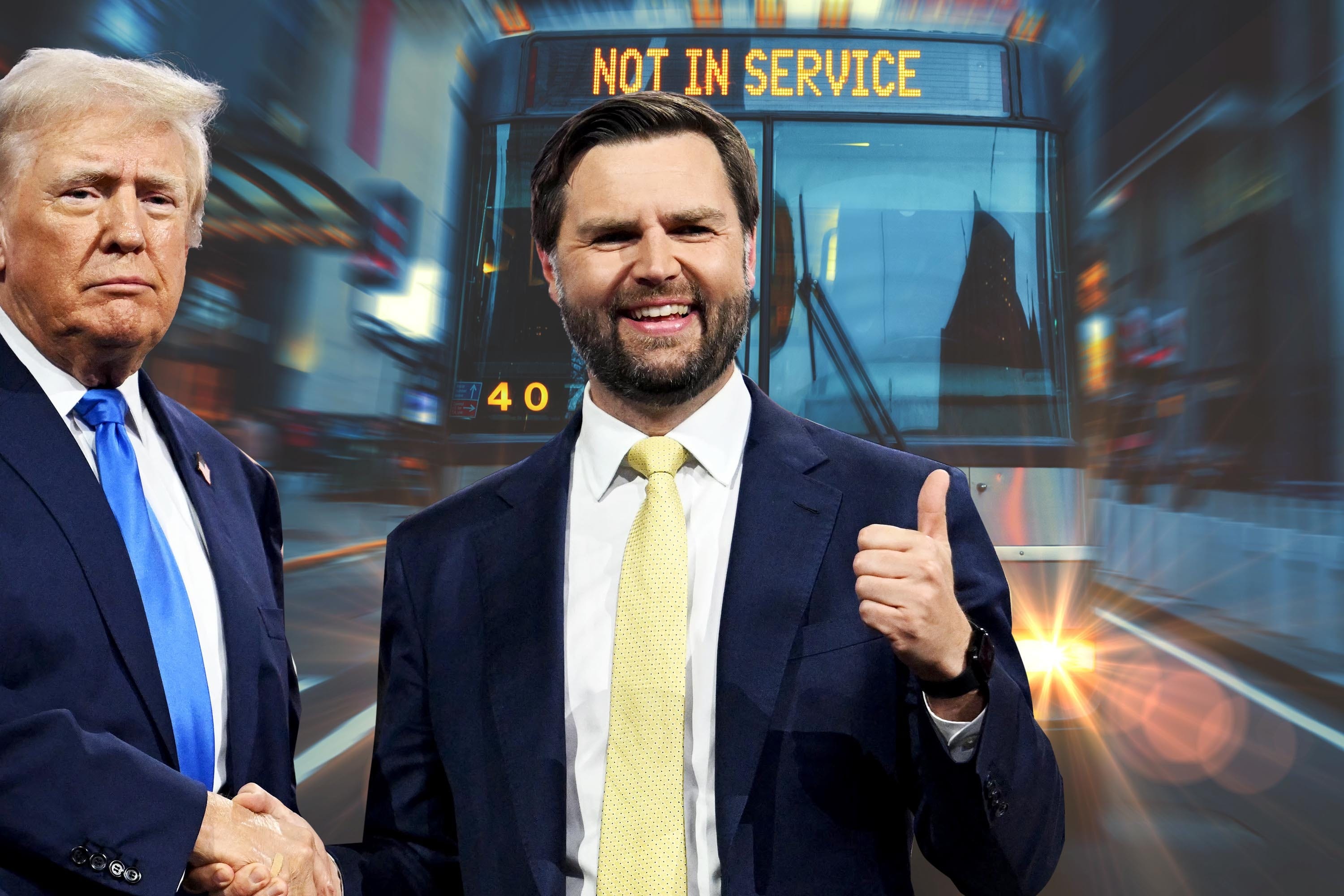
The die is cast
I would never claim to be the first person to compare Donald Trump, with his dominion over the Republican party, to Bane, the primary antagonist of Christopher Nolan’s third Batman movie, The Dark Knight Rises. (I also don’t think I’ll be the Last.) But I’ve been struck once more by the analogy in recent days.
In the opening scene of Nolan’s masterpiece, Bane grabs the shoulder of a fanatical deputy and informs him, “They expect one of us in the wreckage, brother.” The line captures something about the administration’s approach to its memorandum of understanding with Iran. It’s clear, here as it is in so many policy areas, that someone will need to sacrifice it all so that the boss can survive.
Enter JD Vance, the vice president whose stock in the party as MAGA heir apparent has plummeted in recent months.
Vance has been handed primary responsibility to sell the MOU, which is a sort of minimally binding agreement between the United States and Iran that is meant to lead to a more permanent agreement. And as details about the preliminary deal finally started to enter the public discourse late Monday morning, it became readily apparent how hard it would be for him to go unscathed.
Sen. Lindsey Graham (R-S.C.) posted some of his concerns about the deal on X, emphasizing both the need for Congress to ratify any arrangement and exactly who he believes is the “architect.”
“I look forward to reviewing the final product and I believe it is imperative that the architect of the deal, Vice President Vance and his negotiating partners, be part of the process in presenting the final deal to Congress,” Graham wrote. “Congratulations to all in getting us to this point. Time will tell.”
Later on Monday, I asked Graham if he was explicitly saying Vance was the architect of the MOU, to which he replied, “I think he is.”
Graham added that he likes the particulars of the MOU that he’s heard about, but he articulated a simple criterion for judging the final product.
“If they can enrich [uranium] anywhere at all, then it’s the same as the JCPOA,” he said. “If they can’t enrich, then that makes it a good deal.”
A bit cryptic, for sure. But that’s just one senator, right?
When a reporter asked Senate Majority Leader John Thune if he thinks the full Senate should get a briefing from Vance on the still-under-wraps MOU, he expressed noncommittal support.
“Somebody will need to, whether it’s the vice president—but for sure, our members are going to have a lot of questions about it.”
Other Republican senators offered varying takes on the ownership they believe Vance has of the MOU. Their comments ranged from propping him up as integral to the process to claiming they haven’t yet seen him address it.
“It sounds to me like for two months he’s played a significant role,” Sen. Chuck Grassley (R-Iowa) said of Vance. But Grassley withheld judgment on the MOU itself, telling me he’s still waiting to take an actual look at it.
“I haven’t seen anything JD’s said yet,” said Sen. John Kennedy (R-La.). “I’ve been on a plane today.”
Part of the job of any vice president is to eat the shit that the president himself doesn’t want to digest. And Trump, who understands how to play the public relations game better than nearly anyone, clearly is not interested in personally absorbing this deal. He’s already begun dropping Vance’s name any time the question comes up as to who is responsible for it. Asked about whether he would be present for a hypothetical signing ceremony—the most public-facing component of any deal—Trump seemed intent on getting his foremost deputy there in his stead.
“It depends. JD is coming in for it, he was originally going to do it. I will probably be gone by then, we are having dinner, in a day and a half, I think staying quite late,” Trump told reporters Monday, sounding a bit like a man explaining why he might have to miss a pickleball meet-up. “So I may be involved, I may not.”
The same day, Vance actively took up his new role as the administration’s chief spokesman for the MOU, appearing on major television networks to tout the accomplishment and bat down skepticism.
“I don’t trust anybody,” Vance told CNN. “The benefits of the bargain only accrue, again, if Iran actually complies.”
In an interview with Sean Hannity, Vance did not rule out the possibility of future uranium enrichment. Instead, he said the deal requires Iran to “eliminate the enriched stockpile.”
Responding directly to Graham’s comments expressing concerns about the differences between Iran’s account of the MOU and the administration’s claims, Vance told ABC News, “I’d caution Lindsey Graham and anybody else not to believe the hard-liner propaganda in Iran but to believe what’s actually in the agreement.”
The fact that Vance appears to be positioning himself as a potential fall guy for the nascent deal is registering with other interested parties, too. Democratic senators, who broadly support an end to the war,1 are taking note of the vice president’s outsized role in the process.
Sen. Tim Kaine (D-Va.) told me, “I heard [Lindsey Graham] say, ‘Vance needs to come up and explain it to us.’”
“So if there’s gonna be a deal, a bill that I helped write, the [Iran Nuclear Agreement Review Act of 2015], requires any such deal to get submitted to Congress for a review,” Kaine added. “And I heard Graham say that should happen, and we should get VP Vance and others to come describe it. So I don’t know what his role is, but I’m glad that we’re entering into a ceasefire that I hope we can actually get signed [on] Friday.”
This is a fraught moment for the veep. Accepting the frame that you are the main architect of a major initiative means accepting the blame if it fails. That can destroy or at least significantly hinder aspirations for higher office. Just ask Secretary of State Marco Rubio, who spent more than a decade in right-wing political rehab on account of his involvement in the “Gang of Eight” immigration reform agenda, which Trump and others happily used against him in the 2016 Republican presidential primary. Or talk to Kamala Harris, whose role as “border czar” for Joe Biden was widely misunderstood (she was tasked with dealing with the roots of migration not the physical entry points into the country) but nevertheless effectively deployed against her in 2024.
Vance, whom some reporters described in March as an original skeptic of the war against Iran, is evidently making yet another career pivot as he steps in to attempt to heroically end it. But he would do well to watch those steps. The position he’s taken might be the worst place to be in the coming weeks.
Making haste slowly
Despite not having seen any details of the Trump administration’s preliminary deal with Iran, lawmakers now have to grapple with the question of whether they should ratify it, or if they should even have to consider it at all.
The Constitution requires Congress to ratify or reject all treaties. Both the executive and legislative branches have gotten around that responsibility by characterizing various deals, which could be interpreted as treaties, instead as “non-binding instruments” or “soft law pacts” like “executive agreements.”
Discussing the prospect with Senate Republicans, I quickly got the impression that this deal—again, merely an MOU—isn’t one they consider to rise to the level of a treaty, and some take this distinction to remove the burden of the ratification requirement. Once again, there’s nothing legislators hate more than actually legislating.
“I think they’ve got an MOU right now versus a treaty,” said Sen. Steve Daines (R-Mont.). “I haven’t seen the text of the agreement, so we’ll wait and see what comes out.”
There is some intraparty disagreement over this. “We’ll have to see exactly what this is, but you would think it’d have to be ratified [by Congress],” Sen. Rick Scott (R-Fla.) told me.
Despite some waffling, though, quite a few GOP senators did imply they would want to review the nascent MOU in a formal capacity at some point in the process.
“I do think it needs to [be ratified by Congress]—a final resolution, if there is one,” said Sen. John Kennedy (R-La.). “I go into it very skeptical of the government of Iran. I’m not skeptical of the agreement because I can’t assess it. But I congratulate the president and his team for confecting it—whatever it is.”
“Any agreement we make with them has to have guardrails,” Kennedy added. “It has to have a way to judge—through independent inspection—if they’re doing what they say they’re doing.”
The confusion about whether this is a memorandum of understanding, an agreement, or an actual deal apparently didn’t get past Trump, who told reporters Tuesday morning in France that Congress should probably handle the hot turd going forward. He even wondered aloud how he could get Democrats to vote for it.
“What I would like to do is send it to Congress and say, ‘You shouldn’t approve it,’” he said. “And they will approve it.”
As for those Democrats, they no doubt want a say in whether this deal goes ahead. Sen. Kaine told me Democrats are eager to bring the war to a conclusion, even if the MOU is imperfect.
“I think on the Democratic side, we’re almost completely unified—with the exception of Senator Fetterman—that this war is both illegal and deeply foolish,” he said. “And so we want the off-ramp. . . . But we do believe that bringing tension down is the right thing for us and the right thing for the region.”
“We’ll see what the terms are when it comes out. I mean, it’s been a waste, because there was no need for a war, fourteen [American] deaths, billions of billions of dollars, we’re paying more for gas—it was extremely foolish,” Kaine added. “But I’d rather we be moving into a more protracted ceasefire than that.”
Crying havoc
I want to share a piece from 2019 with you by Tom Holland,2 in which the mega-popular historian and author argued that compounding problems in America, while bad and dramatic, simply do not meaningfully resemble the problems that led to the fall of the Roman Empire. I’d also love your thoughts on it, so please let me know your take on Holland’s essay in the comments.3
Since the garish UFC fight at the White House, I’ve seen a lot of fairly predictable tweets and commentary comparing these late-seeming days of the United States to the decline of ancient Rome. In line with Holland, I consider these comparisons a bit foolish. For starters, gladiatorial fights were a fixture during much of Rome’s expansion and great success, not a symptom of its decline.
Second, arguing for simple parallels between America and Rome will lead you into a maze of factual problems. For starters, as a matter of settled strategic doctrine, the United States does not wage wars for conquest (though let’s wait and see with Greenland); it has no formally recognized nobility; and frankly, our country is a much, much safer place for the average citizen. But stressed-out Americans love to relate our situation to the eternal city, as they have since our country’s founding.
As Holland wrote:
The conviction that Trump is single-handedly tipping the United States into a crisis worthy of the Roman Empire at its most decadent has been a staple of jeremiads ever since his election, but fretting whether it is the fate of the United States in the twenty-first century to ape Rome by subsiding into terminal decay did not begin with his presidency. A year before Trump’s election, the distinguished Harvard political scientist Joseph Nye was already glancing nervously over his shoulder at the vanished empire of the Caesars: “Rome rotted from within when people lost confidence in their culture and institutions, elites battled for control, corruption increased and the economy failed to grow adequately.” Doom-laden prophecies such as these, of decline and fall, are the somber counterpoint to the optimism of the American Dream.
And so they have always been. At various points in American history, various reasons have been advanced to explain why the United States is bound to join the Roman Empire in oblivion. In 1919, in the wake of the Russian Revolution, The New York Times warned that the Huns and the Vandals were massing again. “The Roman Empire and its civilization were destroyed by barbarian hordes coming from the East—and it is from the east that comes the wind.” Thirty years earlier, visiting the abandoned Roman city at Baalbek in Lebanon, Brooks Adams—the great-grandson of John Adams—had been inspired by the spectacle of shattered greatness to dread that his own country’s gilded age was bound to end in similar ruin. In the decades before the Civil War, opponents of slavery repeatedly cited the fall of Rome as a warning of what might happen to a slave-owning society. In the 1830s, opponents of Andrew Jackson cast him as a dictator and a demagogue whose tyranny would inevitably bring the infant republic to share in the fate of the ancient empire. Present anxieties that Trump’s presidency portends America’s decline and fall are the contemporary expression of a tradition quite as venerable as the United States itself.
In short, our problems are our own. The Romans couldn’t hold a candle to the extraordinary accomplishments of our republic. Also, we wear pants.
Read the whole piece, and if you need some more context, pick up a copy of one of Holland’s many great books on Rome, including Pax, Dynasty, and Rubicon.4
More on that later.
The historian, not the Spider-Man.
A Bulwark writer is mentioned in the piece. Include his name in your comment, or I’ll assume you didn’t actually read it!
Persian Fire, Holland’s book about the Greco-Persian Wars, is also a fantastic read. Get it as a Father’s Day present, and your pops will be hooked.
One of the funniest Bulwark subheds of 2026 😭
“I think on the Democratic side, we’re almost completely unified—with the exception of Senator Fetterman—that this war is both illegal and deeply foolish.”
Another darkly hilarious moment.