

Sometimes Stopping Extremism Means Getting Your Hands Dirty
The John Birch Society, the Anti-Defamation League, and the American tradition of infiltrating and exposing radical organizations.
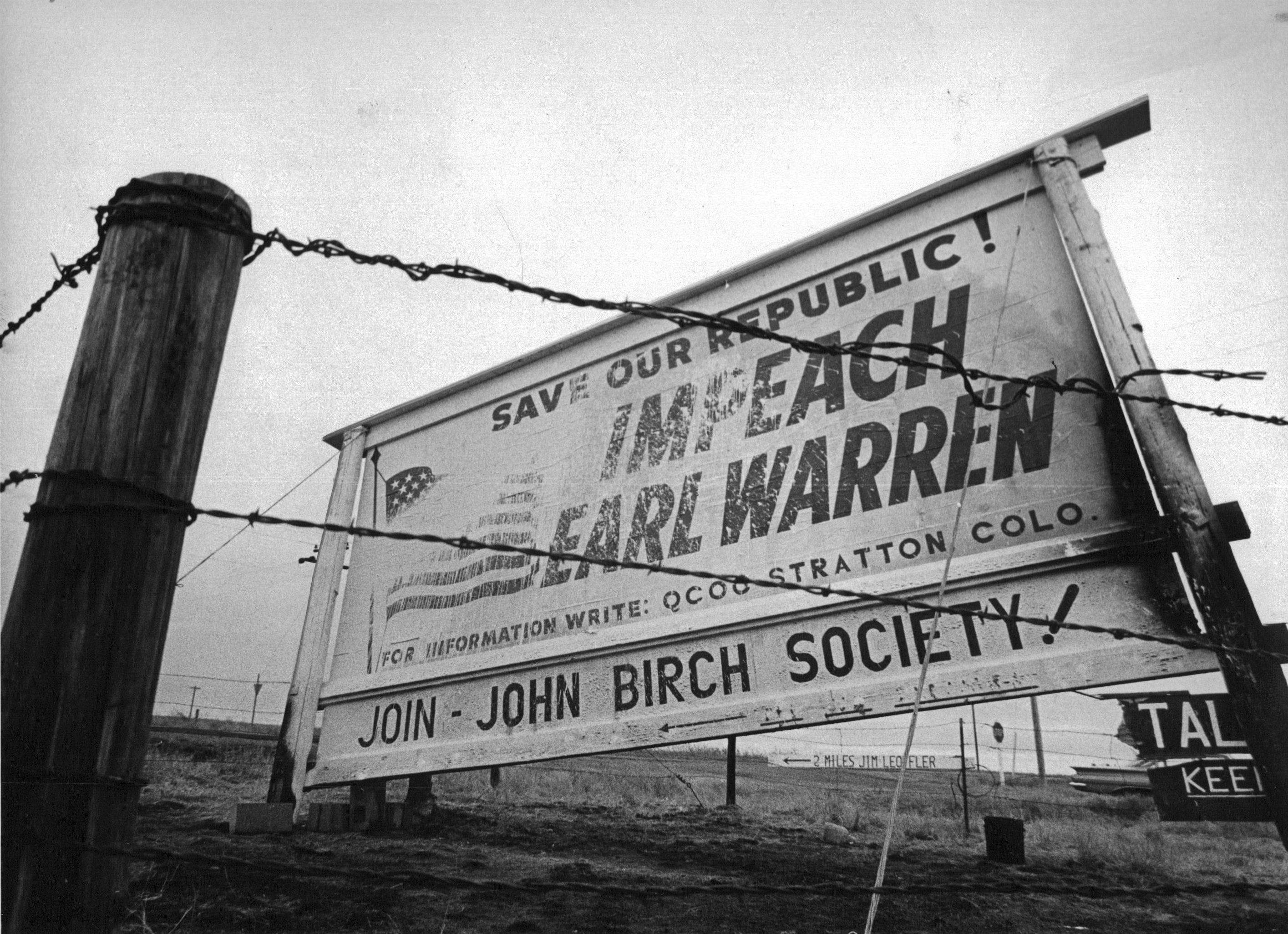
I WAS DEEP IN THE LIBRARY OF CONGRESS back in 2018, researching the John Birch Society. Sifting through the archives, I found an odd letter discussing the far-right, anti-Communist organization. One of the correspondents was Jerome Bakst, the research director for the Anti-Defamation League. Following the historian’s instinct to pursue leads, I wondered whether Bakst might have had any archival records pertaining to the society. So I sent a cold email to the ADL’s main office. Sure enough, a few days later I learned that Bakst had one box of files relating to the group stored in the ADL’s New Jersey warehouse. I was allowed to look at the box in the ADL’s New York headquarters. Inside was material hard to find elsewhere, such as lists of chapter members and donors to the society dating to 1971 and 1972. How on earth, I wondered, had Bakst come into possession of sensitive information about such a secretive organization?
I found my answer a few blocks south in a different ADL collection on the Birch Society, this time housed at the American Jewish Historical Society in the Center for Jewish History. The files were a goldmine.
They revealed that the ADL ran an extensive, multidimensional counterintelligence operation to dig up dirt on the Birchers and publicly expose the organization as hate-filled and anti-democratic. The files contained a trove of information about the Birch Society but also provided a window into the ADL’s sources and methods during that era.
To be honest, I was a little taken aback. Here was evidence that a venerable civil rights and civil liberties organization had spied, extensively, on a grassroots political movement. Some of the items were strikingly personal. The files included a codicil to a Birch donor’s will, credit checks on individuals suspected of membership, Birch members’ home addresses, chapter meetings, license-plate numbers, and more. Code-named agents posing as far-right activists had infiltrated the society, as well as white supremacist groups. Some of the ADL’s reports were sent to the FBI.
Such deceptive methods initially struck me as contrary to the ADL’s mission to advance human dignity and root out hate. However, as I learned more about the ADL’s history and delved deeper into the papers, trying to cast empathy in all directions (as a mentor once advised), I became sympathetic to the spy program. The ADL’s surreptitious activism helped keep an extremist, conspiratorial movement relegated to the margins of American politics, and it did so amid a surge of violence against civil rights protesters as the nation struggled to become a multiracial democracy.
Making sense of the ADL’s worldview, I learned that in the 1930s, American federal and local law enforcement ignored domestic Nazi threats, instead prioritizing perceived Communist threats. The former ADL executive secretary Leon Lewis had once led a spy operation that helped take down a Nazi plot to kill Americans and promote Hitler’s interests in the United States. The Nazis called him “the most dangerous Jew in Los Angeles.”
By the time of the John Birch Society’s founding in 1958, J. Edgar Hoover’s FBI devoted more of its resources to combating alleged left-wing domestic threats. Hoover, his biographer observed, “never investigated the burgeoning New Right with the same fervor he applied to the left.” The ADL opted to enter this breach.
Birchers combined mainstream associations with beliefs widely seen as fringe. Many regarded the growth of government in the first half of the twentieth century, American participation in both world wars, and the unrelenting expansion of welfare programs as steps toward living under Communist rule. Their plan was to teach the masses about the internal Communist threat to the United States. Its founder, Robert Welch, infamously labeled Dwight Eisenhower a Communist agent. By the mid-1960s, the group had recruited some 60,000 to 100,000 upwardly mobile, white, Christian, often suburban men and women to join local twenty-person chapters in their communities.
During the 1960s, Birch leaders denied that prejudice had any part in their movement. The society’s public relations director, Tom Davis, fumed that charges of antisemitism were “the worst kind of defamation.”
The ADL leadership viewed such denials with skepticism. The Holocaust burned freshly in their minds, and they’d had brushes with Nazism. In 1934, Benjamin Epstein, the future ADL national director, witnessed firsthand how the Nazis seized power while he studied history in Berlin. Four years later, Arnold Forster, the future ADL general counsel, recruited pro bono lawyers to help the ADL combat Nazi plots against America. In 1941, the ADL’s future director of fact-finding and public relations in New England, Isadore Zack, became a counterespionage expert for the U.S. Army; during the war, Zack led a team of undercover operatives on a hunt for fascist spies in the northeastern United States.
After World War II, the ADL’s leaders made it their mission to expose what they considered “a vast enterprise” of hate operating in the United States. As National Chairman Meier Steinbrink urged, they needed “ammunition for the war to make our land a more perfect democracy.” The ADL was probably the first of a number of organizations to track the Birchers, and its anti-Birch campaign was ultimately the most effective of them all.
Zack, the counterespionage expert and a regional head of the ADL’s fact-finding program, took an extremely proactive approach to his job. Zack’s agents set out on missions to find any shred of evidence of totalitarianism on the part of Birchers. Some of the scariest or most unflattering bits ended up in the press. The ADL’s campaign unearthed numerous examples of Birchers’ antisemitism, racism, and even admiration for Nazis. One ADL spy infiltrated a front group for the Birchers in Connecticut and reported that he overheard Birchers singing the praises of Adolf Hitler. The ADL’s Pennsylvania director discovered that a Bircher named John Noble was giving speeches to Birch audiences featuring a conspiracy theory that bones found at Buchenwald came from American soldiers killed by Communists and not from Jewish victims of Nazi death camps. The ADL reportedly apprised the FBI that Noble was “inciting racial turmoil.”
The ADL also exposed antisemitism among the upper echelons of the Birch movement. It revealed how Birch cofounder and palindromic classics professor Revilo Oliver was giving talks to hundreds of Birchers about what he termed a “conspiracy of the Jews.” Among other claims, Oliver alleged Israel had exported LSD to sow chaos on American college campuses.
ADL spying also uncovered the apocalyptic edge to some John Birch Society members’ rhetoric and the violent chatter some used in private meetings, at rallies, and in speeches targeting minority groups. Two agents codenamed “Ben Brith” (a play on B’Nai B’rith, the ADL’s parent organization until 2009) were troubled by what they described as “John Birch Society involvement in the purchase of weapons and infiltration of gun clubs.” Another ADL monitor reported that when civil rights picketers showed up at a pro-Birch rally attended by thousands of people, the crowd’s mood turned “sour and ugly.” The agent quoted one attendee saying: “Give me a machine gun and I’ll mow those bastards down.”
The ADL understood how Birchers’ conspiracy theories evoked longstanding antisemitic canards—that sinister forces (read: Jews) controlled the money supply, the news media, and the global order. They documented how explicit white supremacists saw the society as an ally and linked arms with Birchers to promote massive resistance to civil rights programs.
The ADL chronicled much of these covert findings in its newsletters, press releases, and books. Its “Birch Watcher” program even applied economic pressure on some people affiliated with the society. For instance, the ADL warned a major Los Angeles menswear retailer that they would do whatever they could to publicly expose and criticize his antisemitic views.
THE ADL WAS NOT THE ONLY ORGANIZATION keeping tabs on the society. It was part of an informal anti-extremist coalition in the 1960s that included the Kennedy and Johnson White Houses, the NAACP, the union-backed Group Research Inc., and other individuals and organizations tracking the far right. But the ADL stood at the apex of this coalition, and it probably did more than any organization to expose the society’s dark side to the world.
The ADL’s charges were accurate. No smear campaign, this was an exposé. The covert program ginned up negative press and made the society toxic in the eyes of most Americans. The exposure neutered the ability of violent, conspiratorial, white-supremacist elements associated with the society to win elective office or dominate either the Democratic or the Republican party. And the ADL’s campaign forced Birchers to spend time, energy, and resources fending off charges of extremism or bigotry. The incessant public conversation about Birchers as a hate-filled group generated the impression that the organization must be tainted and ought to be shunned.
In this twilight struggle for American democracy, the ADL’s program triumphed. By the 1970s, the John Birch Society had become a shadow of the growing, energetic group it had been at its peak in the mid-1960s. Its ideas would live on, but the organization shriveled. It had money woes. It lost members. And more and more violent, bigoted individuals were lured to its ranks, sowing internal strife. The ADL’s campaign to expose the society’s hostility to democracy, tolerance, and pluralism had played an underrecognized part in the dismantlement.
At its fiftieth anniversary, President John F. Kennedy praised the Anti-Defamation League for its “distinguished contribution to the enrichment of America’s democratic legacy” and its “tireless pursuit of equality of treatment for all Americans.” The ADL believed, with justification, that Jewish Americans and other religious and racial minorities could thrive only in a democracy.
TODAY, LIBERALS AGREE THAT this system is unraveling. On his first day of his second term, President Donald Trump pardoned more than a thousand rioters who had stormed the Capitol in order to overturn the 2020 election. His administration has pointedly argued that the radical left is the only true homegrown threat despite significant evidence to the contrary. The Justice Department recently filed criminal charges against the Southern Poverty Law Center for allegedly committing financial crimes while running a historic program of informants inside extremist organizations.
To read the classic spy novels of the Cold War era is to see how murky compromises made in that wilderness of mirrors leave all involved grubby and jeopardized. Yet, I have come to see the ADL’s spy operation to counter far-right extremism as an example of how such seemingly deceitful activities can strike a blow for democracy. Nonviolent civic groups and individuals that shine a bright, truthful light on extremism have helped build a culture in which reasoned debate, racial and religious tolerance, and free and fair elections can combat conspiracy theories, misinformation, and the hate swirling through American life.
Surreptitious and, at times, underhanded, the ADL’s spy campaign against the John Birch Society was a triumph for liberal democracy, not to mention decency and civility, because it exposed the Birchers’ delusions and bigotries to public scrutiny. Sometimes, worthy ends justify unsavory means.
Matthew Dallek is a historian and professor at George Washington University’s Graduate School of Political Management. His most recent book is Birchers: How the John Birch Society Radicalized the American Right.