John Roberts Gives Trump a License to Bulldoze the Law
The chief justice’s order turns the president’s illegal ballroom construction project into a fait accompli.

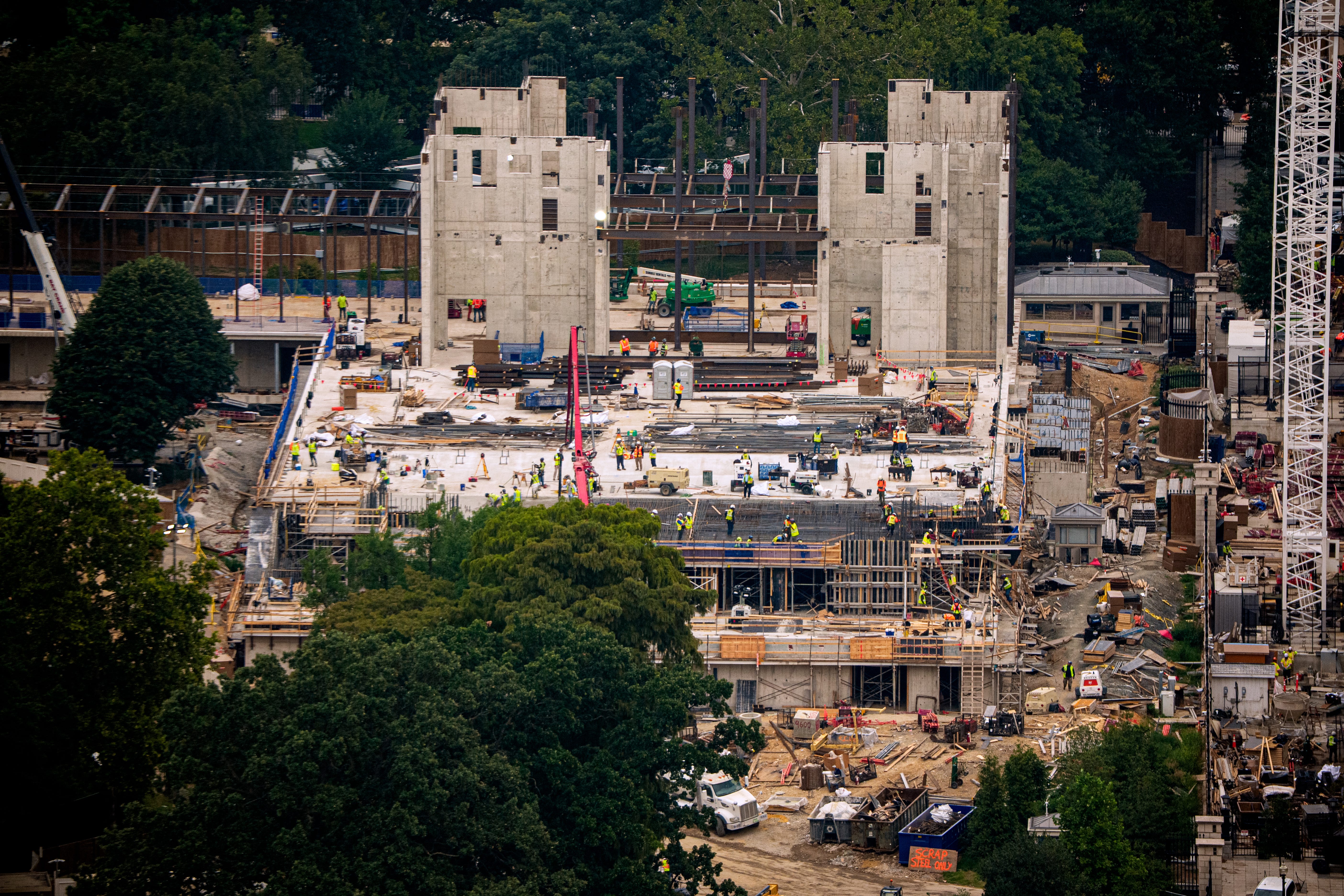
CHIEF JUSTICE JOHN ROBERTS on Friday handed Donald Trump a temporary stay of a lower federal court’s injunction halting construction of his White House ballroom and underground bunker until he seeks congressional approval, as the law requires. The injunction had allowed Trump to proceed with work on the bunker on the dubious claim that it’s vital to national security. As for the rest, all the lower court did was push the pause button to enable Congress to weigh in. The judge had no other choice, which is why the U.S. Court of Appeals for the D.C. Circuit affirmed the ruling but gave Trump fourteen days to ask the Supreme Court to intervene. Trump got what he wanted: the high court let him override the law with impunity once again.
If this sounds hyperbolic, consider what Roberts was dealing with when he penned his one-liner. The Supreme Court has no legal power to suspend or revise the operation of the Constitution or statutory law. The Constitution’s Property Clause (Article IV, Section 3, Clause 2) gives Congress the complete power to manage, regulate, and sell all land and property belonging to the United States. “In 1912,” as the appeals court explained, “Congress placed a statutory exclamation point on its exclusive powers by providing that ‘there shall not be erected on any reservation, park, or public grounds[] of the United States within the District of Columbia, any building or structure without express authority of Congress.’” The key words here are “shall,” “not” and “without”—there is no wiggle room for presidents to override or outmaneuver Congress when it comes to federal property. Trump’s lawyers didn’t even bother to argue to the lower courts that there is.
Instead, they seized on statutory language from 1978 that states: “There are authorized to be appropriated each fiscal year to the President such sums as may be necessary for . . . the care, maintenance, repair, alteration, refurnishing, improvement, air-conditioning, heating, and lighting (including electric power and fixtures) of the Executive Residence at the White House,” and those funds “may be expended as the President may determine.” In reality, all that statute says is that Congress can appropriate money for upkeep and the president can spend it. It does not say that the president can do whatever the heck he wants to the place. The power to manage federal property begins and ends with Congress. But Trump’s lawyers ballooned that statute into a capacious grant of absolute power to demolish chunks of the building.
All along, all that Trump had to do was go to his friendly majorities in both chambers to greenlight this vanity project. This he refused to do, betting that he could run out the clock on the courts and literally bulldoze through any legal barrier until it’s basically a “fait accompli.” That’s precisely the argument Solicitor General John Sauer is making now. John Roberts apparently bought it.
Ballroom aside, what Roberts did is astonishingly destructive to the rule of law and democracy itself, for several reasons. For starters, it ignores the Property Clause. It also ignores binding statutory law. Maybe he would have addressed these insurmountable legal barriers in a full opinion. But that’s not what this is. Roberts also thumbed his nose at his colleagues in the lower courts, throwing shade on their relative authority to hold government officials to account, and thereby suggesting that the Supreme Court has arbitrary veto power—not only over them, but over the law that they duly applied.
Never mind that the Supreme Court is not democratically elected and has no authority to amend the Constitution. That requires supermajorities in both houses and the support of three quarters of the state legislatures. It can strike down statutes if they are unconstitutional, but it has no power to simply dispense with them in a one-line order. The very concept of judicial supremacy to interpret the Constitution is a twentieth-century invention of the Court’s own making. There’s nothing in the Constitution that makes the Supreme Court the sovereign monarch of everyone and everything in America. We’ve just grown to tolerate it because, so far, it hasn’t been abjectly abused. Those days are (tragically) over.
Commentators inclined to be more sympathetic to the chief justice might point out that the Court did the same thing on tariffs—stayed a lower court injunction temporarily, only to ultimately side with Congress’s power. That ruling and the birthright citizenship case are widely cited as evidence that the Court is holding the president accountable. But neither of those cases required any actual judicial decision-making. Like this one, they were easily resolvable under the plain language of the Constitution itself. Trump was just flouting the law. By even entertaining his bogus arguments, the Court was doing damage to our constitutional system.
The administration’s talking point regarding the ballroom/bunker situation seems to be that it would be too much to tear down the ballroom at this point, so what’s a court to do? Sauer told the Supreme Court on August 13 that there was “a 250-person crew working 20 hours a day, 7 days a week to keep the Project ahead of schedule and under budget.” This is a specious argument. To quote U.S. District Judge Richard Leon, who had to issue a second injunction essentially telling Trump that the first one isn’t optional, “Please!” A fait accompli “cannot excuse the Government’s failure to follow the law and then insulate those failures from judicial review.”
Roberts’s “temporary” stay could be overruled by a 5–4 majority in due course. But unlike in the tariff case, Roberts’s action all but ensures that Trump will declare the case over once the ballroom is finished.
A stay is supposed to be a rare occurrence. The applicant is supposed to show that they will likely win under the law and suffer irreparable harm if the stay is denied. Roberts didn’t bother to walk through that standard, but that should hardly be a surprise by now. A reckoning is overdue—not just for Trump and his cronies, but for the justices who continue to shamelessly condone his lawlessness.
 | A guest post by
|
"A reckoning is overdue—not just for Trump and his cronies, but for the justices who continue to shamelessly condone his lawlessness."
Absolutely! And the first step toward such a reckoning next January should be the impeachment of John Roberts. Even without conviction by the Senate, impeachment could clearly present the case for the expansion of the Court, to follow as soon as possible. Extreme times require extreme measures...
Essentially, the Roberts Court (in the person of Roberts himself) has now said that any injunction by the lower courts can be stayed sine die. Thus, it is never necessary for the Court to decide in Trump's favour, but merely to take the entire judicial system out of gear. This is as preposterous as it is craven.