July Fourth Is Different in Uniform
What I learned about this country by serving it overseas.

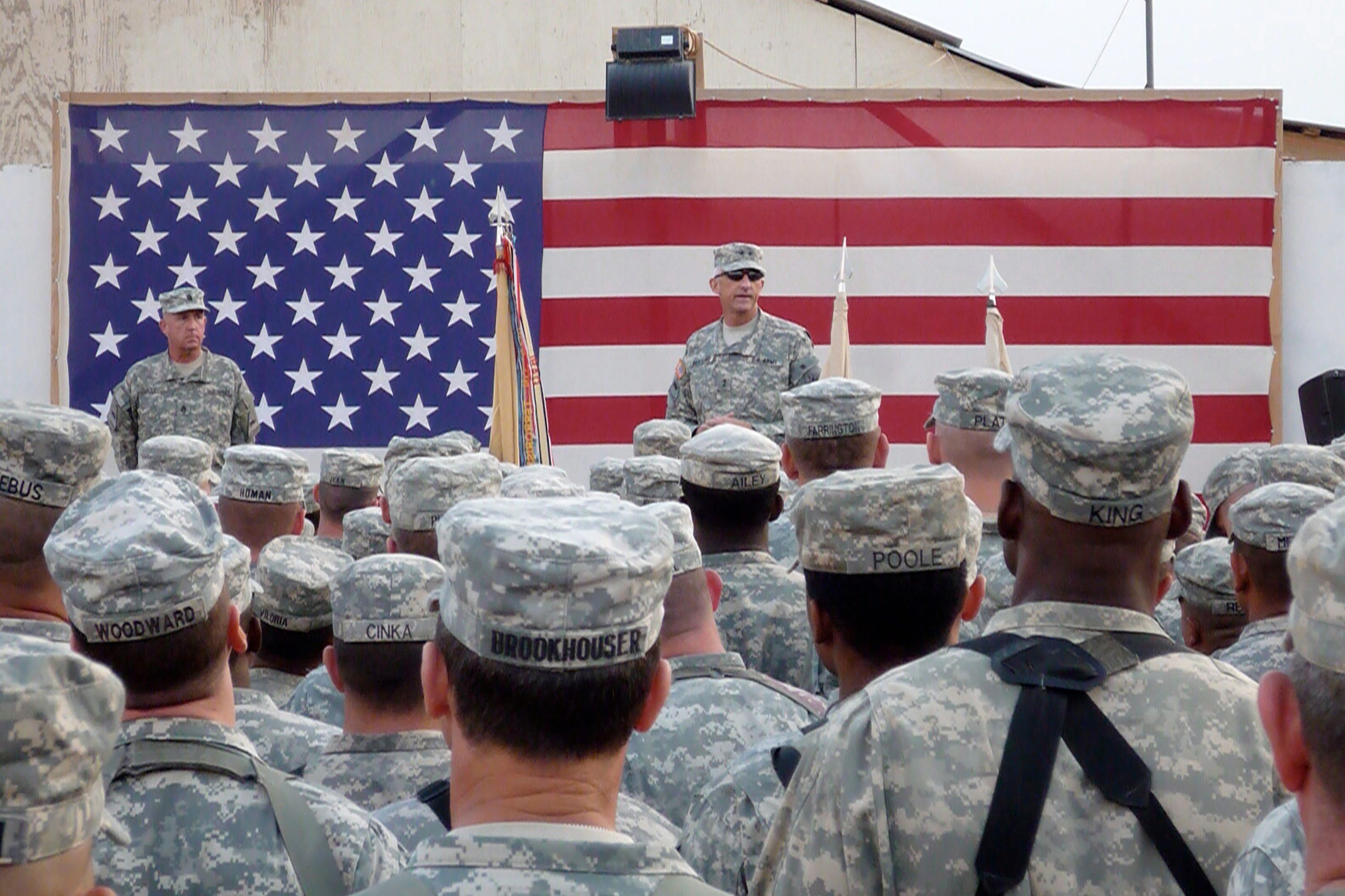
THE FIRST JULY FOURTH I SPENT IN UNIFORM was also the one when I began to understand the significance of the day.
On July 1, 1971, I reported to West Point as an 18-year-old fresh out of high school. Like every member of our class, I had been thrust into “Beast Barracks,” the term used to describe new cadet basic training, where civilian habits disappeared during the eight weeks of before the start of the grinding academic year in September. We woke before dawn, marched everywhere we went, and learned to salute, fire our rifles, make hospital corners on our beds, and survive the harassment and constant corrections issued by cadets in the classes ahead of us. Every day seemed longer than the last.
Somewhere in those first seventy-two hours, many of us shared the same hopeful thought: Surely they’ll give us July Fourth off. After all, this was the United States Military Academy. If any place celebrated Independence Day, surely it would be here.
Nope.
The bugle still sounded at sunrise on our fourth day as cadets. The training schedule and the heat of upstate New York were no less demanding because it happened to be America’s birthday. Only later that evening, immediately after dinner, did the day become something altogether different when we marched to Trophy Point, a monument overlooking the bend in the Hudson River from which the academy gets its name. As dusk settled over the Highlands, the West Point Band began a military music concert, finishing with Tchaikovsky’s 1812 Overture. I had never heard the entire piece before and was surprised when live cannons accompanied the music so effectively. The artillery fire thundered from the bluff, the echoes rolling through the valley, bouncing from ridge to ridge, then disappearing into the distance.
This July Fourth, help us build a community dedicated to the kind of patriotism that goes beyond flag-waving and song-singing to making the country better. Join Bulwark+ for 14 percent off for a limited time.
At 18, I thought all this was simply part of a spectacular concert. But there was a deeper meaning.
Nearly two centuries before, Gen. George Washington understood that whoever controlled the Hudson River controlled the fate of the Revolution. The steep bluffs surrounding West Point became one of the Continental Army’s strongest fortifications. Across the Hudson stretched the Great Chain—a massive iron barrier designed to stop British warships from dividing the colonies in two. The redoubts overlooking the water held cannon whose purpose was not ceremony but defense against British ships.
I’m not sure I realized it then, but thinking back on that memory, I see now that my appreciation of July Fourth changed during that event. It’s one thing to celebrate the country, its achievements and freedoms, its people and natural splendor. It’s another thing to defend the country, to protect it, to wear its cloth and join the generations of Americans who have fought not only for the people and the land, but for the freedoms and achievements. For an idea: “We hold these truths to be self-evident, that all men are created equal, that they are endowed by their Creator with certain unalienable rights, that among these are Life, Liberty and the pursuit of Happiness.” That’s why the country exists. If not for that idea, we’d all still be British.
The next idea is why this country has an army: “That to secure these rights, Governments are instituted among Men, deriving their just powers from the consent of the governed.” In a democracy, the military exists not to preserve rulers, and certainly not to defend political parties or to protect personalities, but to defend the rights of a free people.
IN 1976, I CELEBRATED AMERICA’S Bicentennial as a brand-new second lieutenant stationed in Schweinfurt, West Germany. It was my first Independence Day overseas, and the contrast with West Point could not have been greater.
Only thirty-one years had passed since World War II had ended in Europe. The bombed cities had largely been rebuilt, but reminders of the war remained everywhere—in architecture, in conversations, in the memories of German families who had lived through dictatorship, destruction, and division. West Germany had become one of America’s closest allies, helped in no small measure by our example, the Marshall Plan, and by a generation of Germans determined to build something entirely different from what had come before.
More than 300,000 American soldiers were stationed across Europe then, forming the backbone of NATO’s defense against the Soviet Union. We lived in German communities, shopped in German stores, attended German festivals, and raised children alongside German neighbors. The partnership had become something remarkable. Former enemies had become trusted friends. In 1976, we all watched as they celebrated America’s 200th birthday along with us.
Across Army installations, parades, concerts, open houses, baseball games, cookouts, and fireworks drew not only American families but thousands of German guests—like a mirror image of the parade scene from Ferris Bueller’s Day Off. The bases became gathering places, symbols not simply of military strength but of democratic partnership. Nowhere was that symbolism more profound than in Germany’s capital. There, American soldiers celebrated Independence Day within sight of the Berlin Wall.
The Declaration’s promise of liberty echoed across half a city—and in the other half it reverberated quietly in people’s hearts. The Fourth of July was more than an American holiday. It had become a demonstration that democratic nations stand together—that liberty, once secured, is worth defending even beyond one’s own borders.
YEARS LATER, I FOUND MYSELF again celebrating July Fourth overseas, this time on the Korean Peninsula. Although I was commanding a brigade at Fort Lewis, many of our leaders spent portions of June and July 1998 supporting exercises in South Korea. There, too, America’s birthday carried a different meaning. Only thirty miles separated one of the world’s most vibrant democracies from one of its most repressive dictatorships. Freedom was not an abstract political theory on the peninsula.
The July Fourth celebrations reflected that partnership. South Korean citizens joined American families. Traditional martial arts demonstrations shared the stage with American music. We shared cuisines—burgers and bulgogi, coleslaw and kimchi. The holiday became less about nationality and more about shared values. We celebrated not because Korea had become America, but because both nations had chosen liberty over tyranny.
In 2004, after returning from Iraq, I commanded the U.S. Army’s training center in Grafenwoehr, Germany. One photo from that July Fourth still makes me smile. I am standing over a keg of German beer, wearing a shirt the town mayor gave to me. Around me are American soldiers, their spouses, and German families. Many of our German friends had arrived dressed as cowboys, while others came portraying famous Americans at what they termed our “Independence Fest.” They insisted that I tap the ceremonial beer keg to begin the celebration—a wonderfully Bavarian contribution to America’s birthday. I hit the spike too hard, and beer covered all the participants, resulting in uproarious laughter.
That scene would have been unimaginable in 1945. They celebrated Independence Day with us, and we celebrated Fasching (the German-speaking world’s version of Carnival) with them. German children looked forward to American ice cream just as American children eagerly anticipated German Christmas markets and village festivals. Military alliances are often measured by treaties, troop numbers, and defense budgets, but they are sustained by moments like those. Trust, like freedom, grows through relationships.
Four years after that, I spent July Fourth in Tikrit, Iraq. There were no fireworks displays planned for us, but Al-Qaeda in Iraq provided us with their contribution. Combat has little regard for holidays.
Yet even there, the Fourth remained meaningful. South of us, in Baghdad, more than a thousand service members stood together beneath the rotunda of Saddam Hussein’s former palace and raised their right hands to re-enlist. They were not celebrating war. They were renewing a commitment to something much bigger than the conflict around them. The closing words of the Declaration came to mind: “We mutually pledge to each other our Lives, our Fortunes and our sacred Honor.” For soldiers, those words carry weight.
Every Independence Day taught me something different. I learned that service requires sacrifice, but also rewards it. I learned that America’s ideals can inspire former enemies to become lifelong allies. I learned that liberty is often best understood by those who live closest to its absence. I learned that friendship between nations is built one shared gesture at a time. I learned that even in war, soldiers are ultimately defending peace.
PERHAPS ANOTHER GREAT LESSON through the years came not from soldiers, but from our military families.
Every July Fourth, thousands of spouses hang flags outside government quarters in countries far from home. Children learned to celebrate America’s birthday in Germany, Korea, Japan, Italy, Iraq, and hundreds of other places around the globe. They attend community picnics with allies and partners, introducing them to hot dogs and fireworks over foreign skies. They feel acutely that those they love are dutifully standing guard while the rest of America celebrates.
Those families serve in ways the nation rarely sees, yet they may understand the Declaration just as deeply as those who wear the uniform. Every generation inherits those words in that precious document we celebrate on Independence Day, and every generation decides anew what they mean.
This year, as America marks its 250th birthday, I think back to the echoes of those cannon rolling across the Hudson River. They sounded magnificent to an exhausted 18-year-old cadet. Today, they sound like a reminder.
The men who signed the Declaration did not know whether they would succeed. They did not know whether they would survive. They knew only that liberty required courage, sacrifice, perseverance, civility, and faith in one another. They pledged their lives, their fortunes, and their sacred honor—hoping not only that future generations would be able to celebrate the anniversary of independence, but that they would remain worthy of it.
What makes Independence Day different to those who wear the uniform is not that those who serve love America more than anyone else. It’s that they spend much of their lives seeing just how extraordinary—and how fragile—freedom can be. And they have watched people around the world—from Berlin to Seoul, Grafenwoehr to Tikrit, on every continent and in hundreds of languages—recognize in the Declaration of Independence something worth celebrating alongside us.
Happy Fourth of July sir, and thank you for all you have done for our country.
thank you for this uplifting account.