The Man Who Wouldn’t Give Up on Liberty
One revolution made Lafayette a hero. Another nearly destroyed him. The story of America’s favorite Frenchman.

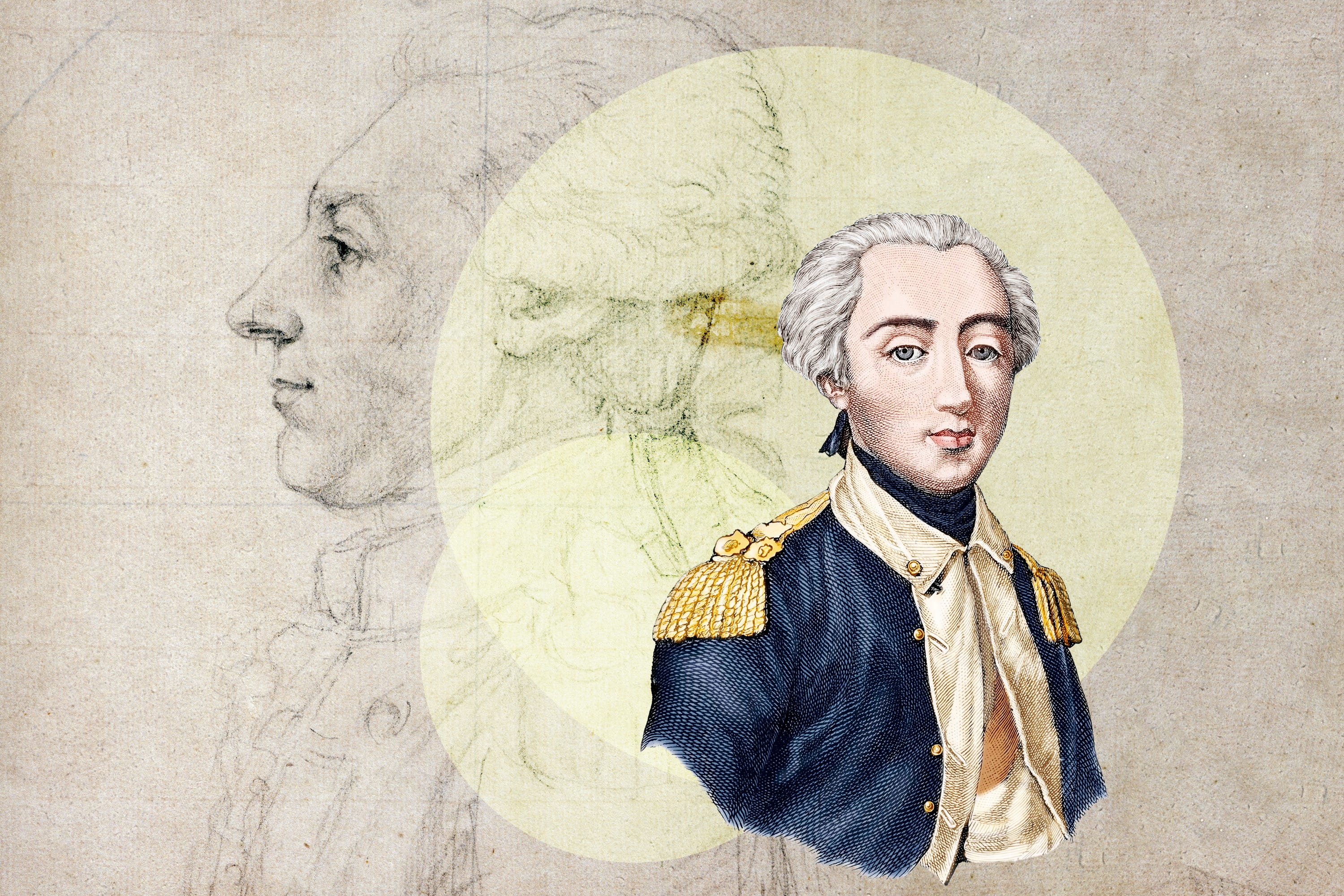
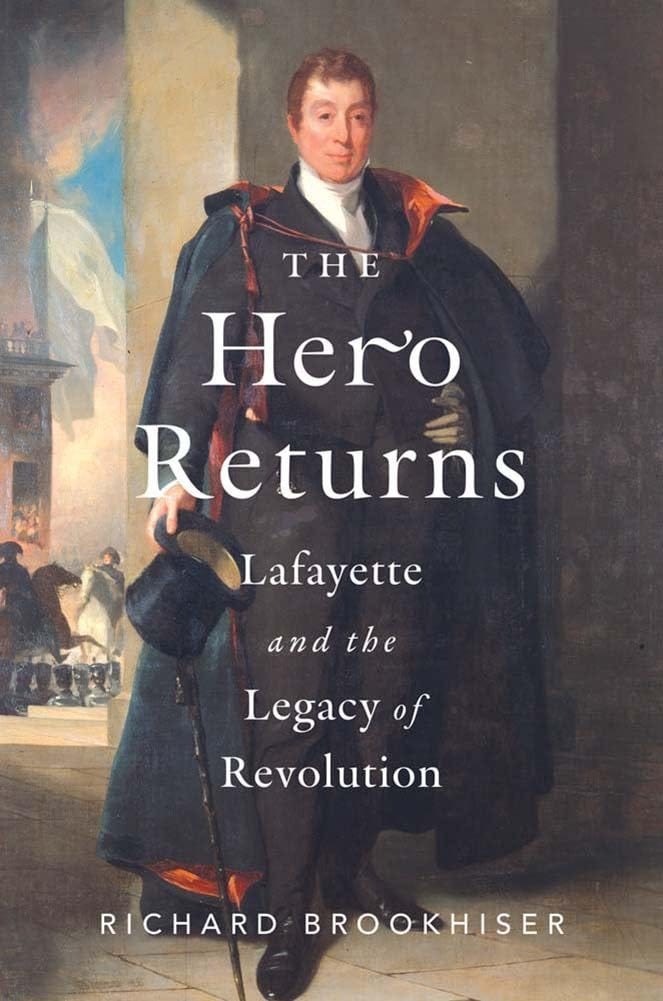
JUST IN TIME FOR THE FOURTH OF JULY semiquincentennial, a fine new book celebrates one of the American Revolution’s most unlikely heroes: a French aristocrat who, almost by accident, ended up fighting in George Washington’s Continental Army. The Hero Returns: Lafayette and the Legacy of Revolution by Richard Brookhiser, a senior editor at National Review and the author of several books on revolutionary history, focuses primarily on the Marquis de Lafayette’s 1824–25 farewell tour of the United States. We’ll return to the book, and the tour, later on. But this is also a good time to visit the larger story of the man who was once known as “the hero of two worlds”—and who was the hero of three revolutions (one of which almost devoured him along with many of its other children). Living in an era of seismic political shifts and social upheavals, Lafayette accomplished remarkable things and made tragic mistakes; but for his entire adult life he remained a staunch champion of liberty and human rights. Such a life is worthy of honoring and learning from at any time—but perhaps especially now, at a moment when many believe liberal democracy is in eclipse.
MARIE-JOSEPH PAUL YVES ROCH GILBERT DU MOTIER, Marquis de La Fayette was descended from one of the most ancient noble families in France, its lineage traceable back to the year 1000; an ancestor by the same name had fought at Joan of Arc’s side in the fifteenth century. Born in 1757, Gilbert inherited the title of marquis at the age of 2 when his father was killed in battle; by the time he was brought to Paris as an 11-year-old after a childhood on his grandmother’s estate, the deaths of several relatives whose legacies were added to the fairly modest La Fayette fortune made him one of the richest people in France.
Liberal sympathies were common among Enlightenment-era French nobility; but Lafayette, even as a child, had an uncommonly rebellious streak. In the engaging 2021 biography Hero of Two Worlds: The Marquis de Lafayette in the Age of Revolution, history podcaster and author Mike Duncan notes that, as a student at the Collège du Plessis, young Lafayette chose the Gallic warrior Vercingetorix—a leader of resistance to Roman conquest—as his hero from antiquity instead of more conventional Romans like Cato and Brutus. Assigned to describe the perfect horse, he penned a vignette in which the horse threw off its rider. In the same defiant spirit, he would, a few years later, add the motto Cur non—“Why not?”— to his family coat of arms.
Teenage Lafayette was also something of a misfit in the high society of Paris and Versailles where verbal agility and social graces mattered most: many saw him as a dull and clumsy country boy. His rebellious temperament got in the way as well; a snarky comment to the Comte de Provence (King Louis XVI’s younger brother and future King Louis XVIII) at a masked ball tanked his chances for a courtier’s career, especially after the young marquis stubbornly refused to smooth things over by claiming that he didn’t know it was Provence under the mask.
Even so, Lafayette seemed destined for a conventionally successful life—particularly after he was married at 16 to 14-year-old Adrienne d’Ayen de Noailles and became a de facto adopted son to her powerful family. (The Noailles were a progressive lot: The kids were allowed to get to know and like each other before being told they were engaged, and the Lafayettes’ arranged marriage turned out to be a genuine romance.) He got a captain’s post in a regiment owned by the Noailles family—standard practice under the ancien régime—and was to start active duty once he turned 18. But fate intervened: the new minister of war, the Comte de Saint-Germain, wanted to professionalize the military by weeding out useless officers who owed their posts to social rank and connections, and Lafayette—who appeared to fit that profile despite being quite serious about military service—got shuffled to the reserves.
Saint-German’s reforms proved short-lived because of backlash from the officer corps; but the setback they delivered to Lafayette may have put him on the path to glory. The following year, in 1776, he learned that a visiting American merchant, Silas Deane, was on a secret mission to secure French assistance for the colonies’ rebellion and maybe even recruit French officers to fight. The rest was history.
The story of 19-year-old Lafayette’s trip to America reads like a thriller with a dollop of comedy. Anxious to avoid open hostilities with Britain, the French government forbade officers to fight on the American side. With stories going about that Lafayette was planning to embark on an American adventure (on his own newly purchased ship, christened La Victoire), King Louis XVI issued an order threatening imprisonment for any officers who defied the ban and explicitly singling out the marquis. Our hero was about to give up, let La Victoire sail to America without him, and comply with his father-in-law’s stern orders to join him on a trip to Italy—until another aristocratic French enthusiast for the American cause assured him that the royal order was just for plausible deniability. In a last-minute reversal, on April 20, 1777 Lafayette rejoined his ship in the small Spanish port where it was waiting for him just in case and went off to America. Adrienne, pregnant with their second child, was informed of his departure as a fait accompli, though Gilbert’s letters did express contrition and anguish at leaving her.
There were other French officers on board, mainly interested in fighting the British, settling scores from the Seven Year War, and sticking it to a geopolitical foe. Lafayette, whose father had died in that war fighting British troops, was not exactly indifferent to those things; but he was also genuinely passionate about fighting for liberty. He was also apparently the only one French officer who could be bothered to study English en route.
When the group arrived in Charleston after nearly two months at sea and then made their way to Philadelphia, America was already swarming with French volunteers and mercenaries; the locals had seen enough shady Frenchmen to snicker when the newbie told them he was a marquis with connections at the royal court. By then, moreover, French officers hadn’t exactly endeared themselves to the Continental Army; many came across as snooty know-it-alls who regarded the insurgent colonists as simple-minded rubes. Lafayette, by contrast, was positively gushy about the Americans, writing to his wife that “a simplicity of manners, a desire to please, a love of country and liberty, and an easy equality prevail everywhere here.”
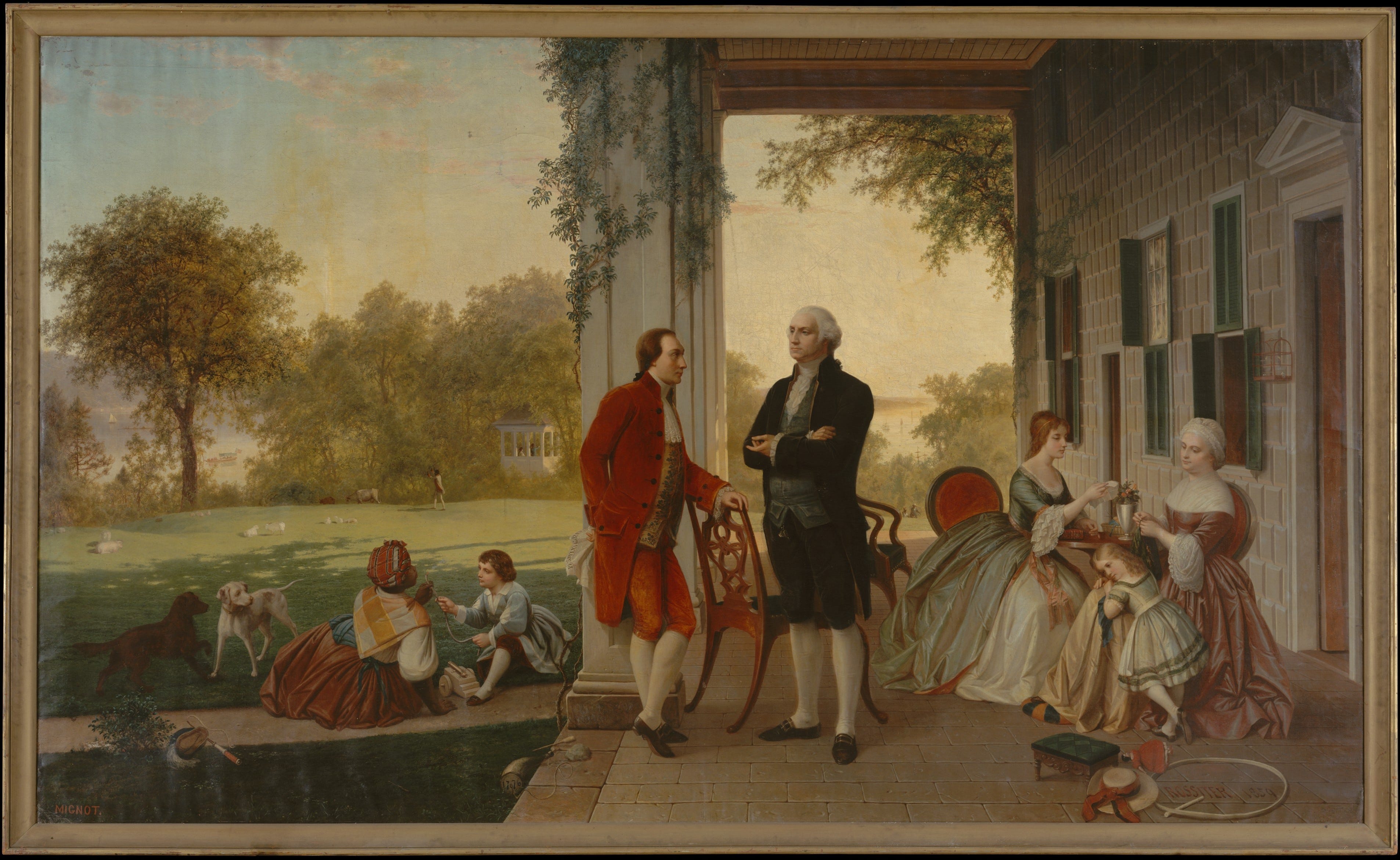
Lafayette’s confirmed credentials and eagerness to serve without pay won him enough favor from Congress to get him a commission as major general in the Continental Army (which Deane had originally promised him in Paris). It was meant to be an honorary post, intended mainly to capitalize on Lafayette’s political and social connections in France. But Lafayette took it literally, or at least seriously—just as he took it literally when George Washington, grudgingly impressed by the young Frenchman’s exuberant enthusiasm, told Lafayette that while he was not going to be given an actual command post, he could regard Washington as a “friend and father.” Soon, the fatherless Lafayette and the childless Washington—whom Lafayette often addressed in his letters as “my beloved general”—established a personal and lasting bond to which the usually stolid Washington brought a remarkable warmth.
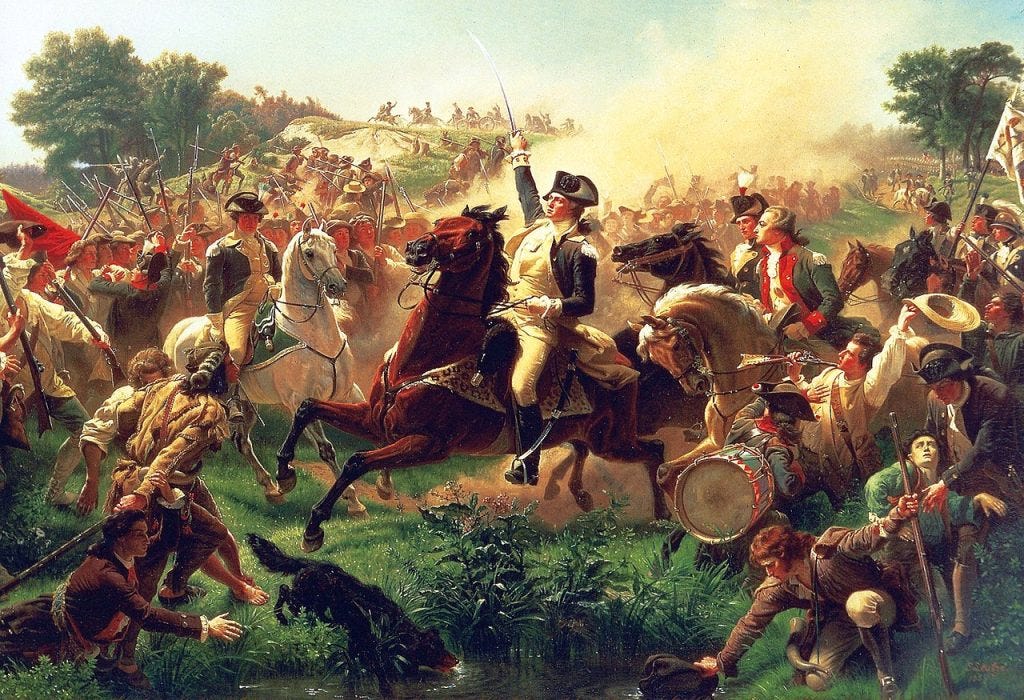
Just as Lafayette was not expected to actually command troops, he was not expected to fight in the Battle of Brandywine in Pennsylvania on September 11, 1777. But the battle took a disastrous turn for the Continental Army (due to bad intelligence that allowed Washington’s troops to be outflanked by British reinforcements), and when Lafayette asked for permission to ride into the battle, it was granted. Despite being wounded in the calf and ordered to leave the field, he managed to intercept some fleeing soldiers at a bridge over a creek and get them to regroup and hold the bridge, ensuring a safer and more orderly retreat for their comrades. The battle was still a disaster for the patriots, leading to the British capture of Philadelphia—but it was an impressive success for Lafayette as a novice fighter. Washington mentioned Lafayette’s injury in his dispatch to Congress and gave the young man command of a division. His first significant engagement in that role, at Barren Hill in May 1778, ended in defeat and near-entrapment; but Washington had words of high praise for the marquis’s “dexterity” in avoiding capture, managing a retreat with few casualties, and slowing down British troops. A month later came the Battle of Monmouth, regarded as a big win for the Continental Army. Before long, Lafayette was a famous war hero.
WHEN LAFAYETTE RETURNED to France in 1779 on a leave of absence—with several other notable battles behind him, including a victory over a numerically superior force of Hessian mercenaries at Gloucester—he was placed under house arrest for eight days for defying the king’s orders. This time, it was definitely for show: A few days after his release, Louis took Lafayette hunting as a mark of royal favor.
He also came back to find himself a star. His American adventure, initially seen as a “brillante folie” by Parisian society, was now widely celebrated; a new play that opened at the Comédie-Française that April even had the heroine enthuse about the unnamed but readily identifiable young courtier who had given up “the sweet pleasures of a new marriage” and the delights of Paris to pursue glory in another hemisphere. By the time Lafayette returned to America a year later, he had fathered a son (Georges Washington Louis Gilbert) and—in his greatest service to the American cause—helped persuade the king to send a French expeditionary corps to America, as well as naval reinforcements.
Lafayette’s last American battle was also the last major battle of the war. After a thwarted mission to trap (and terminate with extreme prejudice) the traitor Benedict Arnold, he was redirected to Virginia, where American and French forces would entrap or engage the main British force commanded by Lord Cornwallis. In the fall of 1781, Lafayette and his troops played a key role in the siege of Yorktown—and in accepting Cornwallis’s surrender on October 19. In the spirit of aristocratic officer-corps solidarity across enemy lines characteristic of that era, Lafayette had an amicable sitdown with Cornwallis after the surrender and expressed sympathy and respect for him in a letter to Adrienne. But, according to some accounts, he also forced the defeated British officers to respect the victorious colonial patriots. Duncan summarizes:
In a not very subtle insult to the Americans, the British kept their eyes fixed squarely on the French army as they filed past. Well attuned to such insults, Lafayette prodded Continental musicians to play “Yankee Doodle Dandy” as loud as they could to force the British to turn and acknowledge their presence.
In January 1782, Lafayette made his triumphant return to France; the following year, he helped negotiate the Treaty of Paris between Great Britain and the United States. His next trip to the United States in 1784 cemented his status as an American hero: He was met with parades, invited to address state legislatures, and granted citizenship in several states—including the status of “natural born citizen” in Maryland, which later made him officially a natural born citizen of the Unites States as well.
THERE IS A STORY (albeit unconfirmed) that in 1778, during Lafayette’s first exploits in America, Voltaire—back in Paris after years of exile—met Adrienne de Lafayette at a social gathering, greeted her as “the wife of the hero of the New World,” and expressed the hope that he would live to greet her husband as “the liberator of the Old one.” While the Enlightenment’s patriarch died shortly afterward, there was a moment, more than a decade later, when his alleged prediction seemed to be coming true. But if Lafayette’s heroic journey in America began with honorable defeat and ended in glorious victory, his trajectory in France began as a triumph and quickly went downhill.
In the fateful summer of 1789, Lafayette was one of the leaders of the liberal nobility in the Estates General, the elected body convened to resolve the country’s fiscal crisis—which then remade itself into a National Assembly with a wide-reaching agenda of reform. After turmoil stemming from conflicts between the King and the Assembly sparked a popular revolt that culminated in the fall of the Bastille, Lafayette took a leading role in the new government as head of the freshly minted National Guard. He also drafted the Declaration of the Rights of Man and of the Citizen with assistance from his friend Thomas Jefferson, then U.S. ambassador to France.
In the Revolution’s early days, few of its leaders could rival Lafayette in popularity and influence. In October 1789, when thousands of Parisian women marched to Versailles clamoring for bread and for the royal family’s return to Paris, Lafayette was able to defuse their rage at Marie Antoinette—who was showered with abuse and threats when she appeared on a palace balcony at the crowd’s insistence—by standing next to the queen and kissing her hand. And yet even Lafayette’s ability to exercise crowd control was limited. Two months earlier, his entreaties had utterly failed to persuade a Paris mob to surrender two royal officials accused of conspiring against the people into his custody; the men were lynched, and their severed heads were paraded around the city on pikes.
There have been many heated debates about why the French Revolution, unlike the American one, descended into terror and tyranny. One difference is that in America, the victories were won on the battlefield, by soldiers subject to strict discipline; in France, they were won mostly by crowds, making it extremely difficult to prevent or punish violent excess. (Legislation allowing martial law in response to riots temporarily curbed the anarchy somewhat but, as we’ll see, eventually backfired.) Moreover, the French Revolution’s street-level energy was driven largely by economic privations after two years of disastrously bad harvests and skyrocketing food prices. This situation was easily exploited by radical activists and journalists to whip up hatred against what we would now call the “One Percent” or “the elites.”
To radicals like Jean-Paul Marat, Lafayette’s elite status automatically made him suspect; he was accused of collusion with the Revolution’s enemies, and satirical prints illustrated this supposed collusion with pornographic images pairing him with Marie Antoinette (who, in reality, thoroughly detested him by then). But the royals were another problem: Despite outward acquiescence with the changes brought about by the Revolution, they never fully accepted many of its innovations, from limitations on the powers of the monarchy to religious freedom. Yet Lafayette, like most other moderate revolutionaries, strongly supported constitutional monarchy; much as he admired American republicanism, he believed it was ill suited to France with its history and traditions. Whatever one may think of constitutional monarchism in theory, in practice—given Louis and Marie Antoinette’s poor judgment—it tied his political fortunes in France to a sinking ship.
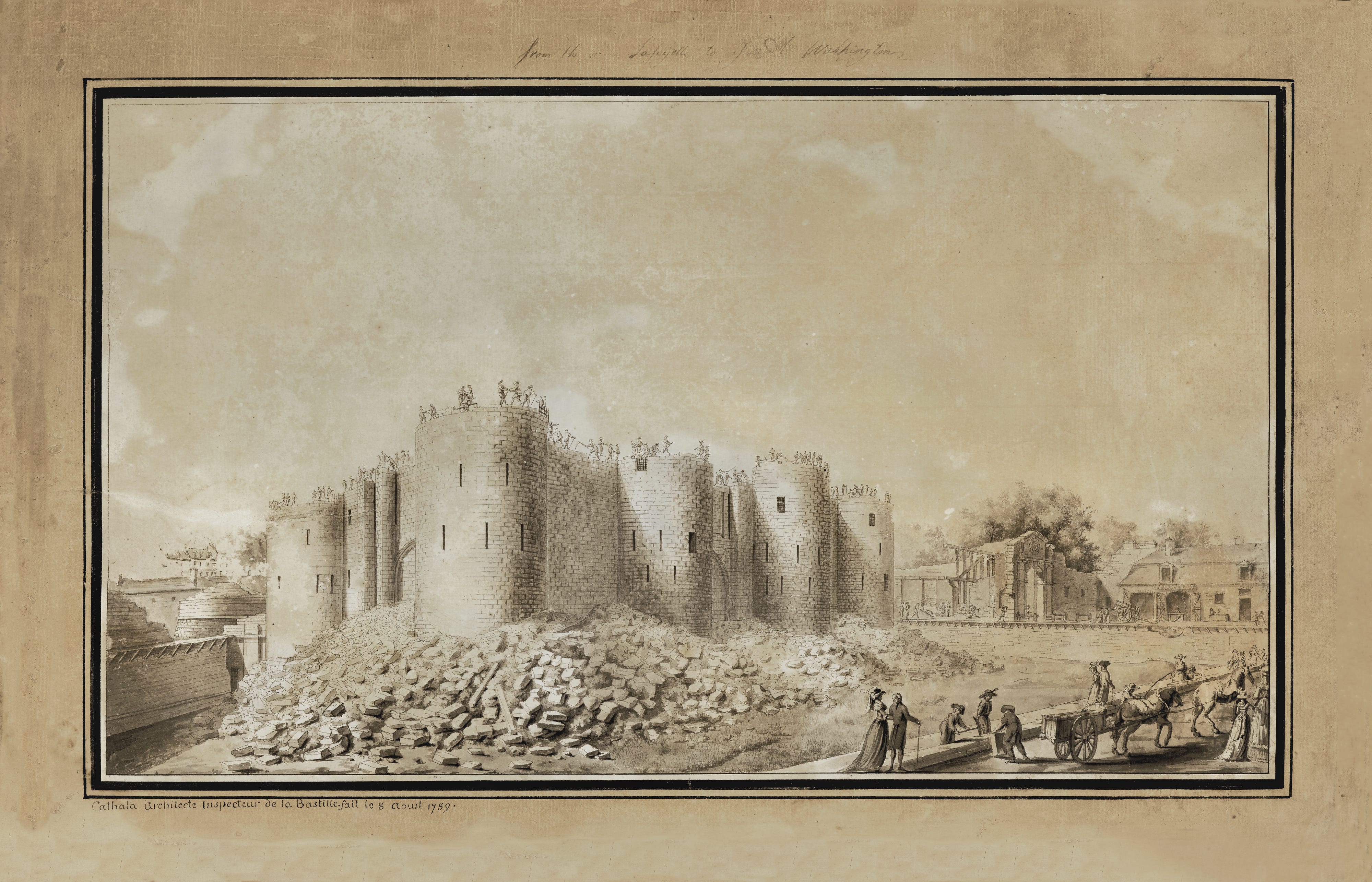
For a while, Lafayette remained an optimist. In March 1790, he proudly sent Washington an ink-wash drawing of “the Bastille just as it looked a few days after I Had ordered its demolition,” along with a key to “that fortress of despotism” which he had received after its fall. (Washington treasured the gifts, proudly displaying them at his presidential homes and then, post-retirement, at Mount Vernon—where the original key and a replica of the drawing can today be seen on display.) While Lafayette somewhat oversold his personal role in the Bastille’s demolition, the letter to Washington showcased his rather rosy view of the Revolution’s future. Admitting that both counterrevolutionaries and radicals were “fomenting troubles,” he dismissed these troubles as “much exaggerated,” mere growing pains of liberation from despotism. Eventually, he predicted, “Energy of Governement just as it was in America, Will propagate implant liberty and Make it flourish throughout the world.”
The July 14, 1790 Festival of the Federation on the Champ de Mars was the high point of that optimism. It was also Lafayette’s hour of glory as he rode across the field on a white horse carrying a tricolor banner and then led the Assembly in swearing fealty to the Constitution (then still a work in progress); the King and Queen repeated the oath.
Less than a year later, on June 21, 1791, it all came crashing down: The royal family left the Tuileries palace in the middle of the night for a famously bungled flight to the Austrian border, apparently to join counterrevolutionary émigré troops. In a very Hollywood detail, Lafayette very nearly bumped—literally—into Marie Antoinette while she was making her getaway and he was making the rounds of the palace, where the National Guard was in charge of security. The frightened queen had to duck into a side corridor, which caused her to get lost and delayed the departure of the carriage that waited outside—contributing to the series of mishaps that ultimately resulted in the royals being intercepted and detained at the town of Varennes.
Heading away from Paris, Louis and Marie reportedly snickered about how awkward things must be for Lafayette. Considering that Lafayette not only outlived them both but helped bury the Bourbon monarchy for good nearly forty years later, one might say he had the last laugh; but at that point, he certainly wasn’t laughing. The populist tribune Georges Danton accused him of treason and darkly insinuated that people had been hanged from lampposts for less. And then it got worse.
On July 17, after the Assembly restored the king’s authority (pretending to accept a laughable cover story about a brief jaunt out of town caused by fears of an assassination attempt), thousands came out on the Champs de Mars to petition for Louis’s abdication or removal. The skittish Assembly used the pretext of a violent incident earlier that day to impose martial law and sent Lafayette with a National Guard detachment to disperse the gathering. Warning shots were ignored, rocks were thrown, and then all hell broke loose as guardsmen shot at the protesters and charged into the crowd on horseback. Lafayette estimated the death toll at about fifty; the radical press claimed that hundreds were killed and dumped into the Seine after dark. Regardless of the body count, Lafayette was now the man who had ordered a massacre of fellow citizens exercising their rights to free speech and peaceful assembly.
Even so, after resigning his National Guard post in October, Lafayette was appointed to lead one of France’s three armies amid preparations for war with Austria and Prussia. By the summer of 1792, the war was underway and going badly; amid (not entirely wrong) suspicions that Louis and Marie were working with the enemy, the clamor for the king’s removal intensified. In June, in a last-ditch attempt to salvage the sinking ship, Lafayette went back to Paris and gave a speech to the Assembly demanding tough action against the radical agitators, including the closure of the Jacobin club. Protesters burned him in effigy; his attempts to mobilize anti-Jacobin volunteers came to nothing.
Lafayette returned to his army post—but not for long. After the August 10 insurrection that ended the monarchy, he fled to Austria, hoping to make his way to the United States. Instead, he was captured by the Austrians, for whom he was still a dangerous revolutionary.
For the next five years, Lafayette was a prisoner, handed back and forth between the Austrians and the Prussians “like a parcel no one really wanted” (as Simon Schama pithily wrote in his magisterial bicentennial history of the French Revolution, Citizens). Lafayette’s captivity was increasingly harsh, especially after a nearly successful escape attempt organized by friends. His U.S. citizenship was regarded as meaningless not only by his captors but by the U.S. government, which in any case had no diplomatic relations with either power.
American intervention, however, almost certainly saved Adrienne Lafayette from the guillotine back in France. The former American ambassador, Gouverneur Morris, and his successor James Monroe (Lafayette’s former comrade-in-arms in the Continental Army), worked hard to convince the French government that Lafayette’s family was “beloved in America” and his wife’s execution would turn American public opinion against the fledgling French Republic. Adrienne spent months in prison but survived. The toll on her family was horrific: Her mother, sister, and grandmother were executed together on July 21, 1794, when the guillotine was working at industrial speed in the Grande Terreur—just a week before the coup of 9 Thermidor stopped the carnage.
Released from prison with Monroe’s help, Adrienne took the extraordinary step of seeking permission to join her husband in prison with their two daughters, Virginie and Anastasie. (Young Georges Washington Lafayette was in the United States, under the care of his namesake and godfather.) Austria’s Emperor Francis eventually granted his permission, assuring Adrienne that the prisoner, then at the Olmütz fortress, was being treated well. In fact, Lafayette had been in solitary confinement for over a year—and when his wife and daughters arrived in October 1795, he was, in Schama’s words, “a ragged skeleton barely alive, gripped by a hacking cough.” For the next year and half, Adrienne shared his cell, with the daughters sleeping next door. Yet their conditions remained wretched, and while Adrienne was able to nurse her husband back to better health, her own health began to deteriorate.
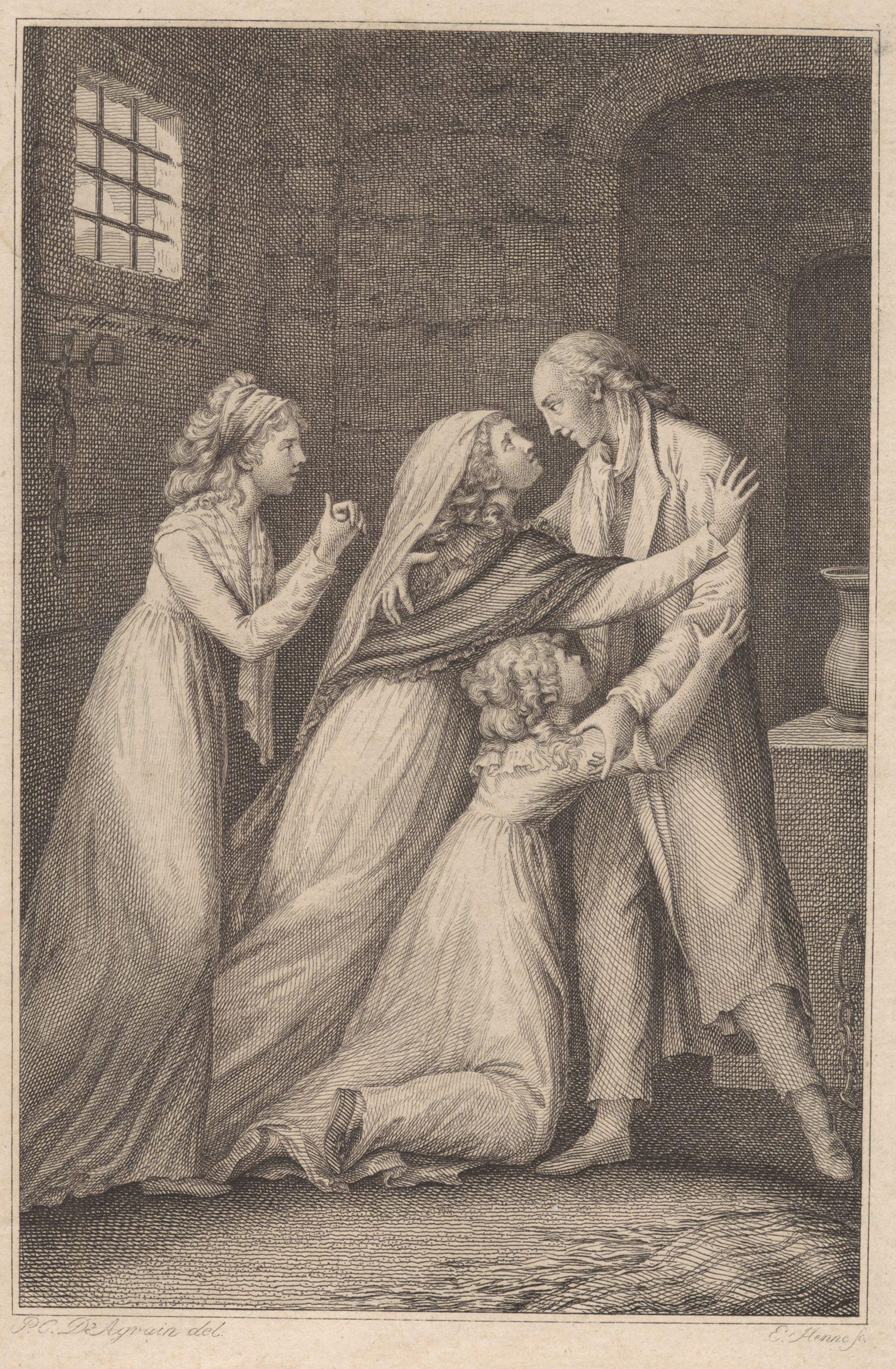
While many prominent men and women across Europe and America tried to win Lafayette’s freedom, it was Napoleon Bonaparte who finally got it done by trouncing Austrian troops in January 1797 and forcing the emperor into peace talks. (To save face, Francis pretended that Lafayette’s release was a goodwill gesture toward the United States.)
Hopes of emigrating to America faded: a diplomatic scandal over a bribe solicitation (the “XYZ Affair”) had sparked America’s first anti-French backlash, and Lafayette’s American friends feared that even he would not be shielded from the general Francophobia. In 1800, he was finally able to return to France and get some of his properties back; but despite personal gratitude to Napoleon, he stubbornly resisted the First Consul’s attempts to win his political support. The fact that Napoleon tried to capitalize on the recently deceased Washington’s image to present himself as the war hero-turned-political leader in the same mold probably alienated Lafayette even further. Still committed to the cause of liberty despite Napoleon’s attempts to assure him that the French people had had quite enough of democracy, the most he could promise was to retire from public life and refrain from openly criticizing the new regime—unless someone asked him for his opinion, in which case, he said, would be honor-bound to speak the truth.
Over the next decade, as the Consulate became the Empire, Lafayette’s dreams of liberty must have died a little more with each passing day. While he found contentment in farming on his estate and being a father and grandfather, tragedy came to his private life too: Adrienne, in poor health since Olmütz, died in 1807. The loss was shattering; Lafayette reportedly started each day by contemplating and kissing her portrait.
But the 50-year-old warrior and statesman still had a few chapters left in his life—including a second American chapter, chronicled in The Hero Returns.
LAFAYETTE’S AMERICAN TOUR came at a complicated time. He had returned to politics and public life after Napoleon’s downfall—first getting elected to the Chamber of Representatives during Napoleon’s brief return for the “100 Days” in 1815 and vainly trying to salvage the parliament after the emperor’s second abdication, then becoming a leader of the liberal opposition in the Chamber of Deputies under the restored Bourbon monarchy. The new king, Louis XVIII—the man he had slighted as the Comte de Provence in his youth—was not a fan: He once griped to a minister about “that animal Lafayette” getting a seat in the parliament.
Like nearly all the liberals, Lafayette lost that seat in the 1824 election, due to governmental machinations that effectively gave a second vote to the wealthiest 25 percent of taxpayers while purging many lower-middle-class voters from the rolls.1 Then came President Monroe’s invitation for an American tour as “The Nation’s Guest.” Sidelined in his first world, Lafayette went back to his second, accompanied by his grown son Georges Washington and his personal secretary (and future diplomat) Auguste Levasseur, whose diaries and memoirs about the visit were published several years later.
The most famous part of that trip is Lafayette’s encounter, at the dedication of a library in Brooklyn, with a 6-year-old boy he hoisted up on his shoulders—the future quintessential American poet, Walt Whitman. But there was much more to the tour, which spanned twenty-four states and was a spectacular triumph. In Manhattan, some 80,000 people—two-thirds of the city’s population at the time—welcomed Lafayette in the first-ever Broadway parade. The last surviving Revolutionary War general, he visited old battlefields and attended the Bunker Hill battle commemorations in Boston. He spoke to Congress and watched the park next to the White House receive its name, Lafayette Square. He made a melancholy visit to the tomb of his “adopted father” George Washington at Mount Vernon. He met with all the living presidents: the three past presidents, his old friends Thomas Jefferson and James Madison, as well as John Adams, who had been cool toward him when they met in Paris in the 1780s but now received him cordially; and two sitting presidents: first Monroe, then the newly inaugurated John Quincy Adams.
In The Hero Returns, Brookhiser brings Lafayette’s journey to life in a brisk, humorous, often moving narrative, with plenty of colorful details—including the lavish and elegant dinner menus with which American hosts tried to impress their French guests; ladies thronging to kiss the hero’s hand (a gesture Lafayette invariably returned, much to the delight of onlookers); the gushy newspaper accounts; and the pickpockets who invariably showed up wherever Lafayette drew massive crowds. This narrative includes Lafayette’s emotional meetings with old comrades or their children. Among them was an Illinois woman identified only by her first name, Mary, a Native American who told Levasseur she wanted to show Lafayette a letter he had once written to her father. Mary was shy about meeting Lafayette in public, or at a private ball held in his honor; but Brookhiser describes their private meeting, quoting from Levasseur’s memoirs:
He and Mary spoke for half an hour. The letter, “a little darkened by time,” was dated June 1778 and had been written at Albany, thanking Mary’s father, evidently an Oneida, for his service in a battle in Pennsylvania earlier that year. Lafayette “could not conceal his emotion on recognizing his letter, and observing with what holy veneration it had been preserved.”
Another remarkable meeting in Virginia involved a farmer named James Armistead Lafayette—once a slave named James who had been a spy and courier for Lafayette during the Revolutionary War, whose freedom Lafayette obtained, with some difficulty, after the war. The Richmond Enquirer marveled at Lafayette’s “goodness,” “liberality” and “true greatness” in embracing the black man; but the general had to tread carefully when addressing the issue of slavery. He saw it as a shameful stain on America’s liberty. But, as Brookhiser puts it, Lafayette understood in the 1820s that “he was a guest—of slave owners and of those who did not own slaves alike,” and was anxious not to insert himself into a contentious debate. He spoke about it privately to Madison and Jefferson, both of whom agreed in the abstract that it should be abolished. (Brookhiser includes a fascinating account of the conversation with Jefferson offered much later by Israel Gillette, who had been, at the time, Jefferson’s enslaved attendant.) In public, Lafayette only alluded to the issue—most explicitly in his appearance with Illinois’s strongly anti-slavery governor Edward Coles. Responding to Coles’s remarks about the free state’s protections from “oppression of every description,” Lafayette warmly praised the effort “to improve those blessings on the soundest principles of American liberty.”
Despite his disgust with slavery and his unease about the treatment of Native Americans, with whom he had always had cordial relations, Lafayette’s devotion to America remained unshaken: On September 6, 1825, celebrating his 68th birthday at the White House, he responded to President Adams’s toast to his and Washington’s birthdays with, “To the fourth of July, the birthday of liberty in both hemispheres.” But he also never gave up his hopes for his native country. At a speech to a French Masonic lodge in Norfolk, Virginia, Brookhiser reports, he asserted, “La liberté n’est pas encore perdue pour la France”—“liberty is not yet lost in France.”
BY THE TIME LAFAYETTE RETURNED to France, there was a new king: Charles X, an uber-reactionary who thought the Restoration had preserved too much post-1789 liberalism intact and made no secret of wanting proper absolutism back, with a muzzled press and a tame parliament. Interestingly, Charles, formerly the Comte d’Artois, had an odd respect for Lafayette—his onetime lyceum classmate—as a fellow true believer, even if their beliefs were diametrically opposed. That didn’t stop him from dissolving the chamber of deputies in 1827 in a fit of annoyance that Lafayette had won a seat; when new elections were held, Lafayette won again. Three years later, Charles’s dogged efforts to reanimate the ancien régime finally sparked a new French revolution—and 73-year-old Lafayette, improbably, got to be its hero once again.
After Charles abdicated in July 1830, plenty of the revolution’s supporters wanted Lafayette as president of a new French republic. He refused, partly because, like many other French liberals, he thought a republic would be too divisive. (Between the Jacobins’ bloodthirsty zealotry and their successors’ corrupt incompetence, the first republican experiment had left too bad a taste.) But Lafayette’s backing played a key role in the ascension of Louis Philippe d’Orléans, hailed as a “citizen king” who would ensure liberty and the rule of law.
It seemed to be 1789 redux, right down to Lafayette returning for a brief spell as commander of the National Guard. (This time, he was able to prevent bloody reprisals against hated royal officials.) Yet the “July Monarchy” soon became another disappointment; Louis Philippe’s commitment to liberté and égalité proved shaky, and by 1831 Lafayette found himself in opposition once again. The next revolution was seventeen years away, but that one would have to do without Lafayette: He died of complications from pneumonia on May 20, 1834 at the age of 76. At his request, he was buried in Paris next to his beloved Adrienne, but also under American soil: Earth from Bunker Hill, brought back from his American tour, was scattered over his coffin.
It was the end of a truly extraordinary life. As historian Laura Auricchio sums up in her 2016 biography, The Marquis: Lafayette Reconsidered:
He lived in treacherous times and made imperfect choices. He failed at more ventures than most of us will ever attempt and succeeded at efforts that stymied countless men, but he never abandoned the belief that he could change the world, and he never despaired of success.
THE LIVES OF GREAT MEN who championed liberty at a time when its full benefits were extended only to affluent white males often pose thorny problems in an age when racial, sexual, and social equality is a normative value. Where does that leave Lafayette, a man who epitomized privilege?
To some extent, Lafayette always remained an exponent of a patrician liberalism. Even his support for democracy only went so far: Like many other nineteenth-century liberals, he favored a minimum threshold of tax payments as a condition for voting rights, though he also favored drastically lowering that threshold and expanding the franchise. One can certainly find episodes in his life that will make most modern readers wince. Lafayette’s early letters from America discussed slavery so complacently that some passages were scrubbed for posthumous publication; he briefly had an enslaved errand boy and, more disturbing still, floated the idea of slave-trading to raise funds for the Continental Army. There was a casual assumption of masculine privilege—despite the genuine devotion between Lafayette and his wife—in his expectation that Adrienne would patiently endure not only his long absences in America but, shortly after his return, two affairs that kindled scandalous gossip.2
But Lafayette also proved capable of genuine growth. At some point in the early 1780s, his attitudes toward slavery shifted radically. Long before his farewell tour, he condemned it in his speech to the Virginia state legislature on his 1784 trip to the United States; he also reached out to George Washington with a proposal for an experiment in gradual emancipation. (Washington, who was by that point opposed to slavery in theory but unable to see a practical path to emancipation, offered polite excuses and good wishes—but his correspondence with his “adopted son” apparently helped convince him to take the rare step of posthumously freeing his slaves in his will.)3 And despite his caution on the 1824–25 tour, he made no secret of where his sympathies lay. Among other things, Brookhiser notes, Lafayette made those sympathies clear by publicly treating black people as full citizens—not only James Armistead Lafayette, but black veterans of the War of 1812. Notably, in a letter to his daughters, Lafayette deplored not only slavery but “prejudices against blacks”; there is evidence that, unlike many of his anti-slavery contemporaries, he was willing to support not only abolition but equality. In that sense, he was ahead of his time, even if his optimism about the peaceful demise of American slavery—and about the status of Native Americans—looks naïve in retrospect.
Lafayette was also, as University of North Carolina historian Lloyd S. Kramer concludes in his 1996 book, Lafayette in Two Worlds, remarkably willing to treat women as full and equal participants in political debates and social activism. While he did not explicitly advocate women’s rights, one of his closest friends late in life was Scottish-born American writer, social reformer, and journalist Frances Wright, who accompanied him for part of his U.S. tour.4 Wright was an abolitionist whose pamphlet outlining an emancipation plan Lafayette strongly recommended to several American friends including Jefferson; but she was also a pioneering feminist who advocated equal education and property rights for the sexes, and eventually female suffrage. Lafayette stood by her even after her advocacy of far bolder ideas such as sexual freedom, birth control, and the lifting of taboos on interracial relationships made her a scandalous figure.
LAFAYETTE SAW LIBERTY as a truly universal ideal, championing freedom movements in Poland, Italy, Greece, and South America, but the United States always had a special place in his heart. “The happiness of America,” he wrote to Adrienne in June 1777, shortly after his first landing on the American continent, “is intimately linked to the happiness of all humanity. It will become the respected and secure refuge of virtue, honesty, tolerance, equality and tranquil liberty.” Later on, Lafayette himself no doubt recognized the rosy utopianism of this prediction; but he never wavered in his belief in America’s promise.
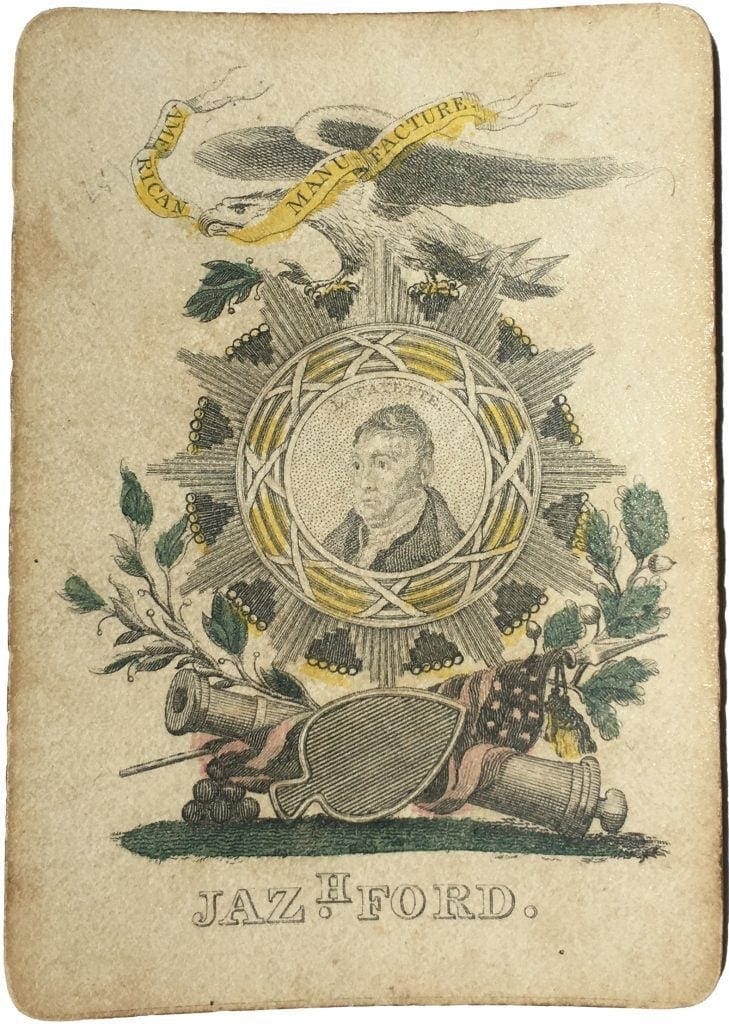
This belief inspired his American farewell tour at a moment when many worried that this promise was dimming; it was hoped that Lafayette’s visit would rekindle the Spirit of ’76 in time for the semicentennial celebrations. There were bitter divisions over slavery and tariffs. The hyperpartisan, polarizing election of 1824 ended in a hotly contested outcome, with Andrew Jackson winning the popular vote, no clear winner in the Electoral College, and the House of Representatives handing the victory to John Quincy Adams. Lafayette, it seems, was especially impressed that Jackson congratulated Adams and shook his hand at a White House dinner just a few hours after his loss—a powerful display of the peaceful transfer of power. Brookhiser pointedly notes the contrast to Donald Trump. And, of Trump’s affection for autocrats like Vladimir Putin, he writes laconically, “Lafayette would be revolted.”
And so he would. But would he have given up on America’s promise? In Lafayette in Two Worlds, Lloyd Kramer wrote that a central theme of his life was “optimism about the future of democratic politics.” Kramer thought that this outlook was widely seen as naïve in the mid-1990s; it certainly seems much more so three decades later. But then, Lafayette’s optimism was also seen as naïve by many of his contemporaries who marveled that, after 1793, he could still remain unflinchingly loyal to the ideals of 1789. In 1800, semi-jokingly chided by Napoleon about not yet being “corrected” on the subject, Lafayette replied:
About what? A love of liberty? What should repulse me? The crimes and excesses of the terrorist tyranny? They only made me hate any arbitrary regime even further and commit myself more and more to my principles.
His core beliefs also included moderation, which earned him hatred from left and right alike. “Rarely has a man held to moderate principles with such tenacity,” Laura Auricchio notes in The Marquis. Yet he pointedly rejected the faux centrism that came to be known in French political language as “juste milieu” or “happy medium,” a notion he derided in a speech in parliament in 1831:
Is it the sort of moderation that consists in maintaining the center between two variable points? Which, when we say that four plus four makes eight, and an exaggerated claim pretends that it makes ten, believes it more reasonable to maintain four plus four makes nine?
Lafayette’s commitment to “principles” remained, like his commitment to liberty, a central feature of his life. He was willing to compromise, but only up to a certain point: Strategic silence was acceptable, active lies were not. Freedom of the press was such an absolute that he refused to sue even ultra-royalists who published slanders about him under the Restoration.
To Lafayette’s detractors across the political spectrum, he was a vain and egotistical glory hound, or a good-natured and starry-eyed simpleton, or a man so blinkered by his idée fixe of liberty as to be blinded to reality. There was probably a bit of truth in all these critiques. Lafayette was certainly not without vanity or self-dramatization. (“I take him to be as amiable a man as his vanity will admit,” Madison wrote to Jefferson during Lafayette’s 1784 visit to the United States.) His idealism certainly had a dose of naïveté and myopia. Schama’s final description of Lafayette in Citizens as the man resolved to be constant to his “abiding faith [of] patriotism and freedom” no matter what—forever “the man on the white horse with the tricolor wrapped around his body”—has more than a smidgen of gentle sarcasm. And yet Kramer had a point when he warned in a 2007 lecture at Lafayette College that “if we choose to dismiss Lafayette’s ideas as naïve or absurdly Romantic . . . we will also be choosing to abandon our most valuable democratic legacy from the past as well as our own aspirations for a better, more democratic future.”
That remains a much-needed warning in 2026.
Ironically, this was accomplished through the mechanism of tax breaks that put many below the 300-franc annual minimum tax payment required for voting eligibility. Who knew you could disenfranchise people so nicely?
In a revealing commentary on the era’s double standards, Adrienne’s family reacted to one of those affairs by relentlessly trashing Lafayette’s mistress, Aglaé von Hunolstein; her reputation was destroyed to such a point that she entered a convent.
Lafayette’s own experiment—the purchase of a plantation in Cayenne (now French Guyana) where some seventy enslaved Africans were paid for their work, educated, and treated similarly to white laborers, with plans for their eventual manumission—tragically illustrates the limitations of such meliorative projects. Lafayette’s properties were confiscated after he fled France; in 1802, Napoleon’s government compensated him for his holdings in Cayenne, but he was unable to prevent the re-enslavement of the plantation’s black tenants when Napoleon restored slavery in the French colonies shortly afterward.
Some believe Lafayette and Wright, thirty-eight years his junior, may have been sexually involved during his time in America; but the consensus among biographers is that he saw her as something of an adopted daughter, perhaps echoing his own relationship with Washington.
Thank you so much for this.
As an older American, my history lessons about Lafayette began and ended with his involvement in the American Revolution, much of it glorified.
I had no idea of his rich history afterwards.
this was a great essay.