Mega-Prison Politics
A new generation of right-wing outsiders is triumphing across Latin America.

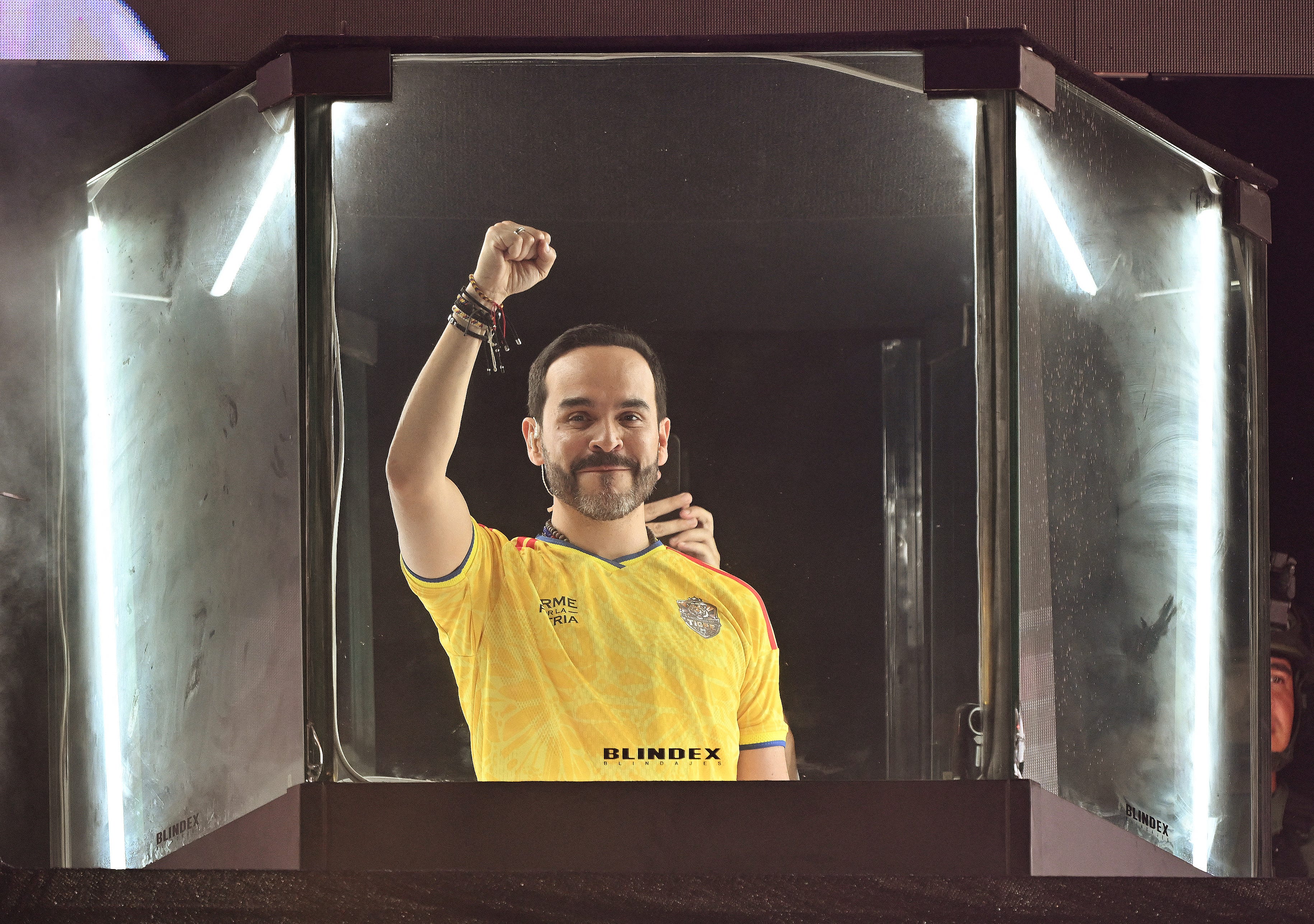
THE POLITICAL LANDSCAPE OF LATIN AMERICA has changed dramatically. Within the span of several weeks, two of South America’s largest democracies have elected leaders from the far right. In Peru, Keiko Fujimori, the daughter of the dictator who governed the country between 1990 and 2000, has apparently won a razor-thin runoff against leftist Roberto Sánchez. In Colombia, far-right outsider Abelardo de la Espriella defeated the candidate backed by the outgoing left-wing government of Gustavo Petro. These results follow a landslide victory in December by far-right candidate José Antonio Kast in Chile.
Latin America is a complicated place, and each of these elections has its own national dynamic. But taken together they tell a larger story of a resurgence in right-wing politics across the Andes.
These elections are more than just a pendulum-like conservative reaction to the prior, often controversial episodes of left-wing rule in each country. Rather, the rightward shift is a product of deeper forces reshaping the political landscape across the region: a spiraling security crisis fueled by drug trafficking and organized crime, a migration shock centered on Venezuela, and the political wreckage left by COVID-19, which included the erosion of incumbent and traditional parties and economic volatility.
A new generation of right-wing politicians has learned—both from each other and from the Trump playbook—how to weaponize these forces to their advantage. And they have seized on the opening provided by mainstream parties that are either in collapse or that have earned a reputation for their incapacity to deal effectively with crime and migration. The question now for the defenders of liberalism globally is whether and how this can be contained.
Keiko Fujimori has acted as if she’s Peru’s president-in-waiting for a decade and a half, and the return of her family to power has been anxiously anticipated since her first presidential run in 2011. Fujimori’s victory in this election caps her fourth attempt to win the presidency and comes at a time when the country’s institutions are in shambles.
Peru has cycled through nine presidents in the last decade, every one of them impeached, convicted, jailed, or driven from office under a cloud of scandal. The country’s democracy has slid in tandem and according to V-Dem it now scores at around the same level to where it stood in the 1980s as it struggled to emerge from military rule and to contain a domestic insurgency. The party system is effectively nonexistent in the country. Instead, parties are mostly legal shells leased to ambitious individuals, with shifty membership rolls, no coherent ideologies, and weak roots in society. Thirty-six candidates ran in the first round of this year’s presidential election, and the two finalists together captured less than 30 percent of the vote.
Against the backdrop of this democratic hollowing, Peru’s security crisis has escalated dramatically, driven by the growth of illegal gold mining—now valued at roughly seven times the country’s cocaine trade—and by the spillover of drug trafficking organizations from Bolivia, Colombia, and Ecuador through Peru’s porous northern and eastern borders. Homicide and theft are on the rise and extortion has become rampant. The Peruvian Congress, rather than rising to the challenge, passed legislation in 2024 that barred prosecutors from investigating crimes with prison terms of six years or less and limited the ability of police to seize explosives from illegal miners.
At the same time, Peru has taken in over one million Venezuelan migrants, many of whom have settled in the dusty peripheries of Lima and are working in the informal economy. Most Venezuelans arrived in the late 2010s as Venezuela’s economy imploded, but that may not be the last wave. The country’s massive earthquake last week could fuel yet another wave of migrants fleeing desperate conditions.
While research shows that Venezuelan migrants commit crimes at lower rates than Peruvians themselves, the public perception—amplified by the media and hardened by high-profile incidents—runs sharply in the opposite direction. Much as Donald Trump has shown in America, this perception has been a windfall for the right.
Keiko Fujimori leaned into a tough-on-crime agenda during the campaign that was inspired by her father’s fight against domestic terrorism in the 1990s. She also invoked the Nayib Bukele model in El Salvador to push for a militarized crackdown on gangs and crime and the construction of top-security mega-prisons to house dangerous criminals. Simultaneously, she has staunchly defended Peru’s market-led economic framework that has delivered the country solid, if unequal, economic growth. That is attractive to many Peruvians in a country that suffered from a post-COVID inflation spike, as well as the right’s base in the middle and upper classes.
Fujimori’s biggest asset is the one thing none of her rivals possess: a durable national political organization. She is nothing if not politically shrewd. If she can successfully crack down on Peru’s expanding criminal networks, she will gain public support and could preside over a political stability the country hasn’t seen in years. That would cement her position. And given her family’s authoritarian instincts, it is not hard to imagine she will attempt to entrench herself in ways that further erode an already weakened democracy.
COLOMBIA’S ELECTION OF DE LA ESPRIELLA, a political outsider with a Bukele-style iron-fist political platform, was driven by a similar logic, though the security situation in the country is far different from Peru. For decades, Colombia has struggled with leftist guerrillas, paramilitaries, and a growing number of criminal organizations that have driven civilian deaths and mass displacement. The country’s drug trafficking organizations have extended into Ecuador, penetrated Peru, and stretched into Central America.
The outgoing president, Gustavo Petro, had hitched his political fortunes to a “total peace” strategy: simultaneously negotiating with guerrilla groups, paramilitaries, and criminal organizations. But few of these negotiations bore fruit. Violence persisted, armed groups expanded their control, and homicides crept up in important areas of the country. By the time voters went to the polls, Petro’s approval ratings had collapsed. The country’s economic trajectory had also underperformed expectations under Petro.
Migration has only complicated these issues. The Venezuelan migrant crisis has hit Colombia, which neighbors Venezuela, harder than almost any other country in the region, with millions crossing the border. Armed groups on the border have recruited Venezuelan migrants in considerable numbers as cheap foot soldiers. And even though, as in Peru, research shows that Venezuelan migrants commit crimes at lower rates than Colombians, Colombians widely believe the opposite is true. Meanwhile, Colombia’s traditional political parties have been in long-term decline. COVID supercharged the anti-incumbent and anti-establishment sentiment that was already building.
THE RIGHT-WING VICTORIES in Peru and Colombia were presaged in part by Chile’s election of far-right president José Antonio Kast late last year. Despite Chile’s history of stability and political moderation since the 1990s, it too has been overwhelmed by the forces sweeping the region. Kast coasted to an impressive election win on a platform centered almost entirely on crime and migration. He explicitly modeled his security approach on El Salvador’s Bukele and promised to build a wall (ring a bell?) on the northern border with Bolivia to stem illegal migration. His administration is already digging deep trenches in the desert along its northern border with Peru.
Chile’s crime surge is real, even if modest by regional standards.. And hundreds of thousands of Venezuelan and Haitian migrants have provided a convenient scapegoat. Meanwhile, previous president Gabriel Boric’s economic record was underwhelming: growth was anemic, inflation spiked in the aftermath of COVID, and many Chileans reported a desire to emigrate.
TO A DEGREE, these wins should not have come as a surprise. The relentless focus on security and political positioning as an outsider with sharp economic instincts has become the template for the resurgent right across the region. Javier Milei won Argentina’s presidency in 2023 by channeling popular fury at economic mismanagement into a libertarian shock-therapy platform. Daniel Noboa won Ecuador’s presidency in 2023 by running as an anti-crime outsider in a country that had been convulsed by cartel violence and prison massacres, deploying the military against gangs in a move that proved enormously popular and won him re-election in 2025. All of these leaders ran on order, competence, and the argument that the left had had its chance and wasted it. Kast, Fujimori, and de la Espriella absorbed those lessons. They also had a new champion in their corner: the Trump administration.
Washington has tilted strongly toward right-wing governments across the region, treating ideological alignment as a substitute for the democracy promotion that had anchored U.S. policy. It pressured Peru’s interim government over purchasing F-16s in the runup to elections. It has warmly embraced Bukele in El Salvador as a model for the region despite its democratic collapse—even sending migrants to his prison. It has celebrated Milei as a free-market visionary and funneled loans to his administration to boost his political fortunes. And it toppled Nicolás Maduro in Venezuela and is tightening the noose on Cuba, two standout leftist governments in the region. The message this sends to ambitious politicians across the hemisphere is that Washington’s approval, investment, and strategic partnership are available in exchange for cooperation and ideological alignment—and that the other option is a hammer.
Still, we should be careful about grand pronouncements. The recent elections in Peru, Colombia, and Chile do not guarantee a lurch toward authoritarianism. Peru’s constitutional arrangement makes it genuinely difficult for any president without considerable congressional majorities to consolidate power. Fujimori will face thin majorities and a legislature accustomed to removing presidents. Colombia’s institutions are more resilient than its recent chaos suggests. Kast faces a factionalized Congress in both chambers that will require him to bargain with the opposition to pursue his agenda, and Chile’s poor and middle-class urban residents, its socially liberal younger voters, and its indigenous Mapuche communities may bridle under his presidency in ways that could reignite the massive protests that rocked the country in 2019 and 2020.
At the same time, the risks to democracy are real. The Bukele model of mass incarceration and military deployment on the streets—and, frankly, the security improvements and political boon it can deliver—has been gaining fans among citizens and politicians alike from Santiago to Lima to Bogotá. The combination of weakened institutions, metastasizing organized crime, and a Trump administration that has abandoned democracy promotion creates conditions in which democratic backsliding can happen quickly.
Latin America has been here before, electing leaders who came to power promising order and then delivering something darker. Whether democracy can survive that now, in a moment when the external guardrails have been removed and the internal ones are already eroding, is a question that will define the coming years. But whatever happens, it is unlikely to remain confined to the region.
Michael Albertus is a professor of political science at the University of Chicago and the author of Land Power: Who Has It, Who Doesn’t, and How That Determines the Fate of Societies (Basic Books, 2025). He writes the newsletter The Good Society.
 | A guest post by
|