

The Nationalist Right Isn’t Taking Orbán’s Loss Well
Mourning one of their own.

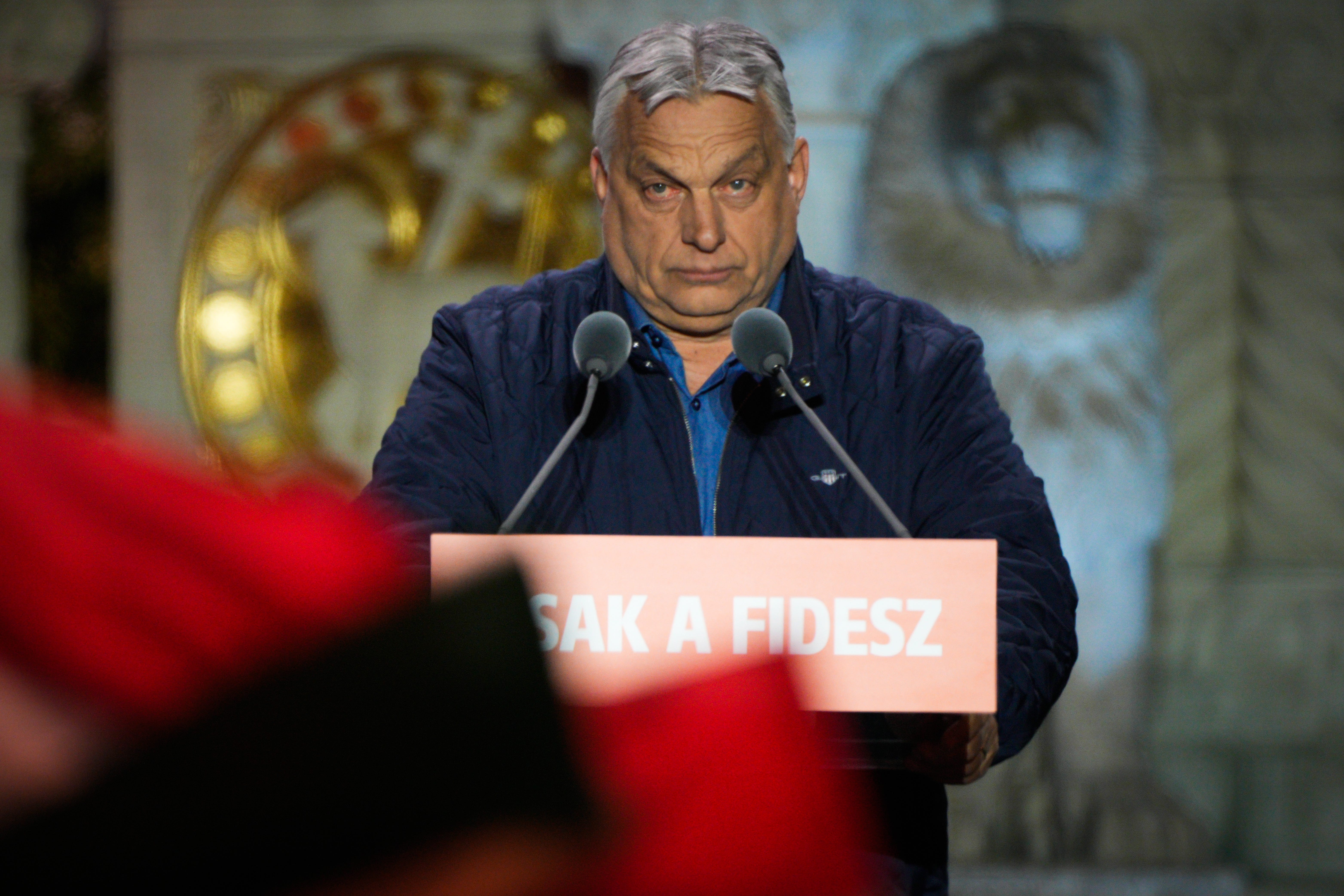
ORDINARILY, THE RESULTS OF PARLIAMENTARY elections in a small European country wouldn’t be major news for an American administration, party, or political movement. But Donald Trump and his MAGA allies and followers had invested a lot of time, energy, and—as we shall see—hope in Hungarian Prime Minister Viktor Orbán. That is, until their favorite authoritarian’s crushing defeat in Sunday’s elections. Just days before Hungarians voted Orbán out of power—after sixteen years of corrupt, self-serving, and increasingly undemocratic rule—Vice President JD Vance had been in Budapest campaigning with Orbán, adding to Vance’s winless track record. Since the results have come in, there’s been a lot of wailing and gnashing of teeth on the American right.

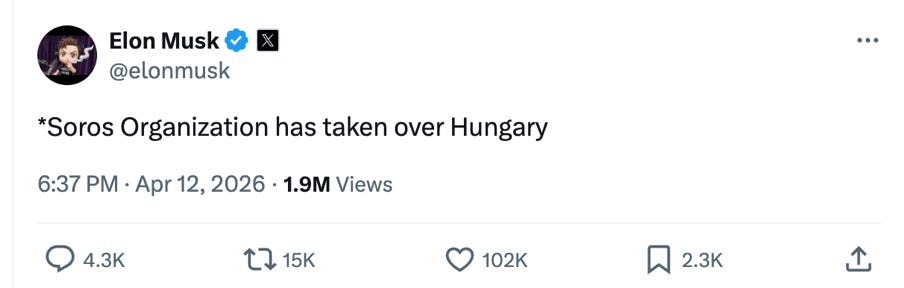
Kevin Roberts, president of the Heritage Foundation, was particularly incensed by Sen. Mitch McConnell’s Fox News op-ed reasonably pointing out that Orbán’s “illiberal court-packing, crony capitalism [and] restriction of free speech” do not reflect American values—to say nothing of “his government’s fealty to Moscow” and recent flirtations with China and Iran.

But no one was harder hit than Rod Dreher, the ultra-traditionalist blogger who has been living in what he describes as “exile” in Budapest since 2022 and has held a paid fellowship at the Danube Institute, which is financed by the Hungarian government—though probably not for much longer. Dreher, who saw Orbán as a model of “what a vigorous conservative government can do if it’s serious about stemming this horrible global tide of wokeness,” played a fairly prominent role in matchmaking the bromance between Orbánist Hungary and the MAGA right (which included several Conservative Political Action Conferences held in Budapest). Not surprisingly, the prospect of Orbán’s ex-associate-turned-rival Péter Magyar winning left Dreher despondent, triggering several posts that were, shall we say, not on the best terms with the facts.
For instance, deploring the Western media’s anti-Orbán slant, Dreher mocked a New York Times column by David Broder for pointing out that Orbán and his Fidesz party “rewrote the Constitution”:
What David Broder doesn’t tell you is that the 2011 Constitution replaced the one imposed on Hungary by the Communists in 1949. . . . If all you knew was what Broder said, you’d think that the sweet, innocent constitution was sitting there minding its own business, until Viktor Orban came along and assaulted it. Communism ended in 1989. No government scrapped the Communist constitution . . . In fact, until Fidesz acted, Hungary was the only former Communist country in Europe that had not replaced its Communist constitution with a new one. The only one! . . . Broder is complaining that Orban’s party replaced a Communist constitution with a liberal democratic one.
Yes, well, what Rod Dreher doesn’t tell you is that while the 1949 Communist Constitution was not officially repealed, it was essentially superseded by a lengthy amendment that took effect in October 1989. Its preamble states that “the Parliament of the Republic of Hungary hereby establishes the following text as the Constitution of the Republic of Hungary, until the country’s new Constitution is adopted.” (Among other things, it recognized Hungary’s membership in the European Union and its compliance with the “generally recognized principles of international law.”) Yes, it’s a bit weird that this de facto 1989 constitution—which is not a rushed draft but a full document with 78 articles—was formally titled “Act XX of 1949,” since it wasn’t really an “act” and took effect in 1989. But if subsequent governments (until Orbán) didn’t bother to change its title or substance, that’s because it functioned adequately as a constitution for a liberal democratic republic. I’m not sure which possibility is worse: that Dreher, who wrote a book titled Live Not by Lies (a quote from Alexander Solzhenitsyn), is deliberately misleading his readers, or that he is genuinely this ignorant about the country he touts as a conservative model.
Dreher also bristles at Orbán being called “Putin’s lapdog.” How unfair, when we know from Orbán himself that he is Putin’s mouse! So he told the Kremlin autocrat in a recently leaked transcript of a phone call from last October—in which he also assured Putin, “I am at your service.” The animal metaphor refers to an Aesop fable in which a mouse, grateful for not being eaten by a lion, later helps free the mighty beast from a hunter’s trap. Now there’s a leader who zealously guards his country’s sovereignty and dignity!
Three days before the vote, reluctantly admitting that JD Vance’s visit may have hurt Orbán in the polls, Dreher still clung to the hope of a close win—and dropped a bombshell: “The news this week that Peter Magyar, the choleric, wife-beating ex-Fidesz insider running against Orban, once got drunk and microwaved the family’s puppy in front of his children—there are photos of the grisly aftermath—is not likely to go down well with voters.”
The source for this claim is an X post and video clip discussing a memoir by Magyar’s ex-wife, Judit Varga, supposedly titled “Sixteen Years with the Monster.” As a community note points out, there is no such book. (Varga, an Orbán ally and former minister of justice who has a complicated personal and political history with Magyar, has indeed accused her ex-husband of abuse after he emerged as an Orbán challenger. But even she has never alleged any puppy-cooking.) Dreher has yet to correct or remove the sensational claim.
One day, Magyar is microwaving pets—the next, “genderfluid” males are ogling naked women in public showers:
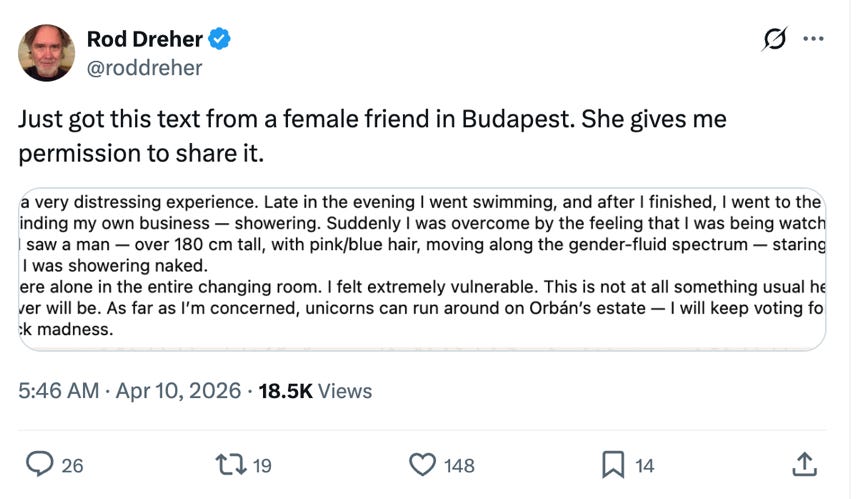
Just to be clear, the message Dreher wants us to take from this story is: This thing, which allegedly happened under Orbán’s leadership, will happen even more if Orbán loses, which is why the Hungarians will look past all of his gob-smacking corruption and re-elect him anyway.
You can see why Orbán’s electoral smackdown was so painful for this crowd.
By the way, Dreher fully acknowledges that Orbán is an authoritarian bully—for instance, that his move to eject the George Soros–funded Central European University from the country wasn’t really about noncompliance with regulations but about stopping Soros from “form[ing] a Hungarian elite in his image”: “socially liberal, globalist and open to migrants.” But to Dreher, that’s fine because “left-liberals practice politics through universities and other non-governmental organizations” while faking neutrality. That view of state power as a culture-war weapon dominates Orbán’s American fandom: Yes, Orbán’s squashing of the CEU was ugly—but c’est la guerre. Or, as Lenin put it, “Who/whom?”
AFTER THE RESULTS CAME IN, the American Orbánists tried for some gotchas by pointing out that Orbán wasn’t actually an authoritarian because he called to congratulate Magyar on his victory.
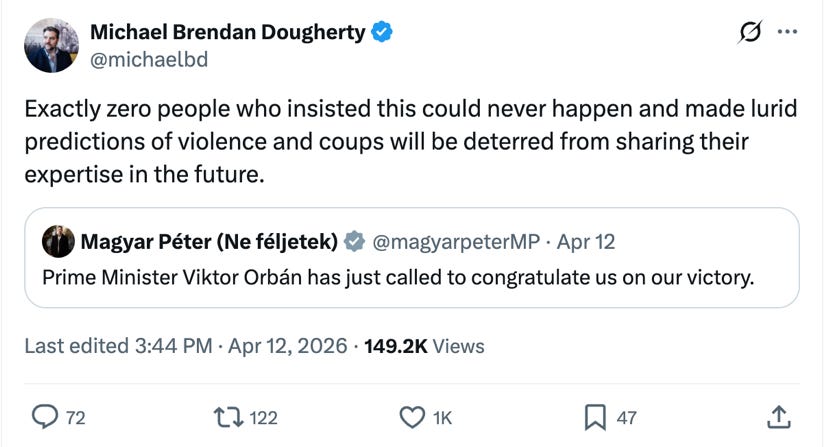
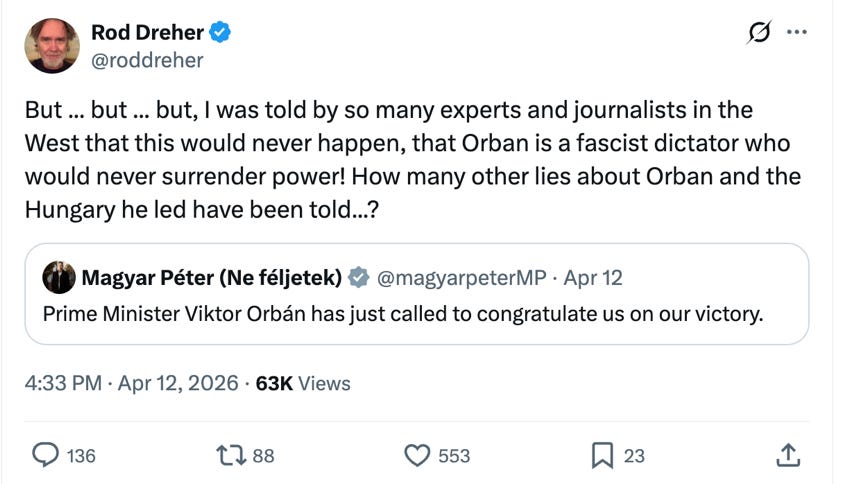
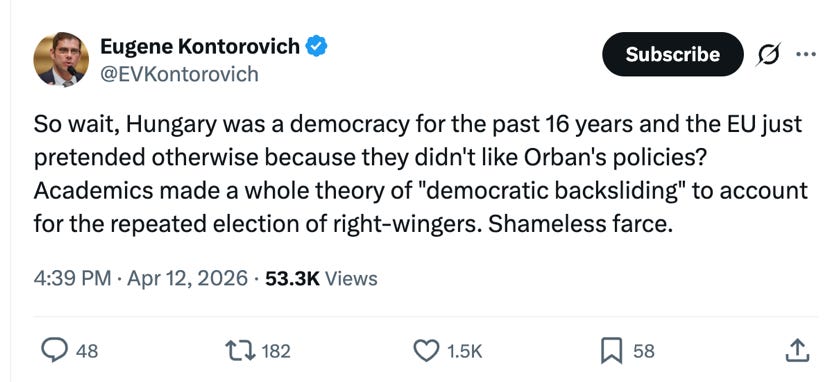
A Wall Street Journal editorial made the same point, pooh-poohing concerns about Orbán’s authoritarianism and possible election subversion as mere pearl-clutching by liberal elites which “cry fascism every time a conservative party does well.”
Of course, as Independent Institute economic historian Phil Magness pointed out, fears that Orbán might try dirty tricks were far from baseless, given the conspiracy theories Fidesz flogged about nefarious attempts to subvert the election on behalf of Magyar’s party, Tisza:
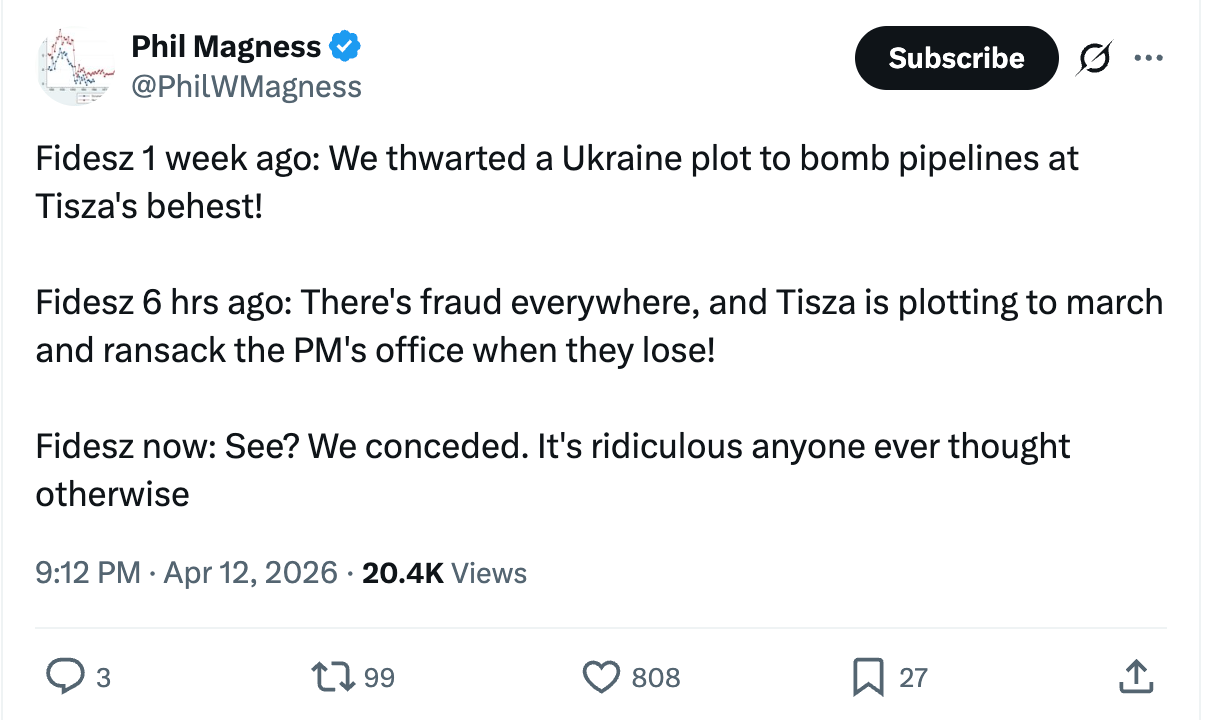
Orbán’s attempt to insinuate a Ukrainian plot to sabotage a Serbia-to-Hungary pipeline transporting Russian gas might have worked—and created a pretext to suspend the election—if not for an inconvenient glitch: While Serbian President Aleksandar Vučić backed his ally Orbán without directly accusing Ukraine, the country’s counterintelligence chief, Đuro Jovanić, confirmed that explosives were found near the pipeline but explicitly disputed a Ukrainian connection.
Orbán’s gracious concession was likely due to the magnitude of Magyar’s victory: “Too big to rig,” as Orbán fanboy Donald Trump kept saying on the campaign trail in 2024. Orbán and Fidesz tried every avenue of manipulation and underhanded coercion to hold on to power. The daunting obstacles faced by the opposition—fine-tuned gerrymandering and other byzantine electoral rules; severe disadvantages in access to media and even billboards; aggressive harassment of opposition candidates and activists—have been well documented. Orbán never went full autocrat à la Putin at least in part, no doubt, because he wanted to stay in the EU and keep the subsidies and the European markets.1 Two cheers for the despised “Eurocrats.”
Another coping mechanism: Maybe Orbán’s defeat is no big deal and maybe JD Vance just went to Budapest for the goulash. According to this narrative, Magyar isn’t actually a liberal; in fact, he isn’t all that different from Orbán, except on Hungary’s relationship with the EU.
But that’s a pretty big “except.” In his post-victory speech, Magyar was emphatic in differentiating himself from his defeated rival, portraying the vote as saying “yes to a free Hungary and yes to Europe” and pledging that “Hungary will once again be a strong ally in the European Union and NATO.” At his first news conference, he promised to unblock EU aid to Ukraine. He has also said that he opposes any attempts to force Ukraine into territorial concessions to Russia.
We don’t know how Magyar will govern. But his first steps clearly represent a pivot back to liberalism—not in the left-wing sense, but in the sense which includes the “conservative liberalism” of a Ronald Reagan or a Margaret Thatcher. No wonder it’s a bad day for nationalist-populist right-wingers in America, for many of whom Orbánism was not only an inspiration but a source of livelihood.
The subsidies have been partly frozen because of the Orbán’s government’s failure to meet EU standards regarding corruption, judicial independence, and civil liberties (which Orbán fans like National Review’s Michael Brendan Dougherty find “undemocratic”). But the funds disbursed to Hungary in 2024 still amounted to some 1.7 billion euros.