No Guns, No Drugs—Why Did We Blow Up These Boats?
Shocking new facts are still emerging about the campaign against ‘drug boats.’

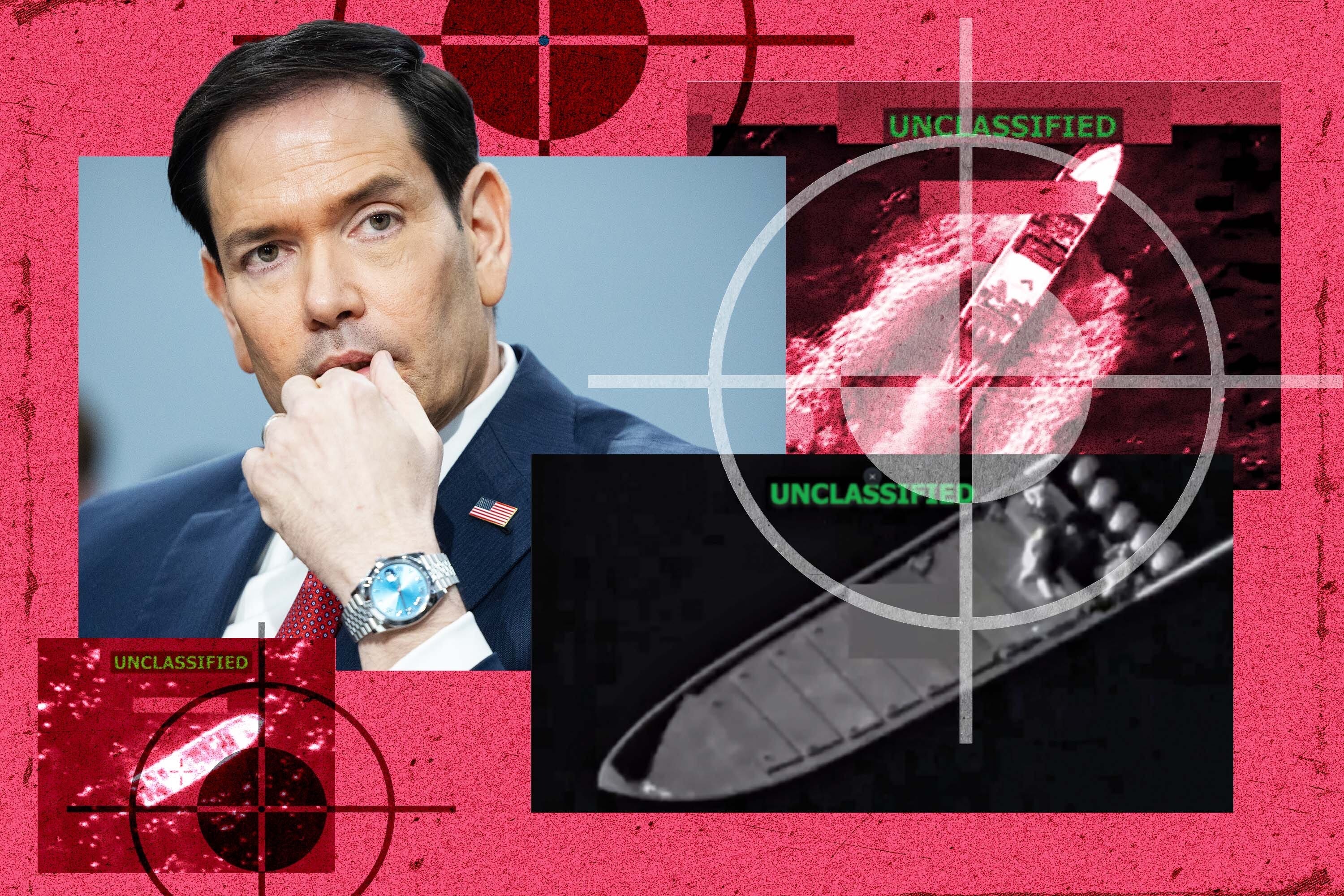
SENATORS TIM KAINE AND RAND PAUL made a shocking revelation last week about the U.S. military’s boat strikes in the East Pacific and Caribbean—attacks legal experts agree are illegal. In questioning Secretary of State Marco Rubio during a Foreign Relations Committee hearing, they revealed that the targeting decisions about which boats would be attacked did not take into account whether they had drugs or arms aboard. In other words, the military may have attacked—and may attack in the future—a boat that carries neither drugs nor weapons, yet somehow, according to the Trump administration, constitutes a military threat to national security.
The importance of their exchange should be understood in the context of how few details the Trump administration has shared in the first nine months of what it has dubbed Operation Southern Spear. Beginning on September 2, the Southern Command has carried out 62 air strikes against boats in the Caribbean and Eastern Pacific, killing at least 205 people. We know this because each strike is announced on U.S. government social media accounts, often with video of the boats blowing up. The Department of Defense claims it has authorization to use military force without congressional approval because the activities of these alleged drug traffickers constitute an “insurgency and asymmetric warfare” against the United States.
This is a ludicrous position. At the very least, insurgency and asymmetric warfare have to include some warlike activity, and merely sailing a boat through international waters is no more inherently warlike than taking a walk in the park or eating a hamburger. The Caribbean and East Pacific are not war zones. Even if the boats the military destroyed were smuggling drugs—an allegation that has not been proven—that would be a crime, not a military attack. While the administration argues the laws of war apply, an overwhelming number of legal experts conclude that they simply don’t.
Human rights groups have asserted repeatedly that if the government’s claims of drug trafficking are true, then the government’s efforts to curb the drug trade constitute a law-enforcement operation, where due process and the right to life must be respected. The government cannot use lethal force unless there is an imminent threat to life and less extreme means—in this case interdiction—are insufficient. Rubio has admitted that interdictions are possible, but that they have “limited to no deterrent effect,” while the strikes “disincentivize” the drug-trafficking industry by “blow[ing] them up” to “get rid of them.” Again, the government has not offered conclusive evidence that the boats they targeted had drugs aboard, and Secs. Kaine and Paul just made clear that they could have been targeted even if the military knew conclusively beforehand that they didn’t.
The United States government has intentionally killed at least 205 people outside any lawful circumstances—and the operation is still ongoing. These extrajudicial killings are a form of murder.
We don’t know exactly where the strikes have occurred. We don’t know what evidence or intelligence was used in determining the strikes. Most importantly, it doesn’t seem that anyone knows whom the United States government has killed. What little we know has been pieced together by civil society and journalists. An extraordinary collaboration launched by the Centro Latinoamericano de Investigación Periodística provides the most detailed account yet of the victims: After months of painstaking reporting, partially building on the work of other organizations and human rights groups, the consortium could identify just nineteen of the victims by their full names, including three wounded survivors. In a reminder that both the named and unidentified leave families and communities behind, two grieving families, with the support of the ACLU and Center for Constitutional Rights, have filed suit against the United States for wrongful death and extrajudicial killing.
We do know that the strikes have not slowed cocaine traffic—which makes sense given that we now know that the government didn’t care if the boats had drugs aboard before blowing them up. The new head of Southern Command, Gen. Francis L. Donovan, stated on the record to Congress in March that the boat strikes are not a long-term solution or “the answer” to drug trafficking.
This is what makes Secretary Rubio’s exchange with the senators on Tuesday so extraordinary. The presence of drugs or arms on the targeted boats would not change the rights to due process and to life of people on board. It is, however, a baffling admission that this cruel and lethal program is targeting these boats based on criteria other than being in possession of the very items purported in the administration’s already unlawful and dubious justification.
More than 200 people are dead just nine months into this illegal operation. We have no transparency. No accountability. And a general who doesn’t even defend the efficacy of it. Congress is being stonewalled. Congress should stop funding extrajudicial killings as a policy and use all available means to perform oversight and its own investigation.
Amanda Klasing is a lawyer and social scientist who has spent two decades working as a human rights researcher and advocate. She is the national director of government relations and advocacy at Amnesty International USA.
 | A guest post by
|