Precision Has a Price
When we burn through expensive precision weaponry, we lose some of our ability to keep distance between American service members and the enemy.

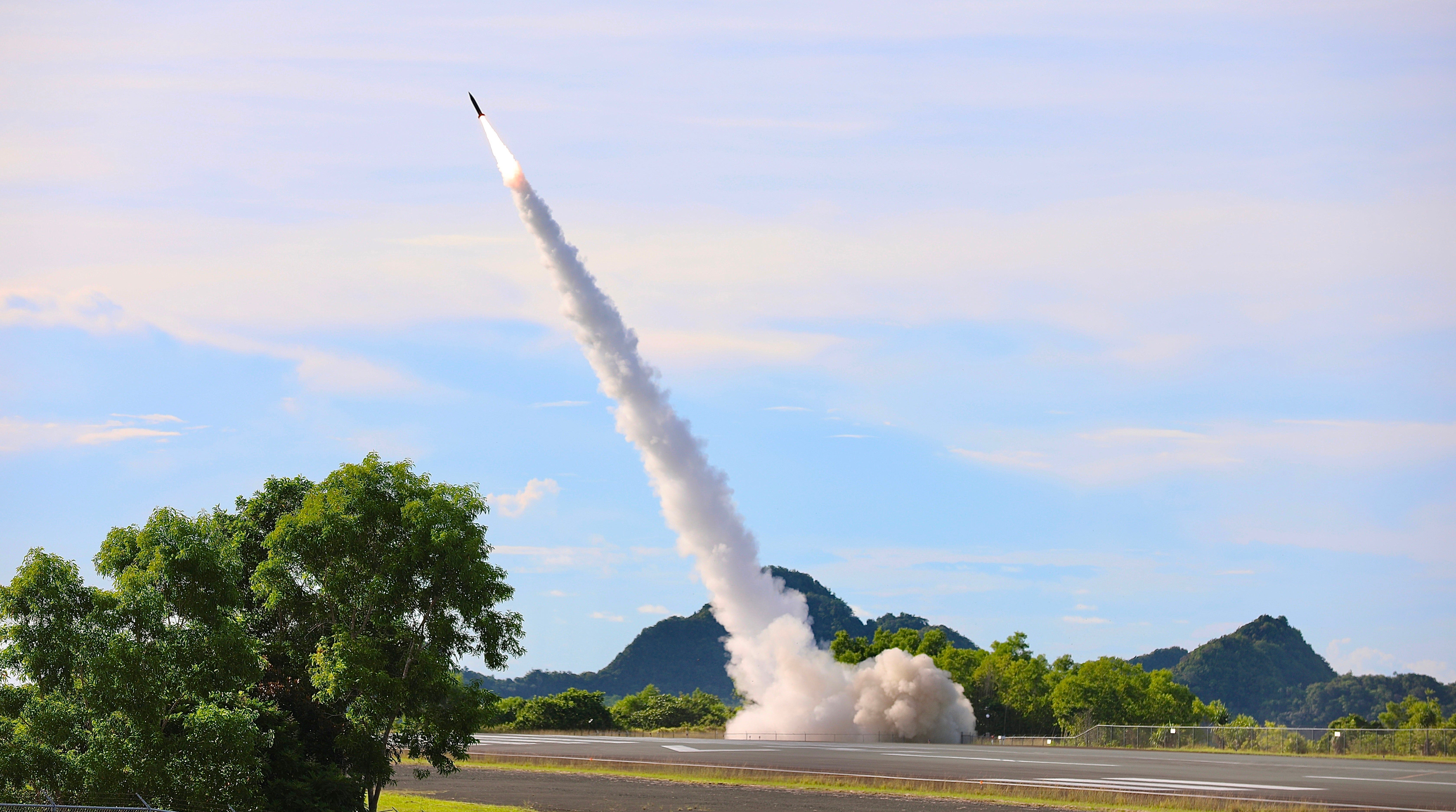
FOR GENERATIONS, SENIOR MILITARY officers attending professional military education have been taught a simple but enduring truth: Logistics establishes the art of the possible. No commander can conduct operations without the fuel, ammunition, and other resources needed to sustain the fighting force. Napoleon learned it. Eisenhower mastered it. Every successful military campaign has depended as much on logistics as on tactical brilliance.
That principle has not changed, but modern warfare has evolved and added another dimension. Today, inventories of long-range precision strike weapons and advanced missile-defense interceptors increasingly establish the art of the possible, as well. They determine how far a commander can reach, how effectively American forces can defend themselves and their allies, and ultimately how much risk servicemen and women must assume in combat. Precision has fundamentally changed the character of war, but in doing so created a new dependency. When those specialized inventories of weapons are constrained, the tremendous advantage that the precision technological revolution provides—the ability to put distance between friendly forces and the enemy—begins to shrink.
Recent operations against Iran have demonstrated both the extraordinary value of precision weapons and the extraordinary difficulty of replacing them.
President Trump has repeatedly insisted that he rebuilt America’s military and that the depleted munitions used to fight this war in Iran can be rapidly replaced because his administration is now building an unprecedented number of ammunition plants and factories. Defense Secretary Pete Hegseth has similarly dismissed concerns about degraded inventories, even while acknowledging that U.S. forces have conducted strikes on more than 15,000 targets during operations against Iran and have expended large numbers of missile-defense interceptors protecting American forces and regional partners from thousands of Iranian missiles and drones fired at their location.
These statements have received increased scrutiny from the public and the press—and that’s appropriate. Not because the United States lacks military strength, but because military capability, industrial capacity, and political credibility are inseparable. When leaders describe one inaccurately, confidence in the others suffers. And our leaders have been describing our capability inaccurately.
THE ISSUE IS NOT that the American military is running out of ammunition. It is not. The United States maintains enormous inventories across thousands of categories of conventional munitions. But there is a far narrower and far more consequential concern. Modern campaigns rely disproportionately on a relatively small family of sophisticated weapons that provide capabilities conventional ammunition simply cannot replicate. Long-range precision strike missiles allow commanders to destroy critical sites like command posts, logistics hubs, missile batteries, and other targets hundreds of miles from friendly forces. In defense, interceptors destroy incoming aircraft, missiles, and drones before they can strike. These systems are not interchangeable with artillery shells or unguided rockets.
I saw the beginning of that evolution firsthand during Operation Desert Storm in 1991. When intelligence identified an Iraqi artillery battalion threatening the advance of our units, destroying it generally required a massed artillery attack. A battalion of Multiple Launch Rocket Systems (MLRS)—the predecessor to today’s long-range precision strike capabilities—would fire dozens of rockets that would cover an area the size of a football field with a targeted strike. Airpower could accomplish similar effects, but doing so entailed a host of complications—pilots, aerial refueling, electronic warfare support, suppression of enemy air defenses, and careful coordination among multiple headquarters. We could achieve the desired effect simply by concentrating large amounts of firepower from the MLRS strike.
That equation changed dramatically over the next three decades. The Army introduced ATACMS, a short-range tactical ballistic missile that allowed a single launcher to strike targets nearly two hundred miles away with remarkable precision—within feet of the point of aim. Today’s Precision Strike Missile (PrSM) extends that reach even farther while maintaining the accuracy. A single PrSM round accomplishes what once required an entire MLRS battalion firing a volley of rockets.
The technological revolution behind precision munitions allowed commanders the ability to attack vital targets deep inside hostile territory without exposing aircraft or ground maneuver forces to unnecessary risk. It is the kind of tactical evolution that each war brings when new technology is applied to the battlefield.
Military technological innovation has consistently sought one objective: increasing the distance between friendly forces and the enemy (while maintaining the ability to destroy that enemy more effectively). A suit of armor puts distance and protection between the human body and a foe’s blade. The longbow extended striking distance beyond the sword or spear. Rifled bullets extended the range and accuracy of the musket ball. Aircraft extended strikes beyond the range of artillery, and precision-guided missiles extended it farther still. Every advance sought the same outcome: strike the enemy at greater distance before he could strike you. Precision weapons became the latest expression of the centuries-long evolution of warfare.
But every technological advance creates new dependencies. Precision substitutes quality and accuracy for quantity. While a single PrSM may accomplish what once required an entire MLRS battalion firing dozens of rockets, each missile becomes far more strategically valuable—and also much more difficult and expensive to build. When inventories of those weapons become constrained, commanders cannot simply substitute conventional ammunition and expect similar results. They either employ larger numbers of less capable weapons (and with them, the increased logistical demands), or they accept that some targets will survive until friendly forces can move closer.
In Iraq, a longtime friend once described close combat associated with the counterinsurgency we were fighting as getting “coffee-breath close” to the enemy. The colorful phrase captures something true about warfare. Every precision strike conducted at distance is one less enemy position American soldiers have to assault at close range. Every command post eliminated deep behind enemy lines with precision disrupts the coordination of those who would otherwise be fighting face-to-face with American troops. But when our long-range precision or “deep strike” capabilities diminish, that protective distance erodes. More missions fall to ground maneuver forces, and history suggests that when armies get coffee-breath close, casualties rise significantly.
The same principle applies defensively. Interceptors do far more than protect installations. They preserve operational freedom by allowing commanders to keep airfields open, ports functioning, logistics hubs moving, and headquarters operating despite missile attack. When these interceptors are depleted or constrained because of another evolution of warfare—massed drones or enemy ballistic missiles—commanders must decide which facilities receive protection, which allied bases assume greater risk, and which critical capabilities must be relocated farther from the fight. Shrinking inventories of U.S. air defense, like the very expensive Patriot or the even more expensive THAAD interceptors, again translates into shrinking distance between the battlefield and those we are trying to protect.
NONE OF THIS SUGGESTS the United States is defenseless. Far from it. The question is whether our nation can sustain the specialized capabilities upon which our force increasingly depends. Thousands of long-range strikes against Iran and thousands of defensive interceptions represent an enormous expenditure of our precision weapons. The exact inventories remain appropriately classified, but the operational reality is obvious: Every missile launched must eventually be replaced, and these kinds of weapons are very difficult to replace.
That brings us back to logistics and our defense industrial base.
The administration is correct that the Pentagon is working to replenish expended inventories. Congress has been asked for substantial appropriations for additional munitions procurement. Defense contractors are increasing production rates by negotiating long-term contracts intended to provide greater manufacturing stability. These necessary initiatives should not be confused with being able to rapidly replace the capabilities consumed during sustained combat operations.
Publicly available evidence does not support the claims of the president and secretary of defense about munitions and defense production. The administration may have held meetings with defense executives in the White House, and there has been some expansion of capacity within existing defense-industry factories, but we have yet to see a corresponding wave of publicly documented new facilities or related delivery of replacement weapons.
That distinction matters because manufacturing precision-guided missiles is fundamentally different from producing conventional ammunition. Our advanced precision systems rely upon rocket motors, seekers, guidance electronics, specialized software, precision machining, and highly specialized subcontractors that are spread throughout an intricate industrial network. At every stage, each component must meet exacting standards. A shortage of a single critical component from within a complicated supply chain can delay an entire production line. Constructing an entirely new missile-production facility requires a dizzying array of contracts, tooling, staffing, training, and years of integration before reaching efficient production. The administration cannot simply announce industrial mobilization. It must be built.
Independent defense analysts conclude that rebuilding our precision weapon inventories will likely require years because the existing defense industrial base was never designed to—and has yet to adapt to—sustain prolonged expenditures at the scale modern warfare is demanding.
The strategic consequences of this reality extend well beyond the Middle East. Reports that Patriot and THAAD interceptor batteries have been shifted from Europe and the Indo-Pacific to support operations in CENTCOM reflect the prioritization that occurs when a nation goes to war in a specific area. Yet every unit and its related ammunition moved into one theater is—temporarily—unavailable somewhere else for any other contingency. As we know, deterrence depends not only upon possessing advanced capabilities but also upon having enough to reassure allies and complicate the calculations of adversaries across multiple regions simultaneously.
It’s not a weakness to acknowledge these realities: it’s good planning. Every commander continuously assesses combat power, ammunition expenditures, logistics, replacement timelines, and future contingencies. Honest assessments allow sound strategy. Political narratives do not replenish inventories.
Precision has a price. It’s not measured only in millions of dollars per missile, but in every factor—the technological investment, the complex supply chains, the skilled workers, the procurement process, and the industrial capacity—that goes into their production. Most importantly, it is also measured in credibility. When political leaders insist that the expenditure of weapons have produced no meaningful degradation in ammunition stocks, or they suggest that years of industrial investment can be compressed into months, they undermine confidence in both military preparedness and national leadership.
The War College lesson remains as relevant today as it was generations ago: Logistics establishes the art of the possible. In the twenty-first century, that art is also determined by the precision weapons that allow American forces to fight at distance and the industrial base capable of sustaining them. If that foundation erodes, the battlefield changes. The distance between American servicemen and women and the enemy begins to close—coffee-breath close. The American people know it by another name: sending more of our sons and daughters into harm’s way than should be necessary because our leaders didn’t plan well, and they didn’t adapt to the realities of the battlefield.
And as Tim Cook so poignantly put it “All the tool and die makers in the US could fit in this room…” Good luck growing those in a hurry.