Shame Won’t Save Us From the Autocrats
One mistake anti-authoritarian movements keep repeating—and the urgent lesson for Americans.

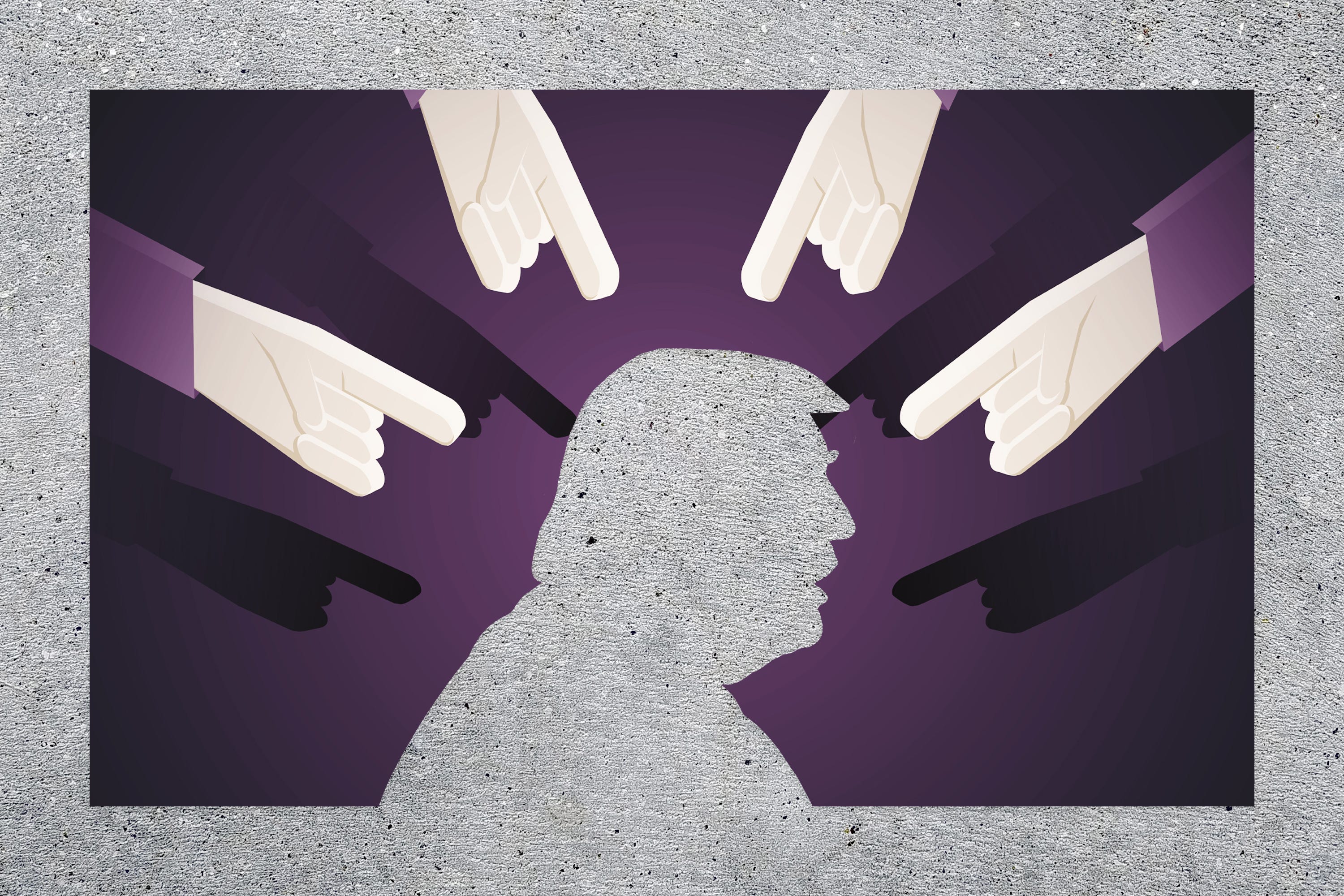
LAST YEAR, AS THE TRUMP ADMINISTRATION was rounding up protesters, invading neighborhoods, and prosecuting enemies, I was interviewing dissidents around the world.
The aim was to identify what Americans facing an authoritarian breakthrough could learn from others who have confronted political repression. My colleague Julia Angwin and I were working toward writing a manual full of practical steps Americans can take to preserve our own democracy.
There was so much about these conversations that surprised me. But among our most striking findings was the posture many dissidents took toward people who weren’t yet on their side. I had long imagined that times of extreme injustice demanded only the most hardened of measures from political activists—maneuvers to deliberately polarize the public, to force a choice, to shame people into changing their ways.
We did hear stories of dramatic tactics used by organizers to humiliate or isolate opponents, or to shift a public narrative, especially against powerful decisionmakers. But of the more than one hundred activists we spoke to on five continents, a far greater number described an approach that prioritized human engagement over demonization, even under conditions of acute injustice.
It was a strange split screen: As I watched a democratic crisis unfold in the United States and listened to organizers, opposition leaders, and movement scholars from other parts of the world, I grew more and more convinced that there is such a thing as overusing the blunt tools of polarization and shame—and that we in the American pro-democracy movement, prone as we are to sweeping statements about the MAGA rank and file, should take heed.
Nathan Law, a leader of the Hong Kong student movement that advocated for the island city to become autonomous from China, steeped his activism in bold acts of civil resistance. He staged a burning of official Chinese Communist Party documents in defiance of the mainland government; he led a 79-day occupation in the city’s financial center; he even went to prison for challenging the government. All of these actions projected the image of a brave but rash student protester—Law & Co. against the world.
Law does not regret his principled activism. But from his apartment in exile in London, he told us that were he to do it all again, he’d spend more time focused on communicating with fellow citizens, and trying different modes of persuasion along the way. “You will need to find other terminology and rhetoric to try to get into their worldview and try to convince them,” Law said. “If your rhetoric goes too far, it will naturally lose influence because people just feel like you are not the same species as them.”
This is a theme among even the most strident of anti-authoritarian dissidents with the benefit of hindsight: a wish that they had tempered their all-or-nothing posture and had been less rigid in message and strategy, more willing to start from a place of interpersonal humility. Freddy Guevara, a former Venezuelan opposition leader, now believes he was too maximalist while building the anti–Hugo Chávez movement in his home country. It was a mistake, Guevara told us, to assume that those who supported former presidents Chávez and Nicolás Maduro did so only out of ignorance or malice.
“If you want people to flip sides, you really have to make an effort to understand where they are coming from, why they believe what they believe,” he said. “I was too sure about my beliefs and not curious [enough] about the other side.”
Guevara recalls the opposition’s singular focus on material incentives, like building pressure on the regime by getting more people in the streets, or offering golden parachutes and pardons to members of the government who might join the opposition. But this thinking, he says, failed to account for the intangible factors that lead people to align with unjust power, such as ideology, world view, or social connection.
“There are many normal people who end up being part of these machines of oppression and they probably have some legitimate reasons—at least to them—that made them join,” Guevara said. “Even if you don’t engage them directly, you can understand what they are holding onto to design better strategies.”
Some leaders of the Russian opposition have advocated for a similar shared-interest approach. In May 2021, Andrei Pivovarov, a former chief of the reform group Open Russia, was preparing to run for a seat in the Russian parliament when secret police agents removed him from a flight that was about to depart. Arrested amid a broader crackdown on opposition figures prior to Vladimir Putin’s full-scale invasion of Ukraine, Pivovarov became one of the country’s most prominent political prisoners, incarcerated on widely discredited charges in a notorious penal colony until he was released in August 2024 as part of a prisoner exchange with the West.
Today Pivovarov is still speaking out against Putin’s abuses. But from his Berlin apartment, he’s no longer focused solely on shoring up the Russian opposition. Instead, today he makes TikTok, Instagram, and Telegram videos addressing conservative Russians whom he believes have become disenchanted with the human and economic toll of the Ukraine war and rampant corruption in the Russian army’s upper ranks.
“I want to speak with people in the army who hate liberals, and hate me as a person who left Russia,” Pivovarov says. He believes he is filling a gap in the information space, giving voice to a narrative he believes many in Russia feel but can’t speak out of fear of meeting his own fate. “My best hope is that they’ll say, ‘He’s a bad guy, but he speaks the truth,’” he told us. “They’ll never be a liberal activist, they’ll never be a person who will fight for democracy. But I hope they’ll be a big problem for the Kremlin.”
NATAN SHARANSKY, THE FAMED SOVIET dissident who in the 1970s and ’80s advocated for the right of Jews to emigrate from the Soviet Union, writes that three kinds of people can be found in illiberal societies: the true believers, the dissidents, and the double thinkers. Sharansky’s third category—the people who “no longer believe in the regime but are too scared to say so”—are often the most important in tipping the scales of a successful political revolution. They’re up for grabs and persuadable.
So, what moves double-thinkers? According to Jonathan Pinckney, a political science professor at the University of Texas at Dallas, when people do change their political commitments, they typically do so in subtle ways—gradually and along a spectrum. “It’s really difficult to make a dramatic shift from one group to another,” Pinckney says. “The more authoritarian a country becomes, the harder it becomes to gauge what people’s true opinions are, and whether they might be willing to shift loyalty or defect in some kind of important way.”
That’s due, in part, to a fear of how a repressive regime might respond to dissent. But another fear can hold people back: fear of social ostracization. People care intensely about group identity. The desire to belong to a tribe is a basic human impulse, a primal need that even today remains a matter of survival. We depend on our friends, family, and social or professional communities for our spiritual, psychological, and material needs.
Breaking with our group’s dominant views can put those relationships at risk, leaving us alone and vulnerable. That’s why speaking out can feel existential, Pinckney explains. “If your strategy depends on saying, ‘We need people who are our most vehement opponents to become our most vehement supporters or else we’re not interested, that’s unlikely to work.”
A better goal, oftentimes, is provoking smaller shifts among the targets of a campaign. “Movements and campaigns are [not won] by overpowering one’s active opposition,” writes Nadine Bloch, a longtime strategic nonviolent action trainer who has worked on a range of issues, from banning dangerous chemicals in schools to fighting nuclear proliferation. Instead, they work “by shifting each group one notch around the spectrum (passive allies into active allies, neutrals into passive allies, and passive opponents into neutrals).”
There’s a time and place for more aggressive tactics. “Extreme opposition folks need to be isolated, made to look bad, exposed as evil, ridiculed,” Bloch says. When matters of human life and dignity are at stake, when rights hang in the balance, there is an imperative to polarize the public to push decisionmakers: Will we abolish slavery? Will we enfranchise all our people? Will we allow a leader to get away with stealing an election? Successful anti-authoritarian efforts often rely on a strategy of imposing costs—including public shame—on powerful figures and their allies. Successful dissidents make it painful for the state to continue with its illiberal behavior.
But the way a movement engages its potential allies—ordinary people simply existing in the shadow of politics, even those who may sometimes disagree with or even dislike the movement—can also move them to join, or hold them back, and ultimately influence the movement’s success.
Black Lives Matter cofounder Alicia Garza once described to the writer Anand Giridharadas a dinner where frontline activists were networking with wealthy liberal-minded donors. The goal, after decades of billionaire backing for the American conservative movement, was to facilitate relationships that could lead to a better-funded progressive movement.
During the dinner, one of the affluent supporters shared a comment Garza found awkward. The remark indicated that the woman had good intentions, but still evolving politics. An activist in the room reacted by chiding the donor, until the donor withdrew and then headed for the exit. “I have never seen an instance where, because somebody was deeply shamed or called names or ignored, they changed their mind,” Garza told Giridharadas, who wrote about the episode in his 2022 book The Persuaders. He later paraphrased Garza’s insight: “If there’s non-radical people in your radical space, that’s when your movement is succeeding.”
This is a core irony of a dissident’s work: Though you may begin in a political home small enough to house a committed few who share your views, you will succeed only when that home grows to fit a far broader range of ideas and identities.
Does this mean the movement for constitutional democracy in the United States must accept all people of all views at all times? Absolutely not. A big tent is not the answer to every problem. People of good faith can get played—and movement goals can suffer—when democrats join together with authoritarians, reformers get in league with those accused of corruption, sketchy figures sidle up to those who might cleanse their image. These arrangements are what researchers Duncan McCargo and Rendy Wadipalapa call “toxic alliances,” a term they coined in a 2024 article in the Journal of Democracy.
“While superficially compelling, calls for unity may be wide open to manipulation and abuse by the politically unscrupulous,” McCargo and Wadipalapa write. If what you’re after is a democracy where all people have equal rights, dignity, and opportunity, it is counterproductive to make common cause with those who don’t share that fundamental vision. A democratic movement must do the difficult work to recognize the difference between those who will never share its views and those who might.
IT IS RARE FOR A COUNTRY to escape democratic backsliding without a massive, broad-based coalition. The global dissidents Julia Angwin and I met echo in their stories what social movement researchers have found in their scholarship. Constrained political circumstances require pro-democracy actors to adjust the ideological standards to which we hold our allies for the task of reclaiming a democracy. There is no reason to believe that the kinds of compromises that have helped head off power grabs in places like Zambia, Poland, and Brazil can’t work in the United States. And coalitions that are expanding their power will, by definition, include people who have changed their mind.
Granting people the space to shift their political behavior without shame is all the more important under authoritarianism. What Garza and the dissidents we interviewed describe is essential not only for the sake of personal redemption, but also because a politics that seeks, facilitates, and embraces personal evolution is one that’s serious about movement growth and bringing about material change in people’s lives: better wages, housing that people can afford, rights that the government actually defends. And a true, multiracial democracy.
Even some of history’s most unflinching moral voices have seen great value in meeting ordinary people where they are. Steve Biko, the South African anti-apartheid activist and martyr, was once traveling through the country when he spotted two young white men hitchhiking on the side of the road. It was the height of apartheid, and Biko had become a hero among blacks but despised and feared among whites, known for his stirring calls for black South Africans to liberate themselves economically, culturally, and psychologically from the white society that subjugated them.
Biko was a strong proponent of black South Africans withdrawing from all cooperation with white institutions, a position that exceeded even what the African National Congress was willing to embrace. Yet when the dissident leader spotted the hitchhikers, he pulled over to offer them a lift. With no other options, the young men reluctantly got in. “Are you boys English-speaking or Afrikaans-speaking?” Biko asked them. “I’d love to practice my Afrikaans with you.” Knowing that many black South Africans resented Afrikaners, the passengers insisted they spoke only English.
But their driver could hear in their heavy accents hints of the Dutch-inflected language spoken by many whites. To the mind of Biko, whose activism emphasized cultural pride and self-worth, there was a difference between the identity of his passengers and the racist ideology of their white supremacist government, and even the profoundly harmful attitudes that pervaded white society. A person is a person, all people can change, and when people change, so too can a society.
“There’s nothing to be ashamed of in language or culture,” Biko called back to them from the driver’s seat. “In fact, you should be proud of these things!” His passengers loosened up and the three travelers made conversation in Afrikaans all the way to Johannesburg.
Ami Fields-Meyer is the coauthor, with Julia Angwin, of On Courage: How to Be a Dissident in an Age of Fear, published this week by Mariner Books, an imprint of HarperCollins. A senior fellow at the Harvard Kennedy School, Fields-Meyer was a senior policy adviser in the Biden White House, where he led initiatives on civil rights, technology policy, and consumer protection. His writing has appeared in the New York Times, the New Yorker, the Atlantic, and Foreign Policy.
 | A guest post by
|