Still Radical, Still American
Gordon Wood chronicled America’s rambunctious democratic culture. It’s giving way to a new deference to authority.

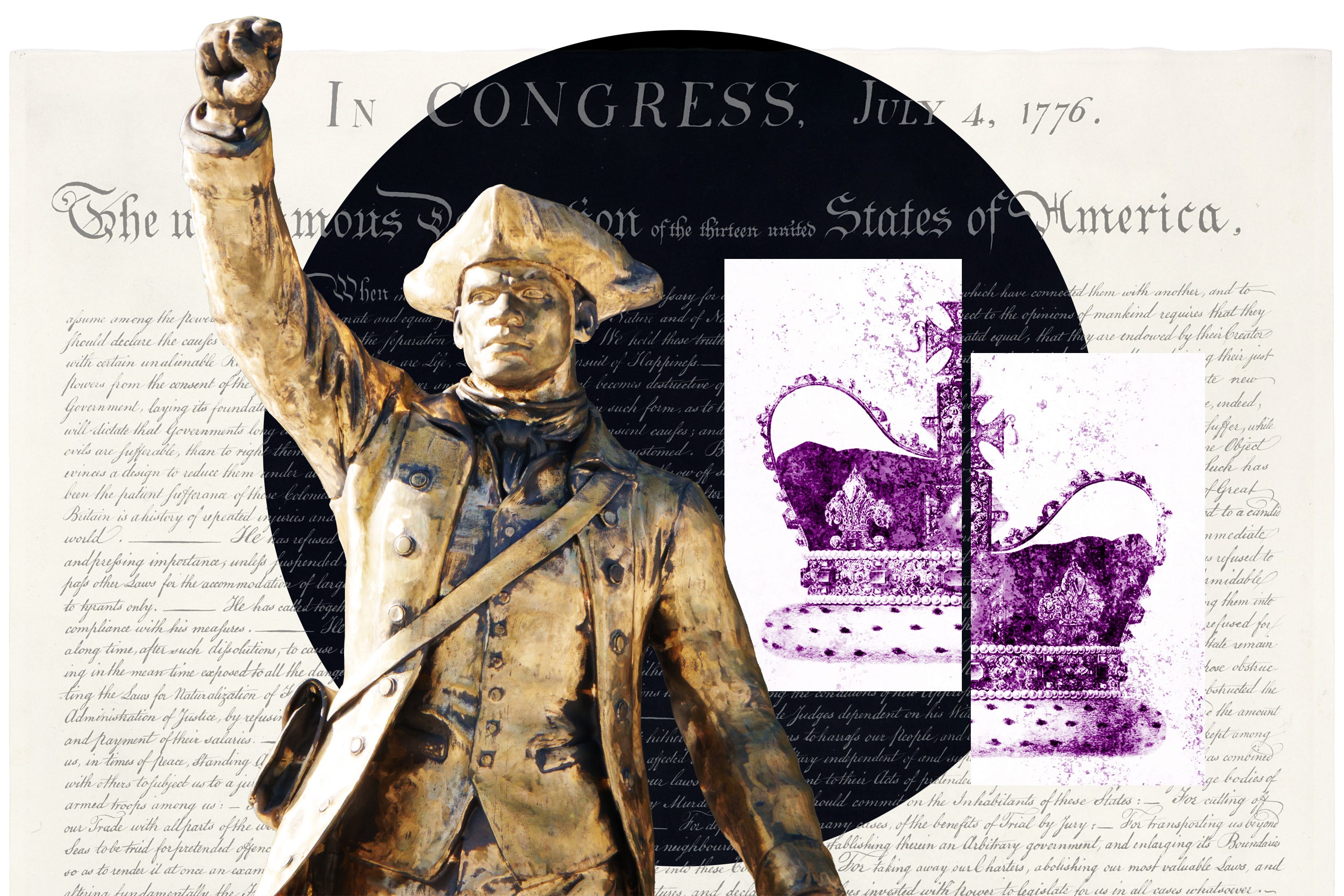
AS AMERICA APPROACHES ITS SEMIQUINCENTENNIAL, the country is in a profound, self-doubting mood. A recent Reuters poll found that 40 percent of respondents are uncertain the United States will even exist in another 250 years, while two-thirds believe that even if the country itself endures, American democracy as an organizing political and social framework is in danger of failing.
Such gloom is far from the triumphant spirit that animated the Centennial Exposition in Philadelphia in 1876, when Americans emerged from the blood and rancor of the Civil War to celebrate the preservation of the Union; or from the tall ships, fireworks, and unabashed patriotism of the Bicentennial a century later. Americans approaching their 250th birthday seem less inclined to celebrate the nation than to wonder what, exactly, has become of it.
In part, this crisis of confidence reflects our political moment—one marked by extreme partisan rancor, ideological self-sorting, and the erosion of norms and institutions that generations of Americans regarded as central to the nation’s character. But it hints at something deeper. Beneath our contemporary political disagreements lies a more fundamental uncertainty about the kind of people the American Revolution created and whether we still wish to inhabit the anti-hierarchical, fiercely democratic culture it bequeathed to us. No historian did more to illuminate that inheritance than the late historian Gordon Wood.
Wood, who died tragically this month at the age of 92 after being struck by a car, was a towering figure in the American academy.
More than any other scholar of his generation, he reshaped how Americans understand the Revolution and its consequences. In a series of influential books culminating in his Pulitzer Prize-winning volume, The Radicalism of the American Revolution, Wood argued that the Revolution was more than a successful rebellion against Britain or the creation of a new constitutional order. It created a social and cultural revolution that transformed Americans themselves.
That insight altered the course of American historiography—the way historians think about and write history. If earlier generations of historians had focused on why Americans rebelled, Wood asked: What kind of society did the Revolution create?
His answer was provocative. Wood argued that the Revolution’s most enduring legacy was the dismantling of a world marked by inherited authority and social dependency and the creation of a fiercely (and, in its early years, uniquely) democratic culture that was both egalitarian and individualistic. When Wood referred to the “radicalism” of the American Revolution, he meant this world made anew.
I knew Wood first as a teacher and later, briefly and improbably, as a colleague at Brown University. We were never close, but he was invariably kind to younger scholars. What I remember most, however, was the devotion he inspired among undergraduates. Despite belonging to a different generation, students found his lectures exhilarating, challenging, and intellectually transformative.
As we mark America’s 250th, perhaps no book is more essential to revisit than Wood’s magnum opus. Its rich scope and insightful analysis help explain both the democratic culture we’ve inherited and the growing temptation, in our own time, to trade parts of that inheritance for newer forms of hierarchy.
WHEN HE EMERGED AS A MAJOR SCHOLAR in the 1960s and 1970s, Wood was writing against a historical interpretation of the American Revolution that had dominated much of the century until then. For decades, so-called Progressive historians like Charles Beard shaped the field and defined the terms of debate. Viewing history through a materialist lens of social classes and conflict, they challenged older patriotic accounts that portrayed the founders as disinterested statesmen guided primarily by virtue and principle.
Instead, Progressive scholars argued that the great political conflicts of the eighteenth century really reflected competing economic interests and class divisions. The Constitution, Beard famously contended, was less the product of high political ideals than an effort by wealthy landowners and merchants to protect their economic interests against democratic pressures unleashed by the Revolution itself. As for the Revolution, the Progressive scholar Carl Becker memorably argued that the central question was not simply one of “home rule,” but of “who was to rule at home.”
Wood, alongside scholars like Bernard Bailyn (his graduate dissertation advisor at Harvard), did not restore the old heroic approach to the Founders. But he challenged the prevailing assumption that revolutionary rhetoric merely disguised the leadership’s material interests. Americans, he argued, genuinely feared corruption, arbitrary power, and the destruction of republican liberty. Revolutionary leaders were not simply advancing parochial economic agendas while using the language of republicanism; they believed those principles deeply.
Wood added a real depth to our understanding of the republican ideas prevalent in the Revolutionary era. Yet his most enduring contribution came with The Radicalism of the American Revolution, published in 1991.
Historians had long treated the Revolution primarily as a political event—a successful colonial rebellion that created a new nation and government. But Wood argued that its deepest significance lay elsewhere. The Revolution unleashed a social and cultural transformation that dismantled the era’s inherited authority and aristocratic pretensions, and in doing so created one of the most democratic and egalitarian societies in the modern world. Independence, in Wood’s telling, created a new type of people: Democrats, with a small “d.”
THE PRE-REVOLUTIONARY WORLD that Wood described was a monarchy in that it had not just a king, but assumptions of hierarchy and human difference that permeated society from top to bottom in ways modern Americans would find almost unrecognizable. As “pater familias of the nation,” per William Blackstone, the king stood at the apex of a deeply ordered society that extended from government to church, workplace, and family.
The assumptions governing relations between kings and subjects extended to those between fathers and children, masters and servants, gentlemen and commoners and, in the American colonies, enslavers and the enslaved. David Hume observed that the monarchical world of the eighteenth century was “a long train of dependence,” or in Wood’s words, “a gradation of degrees of freedom and servility that linked everyone from the king at the top down to the bonded laborers and black slaves at the bottom.” As a Revolutionary-era minister put it, “Every Person has his proper Sphere and is of Importance to the whole.”
This hierarchy went beyond politics and economics, shaping the emotional and psychological worlds colonial Americans inhabited. A son was expected to defer to his father, a tenant to his landlord, a commoner to a gentleman, and a colonial governor to the king. People understood themselves not as autonomous individuals but as occupants of a particular station within a larger social order.
Although he argued against explaining Revolutionary politics solely in terms of vested economic interests, Wood didn’t deny that inequality existed in the era. But he wanted his readers and students to resist the temptation to view the eighteenth century through a modern lens. Colonial Americans did not understand themselves in terms of class. They lacked what Wood called the “large-scale, horizontal solidarities of occupation and wealth with which we are familiar today,” explaining that “Distinctions in colonial society were measured by far more subtle, far more emotionally powerful criteria. Money and property were of course critically important, but by themselves they could not create and sustain the inequalities of this social hierarchy.”
In fact, most white colonial subjects would have agreed that the world they inhabited was just and normal. As the celebrated English poet Alexander Pope wrote in his influential Essay on Man, “Order is Heav’n’s first law,” and in that order, “Some are, and must be, greater than the rest.” The New England Calvinist preacher Jonathan Edwards echoed the sentiment when he observed that all people had “their appointed office, place and station . . . and everyone keeps his places, and continues his proper business.”
And the system was not understood as one in which benefits only flowed upward. Those of a higher station had duties to the lower, and were expected to provide leadership, protection, patronage, charity, and employment to those beneath them. In turn, inferiors owed their superiors obedience, respect, and loyalty. Society was viewed not as a battleground of competing interests but as an organic whole whose members possessed different responsibilities yet remained bound together by reciprocal obligations.
In Wood’s view, the existence of this hierarchical world alone didn’t lead to Revolution. The crisis came because colonial reality increasingly contradicted these inherited assumptions. Compared to the Old World, America’s social hierarchy was comparatively shallow. (Wood called it a truncated aristocracy in which there were fewer aristocrats, fewer peasants, and more people in the middle.) The continent’s abundance of land, once wrested from Native hands, fostered widespread land ownership and with it a degree of independence unknown in much of Europe. Far from London, colonists grew accustomed to governing themselves through local assemblies and institutions. When imperial officials after the Seven Years’ War sought to tighten control over the colonies, many Americans came to believe that the Crown and Parliament had violated the reciprocal obligations that bound ruler and subject together.
It was this perceived breach of trust that made Americans perhaps the most receptive audience to the writings of England’s Country Whigs, a loose group of radical writers and thinkers whose opposition to the Crown warned relentlessly of corruption, arbitrary power, and conspiracies against liberty.
At first, the colonists drew upon these ideas to defend what they regarded as their traditional rights as Englishmen, still living mentally inside that tight, hierarchical world. But the logic of the imperial crisis carried them further than they initially intended. In challenging the authority of Parliament and ultimately the king, Americans began questioning the assumptions that underlay monarchical society itself. By the eve of independence, many had ceased to think like subjects and had begun to think like classical republicans.
Wood spent much of his career deeply interested in why the Revolution happened and how Americans came to embrace republican ideas. But over time he began to wonder what that rupture had done to them. How did the rejection of kings, aristocrats, and inherited authority transform the way ordinary people understood themselves and their place in society? His answer was his most important contribution to our understanding of the Revolution and, perhaps, of ourselves.
THE REVOLUTION DID NOT STOP WITH INDEPENDENCE, or even the end of monarchy. The colonists who embraced republican ideas in the 1760s and 1770s, including the signers of the Declaration of Independence, did not seek to create a radically democratic society. Most hoped merely to replace a corrupt monarchy with a virtuous republic governed by independent, disinterested citizens. In many respects, they retained the older assumption that society possessed a single public interest that wise and virtuous men could discern.
But revolutions seldom contain themselves. Wood’s mentor, Bernard Bailyn, had already detected what he called the Revolution’s “contagion of liberty.” Once Americans embraced the idea that authority required greater justification than inheritance, the implications spread rapidly beyond the imperial crisis and throughout society.
Colonists had routinely denounced parliamentary overreach and imperial control as forms of “slavery” during their struggle with Britain. After independence, some began to confront an unsettling contradiction: If political slavery was intolerable, how could actual slavery be consistent with the Revolution’s principles? In the years immediately following independence, states dismantled established churches, broadened political participation, and, throughout much of the North, began the slow process of abolishing slavery.
Beyond the question of slavery, Americans scrutinized other ancient assumptions. If ordinary citizens were capable of governing themselves, why should they defer to social superiors? Indeed, why should citizens assume that there was a single, overriding common good? The Revolution gradually transformed the way Americans understood authority itself.
Consider this revealing example from a 1786 debate in the Pennsylvania legislature over whether to renew the state bank’s charter. Defenders of the bank, many drawn from the state’s elite, insisted they were acting on behalf of the public good. Their opponents were unconvinced. William Findley, a Scotch-Irish immigrant and former weaver from western Pennsylvania, observed that, far from disinterested guardians of the common welfare, many of the bank’s advocates were also its shareholders and were “acting as judges in their own cause.” More strikingly still, Findley thought self-interest was just fine. “Any others in their situation . . . would do as they did.” Different groups, regions, and occupations possessed different interests, he argued, and politics existed to negotiate among them: That was democracy.
Wood saw a critical turning point in this exchange. The older republican world presumed an organic society held together by shared interests and guided by men of virtue, and, sans king, it was not altogether different from the world that preceded it. Such was the worldview of leading federalists like John Adams, Fisher Ames, Alexander Hamilton, and George Cabot.
The democratic society that emerged from the Revolution more and more assumed the opposite: that citizens would pursue competing interests, that disagreement was natural, and that no individual or class possessed a unique claim to wisdom or authority. What began as a republican critique of monarchy swiftly evolved into a broader assault on hierarchy itself.
These democratic implications went well beyond governing bodies and elections. If ordinary citizens no longer needed to defer to aristocrats, why should they defer automatically to anyone else? Over the first half of the nineteenth century, professions such as law, medicine, and the clergy underwent thoroughgoing democratizations. States loosened educational and licensing requirements. Expertise itself even became subject to popular scrutiny. Not everyone welcomed the change. One college president worried about a future populated by books entitled Every Man His Own Lawyer, Every Man His Own Clergyman, and Every Man His Own Physician. Another critic lamented a culture in which “the unalienable right of private judgment involves the liberty of thinking as we please on every subject.”
The society that emerged from the Revolution bore little resemblance to the hierarchical world Americans had inherited from Britain. By the age of Andrew Jackson, broadly the 1830s and early 1840s, voting qualifications had been dramatically relaxed, established churches were in retreat, and a cacophonous marketplace of evangelical denominations competed for converts. The deference once accorded to gentlemen steadily eroded as ordinary citizens demanded a greater voice in every aspect of public life. Even status itself was redefined. In a society that increasingly celebrated enterprise and self-making, inherited rank mattered less than individual achievement and the accumulation of wealth. The result was a noisier, more contentious, and more democratic culture than the Revolution’s architects had ever envisioned, and something thoroughly American.
Wood did not celebrate every consequence of this transformation. But he regarded it as one of the Revolution’s most significant legacies. Americans gradually dismantled a culture of deference. The old assumption that wisdom flowed naturally from station gave way to a far more democratic and often more unruly conviction that individuals were entitled to judge for themselves and chart their own path. Having begun as a protest against arbitrary political authority, the Revolution ended by challenging authority of nearly every kind.
OVER TWO CENTURIES LATER, Americans are unmistakable heirs of the democratic culture Wood described. We see it in the suspicion of expertise chronicled by political scientist Tom Nichols in The Death of Expertise, in the modern impulse to “do your own research” (experts be damned!), and in the expectation that every opinion deserves a hearing regardless of credentials or station. Far from departures from the American tradition, they are products of it. The Revolution’s assault on hierarchy helped create a society in which inherited, and even earned, authority commands little automatic respect, and individuals feel entitled to render judgment on nearly every question.
As we approach America’s 250th birthday, I think another development would have fascinated Wood. He spent a lifetime chronicling Americans’ growing distrust of inherited authority, social rank, and deference. Yet his work also suggests a paradox he never fully explored. If Americans continue to distrust traditional sources of authority, they seem to be simultaneously drawn to new forms of hierarchy and deference.
Donald Trump has governed less as a constitutional republican (and certainly not a democrat) than as a leader openly attracted to the symbols and prerogatives of personal rule. His redesign of Washington, D.C., complete with grandiose architectural projects, monumental displays, military pageantry, and the conspicuous branding of public spaces with his own name and image, reflect a distinctly monarchical understanding of political power and prestige. His repeated assertions of executive authority at Congress’s expense similarly suggest an idea of leadership rooted in personal command, not republican restraint. His demand of fealty and obeisance, particularly from his own cabinet members and followers, would have seemed entirely normal in 1750, or even 1775.
Neither is the phenomenon confined to politics. In a nation born in rebellion against inherited authority, millions now look upon technology billionaires with the admiration and deference earlier generations might have reserved for aristocrats. The language differs, but the impulse is familiar: Exceptional individuals are imagined to possess unique insight, wisdom, or legitimacy by virtue of their success. If Elon Musk’s new IPO is valued at entirely improbable multiples, well . . . he’s Elon Musk! Ordinary people are honored to transfer their wealth to him.
Wood’s insight points toward this paradox. Americans have spent two centuries rebelling against inherited authority and elite expertise, only to create new forms of authority in their place. The pattern is an old one, visible as far back as Andrew Jackson’s assault on established elites. But today’s version is particularly striking. A movement born in opposition to experts, institutions, and credentialed authority often transfers its trust to celebrities, billionaires, influencers, and charismatic political leaders. The American suspicion of hierarchy has rarely abolished hierarchy; more often, it has replaced one set of objects of deference with another.
That may be one of the enduring lessons of the American Revolution as we approach its 250th anniversary. The Revolution created a society more democratic and egalitarian than its architects could have imagined. But it did not free subsequent generations from the perennial challenges of self-government: deciding whom to trust, how much authority to grant them, and how to preserve liberty without surrendering either to blind deference or corrosive cynicism.
In effect, Americans remain deeply democratic in their instincts, yet increasingly comfortable with concentrations of wealth, power, and personal authority that would have struck many nineteenth-century heirs of the Revolution as unsettling.
That paradox—our simultaneous suspicion of authority and longing for it—lies at the center of contemporary American life. It is also why Gordon Wood’s great book remains so relevant. The question confronting Americans on the eve of our 250th birthday is not whether the Revolution succeeded. It is whether we remain committed to the radically democratic society that it produced.
 | A guest post by
|