Talk of Canceling Elections Shows Trump Is Unfit for Office
No president has ever canceled a federal election, even in our deepest crises.

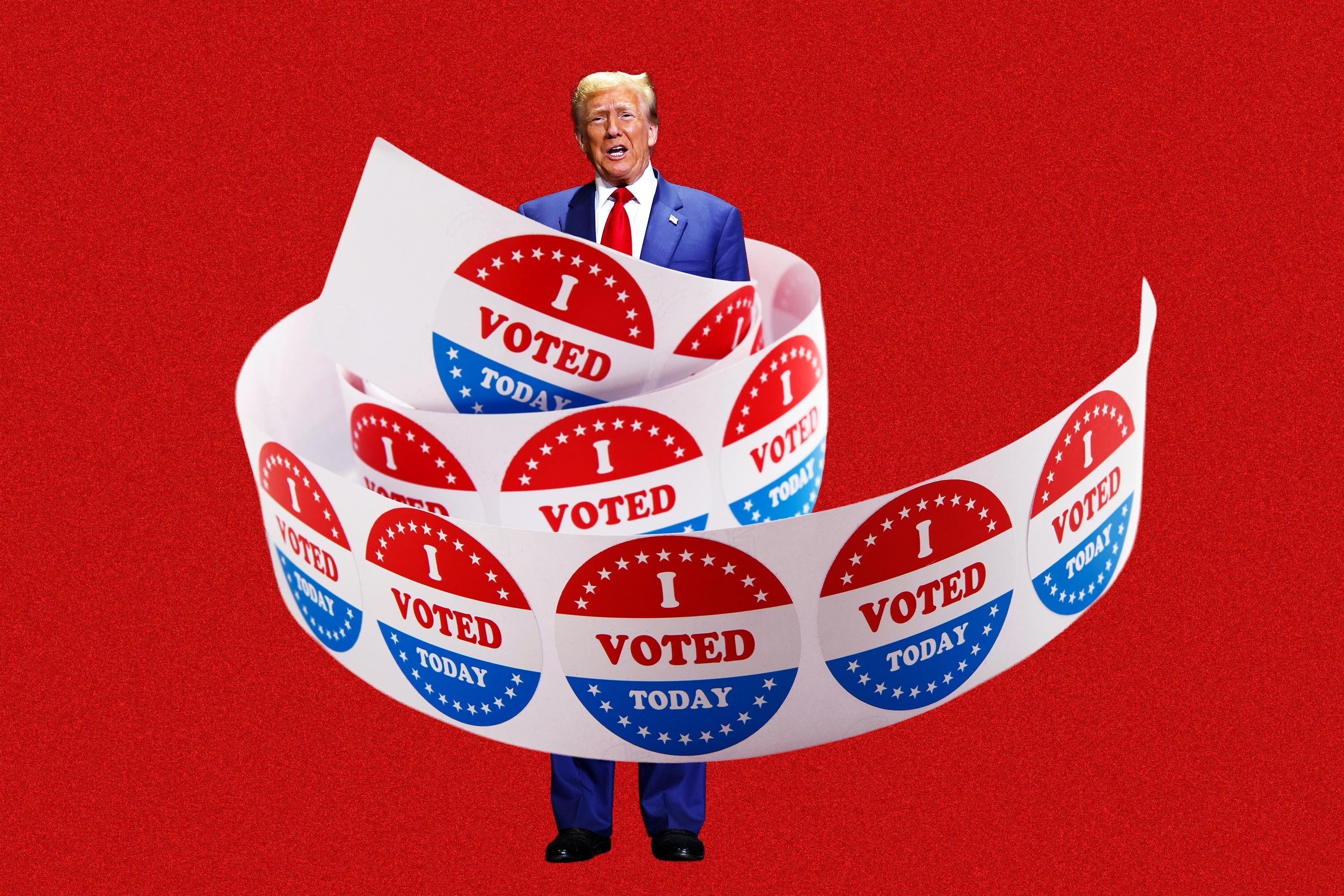
IN A CONVERSATION with Ukrainian President Volodymyr Zelensky last August, President Donald Trump noted that Ukraine hadn’t held elections since the Russian invasion, asking whether elections are called off during a war. Before Zelensky could respond, Trump added: “Oh, that’s a good thing.” Five months later, Trump mused apophatically about canceling elections out of disdain for Democrats. Just days after that, in an interview with Reuters, Trump reflected with his typical braggadocio that, given his great success as president, “we shouldn’t even have an election” this November. The sheer number of times Trump brought up canceling elections forced White House Press Secretary Karoline Leavitt to clarify that the president was only joking.
But in light of Trump’s repeated affronts to democracy—including January 6th and his sustained lies about the results of the 2020 election—we are forced to take these remarks seriously. His comments show that he does not understand the essential place elections hold in our constitutional order and, in doing so, reveal a man unfit for the office he holds.
If and when Trump, believing he will lose control of Congress and face a third impeachment, tries to suspend November’s congressional elections, voters need to remember that Americans have held elections through national and international upheavals far more worrisome than anything the forty-seventh president can cite.
In 1862, in the midst of the Civil War that killed as many Americans as every other conflict in the nation’s history combined, Abraham Lincoln did not try to suspend the country’s congressional elections. Nor in 1864, when he ran for a second presidential term against Union General George B. McClellan, did he defy the country’s electoral laws and traditions.
Similarly, in 1898, during America’s war with Spain, William McKinley never tried to call off America’s congressional elections. And, despite warning against the dangers posed to the country’s democratic and economic systems by “radical” Democrats led by William Jennings Bryan, McKinley did not try to block the presidential election in 1900. Since there were no polls to encourage McKinley’s hope of winning, he simply believed Americans would not abandon their regard for traditional political institutions by electing Bryan. He, of course, was right.
Between 1914 and 1918, as Europe fought World War I, which the United States joined in 1917, Woodrow Wilson believed it essential to hold the 1916 and 1918 presidential and congressional elections. These elections demonstrated that, even in times of crisis, American democracy remains an effective form of governance.
In 1930, after the New York Stock Market crash of 1929 that triggered the Great Depression, the worst economic downturn in American history, Herbert Hoover did not try to suspend the congressional elections—elections in which the Democrats won control of the House for the first time since 1918. Despite a worsening economy that deepened public animus toward Hoover, he refused to declare a national emergency or try to call off the 1932 presidential election. When Hoover’s argument that the Democratic candidate, Franklin D. Roosevelt, would only make things worse failed to convince voters, he accepted defeat and transferred power to Roosevelt.
In period separating FDR’s election and inauguration, national conditions were fraught and unstable. In the chaos, an unemployed immigrant, Giuseppe Zangara, tried to assassinate Roosevelt in Miami, where the president-elect had gone to fish before assuming the burdens of office. When a bystander hit the gunman’s arm as he fired his pistol, the bullet missed Roosevelt, instead killing Chicago Mayor Anton Cermak, who had been chatting with Roosevelt as the patrician politician sat atop an open convertible.
Around the time of Roosevelt's inauguration, there was some public discussion about whether the new president would need to assume dictatorial powers—a possibility also suggested privately to him by Eleanor Roosevelt and columnist Walter Lippmann, and even alluded to in his inaugural address. Yet Roosevelt refused. Such a step would have meant following the lead of Benito Mussolini’s fascist Italy, Adolf Hitler’s Nazi Germany, or Imperial Japan’s military dictatorship. Roosevelt was determined to prove that America’s democratic system could manage the crisis and prove itself superior to repressive foreign systems of governance.
Roosevelt’s first term saw the development of a modern economic and regulatory system that not only foreshadowed the system of social safety nets later adopted by virtually every developed economy, but also generated worldwide hope that democracy remained more viable and humane than any dictatorship’s dehumanizing, repressive controls.
Of course, Roosevelt and American democracy faced another test in December 1941 when Imperial Japan destroyed much of the United States’ Pacific fleet in a surprise air attack on Pearl Harbor. It was a disastrous defeat for the United States. When Germany and Italy joined Japan in declaring war on the United States, it represented the greatest challenge to American democracy since the Civil War. Even the Chicago Tribune, a major isolationist paper that had ardently opposed U.S. entry into the war and had even published sensitive information about the fleet on its front page just days before Pearl Harbor, made an about-face and called for war after the sneak attack. Most Americans rallied round the flag.
Fighting for American democracy demanded sacrifices, including from those to whom the country had not extended equality. Many Americans applauded the incarceration of West Coast Japanese Americans—an act affirmed by the Supreme Court. In 2018, the Court overruled the case, calling it “gravely wrong the day it was decided.” Despite tremendously unequal treatment, Japanese Americans and African Americans, both segregated minorities, performed heroically in defense of the nation. The Tuskegee Airmen, for example, had a heroic flying record that included three Distinguished Unit Citations. Likewise, the 442nd Infantry Regiment, composed almost entirely of Japanese Americans, fought valiantly in the Allied attack on Italy, suffering many casualties. Its 100th Infantry Battalion remains the most decorated unit in American military history.
In the midst of these sacrifices and the greatest international conflict in history, Roosevelt demonstrated his and the nation’s loyalty to the country’s democratic traditions by holding congressional elections in 1942 and both congressional and presidential elections in 1944, when Roosevelt was elected to a fourth term.
There is nothing Trump can point to that compares to this history. His efforts to manufacture a crisis in American democracy are embarrassments. If he were to try to hold on to power through schemes and chicanery, or by suspending the 2026 congressional elections or even the 2028 presidential election, he would consign himself to rank as the worst president in the country’s history.
For Trump to consider—even as, at best, a joke—abandoning elections shows a lack of true understanding of the American order. Any person who cannot see that elections—which are constitutionally mandated and have never been forsaken, even at our darkest hour—are the beating heart of our democracy is not fit for the presidency.
Robert Dallek is the author of the New York Times bestselling biography An Unfinished Life: John F. Kennedy, 1917–1963. He has taught at UCLA, Boston University, and Oxford University. His history of the foreign policy of Franklin D. Roosevelt won the Bancroft Prize for History.