The American Revolution Was So Much Weirder Than You Think
Alongside the Enlightenment reason we associate with the founding there were mystics, occultists, and conspiracy theorists.

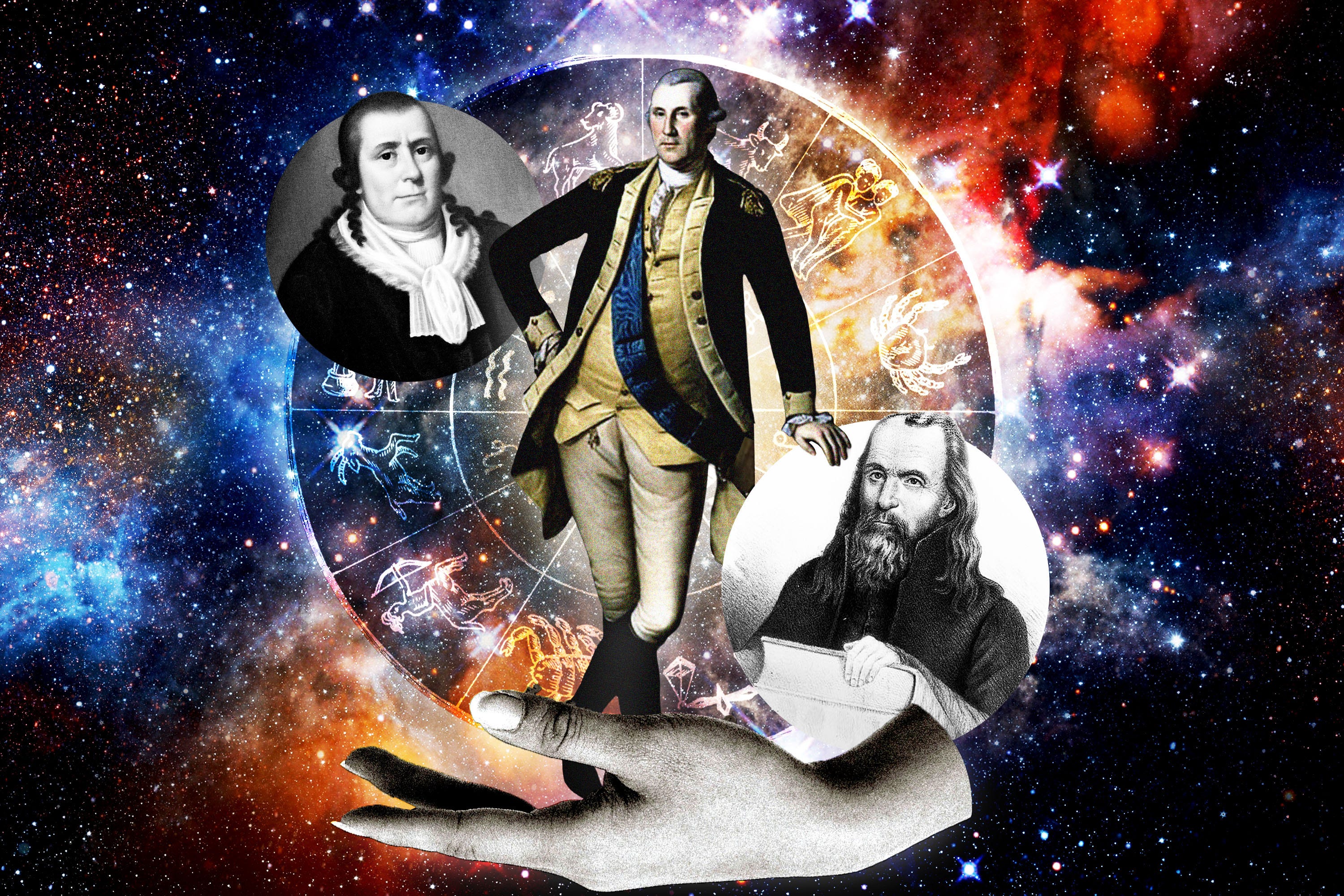
IF WE TAKE 1776 AND 1787 as the bookends of the American Revolution, defined by the founding documents that emerged during each of their summers, it’s easy to forget that these years were also marked by angels and demons.
A few months after Thomas Jefferson handed over the Declaration of Independence to the Second Continental Congress, a young New England woman by the name of Jemima Wilkinson fell deeply ill and nearly died. When she recovered, she claimed that she had ascended body and soul into heaven, where she spoke with archangels before returning to earth reborn as a genderless being called the “Publick Universal Friend.” She would spend the war years as an itinerant, preaching abolitionism, humanity’s universal salvation, and the impending apocalypse.
Eleven years later, as the Constitutional Convention sweatily debated the question of congressional representation in Independence Hall, a mob paraded an old woman accused of being a witch through the streets of Philadelphia before beating her to death. The Pennsylvania Evening Herald reported on the woman’s sorry fate with shock, and frankly a bit of embarrassment. “It is hoped that every step will be taken to bring the offenders to punishment in justice to the wretched victim, as well as to the violated laws of reason and society,” its editors huffed. The American colonies had ceased legally prosecuting witchcraft in the 1730s, and what else had the new nation fought for but to, as another newspaper put it, “emancipate[] itself from the superstitions of authority”?


When we think of the American Revolution and the period leading to the drafting of the Constitution, what often comes to mind is an impression of metaphysical orderliness—of intellectual connections to the parallel Enlightenments occurring in England, Scotland, and France; of principled and articulate leaders (many of whom embraced rationalistic belief systems such as Unitarianism and Deism); of mathematical and mechanistic metaphors and arguments; and of an appeal to natural rights and common sense.
But common sense is a door that swings two ways, suggesting at the same time both a universal standard of reasonableness and an individual’s particular claim on the truth. When the revolutionaries enshrined “life, liberty, and the pursuit of happiness” as unalienable rights, they created the conditions for a remarkable array of political and civic institutions to emerge that gave specific meaning and shape to these freedoms. But freedom is always wont to seep out of its various containers. The world the Revolution created was certainly one of state and federal constitutions, organized religion, voluntary associations, and material progress, but it was also one of miracles, syncretic beliefs, conspiratorial thinking, and the magic of crowds. The Revolution was, in a word, weird.
ALTHOUGH THE WITCH TRIALS that made Salem, Massachusetts, famous suggest that the American colonists harbored hatred and fear of the occult, Christianity was not the only belief system that made its way across the Atlantic from Europe in the seventeenth and eighteenth centuries. Historians have shown that religious and political leaders in both the northern and southern colonies possessed an array of works on alchemy, astrology, and magic in their libraries. Books like John Baptista Porta’s Natural Magick, Thomas Tryon’s Pythagoras: His Mystic Philosophy Reviv’d, and Thomas Vaughan’s Magia Adamica blurred the lines between the study of the natural and supernatural. Such an interest wasn’t limited to elites. Almanacs full of astrological predictions were popular among all classes of colonial society, and printers lamented that readers just wouldn’t buy almanacs that omitted diagrams of the zodiac.
As always, the religious practices of ordinary folk were a point of contention for American religious leadership. As Anglicans, Presbyterians, Quakers, and the many other Protestant sects that made a home for themselves in the colonies grew, built churches and seminaries, and intertwined with colonial governments over the course of the eighteenth century, their ministers denounced occultism more and more furiously, even as their flocks continued to embrace some of its practices.
In his carefully researched 2017 book on magic and miracles in the early Republic, Adam Jortner argues that the popularity of fortune-telling and grimoires persisted beyond the last few decades of the eighteenth century. Works like The Complete Fortune Teller and Dream Book (supposedly published by “Chloe Russell, A Woman of Colour of the State of Massachusetts”) and Ebenezer Sibly’s New and Complete Illustration of the Celestial Science of Astrology underwent multiple printings and circulated well into the antebellum period. Sibly even included a birth chart for the United States in his Illustration of the Celestial Science, suggesting that the new nation had been born under auspicious planets that forecast “wisdom, strength, and unanimity” in its politics, “extensive and flourishing commerce,” and “prosperity amongst the people.”
The enduring popular interest in witches, fortunes, and “countermagic” (charms and spells that drew on Christian prayers to ward off demonic influences) disturbed many American commentators who subscribed to more modern and orthodox views on matters of science and religion. In a democratic republic where the vote had been extended to the majority of white men (and, until 1807, even some white women), nothing was more dangerous than voters who, as one nineteenth-century piece of doggerel put it, could with “fanatic zeal” empower candidates who appealed to their fascination with “brimstone, and fire, and supernatural war.”
And while empirical approaches to knowledge were ascendant by the start of the nineteenth century, many Americans still acted as if they lived in an enchanted age. They kept hauling some women suspected of witchcraft before befuddled judges until well into the 1830s (along with some men, like “Gullah” Jack Pritchard, whose reputation as a necromancer certainly informed aspects of his trial for participating in the 1822 Vesey slave rebellion). And they consulted others for folk remedies and glimpses into the future for many decades after.
EMPIRICISM COULD SWING BOTH WAYS. On May 19, 1780, seven days after the British had captured Charleston in a massive military setback for patriot forces, the midday sky across the New England coastline turned black. Witnesses recorded the unnerving phenomenon from states ranging from Maine through New Jersey, including figures as disparate as the Publick Universal Friend and the prolific diarist and Revolutionary War soldier Joseph Plumb Martin. Many interpreted the event as a sign of the end times not just for the patriot cause, but for the entire world.
Far from inaugurating Armageddon, New England’s “Dark Day” (likely the result of a massive forest fire) became known more for beginnings than endings. After worshipping in secret for half a decade, a Quaker offshoot sect led by an English woman named Ann Lee interpreted the meteorological oddity as the signal to begin publicly proselytizing in the nascent United States. Lee and the “Shakers,” who viewed her as the Second Coming of Jesus Christ, believed that they had been bestowed with the kinds of spiritual gifts that the Twelve Apostles had received at Pentecost, including the abilities to heal the sick, exorcise the possessed, and speak in divine tongues. As Molly Worthen notes in her recent history of charisma in the United States, they “transformed direct revelation into a ritual practice available to average people, not just anointed prophets.” The American Revolution had turned the world upside down and Heaven with it.1
The Shakers are just one example of the larger democratization of American Christian belief and practice that got turbocharged by the United States’ refusal to create an established church at the national level—a decision most states incorporated into their constitutions during the early republic. The denominations that flourished during this “Second Great Awakening,” such as Methodists and Baptists, emphasized the importance of appealing not just to minds, but to hearts. The American Revolution gave birth to an energetic and intoxicating culture of revivalism that spoke to ordinary Americans’ desire to find individual transcendence through communal worship—especially worship that pushed the boundaries of emotional and physical experience.
Among the most famous of these early revivalists was Lorenzo Dow. Only loosely affiliated with the Methodists, the long-haired, poorly dressed, and wild-eyed Dow crisscrossed the United States in the early nineteenth century preaching a gospel of “common sense,” drawing on both traditional Methodist teachings and the deeply anti-institutional Jeffersonian politics of the era.
Dow too claimed to have direct contact with angelic and demonic beings. He believed Americans were living in both an “Age of Inquiry” and an “Age of Wonders” that combined signaled the new nation’s role as a refuge from authority in any form—political, religious, or otherwise. His revival meetings featured crude humor, witty banter, clever theatrics, tales of folk miracles, and calls for the audience to dance and surrender their bodies to the influence of the holy spirit. Describing the contagious nature of these “jerking exercises” in his journal, Dow captured the democratic character of this religious ecstasy:
I have seen Presbyterians, Methodists, Quakers, Baptists, Church of England, and Independents, exercised with the jerks; gentleman and lady, black and white, the aged and the youth, rich and poor, without exception; from which I infer, as it cannot be accounted for on natural principles, and carries such marks of involuntary motion, that it is no trifling matter.
OF COURSE, THERE ARE THOSE who looked upon these ‘festivals of democracy,’ as a visiting Frenchman dubbed them, with alarm. Critics included Yale-educated and Federalist-aligned Congregationalist and Presbyterian ministers like Timothy Dwight and Lyman Beecher, who fretted that untrained ministers like Dow would corrupt the spread of Christianity in America with “quackery.” But even the fusty Federalists weren’t immune to brushes with the fantastical. John Adams and many of his Federalist allies spent the late 1790s collectively obsessing over fears that a quasi-Masonic international order known as the “Bavarian Illuminati” had fomented the French Revolution and was plotting to overthrow the new U.S. government. Jefferson, for his part, characterized Adams’s administration as a “reign of witches” before spending much of his own presidency and early retirement convinced that Federalists were conspiring to restore monarchy in America.
The late historian Gordon Wood argued that the penchant for conspiracy theories among the Federalists (and some of their opponents) in the early republic emanated from their prevailing belief in “a rational moral order and a society of deliberately acting individuals who controlled the course and shape of events.” This belief, Wood clarified, was neither unique to Americans nor one that could endure entirely uncontested in a modern, rapidly growing, and increasingly complicated nation, where the connection between individual intention and the effects of one’s actions grew ever more muddled.
But what might be distinctively American is the extent to which the belief that men and women are in control of their own destinies has stubbornly persisted in the United States. It’s been almost the default epistemological posture among most Americans over the past 250 years. Some may speak compellingly of the mechanistic and impersonal systems that govern our lives, but many Americans continue to insist on the weight of their own agency and interpretive authority, no matter how weird the world becomes.
The world has indeed only gotten weirder since a young John Quincy Adams concluded that “a strange combination of the powers of imagination and reason” had to explain why so many of his fellow Americans believed in “ghosts, spirits, fairies, witches,” and other supernatural agents. Over just the last three decades, the American-led internet revolution has made us both more interconnected and disconnected than ever before, accelerating the contagiousness of conspiracy theories both very new and very old. One such digital conspiracy led a mob to launch the first successful assault on the U.S. Capitol since the War of 1812 in response to the election loss of a reality-TV star raised on a version of the prosperity gospel, who has since regained the presidency. Imagine explaining that to Adams.
Then again, perhaps he wouldn’t be that surprised. He seemed to understand that a revolution against the old world did not spell the beginning of disenchantment in the new world but rather the opposite. Even today, as participation in organized religion is in freefall, atheism in the United States is stagnating while nondenominational Christianity and belief in astrology, neopaganism, “manifesting,” and other forms of hyperpersonalized spirituality remain vibrant. As we stand on the cusp not just of the nation’s semiquincentennial but of a new revolution in artificial intelligence, is it any wonder that so many expect to find a divine spark within the machine? Since the birth of the United States, Americans have believed that by stretching out their own hands, they can tap on God’s shoulder.
The Shakers—among whose cultural contributions are several songs and a distinctive style of furniture—devoted themselves to celibacy, which is perhaps the main reason they disappeared; there are fewer than five professing Shakers in the United States today.
 | A guest post by
|
"Over just the last three decades, the American-led internet revolution has made us both more interconnected and disconnected than ever before, accelerating the contagiousness of conspiracy theories both very new and very old. One such digital conspiracy led a mob to launch the first successful assault on the U.S. Capitol since the War of 1812 in response to the election loss of a reality-TV star raised on a version of the prosperity gospel, who has since regained the presidency. Imagine explaining that to Adams."
Priceless!
Excellent! I really enjoyed this article. There are so many interesting "sidebars" to U.S. history and love when folks bring them to light.