End of the Endless Summer
The Eve Babitz revival offered an intoxicating escape from our modern literary anxieties. Her final, briefly wonderful book of letters brings us back down to earth.

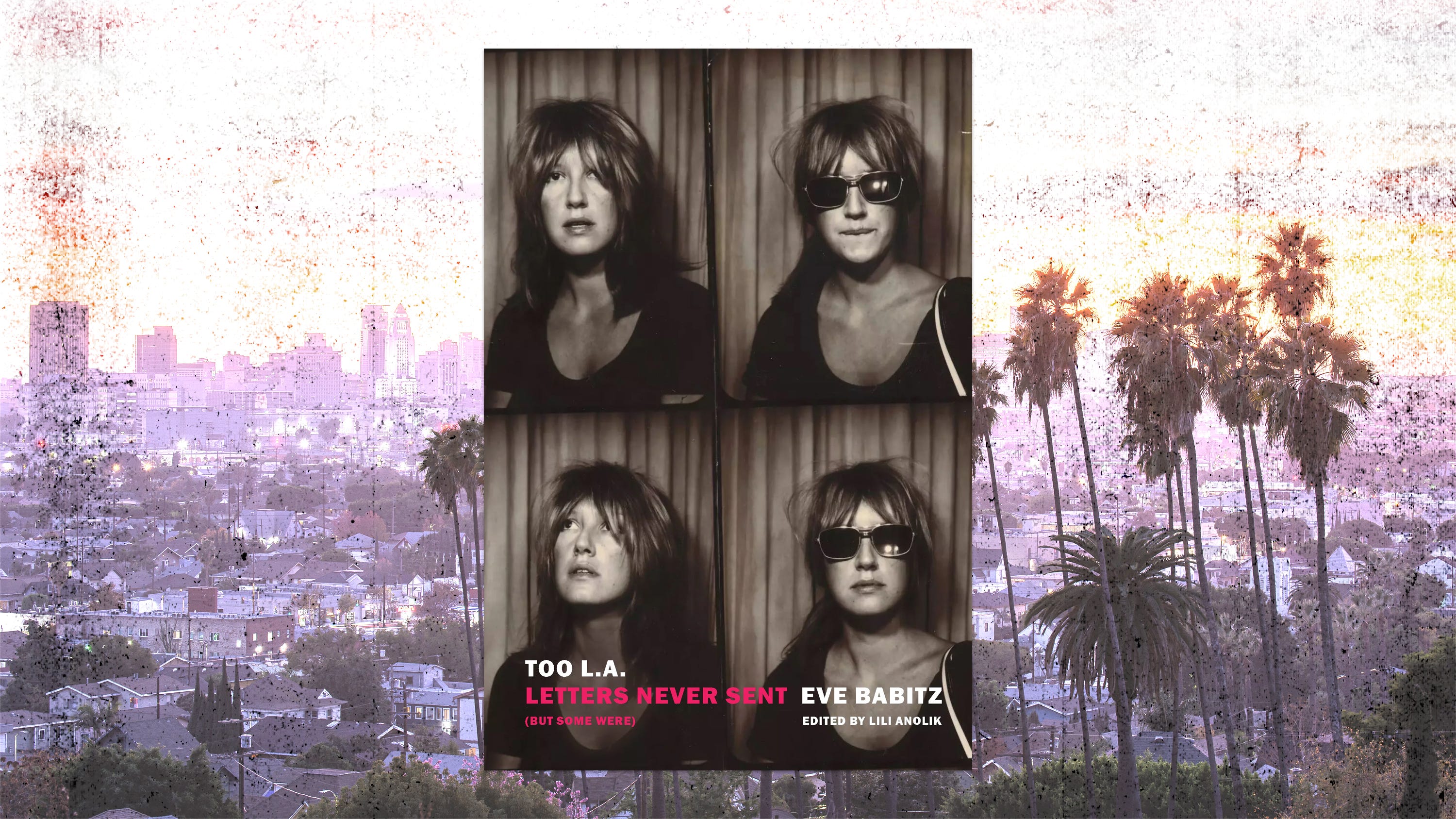
Too L.A.
Letters Never Sent (But Some Were)
by Eve Babitz, edited and annotated by Lili Anolik
New York Review Books, 448 pp., $18.95
EVE BABITZ RETURNED WHEN WE NEEDED HER MOST: in the late 2010s and early 2020s, when the pressures created by a rapidly shrinking media industry, a diminished appetite for literary fiction, and an ascendant social media panopticon made for a dismal, paranoid atmosphere in the world of letters. The most acclaimed novels of the period were chilly and self-interrogating; they made the act of writing seem like something to be vaguely ashamed of. The dominant tone in literary nonfiction was a mix of indignant hectoring and handwringing solipsism. Neuroticism and uncertainty ruled the day. Is it okay to get on an airplane in the age of climate change? Am I adequately reckoning with my privilege when I eat this Sweetgreen salad? Is it suspect to enjoy Tolstoy or Picasso or Phil Spector or any of history’s other monster-geniuses? Am I saved or damned? Am I a Good Person?
All of this was very overbearing and a real drag. So it was no wonder that, beginning in 2015 or so, there was a sudden flood of interest in Babitz, a cult Los Angeles writer of the 1970s who became a sensation after her books Eve’s Hollywood and Slow Days, Fast Company were reissued by the New York Review Books NYRB Classics imprint.
Babitz had a moral core and an admirable sense of feminist self-respect, but if she felt anything akin to millennial neuroticism, it never came through in her prose. She is instead a voluptuous, good-natured, inviting writer of supreme insouciance and lovable glamour, dedicated to celebrating pleasure in all its forms, from sex to taquitos to a Dodgers game. Life as a big-city writer, she seemed to say, doesn’t have to be an endless climb out of a bucket full of crabs or the constant evasion of a howling mob of internet vigilantes. You could ignore all that. You could move to L.A. You could take Sunset Boulevard all the way to the beach and listen to the Byrds and carry on no-strings-attached affairs with young and beautiful scenesters. Life could look like palm trees and jasmine and courtyard apartments and feel like the first sip of the second margarita. Life could be, as the song goes, a dream.
It was an enchanting vision, and unlike many so-called lost masterpieces, the books really were that good, or at least Slow Days, Fast Company was. (Eve’s Hollywood is nearly great, Babitz’s journalism is fun, the other novels vary wildly in quality from page to page.) Slow Days, a collection of short autofictional episodes and encounters in way-out 1970s Hollywood, is one of the great books about the city—the sunset-hued heaven to Play It As It Lays’s bleak hell. It can seem slight and tossed-off at first glance. But try to write in her style—breezily vivacious with an undercurrent of melancholy, evincing a sort of Zen awareness of life’s beauty and its transitory nature—and you’ll realize how much skill it actually requires. She offers a delicately layered vision of life, full of people and places and gossip but suffused with California light and still air, as evocative in its way as David Hockney, or A Month in the Country, or Swann’s Way.
Now, marking the close of the Second Babitz Era, comes what will presumably be the last work we ever have from her: Too L.A., a collection of mostly unsent letters. Really, they are diaries in letter form, which Babitz’s biographer Lili Anolik discovered after her death in 2021. It was Anolik who first brought Babitz back into the public consciousness in a splashy 2014 Vanity Fair article, and who set down her story for posterity in her 2019 biography Hollywood’s Eve. Anolik went back to the well in her followup, Didion & Babitz, which looked at the intertwining stories of the two L.A. writers, and which was widely interpreted as an attempt to permanently knock Didion off her pedestal as First Lady of L.A. Literature and install Eve in her place.
A forgotten talent needs a champion, and Anolik’s often quite excessive praise of Babitz in these books can be forgiven as the zealotry that accompanies a noble crusade. And the prospect of reading the unfiltered thoughts of Babitz, a writer who made the social world her subject, is certainly exciting. Still, one raises a skeptical eyebrow when Anolik claims in the introduction that Too L.A. is “Eve’s second masterpiece—her first being, of course, Slow Days, Fast Company—and her most consequential work,” and goes on not only to compare it to “a West Coast, late twentieth-century A Room of One’s Own,” but to claim it is “every bit as candid, every bit as lucid, every bit as brutal, every bit as delicate as Virginia Woolf’s celebrated manifesto.”
So, is it? Uh, no. The first half of Too L.A. is, even for an avowed Babitz fan, quite boring. Janet Malcolm, one of my heroes and a great skeptic of biographers, once wrote that “books of letters move us as biographies do not,” they provide “the rapture of firsthand encounters with another’s lived experience.” I’ve thought of that Malcolm quote every time I’ve purchased a book of letters with excitement, and I’ve also thought of it every time I’ve found myself halfway through one of those books and bored as hell, trying to keep track of who went where and did what and slept with whom, with only the occasional flash of literary inspiration to keep me going. Many famous names flit through Too L.A., if you’re into that sort of thing, but without much detail or reason to care. A typical passage:
Saw the Burrito Bros at [Thee] Experience Friday. Peter [Pilafian] was there with his “New Flame.” Earl was there with Mrs. Dunn1 (who looked horrified at what a toilet Thee Experience is).
I’ve been practicing on how to make the perfect omelet.
Of course, these are private letters and diaries, so one can hardly blame Babitz for not being her most interesting self on the page. And anyway, collected letters are usually meant for scholars and researchers, so some judicious skipping and skimming is to be expected. But the lack of an index with which to keep track of Eve’s many relationships and the breathless rapture of the introduction certainly lead one to think that Too L.A. is meant to be read straight through, as do Anolik’s chatty, faux-chummy footnotes. “Keep your eye on Larry Dietz,” urges one, “He’ll pop up again and again, always to Eve’s displeasure.” (This promised plot thread with Larry Dietz does not turn out to go anywhere terribly interesting.) Elsewhere, a use of the word “faggot” in a letter prompts Anolik to leap to Eve’s defense: “I feel honor bound to say that Eve is not a homophobe. . . . I think she sometimes just likes to talk hard, casual, cruel—a pose she’s trying out.” The effect is rather like having a conversation with Babitz and a mostly silent friend, who occasionally chimes in with something to the effect of Isn’t Eve awesome? Isn’t she beautiful? Isn’t she brilliant? After a while, it all begins to seem vapid, exhausting, shallow, pointless. After a while, one begins to get sick of the oh-so-perfect Eve.
But—miraculously—something happens around 1972, when Babitz really begins to take writing seriously. The letters suddenly take wing, away from the quotidian and into the jacaranda-scented dream realm of Slow Days and Eve’s Hollywood. Her signature charm, only occasionally glimpsed in the first half of the book, floods out of the page like a 12,000 watt spotlight. Scenes that would have been described flatly and prosaically a few years earlier are given wonderful specificity and detail. Letters become more pointed and more literary: There are more love letters and more breakup letters and wonderfully angry ones (she has a major talent for cutting people, particularly men, down to size). She becomes something like a machine for producing memorable sentences.
On an article in Rolling Stone, from a letter written to editor-in-chief Jann Wenner:
I looked at Reliable Sources and thought that Granola article was not engrossing. I hate crunchy granola and breakfast generally and find any reference to it, especially in the public press, to be vile and obnoxious.
On the fine art scene:
My artist friends have extraordinary dearness for me, though I could never become one of them because I always had wall-to-wall carpeting and how can you be an artist if you’re a Jewish girl with [wall-to-wall carpeting]?
On her novel-in-progress Sex & Rage:
I am going to write the most luxurious, Beverly Hills Hotel greenery, lion’s paw amber kind of dangerous book.
On the publication of Eve’s Hollywood:
When Gerald Murphy (i.e. Dick Diver in Tender is the Night) said “Living well is the best revenge,” [he] was only slightly off. Having your book on the bestseller table at Pickwick is the best revenge.
Yes!, you think. There she is! Our Eve! It’s inspiring to see her suddenly become herself, like watching a favorite baseball player break out of a slump. It makes you marvel at how someone can appear initially so minor—just another L.A. scenester—and yet all the while she is simmering, simmering, simmering until she boils. To see her metamorphose in real time nearly makes the slog of the first 200 pages worth it.
The letters also provide a valuable opportunity to learn more about Babitz’s literary influences, and the picture that emerges is of someone who reveres the Anglophone novel of manners: Woolf, Forster, Henry James, Anthony Powell, and all those other magi of the drawing room. (How charming to think of her leafing through The Ambassadors or At Lady Molly’s in the soft light of morning following some raucous bender in the hills.) I still don’t think Too L.A. is as good as Woolf, but you can at least start to see why Anolik reached for the comparison. Babitz takes the drawing-room wit and the mixture of bohemian daring and Victorian propriety that defined the Bloomsbury set, applies it to her own environs, and gives it a California makeover: looser and groovier, with hotter people and better music.
This golden period lasts about seven years—100 pages or so of the 400-page Too L.A. Then, the long slow fade. Even as she was doing some of her best writing, Babitz was spiraling into a major cocaine addiction; her ex-boyfriend Paul Ruscha (brother of artist Ed) recalled dropping by her apartment and finding that “There wasn’t an inch of floor not covered in bloody Kleenex. The cats were running around high.” She got sober in 1982, but the pace of her writing drastically slowed. In 1997, an accident with a cigar left the lower half of her body horribly burned. She became reclusive; her signature vivaciousness curdled into grouchiness, misanthropy, Rush Limbaugh–listening delusion. Barely any letters appear from 1980 onward, and after her accident, writes Anolik, Eve lives “a posthumous life. . . . a life without letters.”
Good old American Protestant morality tempts us to read this as a cautionary tale: fly too close to the sun and you’ll—literally, in her case—burn up. And here in present-day Los Angeles, with an evaporating film industry and half the city threatening to burn down every year and jackbooted federal agents stomping through the streets and gigantic chemical fires making the air smell wretched and a general miasma of bad vibes pervading, it’s tempting to resent Babitz for exaggerating how much of her life in the Seventies was sun and sex and beauty (and, to judge from these letters, for not having to work very much).
But why should we? The persona she created—wise, wistful, self-deprecating, righteously indignant when necessary, always up for anything, and always aware of where the best party is—is an example to strive for, even if the life of the real Babitz never quite lived up to the one on the page. Thanks to Too L.A., uneven as it may be, we have a better glimpse into how she created that persona, and how for six or eight or ten years, before she crashed back down to earth, she embodied something eternal: the destructive, cruel, frustrating, inspiring, beautiful California Dream.
Mrs. Dunne, whom Babitz flippantly renders as “Dunn,” is Joan Didion, married to the writer John Gregory Dunne.
 | A guest post by
|
Discussion about this post