The Great Books Are for Everybody
An unlikely champion of the canon urges readers not to think of the books as “belonging” to conservatives.

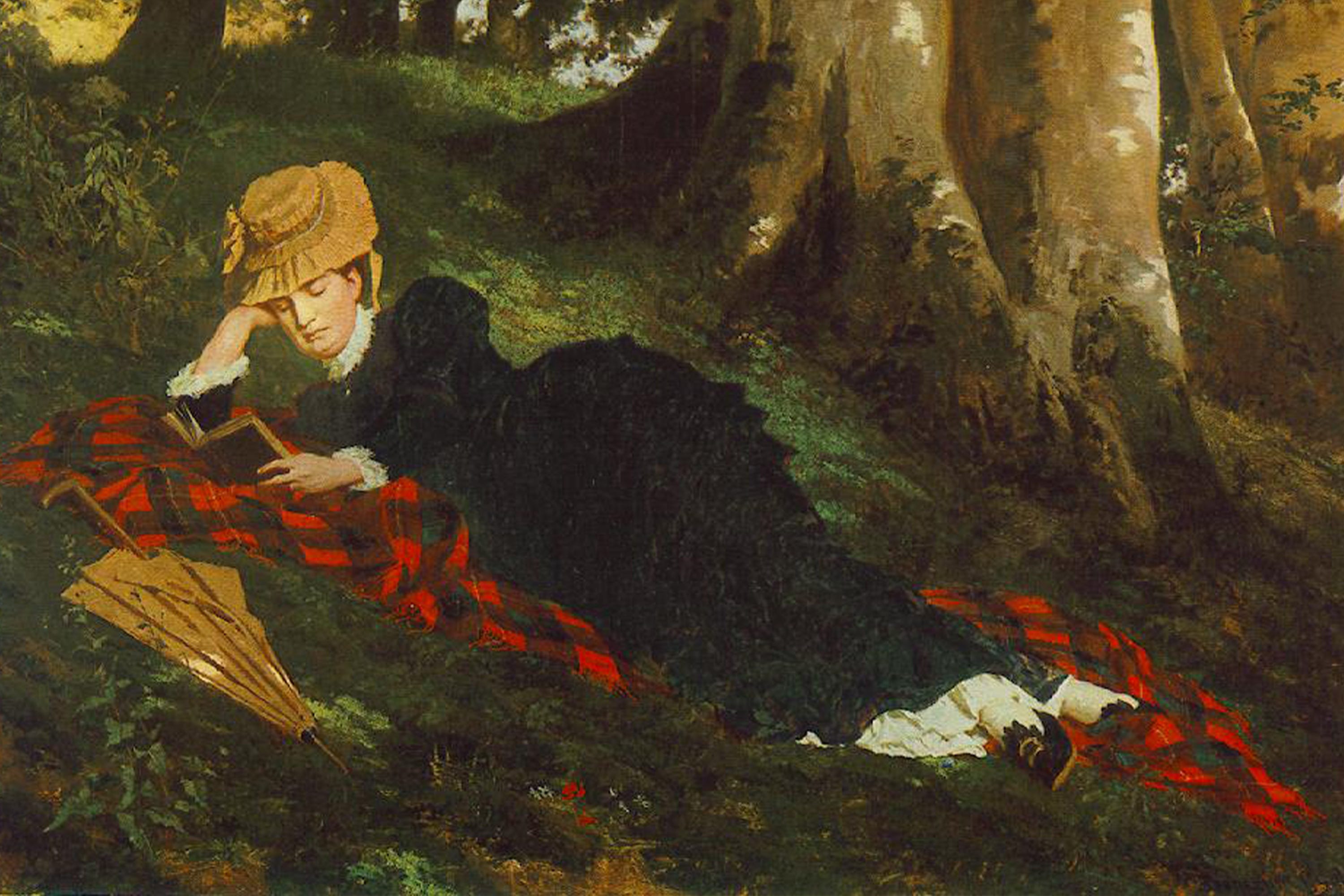
What’s So Great About the Great Books?
Why You Should Read Classic Literature
(Even Though It Might Destroy You)
by Naomi Kanakia
Princeton, 262 pp., $25.95 (hardcover)
AMID ANXIETIES ABOUT artificial intelligence and reports of social media–induced brain rot which some say has left college students unable to finish reading twenty-page articles let alone full-length books, there is also talk about a book resurgence. The young’uns, evidently, are discovering the joys of print. So it couldn’t be a better moment for Naomi Kanakia’s new book about the classics of literature.
Kanakia, a novelist and blogger, is not only left of center but an unabashed cultural progressive who takes concerns about harm to underprivileged groups very seriously and who regards the “decolonization” of the humanities, in the sense of opening up them up to more nonwhite and non-European voices, as a worthy project (even if she winces at some crudely polemical “decolonizing” discourse). But she is also unabashedly in love with the classics, having discovered them in her mid-twenties after a previous diet of mostly science fiction. Her book is addressed primarily to an audience inclined to think that the “Great Books” are irrelevant, hopelessly dated, too much of a slog, or even hopelessly “problematic” and harmful for various reasons: Aren’t they mostly written by dead white men, thus signaling that literary greatness is white and male? Aren’t they full of toxic stereotypes about race, ethnicity, religion, and gender? Aren’t they championed by cultural reactionaries?
Kanakia tackles these questions with panache, humor, and humility, often drawing on her own experience as someone who had a hard time getting into Marcel Proust’s In Search of Lost Time and later came to passionately love it. “Everyone who’s ever approached a difficult book has had the experience of not getting it at first and then suddenly getting it,” she writes. “That experience is exactly why you read these books.”
The proselytizing of What’s So Great About the Great Books? is not dogmatic; readers more culturally conservative than Kanakia may even feel that she lacks the full courage of her mission since, at the end of the first chapter, she makes a concession on a key point:
It would be somewhat disingenuous for me to say that your life would be poorer if you didn’t read them. I cannot say whether that is true.
And yet the rest of the book effectively explains why the answer is yes. The classics, Kanakia argues, offer deep engagement with a uniquely rich and diverse (not demographically but intellectually) legacy of human thought and experience. They develop our taste—“the ability to discriminate, to discern fine nuances, and to see what truly exists within an object, versus what we are projecting onto it.” That includes a kind of moral instinct—the ability to sense “which positions and which actions are dirty.” To Kanakia, “the Great Books are, more than anything, marked by their tremendous rigor, their drive to hold their own ideas up to scrutiny.” And “they expose us to fundamental truths about the nature of beauty and of reality,” truths that are “both above and beneath the political.”
Why these particular books?1 Here, the answer is disarmingly simple: because, actually, there’s a pretty strong consensus about these books and these authors that “spans culture, religions, and politics.”
Support our independent coverage of books, the arts, and ideas by signing up for a Bulwark+ membership.
PERHAPS UNSURPRISINGLY, the book’s most dynamic and thought-provoking sections are the ones dealing with the “problematic” nature of the Great Books. Kanakia is sympathetic to the perspective of “marginalized” people who sometimes feel “emotional pain” when encountering bigoted ideas, themes, and passages in the old classics. Here, more culturally conservative “Great Books” lovers may roll their eyes; I would not, despite being considerably to the right of Kanakia’s progressivism. In my younger days, as a Jewish, female bookworm, there were times when I felt almost literally gut-punched by stumbling on misogyny or antisemitism in texts by beloved authors, such as Voltaire’s anti-Jewish venom or Byron’s jeers at intellectual women. (I grew out of it in my early twenties and learned to understand that sometimes—in Byron’s case, for instance—it’s a lot more complicated.)
For Kanakia, too, these issues are intensely personal as a bisexual transgender woman of Asian background. In particular, she discusses at some length the tension between her identity and the fact that the publications most congenial to her interest in the classics are also the most likely to promote views unfriendly to transgender rights. Kanakia herself acknowledges that less progressive readers are likely to find these sections alienating and to argue with her description of some authors as transphobes (even if she notes that she’s far less of a hardliner on the issue than her wife). There were moments when I myself had some “trusty nitpicks,” as Kanakia puts it. But this is not a tract on gender politics—and it’s sufficiently nuanced to come down on the right side of the Great Books: It doesn’t matter if an author is liked by people with the wrong politics, or even if the author himself or herself has bad ideas, because the books are far greater than that.
Ultimately, even people who strongly disagree with Kanakia’s politics (and may be annoyed by how much time she spends rebutting left-wing objections to the classics) should be able to enjoy this book, if only because she approaches her politics with such appealing humility. She admits that her views would likely have been very different had she lived in Omaha rather than San Francisco and grown up in a family of conservative Christian homeschoolers and not of two liberal Ph.D.’s. Her dislike of conservative politics does not prevent her from quoting conservative luminaries like Allan Bloom, T.S. Eliot, and Edmund Burke. And, admitting that we don’t know whether reading the classics can help create a “fair and just society,” she adds that in any case, “we don’t really know what a fair and just society looks like, nor what system of education would bring about that society.” (These are, of course, some of the fundamental questions that Great Books can inform.)
In the meantime, Kanakia deftly skewers some of the objections to the “problematic” nature of love for the Great Books. Black people should stick to black authors and eschew the majority culture? Then it’s hard to make the argument that the majority culture should value black culture and that Americans of all races should read African-American authors. The classics are an important vector for racism and sexism? Hardly: racist and sexist notions can be encountered anywhere (especially in 2026!), and “reading or not reading the Great Books” surely has a minor impact on whether someone embraces such notions. The classics are reactionary? Not all: Kanakia cheekily suggests that reactionaries who demand a Great Books curriculum at conservative schools like Hillsdale College have “invited a Trojan horse into their own camp,” since Aristotle, Nietzsche, and Tolstoy contain plenty to challenge right-wing beliefs. Reduce the kids’ reading program solely to “books by old White guys,” and “it is these very books that will someday lead them out of the darkness.” Let’s hear it for old white guys.
KANAKIA GOES ON TO OFFER a fascinating discussion of how the idea of the Great Books emerged in American higher education, partly as an effort to craft a universal literary heritage in a country that has no ethnicity-based cultural legacy. Among other things, her book is a valuable reminder that teaching what we now regard as the Western classics in college is not, strictly speaking, a traditional idea: There was a time when university-level readings consisted of classics from antiquity in the original Greek and Latin, and a time when reading any books in translation was frowned upon.
How should the educational system approach the Great Books? As always, Kanakia comes away with no pat answers. She notes that during her student years at Stanford in the early 2000s, she found English classes alienating—and embarked on a Great Books reading program the year after her graduation. But she also acknowledges an important educational influence: “I was taught about these books during high school in a way that accepted their preeminence as a given.”
In that sense, trying to “decenter” or “disrupt” the Great Books, as some progressive educational activists have been seeking to do, is likely to do harm. Writes Kanakia:
When I was sixteen and reading my sci-fi novels, I might’ve felt thrilled if someone had told me, “Actually, Tolstoy and Proust are fakes, and you don’t need to bother with them.” But I don’t know if I would’ve really been enriched by that belief. Instead, because I believed in the concept of greatness, I was driven to seek out what was great—an activity that has given structure and meaning to the last seventeen years of my life.
Kanakia is as engagingly humble about her Great Books evangelism as she is about her politics. She readily acknowledges that there are many people—including her own wife, a medical researcher—who lead full and rich lives without those books and cannot squeeze an intensive reading program into their busy existence. And yet:
Let’s say I could go back in time, to when she was in med school, would I advise her to read the Great Books then?
Probably!
Kanakia comes back again and again to the idea that people crave the classics:
I’ve realized there is a deep hunger for that greatness. People want to open these books. They want to see what the hype is all about and to learn if there’s anything worthwhile in those pages. And people like me are in possession of the precious knowledge that yes, there is treasure. Yes, reading through these books is worth your time.
And perhaps the strongest case for the Great Books can be found in the glimpses into these classics that Kanakia offers. Her comparative discussion of the portrayal of marriage in Tolstoy’s Anna Karenina and George Eliot’s Middlemarch made me want to reread both novels. Early in the book, as an example of how classics never give simple answers, she quotes verses from the Iliad in which Achilles talks about choosing glory and death over life without glory—and then verses from the Odyssey in which the now-dead Achilles dolefully tells Odysseus that being the lowliest living slave is better than being a dead hero among the shades. If you don’t find yourself mesmerized, you’re probably hopeless.
But I’d like to believe that this quirky, smart, passionate, occasionally frustrating but far more often charming volume does offer hope: that, even in the age of smartphone screens, Instagram, and TikTok, there is still room for the Great Books and for the ways in which they can help us think more deeply about what it means to be a human being and a citizen.
Kanakia is talking primarily about the list of over 130 books on the “lifetime reading plan” first compiled by the noted literary critic Clifton Fadiman in 1960 and updated by historian John S. Major in 1997, which Kanakia reproduces at the end of her book. That was the list that she herself used to plunge into the world of the Great Books. She also discusses and draws on other lists, especially the Great Books of the Western World set put together in 1952 by Mortimer Adler that sold a million copies for its publisher, Encyclopædia Britannica.
This is the first time in my life I have ever encountered the perspective that the study of the great books is somehow characterized as a culturally conservative endeavor! My understanding of the liberal arts tradition that engages with the great books has always been that it is a fundamental and crucial aspect of learning to treat all works of literature, including works of history, works of science, and works of religion as the distinct products of their authors, times, and places. To never ever understand them as works of dogma to believe or follow or not believe or not follow but to comprehend them, as best one can, and to assess and find the value in the full scope of their historical and cultural significance; to engage their context as fully as possible. To treat them seriously is never to take them too seriously, but to enjoy the opportunity to learn how and why and where and when they entered the canon and what for.
I would almost venture to say that that is close to the prime endeavor of the liberal art.
I might have to read this book just to see how and where and why and what for and by whose insult The Canon came to be viewed as a "conservative" body!
Fascinating. I like that the Bulwark leaves space (makes room?) for the Humanities on a [mostly] Politics and nothing but Politics site. Your review, Cathy, brings forth a book and author that otherwise would not have crossed my attention. Now purchased. Thank you.