

The Holiday from History Is Over
And the great powers are back.

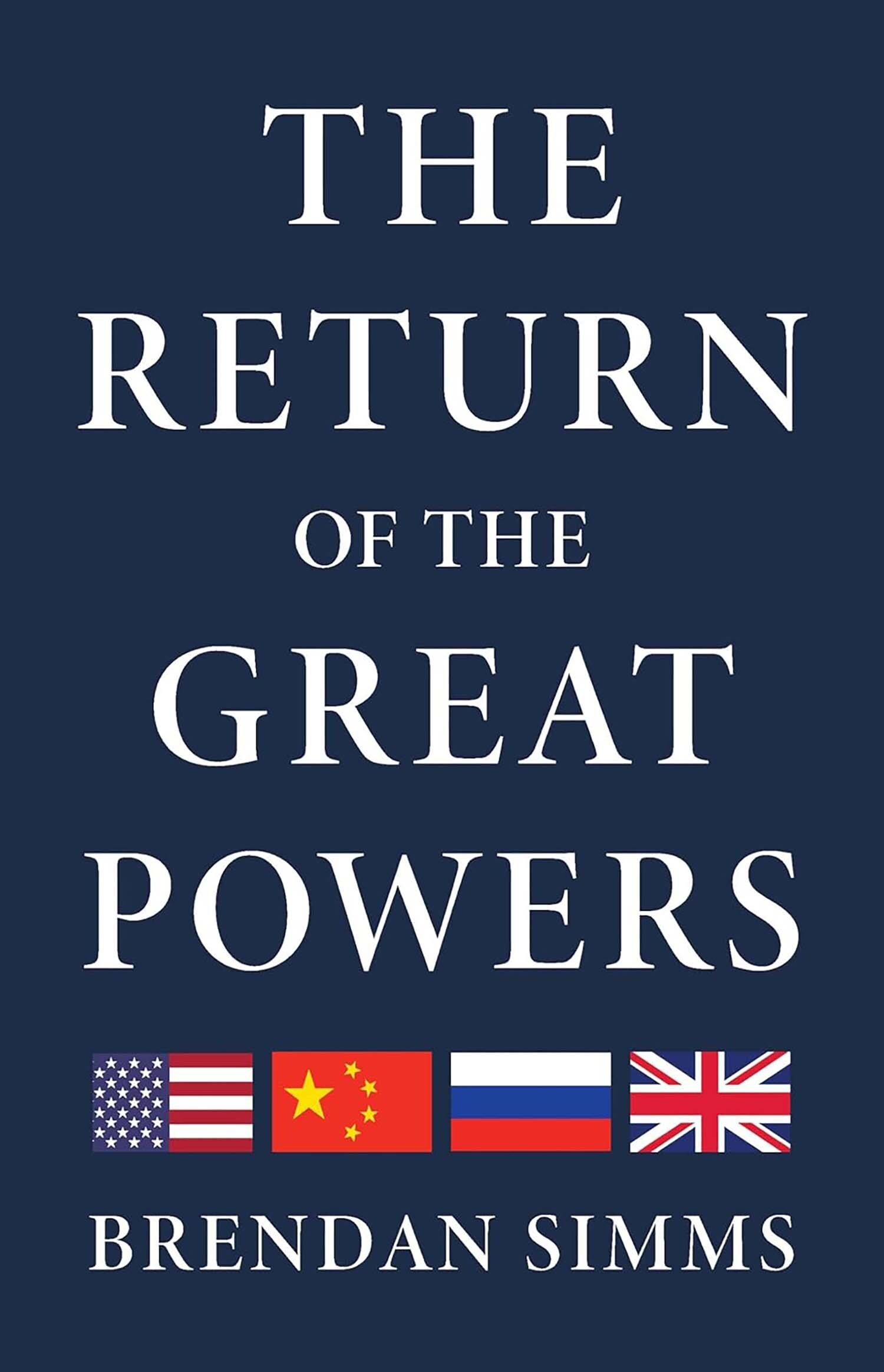
The Return of the Great Powers
by Brendan Simms
Basic Books, 480 pp., $32
BY NOW IT’S CLEAR THAT THE INTERLUDE of relative peace, prosperity, and democratization (for most of the world) that followed the fall of the Berlin Wall and the collapse of the Soviet Union was not the dawning of the Age of Aquarius, but a short blip in which the gears of global history briefly slipped.
With his meticulous new book, The Return of Great Powers, Brendan Simms arrives as the stoic chronicler of the post–Cold War false dawn, and of the grim realities of power that confront us anew. A Cambridge historian of grand strategy and European power, Simms has written a brisk account—he calls it a “gallop”—through five hundred years of Great Power conflict from 1490 to 1990. He does not merely argue that we were wrong to envision a peaceful globalized world at the end of that stretch; he suggests that by dispensing with the old-fashioned verities of hard power, the West has spurred on enemies of the liberal order that now threaten to overthrow it.
Simms contends that our three-decade sabbatical from reality was a “colossal failure of geopolitical understanding” that has left the American order teetering. For more than a quarter of a century, the West operated under the assumption that the world was becoming a flat, interconnected marketplace where the old frictions of nation-states would be rubbed away by trade and technology. We treated geopolitics as a hobby for eccentrics and antiquarians, a peculiar remnant of the world of yesterday. While we were busy celebrating the “end of History” and debating the finer points of post-national identity, the old gods of geography, identity, and force were sharpening their spears.
Simms’s book is a stinging indictment of the impulse to move beyond—or, more bluntly, to ignore—power politics. Instead of a new order based on international law and economic cooperation, we have entered a period of “peer competition” among the most powerful states in the global order. “Now,” Simms observes, “we are returning to a Great Power system in which raw military might is rated higher than economic heft, the strength of legal arguments, or moral standing.”
This dangerous new epoch did not emerge without warning. Simms recalls Russia’s invasion of Georgia in 2008 and China’s increasingly aggressive behavior in the South China Sea that once took Western leaders and publics by surprise. (His overriding focus on rivalry between the Great Powers prevents him from lingering on the rise of transnational Islamist violence from the 1970s through the present, though that phenomenon also warned against the mistaken assumptions about the superiority of economics over geopolitics.)
Even in 2014, when Russia occupied Crimea and fomented civil conflict in eastern Ukraine, German Chancellor Angela Merkel dismissed the Russian leader Vladimir Putin as a man who was trapped in the past. This mirrored the response of the custodians of American power, including President Barack Obama and Secretary of State John Kerry, who likewise derided Russian revanchism as “nineteenth-century behavior in the twenty-first century.” Simms summarizes the prevailing attitude of the time: “It made sense to speak of multilateralism or unipolarity, but not of the kind of ‘multipolarity’ which had been routine in the Great Power world of the past.”
Simms conceives of an alliterative list that assesses national capabilities according to four criteria: resources, reach, reputation, and resilience. These vital components allow a great power to project force outside its borders, simultaneously securing its population against foreign threats and defending its interests in its respective region. Simms is right to emphasize that past great powers—he highlights the Habsburg Empire—have showed “enormous staying power in adversity.” Since reversals and setbacks always attend the use of power, “losing and recovering is as critical as winning.” Great powers may not always prevail on the battlefield, but they always, as the historian Tim Blanning observed of the Habsburgs, have an army and an idea.
Another notable asset of The Return of Great Powers is that, in pointed contrast to many “realist” words emanating from the academy, its author recognizes that “a Great Power always stands for something beyond just brute force.” Whether it was Great Britain’s globe-spanning colonial project or France’s mission civilizatrice or the People’s Republic of China’s civilizational identity as the Middle Kingdom, large and powerful nations do not live by bread alone.
Simms’s single false note sounds when he indulges an uncharacteristic optimism in writing about the MAGA wing of the American right. Pointing to Trump’s air strikes on the Iranian nuclear program in June 2025 and a rumored restoration of its military support for Ukraine, along with other discrete deeds to shore up global order, Simms records that “the traditional foreign policy Republicanism of (much of) Trump’s first presidential term, which appeared completely eclipsed, began to resurface.” This glib presentation of Trump as a misunderstood figure who is actually invested in the liberal order is belied by all available evidence and will leave honest readers gasping. If Simms had merely been a little off about events that transpired since he completed his manuscript, a sympathetic reader could just shrug that no one can predict the future. But Trump’s instincts, preferences, priorities, and practices have been noxious since he entered politics, and no one should be surprised that he is who he always said he was.
Simms’s thesis acts as the spiritual successor to the sober warnings issued by Robert Kagan and Robert Kaplan a generation ago. Like Kagan in The Return of History, Simms understands that the liberal order was never a natural evolution; it was a contingent reality, backed by a very specific kind of American power that has since grown brittle and deformed under the weight of insularity and illiberalism. And like Kaplan’s The Coming Anarchy, Simms reminds us that beneath the veneer of Davos and the UN, the world remains a place of ancient grievances and fierce antagonisms.
The core of Simms’s indictment lies in what he calls “misplaced optimism” and the corresponding desire—a constant aspiration of Enlightenment liberalism for more than two centuries—to find an organizing principle other than power. This rosy outlook has not bred some trivial mistake in the realm of policy, but rather a foundational error in how we view human nature and the world of nation-states. The liberal West believed that China’s entry into the global market would dilute its harsh authoritarianism; instead, it fueled the rise of a formidable surveillance state and totalitarian autocracy that now challenges the West on every front. The liberal West believed Russia was a “partner for peace” that could be integrated into the European fold through gas pipelines; instead, we found ourselves funding the very armored columns that would later roll toward Kyiv.
The tragedy Simms describes is one of intellectual vanity. The United States gradually adopted the postmodern European view of geopolitics as something for the czars and the kaisers, not for the architects of the European Union or the whiz kids of Silicon Valley. While an aging and complacent liberal superpower guaranteed Western security in theory, it pared back its military spending and outsourced manufacturing to a rising rival, all while indulging the fantasy that globalization would somehow resolve the differences that once sparked world wars. It was smugly assumed that interdependence was a shield, only to discover that it was a weapon—a vulnerability that revisionist powers could exploit to hollow out our industries and undermine our national strength and cohesion.
What makes The Return of Great Powers so unsettling to modern sensibilities is Simms’s quiet but persistent insistence that great power is neither unnatural nor remotely obsolete, but an eternally present element of the international system. He identifies the recurring patterns of hegemony that have defined the last five hundred years, arguing that the vacuum left by a retreating or distracted West is being filled by powers that do not share our liberal preferences and principles.
The Return of Great Powers is an erudite meditation of maritime and continental struggles over the centuries, and it offers a necessary corrective to the lazy contemporary habit of economic determinism. It illustrates that economic factors alone have rarely been decisive in the great game of power. For instance, there were many richer states than Prussia and Russia in the nineteenth century, but few as powerful. Simms also points out that the United States was the world’s largest economy by 1916 but only became its strongest power in the midst of World War II. (When Imperial Japan struck the American fleet at Pearl Harbor, the United States possessed the seventeenth-largest army on earth, smaller than that of Portugal.)
Economic strength did not preserve Napoleon’s Continental System, since it was cut off from Asia and America by the Royal Navy. “Thanks to the British blockade,” Simms notes, “one of the richest countries in the world, Wilhelmine Germany, suffered serious food shortages during the First World War.” What determines the rise and fall of nations is not just resources, but the ability and the will to “mobilize” them, “not just in peacetime but in times of conflict.”
Simms doesn’t skimp on American sins in this era of mounting great-power competition—both those committed by doing something wrong, and those committed by failing to do something right. But he lays heavy stress on the EU’s parochial attempt to become a “civilian power”—a state-like entity without the stomach for state-like force. (Many in the United States have succumbed to the same temptation, as Eliot Cohen outlined a decade ago in The Big Stick.) This project, Simms argues, has left “mainland Europe” replete with “almost great powers” like France and Germany, and with an insatiable “thirst for Russian energy and Chinese commerce.” This has been a moral and strategic calamity—not least for Ukraine today and Taiwan tomorrow.
Vulnerable to the predations of Moscow and the economic coercion of Beijing, and bedeviled by societal malaise around migration, Europe lost its way while preaching the virtues of an imaginary “rules-based post–Great Power order it had invented for itself.” Simms suggests that the illusions of the post-Cold War era led to a systematic dismantling of the very deterrents that kept the peace during the long twilight struggle against Soviet communism. Europe didn’t take long after the Cold War triumph to forget how it was won. It continued to shrink its armies and allowed its strategic muscles to atrophy, all while deprecating American hegemony that had guarded and continued to guard its peace and paradise. Meanwhile, it was enhancing the very authoritarian great powers who were, in Xi Jinping’s terms, patiently building their “comprehensive national power and international influence” and preparing to use it to alter the world.
Reading The Return of Great Powers is a sobering experience marked by a sense of lost time. Simms wades into the long-simmering argument between those who say the United States “overreacted” to September 11th and those who maintain that the reaction only looks excessive in retrospect because it prevented another similar attack. Simms explains,
The global balance began its dramatic shift after 2001. The attacks on America by Islamist terrorists . . . and the resulting US-led ‘Global War on Terror’ changed the course of history. In the short term, interstate relations [among the great powers] improved as governments around the world rallied in sympathy. Some, such as Russia and China, sought to leverage the new situation to gain US imprimatur for their own struggles against refractory Muslims in Chechnya or Xinjiang. . . . President Bush went so far as to say in 2002 that ‘the world’s great powers [now find themselves] on the same side—united by common dangers of terrorist violence.”
Then the international consensus collapsed.
The blow that shattered the consensus was the 2003 invasion of Iraq, but “the twenty-year Western deployment to the Middle East and South Asia also changed the Great Power calculus in other ways. It . . . distracted the United States and Europe from addressing the geopolitical challenge posed by the revival of Russia and the rise of China.”
That all is true enough. But the United States withdrew all forces in Iraq in 2011 (before returning a limited force to defeat ISIS a few years later) and ended major combat operations in Afghanistan in 2014. The 2017 National Security Strategy identified China as the principal threat to the United States—and that was almost a decade ago. The post-9/11 wars explain some, but not all, of how America let its international position slip; the last decade or more requires another explanation. It’s fitting that the word “terror” (including “terrorist,” “terrorism,” etc.) appears fifty-two times in the text, while the word “Trump” appears more than 140 times.
After the Global War on Terror, the United States decided that the world wasn’t worth engaging in, couldn’t be helped anyway, and was not ultimately our problem, while the Europeans continued to try to build a world in which right made might. The resulting failure is most visible in the current wreckage of U.S. foreign policy and the splintering world order. We see it in the Far East, where a rising hegemon prepares to expel American power from the Indo-Pacific. We see it in the Persian Gulf, where the United States, despite its massive miliary advantages, has been humbled by Iran. The sole bright spot on the horizon is to be found on the steppes of Ukraine, where a war of conquest has been halted by American and European military assistance and turned back by a country that has embraced and united behind the logic of righteous violence in defense of freedom and human rights. These are not isolated crises; they are the symptoms of a world returning to its natural condition: a violent competition for space, resources, and prestige.
In deftly sketching the contours of this return to a world of giants, Simms may be mistaken for a cynic. This would obscure the fact that he is a realist in the truest sense of the word. He argues that geopolitical rivalry never actually ceased; dissatisfied imperial powers merely awaited opportunity to press for advantage. Who at this stage can doubt the accuracy of that argument? His book is a call for a restoration of the strategic mind—a plea for the West to rediscover the language of interests and the necessity of strength. He demands that we recognize that “soft power” is a phantom that will be of no avail without the “hard power” of military readiness and industrial capacity on which the peace of the world ultimately rests.
 | A guest post by
|