Trump Court Deals Blow to Sperm-Obsessed MAHA Crowd
The Supreme Court’s ruling in Monsanto v. Durnell was a victory for Roundup. It could become a political loss for the president.

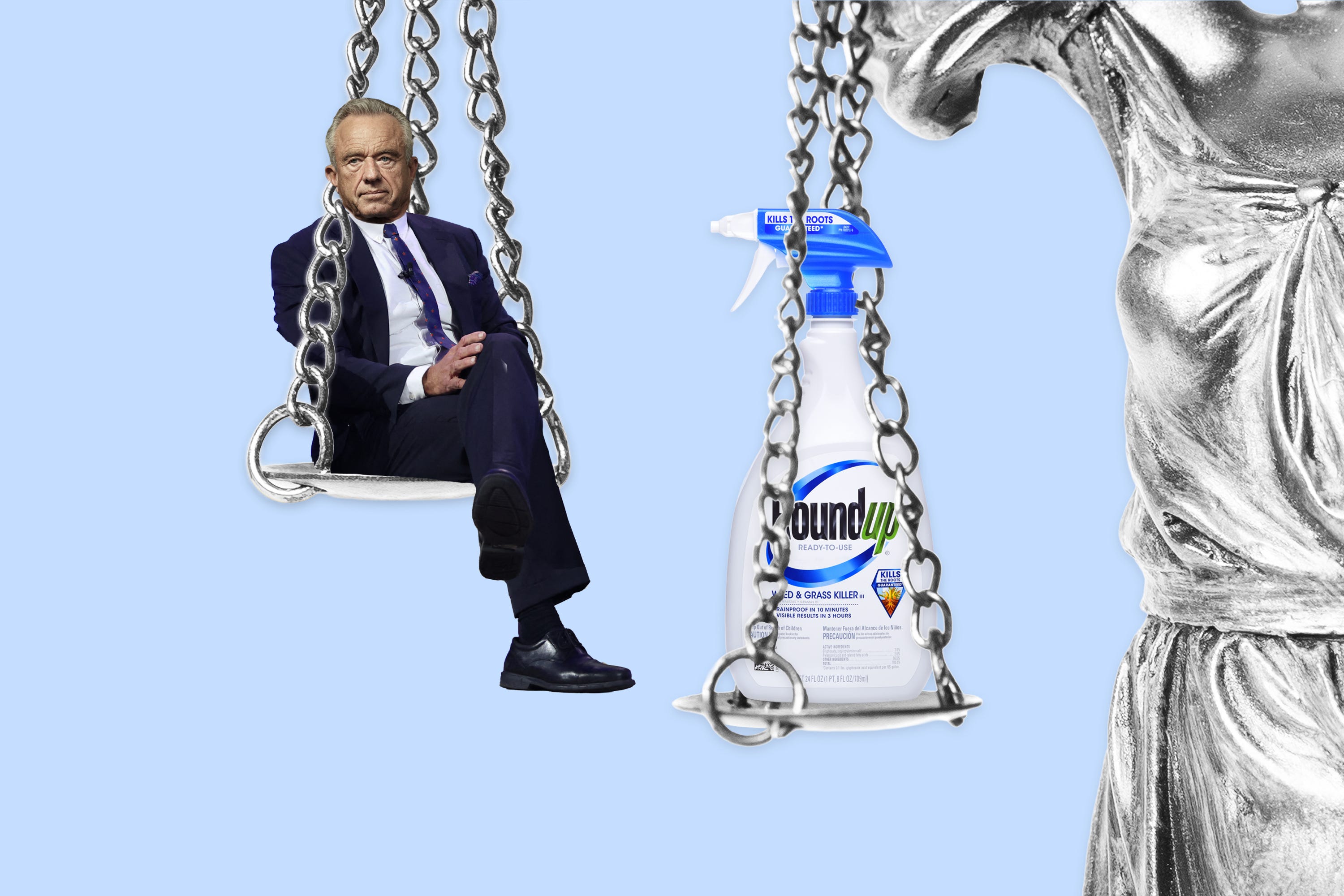
THE SUPREME COURT JUST HANDED Bayer Corporation—and its wholly owned subsidiary Monsanto—a major victory. In an 7–2 decision, the Roberts Court ruled that the moment the Environmental Protection Agency approved Roundup’s label, the company bore no responsibility for what the product did to the people who used it. With that, Missouri farmer John Durnell’s quest to get compensation for the cancer he says Roundup caused screeched to a halt—along with the claims of about two hundred thousand other plaintiffs. The halls of justice are now closed to them.
Less immediately visible, but just as consequential, is the imminent political fallout. Rural farmers, MAHA moms, and specifically the young men who broke hard for Trump in 2024 have all paid close attention to this case. And they could very well end up viewing it as a betrayal from an administration they believed shared their values.
Back in April 2025, a 17-year-old named Eric Zhu organized an event in a Los Angeles film studio: the first ever sperm race. Zhu put sperm samples (unclear if his were included) on a microfluidic track, pointed a camera at them, threw the footage on a jumbotron, and invited a crowd. There was a leaderboard. There were commentators. The hip-hop artist, Ty Dolla $ign, performed. UC students in hoodies cheered for their classmate, one of the competitors in the race (so to speak), with almost the same energy they’d bring to a football game against a top rival. The event had the air of the inside-joke-masquerading-as-stunt that this generation flocks to. But Zhu was completely serious about the subtext.
An associated manifesto clearly stated the mission of the event. Namely, to address “the falling fertility rates and sperm health of Gen Z.” Here it was gamified in sticky detail. Zhu was careful to distance himself from the Elon Musk-style pronatalism crowd. “I have nothing to do with this, I’m not like an Elon Musk, who wants to repopulate the Earth,” he said. Instead he framed it as a health awareness project.
But the concern underneath Zhu’s event was the same one that hums through the fitness podcasts, health forums, and group chats where Gen Z men actually live: falling sperm counts, declining testosterone, a body under chemical assault, and—ultimately—a stunted quest for a core biological drive to procreate.
Sperm Racing has since toured college campuses across the country and accumulated over a billion impressions online.
These events strike a collective nerve. Falling sperm rates, a trend documented since the 1970s, put a fine point on the health, vitality, and families young men say they actually want, but which feel out of reach against the backdrop of rising economic and social instability. Young men who gravitated toward Trump moved in part because they saw in his overtly masculine politics as a reflection of those values.
In Thursday’s Supreme Court’s ruling in Monsanto v. Durnell, which was written by Trump-appointee Justice Brett Kavanaugh, and in everything the administration did to get here, young men felt something else: A stab in the back.
THEIR FEARS AND ANGER have a scientific foundation. Multiple peer-reviewed studies link glyphosate, Roundup’s active ingredient, to reduced testosterone, lower sperm concentration, and degraded sperm motility. A 2024 French study was the first to find glyphosate inside human sperm cells, and the men who had it also showed elevated markers of cellular damage linked to infertility. While the science is contested at the margins, it’s solid enough to explain why the glyphosate-and-fertility conversation has been growing steadily in these communities for years.
Young men’s attraction to Trump was driven in no small part by his embrace of MAHA superstar Robert F. Kennedy Jr. in 2024. And between Kennedy’s chaotic, MAHA-inflected leadership of the Department of Health and Human Services and Trump’s aging politics of virility, the Republican coalition has held on to the young male voting bloc that simultaneously perceives Democrats as feminized and joyless.
Yet, in a single week in February, three events shook that alliance: House Republicans unveiled a farm bill preempting state and local governments from requiring cancer warnings on pesticide labels beyond what the EPA approves; Bayer announced a proposed $7.25 billion class settlement to cap its remaining Roundup liability; and on February 18, Trump signed an executive order invoking a wartime emergency authority to guarantee the domestic production of glyphosate and extend liability protections to its manufacturers. Bayer, through its subsidiary Monsanto, is the only domestic producer of glyphosate in the United States.
The MAHA coalition didn’t take it quietly. Zen Honeycutt, founder of Moms Across America, told CNN: “I was outraged. I was actually sick to my stomach. When I saw this executive order, it was basically a love letter to glyphosate.” Vani Hari, another of the movement’s most prominent wellness voices, called it “a direct assault on MAHA.” One MAHA podcaster compared the administration’s reversal to “finding out your husband was having an affair.”
Ironically, the administration’s own MAHA Report, released in May 2025, highlighted research documenting “reproductive and developmental disorders as well as cancers, liver inflammation and metabolic disturbances.” Despite the report’s alarm, only nine months later Trump signed an executive order expanding the chemical’s production.
The disillusionment MAHA has felt is heightened by the role RFK Jr. is playing. Prior to saddling up with Trump, Kennedy had been at war with glyphosate for years, having helped win a landmark Roundup cancer settlement in 2018. “I believe glyphosate causes cancer,” he said earlier this year on a podcast hosted by Katie Miller, wife of the influential White House Deputy Chief of Staff for Policy Stephen Miller.
But Kennedy immediately acquiesced to Trump, undercutting his credibility on the issue and the convictions many young men found attractive. He supported the president’s executive order while simultaneously acknowledging that the nation is “dependent upon something that we know makes us sick.”
Then Trump’s Department of Justice doubled down on the administration’s pro-glyphosate position at the Supreme Court. Solicitor General John Sauer filed a brief siding with Monsanto on the core preemption argument shielding the company from the class action suits. He then secured time at oral argument to press it. The administration’s position was that federal approval for Roundup amounted to a permanent liability shield—even when two hundred thousand people sue.
LONGTIME KENNEDY CONFIDANT Del Bigtree was there on the steps of the Supreme Court in April when arguments in the case against Monsanto were being heard. “Donald Trump has done real things for MAHA. I believe that,” he said on X shortly thereafter. “But when the Department of Justice shows up to defend Bayer and Monsanto against the American people, against the health of our children, I have to say: you got this one wrong.”
Marjorie Taylor Greene, no longer in the House at that time, followed with more force, posting that Trump “turned his back on MAHA by signing an executive order to protect glyphosate.” Alex Clark, a conservative wellness podcaster aligned with Turning Point USA, said the EPA had become “one of the largest uncontrolled chemical experiments in human history” while scoffing that it was happening under “an alleged ‘MAHA EPA.”
If you want to know whether this issue moves votes, you don’t have to wait for the midterms. Three weeks ago, Zach Lahn, a previously little-known farmer, defeated Trump’s endorsed candidate in Iowa’s Republican gubernatorial primary by less than a percentage point.
After his father developed non-Hodgkin’s lymphoma after a lifetime working the fields, Lahn ran explicitly against Bayer, liability shields, and the “Big Ag cartels.” “Iowa has the fastest-growing cancer rate in the world,” he said in his victory speech. “But too many politicians from Washington, D.C., to Des Moines have had their heads stuck in the sand while Big Ag and Big Pharma printed money.”
Lahn beat Trump’s pick in Iowa on that message. It was the first time this cycle that a Trump-backed candidate for a major office lost a primary.
MAHA PAC, a group run by RFK Jr. allies, declared that the results were “a signal that pro-pesticide does not mean pro-farmer.” But the implications run far beyond farm country. A winning issue in a rural state wasn’t immigration or culture-war chum. It was the government protecting corporations that are killing you and your dreams of a future family.
THE CONTRADICTIONS IN THE RIGHT’S COALITION become clearer every day, and the administration’s record on glyphosates reveals key fault lines.
Republicans have owned the “pro-family” narrative for a generation, usually as an evasive way of speaking about culturally conservative issues in ways that have to do with sex and sexuality. The implicit message was that the GOP takes families seriously.
Young men got it. According to a 2025 NBC poll, Gen Z men who voted for Trump ranked having children as important personal goals while their female counterparts didn’t rank those aspirations at all. Their desire is real. This is a generation that wants to start families and isn’t sure it can.
The government has now gone out of its way to protect glyphosate and insulate producers from legal challenge all while telling young men that demographic collapse is civilization’s defining crisis.
If we take the pronatalist argument at face value, then defending Bayer is the most anti-natalist thing this administration has done.1
The science popular in fitness forums and health podcasts says glyphosate accumulates in sperm and degrades its quality. The administration told young men that fertility is a crisis, then spent months in court defending the corporation the science links to fertility decline.
You can’t message your way out of that. It’s a policy record.
It’s also an opportunity. For a decade, Democrats have struggled to land the argument that Republicans protect corporations at the expense of ordinary people. The Trump administration’s record on glyphosates gives them both a record to run against and a powerful narrative.
It’s an argument already being made by MAHA influencers, conservative podcasters, the Republican gubernatorial candidate in Iowa, and Marjorie Taylor Greene.
Monsanto v. Durnell won’t fracture the Trump coalition, but it will focus the manifold grievances about testosterone, sperm counts, chemical exposure, and regulatory capture into a single datable moment.
Young men who want families are already asking the right question about who protects their futures. Today’s ruling answers it.
Outspoken pro-natalism advocate and practitioner Elon Musk has been conspicuously silent on the case and the ruling to date.
 | A guest post by
|