

Trump Is Making China Great Again
America’s friends and trading partners are running into the arms of our adversaries. What a mess.

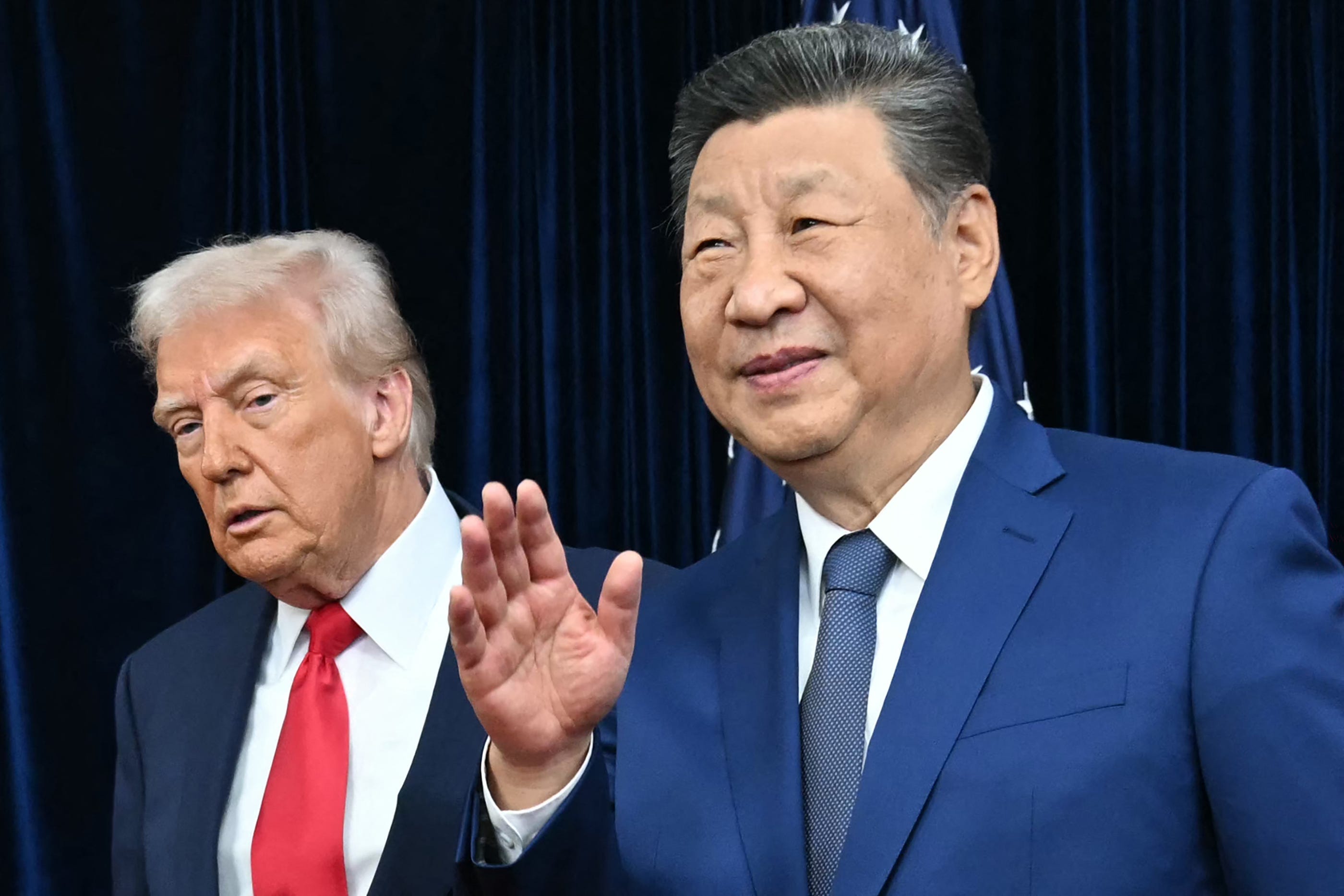
SOMEONE ALERT the Norwegian Nobel Committee: Against the odds, Donald Trump has succeeded in peacefully uniting the world.
Unfortunately, the world has been united against us.
This Pax (Ex) Americana era was illustrated Friday, as Canadian Prime Minister Mark Carney wrapped up a trip to China. This wasn’t just any old visit, either: It marked the first time a Canadian PM had been to the world’s second-largest economy since 2017—and based on the glamorous video Carney’s team released, it was a smashing success for Beijing.
Carney and Chinese President Xi Jinping unveiled a “new strategic partnership” between the two countries. Among the key planks of this agreement, China will reduce tariffs on Canadian canola seed, peas, and lobsters. It will also allow visa-free travel for Canadians, who are apparently eager for new tourism destinations.1 Canada, in turn, will allow 49,000 Chinese electric vehicles into its market at lower tariff rates.
Why is this a big deal? Because the U.S. government had been trying to contain China’s global economic influence. It had been trying to expand U.S. exports. And it had been working to prevent inexpensive Chinese EVs from blowing up the U.S. auto industry. But after a year of bullying, insulting, and threatening to invade our polite northern neighbor, we undermined all those objectives and drove a close friend into the arms of an adversary. After all, Trump declared just this week that Americans “don’t need” any products from Canada, even though the country is our second-largest trading partner.
“We’re forging new partnerships around the world to transform our economy from one that has been reliant on a single trade partner,” Carney2 said before his Beijing visit, “to one that is stronger and more resilient to global shocks.”
In short, Trump’s big bet that countries would ultimately determine that they simply can’t live without America’s markets, and thus would cave to his every whim, was dangerously wrong. Instead, Carney’s Beijing visit shows just how much Trump has done to make China great again. In recent weeks and months, China has advanced or rekindled relationships with many of our allies, hosting a parade of foreign leaders.
In early January, for instance, South Korean President Lee Jae Myung visited Beijing. It was the first official visit by a South Korean president since 2019. A few months earlier, Xi had had his first visit to South Korea since 2014. The two countries have now signed more than a dozen agreements across the tech, consumer goods, and supply chain sectors. Lee said he hoped the January summit represented an “opportunity to make 2026 the first year of full-scale restoration of Korea-China relations.”
Additionally, last spring, China, South Korea, and Japan had their first economic dialogue in five years. If you know anything about Chinese–Korean–Japanese national relations—and the mutual mistrust that dates back generations—you’ll realize what an enormous deal all this is.
You’ll also realize how much we must have pissed off our friends to force this outcome.
Later this month, British Prime Minister Keir Starmer is slated to visit China, too, in what will be the first trip to the country by a British PM since 2018. German Chancellor Friedrich Merz is also slated to visit China in February.
Chinese companies are already reaping the rewards; the country has just boasted its biggest trade surplus on record. Sure, exports to the United States fell 20 percent last year, but businesses in China found plenty of willing buyers elsewhere. Chinese exports to the European Union grew 8.4 percent, and those to southeast Asia shot up 13.4 percent.
Other economic alliances are forming without us, too, as Trump saber-rattles toward Greenland, and other long-term friends openly question whether America remains an ally.
Last week, the European Union greenlit an enormous trade accord with four South American countries, creating a new free trade zone encompassing 700 million people. The pact has long been controversial; negotiations for it began more than a quarter century ago, and European farmers are now blocking highways in protest.
But in spite of this opposition, the need to unite against economic threats from Trump convinced negotiators to nudge the agreement through.
Once upon a time, it was the United States urging likeminded liberal democracies to band together to prevent an authoritarian superpower from writing the “rules of the road” on trade and other economic relations. That was the exact pitch then-President Barack Obama made a decade ago for the Trans-Pacific Partnership, a trade pact designed to box in China.
But first congressional Democrats blocked it, and then Trump withdrew us from it entirely on one of his first days in office in 2017. The remaining signatories moved ahead without us, and if recent events are any indication, more pacts designed to knit together the rest of the world will be signed in the years ahead. And it will be the United States—not China—that finds itself boxed out.
TRADE WARS AREN’T THE ONLY REASON why the United States looks more and more like an unreliable economic partner for both foreign governments and companies. There are other ways in which our institutions and the rule of law are fraying, which makes America a less attractive place to do business.
Trump’s attempts to politicize the central bank—including, most recently, by criminally investigating Federal Reserve Chair Jerome Powell—should send shivers down the spines of anyone thinking of investing in the United States. That’s because putting the money supply in the hands of an authoritarian politician is precisely how you can get hyperinflationary outcomes à la Venezuela, Argentina, Turkey, Zimbabwe, pre-euro Italy, and many other troubled states.
Indeed, in the wake of the Powell investigation, some European bond traders finally began digging into Project 2025, the Heritage Foundation playbook for Trump’s second term. When they did, they were apparently aghast to discover its proposal to “effectively abolish” the Fed.
Trump has also seized equity stakes in healthy companies—including in an alumina refinery just this week. “Prior to Trump, the US government hadn’t taken a permanent, non-crisis investment in a healthy private company since at least the 1950s,” notes Cato Institute scholar Scott Lincicome. “Now we have 11.”
Not all of these companies are American, either: Trump demanded a “golden share” of U.S. Steel as a condition of approving its acquisition by a Japanese company. The share allows Trump—and only Trump, but no subsequent U.S. presidents—to veto key business decisions the company might make.
Meanwhile, the president is changing the rules under which businesses may operate, by social-media fiat.
Last week, he announced that credit cards may not charge more than 10 percent interest, a change that would require new legislation from Congress. But don’t worry, his top economic adviser Kevin Hassett declared Friday: Legislation won’t be needed because the White House expects banks to comply via “really great new Trump cards” that banks will offer their customers “voluntarily.”
Or else, wink-wink.
Elsewhere Trump appears to be imposing capital controls on immigrants. And manipulating mortgage markets. And unilaterally restricting purchases of single-family homes. And opening offshore bank accounts to hold the proceeds from stolen assets.
In this context, it should be unsurprising that countries and companies are looking for alliances elsewhere—including with China, where at least this kind of economic thuggery is out in the open.
Ramparts
— Fed governor Stephen Miran was asked this week about threats to U.S. institutions, and whether they might affect the dollar’s standing in the world. Miran replied that “institutions in the United States are very, very strong,” and anyone who says otherwise is doing so “for clicks.” For context: In an unprecedented move last fall, Miran refused to resign his senior White House job while serving on the Fed board, which is supposed to be politically independent. Miran also scolded central bankers around the world who stood up for Powell.
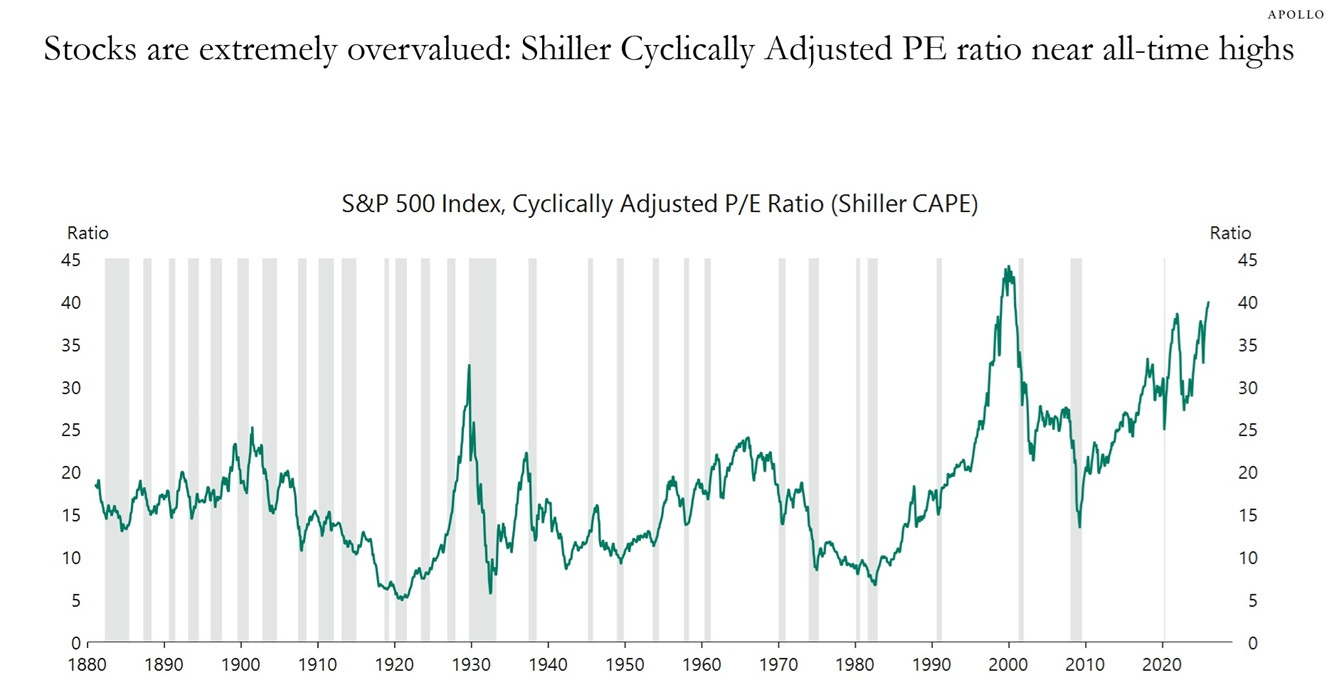
— Two scary charts about the U.S. stock market, both courtesy of Apollo’s Torsten Slok. The first shows that equity valuations are near their highest levels since 1880. Translated, this means that stocks are priced very high relative to what the underlying companies are actually earning.
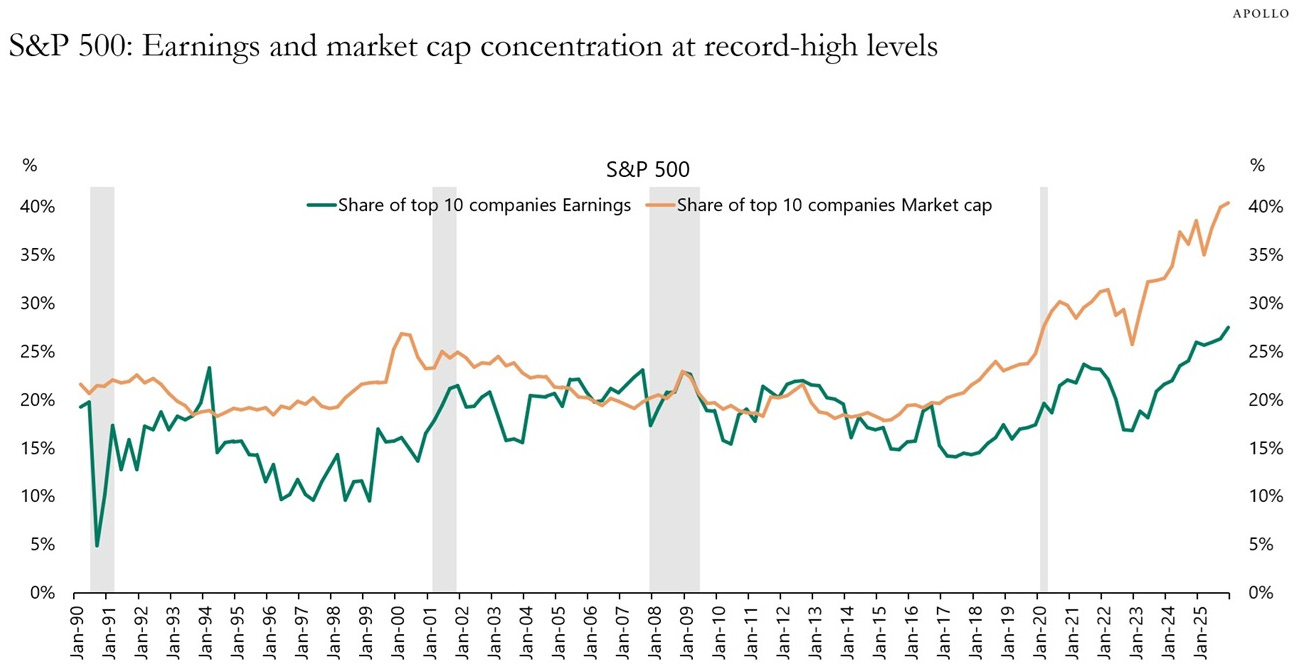
The second shows that this boom is largely about just a few (AI-related) stocks: There is record-high concentration in the S&P 500’s market cap, returns, earnings and capex.
— The Trump administration’s order to change the name of the Defense Department to the “Department of War” could cost taxpayers anywhere from a few million dollars to $125 million, the Congressional Budget Office estimates. Where’s DOGE when you need it?
Canadian travel to U.S. destinations has plummeted. In December 2025, the number of Canadians returning from the States by automobile was down 30.7 percent from the same period a year earlier.
Fun fact: Three of our greatest bulwarks of Western liberal democracy right now are investment bankers–turned–public servants: Canadian PM Carney, French President Emmanuel Macron, and Federal Reserve Chair Jerome Powell. Credit to Neera Tanden for pointing this out.
Agreed, Trump is turning the US into Russia on CRACK! And the world has taken notice.
Furthermore, all of this chaos is a deliberate ploy by Trump and his associates to destroy the EU; helping Putin achieve success in Ukraine, while exerting pressure on Europe by doing what Russia successfully achieved here with the help of a bunch corrupt, useful idiots.
Additionally, they intend on supporting the right-wing European candidates throughout Europe; turning Europe into a Russian proxy.
And as we’ve seen, Trump’s policies and threats in the America’s tells us everything we need to know about his presidency and ultimate goals; influence over all of the Americas.
After all, if he can just take a Nobel Prize, make billions while in office, receive gold bars and $400 million dollar airplanes from foreign governments; then the “sky’s the limit”!
Anyone who believes otherwise honestly needs to find a good therapist; because nothing about this presidency is normal …:)
The stable genius started using tariffs like a kid who’d found his father’s gun. It never crossed his little mind that all the other nations would simply trade with each other and China and leave us in the dust.