Trump’s Friend in Poland Is Doing Putin a Huge Favor
Polish President Karol Nawrocki is the reason for the recent row with Ukraine.

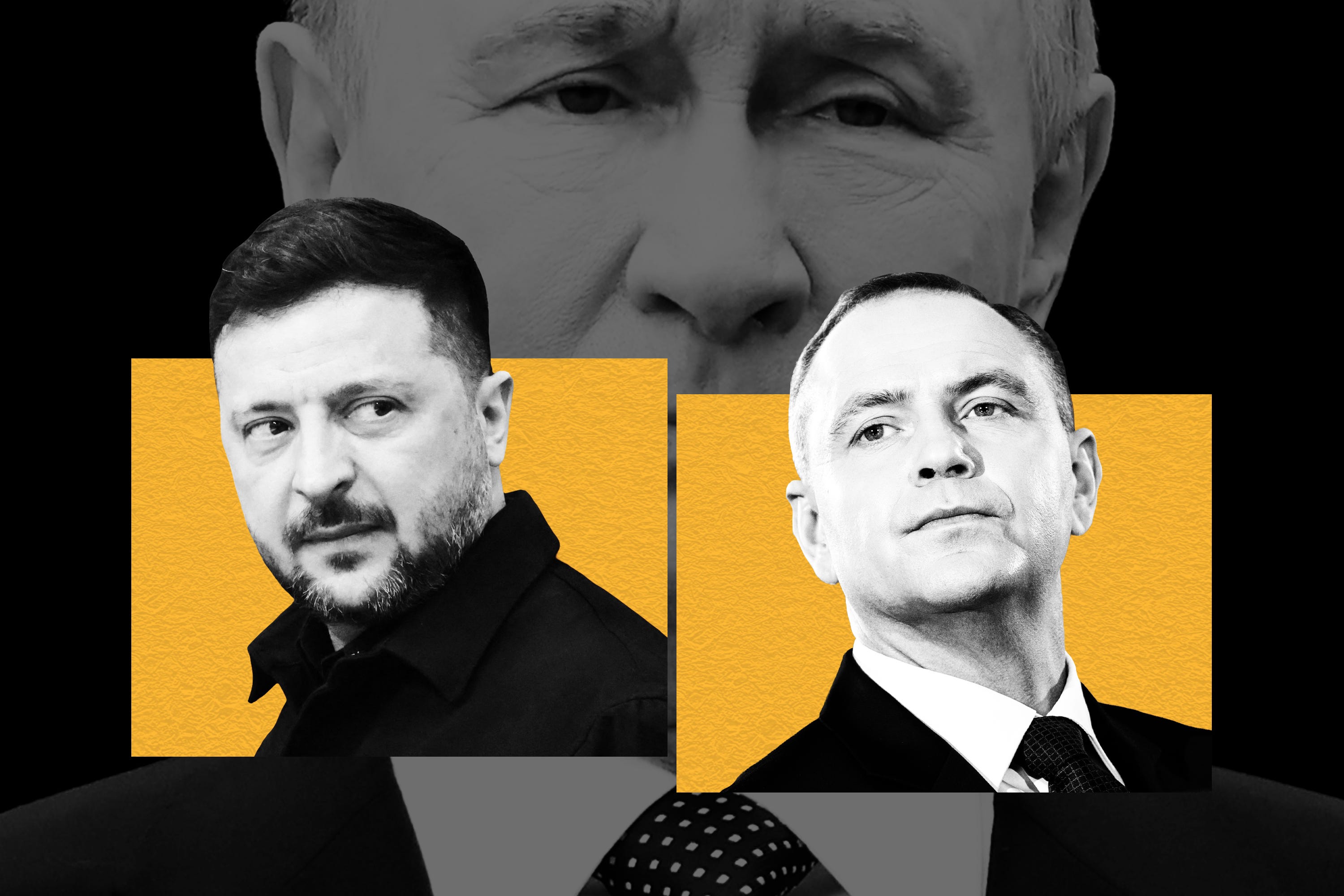
OTHER THAN MAKING PROGRESS on the battlefield, which now seems beyond hope, there is little else that Vladimir Putin yearns for than driving a wedge between Ukraine and its key allies. This past month, he has received a lot unsolicited help in that regard—both from Kyiv and from Warsaw.
The current crisis in the Polish–Ukrainian relationship started on May 26, when Ukrainian President Volodymyr Zelensky signed a decree conferring the honorary name “Heroes of the UPA” on an elite special-operations unit. To most Ukrainians, the UPA (“Ukrainian Insurgent Army”) is remembered for its guerrilla war against Soviet rule well into the 1950s. For Poles, however, it stands for Nazi collaboration and for the massacres of 1943–44, in which UPA fighters slaughtered tens of thousands of Polish civilians in a campaign that Poland’s parliament has formally declared a genocide.
In response, Polish President Karol Nawrocki stripped Zelensky of the Order of the White Eagle, Poland’s highest distinction, conferred by his predecessor, Andrzej Duda, barely three years ago. Ukrainian dignitaries—Foreign Minister Andrii Sybiha and former Presidents Leonid Kuchma and Viktor Yushchenko—began handing back their own Polish medals in protest. And this week, as a Ukraine reconstruction conference prepares to open in Gdansk, Nawrocki’s office let it be known that the Polish president had not been invited and would not attend—and neither would Zelensky. Nawrocki’s foreign-policy chief, Marcin Przydacz, hoped aloud that Prime Minister Donald Tusk would focus on “Poland’s interests, rather than just raising money for Volodymyr Zelensky.”
Zelensky’s UPA decree was an unforced error. Sybiha’s claim that the soldiers themselves chose the name and “had no intention of offending the friendly Polish people” may have been true, but it’s entirely beside the point. Faced with initial indignation from Poland, he doubled down by retorting that the White Eagle still adorns the chests of Catherine the Great, Benito Mussolini, and Gerhard Schröder—which also is beside the point.
Yet the responsibility for turning a diplomatic irritant into a strategic gift to Moscow lies overwhelmingly with one man: Karol Nawrocki.
Nawrocki, who ran last year as a candidate of the right-wing populist Law and Justice (PiS) party has become a poster boy (the only successful one, to date) of MAGA’s influence over European politics. In his campaign, he branded himself as the pro-American, Trump-endorsed candidate—in contrast to Tusk, who occasionally sparred with Trump on social media. “You will win,” Trump allegedly told him when he was received in the Oval Office ahead of the first round the election in May 2025. Few days before the run-off, Nawrocki appeared at CPAC conference in Poland, together with then-Secretary of Homeland Security Kristi Noem, who had flown over the Atlantic to endorse him.
Whether or not one wants to give Zelensky, leading his country through wartime, the benefit of the doubt, it is hard to grant the same treatment to Nawrocki. As part of his Polish MAGA strategy, he ran on an explicitly anti-Ukrainian campaign. One of his first presidential vetoes blocked legislation extending assistance to Ukrainian refugees in Poland.
Now he is working overtime to derail a complicated process of reconciliation, spearheaded by his predecessor and political ally, President Duda. In 2023, in a powerful gesture, Duda and Zelensky jointly commemorated those massacred by UPA in Volhynia, then part of Poland and now in western Ukraine. The two governments took other steps to depoliticize the issue as well. Last year, for example, the first exhumations and reburials of victims began—a long-standing Polish demand blocked by Kyiv since 2017.
It’s hard to believe that Nawrocki’s confrontational stance over a painful issue of collective memory is just a mistake, rather than a product of a rather malevolent political calculus, misusing politics of historical memory. In fact, Nawrocki is a historian and served as the head of Poland’s Institute of National Remembrance, where he made his reputation for pressing the issue of German reparations—and seeking to suppress any discussion of Polish complicity in the Holocaust.
Make no mistake, these are not esoteric or academic discussions. The purpose of the Gdansk conference Nawrocki is now boycotting is to mobilize Western money and firms to rebuild a country Russia is still bombing nightly. Tusk has some 200 Polish–Ukrainian business agreements ready to sign there. The president’s contribution has been to gripe that the affair is a fundraiser for Zelensky, while his prime minister is left, in his own weary words, “minimizing the damage” his head of state has caused.
None of this is lost on the Kremlin. When Nawrocki vetoed the refugee bill last year, Polish Deputy Prime Minister and Defence Minister Władyslaw Kosiniak-Kamysz observed that “Russia was delighted,” as hundreds of troll accounts cheered the president on. They are cheering again. A Polish–Ukrainian rupture is among Moscow’s oldest strategic ambitions; for the price of a few press conferences, a Polish president is handing it over.
In earlier times, Washington would have been a moderating influence, but the United States under Donald Trump has been at least as hostile to Ukraine as Nawrocki has been, and the Polish president’s allies in the MAGA movement are probably happy to see Poland turn on Ukraine.
Still, Poland is the conduit for a vast majority of Western weapons, trainees, and supplies that reach the Ukrainian front. Ukraine, meanwhile, is the army standing between Poland and the Russian border. Neither side can afford this quarrel, and the grown-ups—Tusk above all, but other Europeans leaders too—know it. History deserves honesty, and Poland’s dead deserve their graves. But the surest way to dishonor them is to hand Russia defeat so many Poles and Ukrainians over the generations have fought and died for.
 | A guest post by
|