

Very Low-IQ Trump Too Stoopid to Win War
There’s a revolution in military affairs and America is on the wrong side of it.

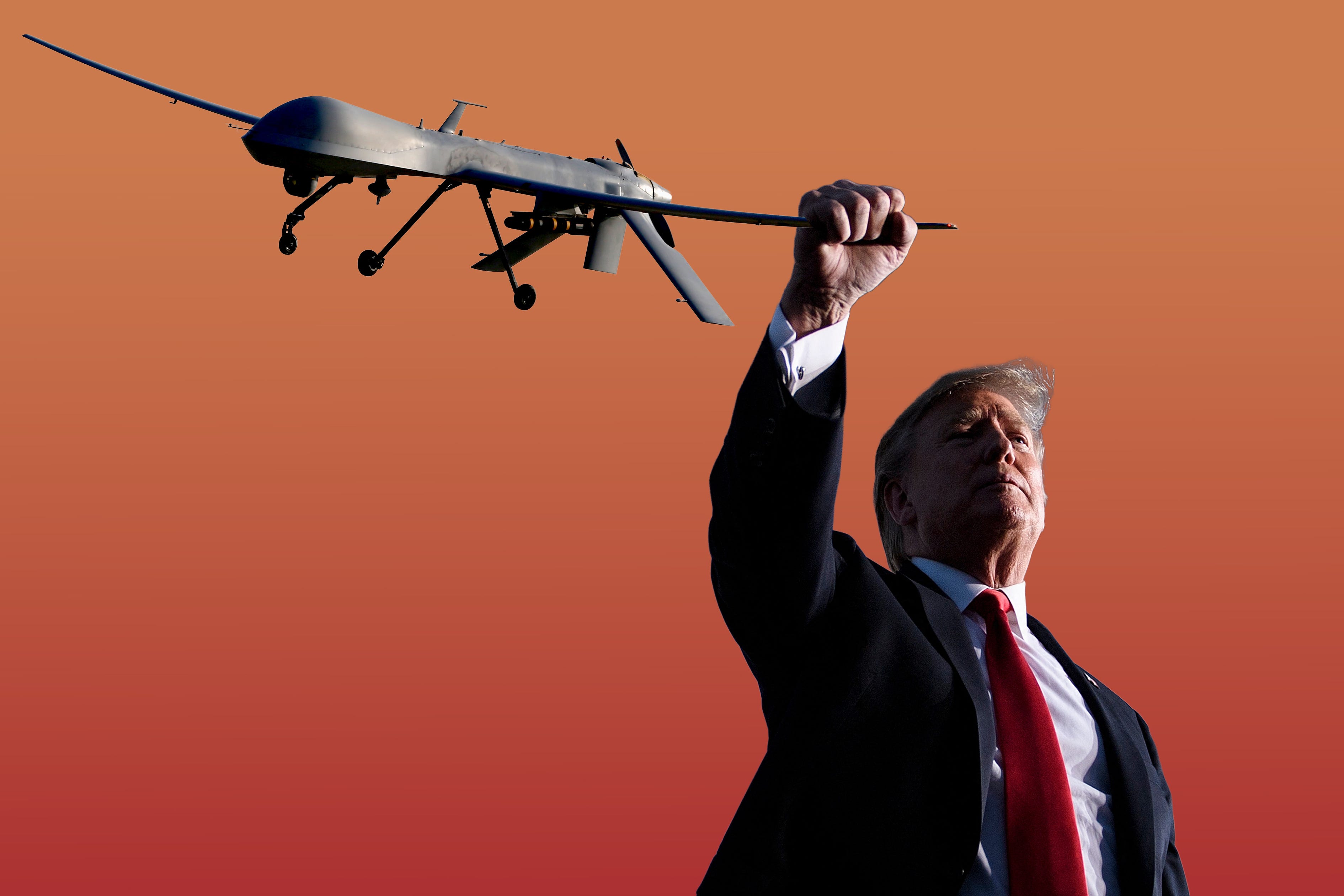
1. Economics
Earlier this week Ed Luce noted the similarities between Ukraine and Iran: Both were attacked by much larger powers. Both have stopped the much larger powers in their tracks.
How? Because both Ukraine and Iran mastered a revolution in military affairs before their adversaries even understood that one was afoot.
Today we’re going to talk about:
What the Ukrainians and Iranians figured out.
What this revolution means for the future of war.
How Donald Trump failed to prepare the U.S. military, leading to our defeat in Iran and the end of the American-led global order.
In addition to Trump’s other failures, he has been buying up cavalry horses at a time when our adversaries are building tanks. This stupidity failed the American military, diminished American power, and made our interests across the globe less safe.
This is going to be a journey that is nominally about drones, but is really about Trump and the end of the American order.
We start by understanding that the drone is both the present and the future of warfare. This is not new.
America was the first military to widely integrate drones and we did it thirty years ago with the Predator and then the Reaper.1 The key insight was that where air forces historically prized speed and power, unmanned aerial vehicles (UAVs) could be valuable precisely because of how slow they could move. The Army could park a Predator over a patch of grass for hours at a time and it was the equivalent of having a geosynchronous satellite feeding them real-time intelligence—and for the tiniest fraction of the price.
We gradually turned surveillance drones into weapons platforms, but the emphasis in America was still on Big. Our drones were cheap by the standards of fighter jets, but they still cost real money.2 Nations which did not have the resources to manufacture even “cheap” Predator-like drones looked to the consumer drone space for inspiration—and that’s when the real revolution happened.
In 2020 Armenia and Azerbaijan went to war for the second time in a generation. The First Nagorno-Karabakh War lasted six years. The Second Nagorno-Karabakh War lasted six weeks. That’s because the Azerbaijanis used a combined-arms strategy centered around the integration of cheap drones used both for surveillance and as smart-munitions. The Armenians, who fielded a conventional force based around armor, artillery, and infantry were routed.
Military planners in Kyiv and Tehran were paying attention. People in Donald Trump’s administration—and Vladimir Putin’s army—were not.
By this point the supremacy of drones in the Russo–Ukraine war is well-documented. You should understand that drones are also the reason America has lost the Iran war.
In a recent interview with the Atlantic Council’s Danny Citrinowicz, Isaac Chotiner asked:
The fundamental question I keep returning to is: Did the Iranians not realize how much control they had over the global economy before the U.S. and Israel attacked them? Or had they always known this and were they just waiting to wield that power?
The answer to this question is that that while the Iranians had a theory about controlling the Strait of Hormuz for decades, the practical ability to execute this plan did not materialize until the age of the drone.
In pre-drone times, Iran would have needed to rely on mines, fast-boats, and anti-ship missiles. Mines are hit-and-miss and slow to deploy—plus they’re hard to un-deploy, which is inconvenient for Iran because while they can close the strait in the short term, in the long term they need it open. Boats and missiles are relatively expensive and can be neutralized by conventional means. The Iranians needed another option—which is why they poured resources into their drone industry beginning in 2010.
It was the drone that allowed Iran to close the strait and win the war.
Next, we should understand what makes the drone so special. The drone does not represent a technical advance. It is an economic advance.
Guided munitions—smart bombs, rockets, and shells which can seek out targets after being fired—have done what drones do for a long time. What makes the drone different is the cost basis.
A guided munition is expensive. A Tomahawk missile, for example, costs about $2m. These munitions then need dedicated platforms from which to launch—typically a submarine or ship in the case of the Tomahawk. Other guided munitions can be fired from aircraft or land-based batteries or, in the case of some extremely short-range weapons like the Javelin anti-tank missile, by infantry.
In every one of these cases, the munition itself is costly but that price is dwarfed by the long tail of costs needed to put those munitions in the field. To stick with our $2m Tomahawk, it can be launched from an Ohio-class submarine—which cost about $3 billion each and requires about 155 crew members, never mind the dockside logistical costs to keep the boat running, pay veteran’s benefits, etc.
A Shahed 136 drone costs between $20,000 and $50,000. Do the math.
For the cost of a single American submarine carrying 154 Tomahawks, Iran can make up to 150,000 drones.
Here is the key insight that I want you to put on a pillow:
War is politics by other means. It is also economics by other means.
If you heard the term “cost-exchange ratio” you might think it’s about stonks. It’s not. It’s about the economics of destroying things.
Take Ukraine as an example. When Russia started firing cheap, Iranian-designed Shahed drones at Ukraine, the only thing the Ukrainians had on hand to shoot them down were expensive missile systems designed to take down airplanes, helicopters, and conventional missiles. As a financial and economic matter, you can’t shoot down $20,000 drones with multi-million-dollar missiles over the long term. Even if you could manufacture interceptors fast enough, you’d bankrupt yourself.
That’s why the Ukrainians developed other, inexpensive ways of downing cheap Russian drones, such as using drones of their own, or electronic warfare that causes the Russian drones to crash, or sitting in the open canopy of a propeller plane and just shooting the Shaheds with a gun.
If Ukraine can get its average cost to destroy a $20,000 Russian drone down to, say, $5,000—then they are winning the war.
And that’s why drones are a revolution. At its most basic, war is a competition to kill people in the most economically efficient way possible, so that your resources outlast the other side’s resources.
Modern low-cost drones undercut the entire superpower economic model of warfare that America relied on for half a century.
2. COVID Part 2
Remember Donald Trump in the age of COVID? When our idiot president would stand in front of a podium riffing about bleach and hydroxychloroquine, instead of spinning up PPE and test kit production?
Think back to how utterly incompetent the Trump administration’s management of the COVID crisis was.
Because that’s pretty much what Trump has done to the American military, too. He was asleep at the switch while the entire universe of warfighting shifted around him.
By most accounts, Trump thought the attack on Iran would be a cross between his kidnapping of Nicolás Maduro and Israel’s destruction of Gaza. What anyone could have told him was that there was one key difference between Venezuela and Gaza on the one hand, and Iran on the other.
You know what that difference was?
Iran has a huge, home-grown drone industry.
Not appreciating this fact is one of the biggest strategic miscalculations in American military history.
How could the commander-in-chief be so utterly stupid and incompetent?
Oh, right.
But it’s not just that Trump didn’t understand the importance of drones in a war against Iran. He has spent his presidency pushing the U.S. military in the opposite direction.
He’s spending $20 billion on a sixth-gen fighter platform, the F-47, because it has his name on it. (Sort of. If you squint.)
He’s spending at least that much on a “Trump-class battleship” which will never touch water.
He’s spending $75 billion on a “Golden Dome” to counter ballistic missile threats to the continental United States. (The Congressional Budget Office says the real cost of the “Golden Dome” would be more like $1.2 trillion over 20 years.)
He spent time and resources putting tanks in Washington, D.C. for a “military parade” while his secretary of defense prioritizes physical fitness—physical fitness!—and tries to prevent officers from attending elite universities.
And early in the Iran war, when Ukraine offered to help the U.S. military defend against drone attacks, Trump brushed them aside. He thought it was unnecessary.
Push-ups, battleships, and high-cost stealth fighters in an age where warfare is dominated by disposable, adaptable drone technology. Like I said: This is the equivalent of outfitting horse-mounted calvary with shiny swords and fancy hats in 1935 while the Germans are cranking out Panzer III’s by the thousands.
As Noah Smith and Shawn Wang recently wrote, all non-drone militaries are now obsolete. And yet Trump is intent on pushing gussied up, old-world tech as the backbone of American military power.
No wonder we just got pantsed by the Iranians.
Quick aside: If this is the kind of long-lens thinking you get value from, come and be a part of Bulwark+. We do this every day.
Which brings us, finally, to the collapse of the American-led world order.
Bob Kagan sat down with Tim this week for an excellent conversation—don’t miss it.
Bob notes that one of the lynchpins of the American-led order was that the U.S. military guaranteed freedom of the seas. Trump has just proved to the world that this guarantee is no longer valid.
Not in some theoretical sense. We have actual, real-world proof. You cannot overestimate the effects of this shift.
Until two months ago the Strait of Hormuz was governed by international laws which we wrote to benefit ourselves. From this point forward, the strait will be governed by the Islamic Republic of Iran. This fact makes Iran a world power which must be accounted for. Every nation in Asia will have to reach an accommodation with the Iranians. And China’s alliance with Iran has now become infinitely more valuable.
More than that: The blueprint has been created for China to dominate shipping in the South China Sea—meaning that every country in Asia will have to make deals with the Chinese, too. These shifts will cut America out of half of the globe. Our interests have become irrelevant outside of our narrow slice of hemisphere.
America goes from being the country that set the rules for the entire world order to being a regional power that must content itself with bullying Venezuela and Cuba.
For a certain type of MAGA, Trump’s performance as commander-in-chief is judged entirely by how many helicopter rides the Army gives Kid Rock.
But for people who prioritize winning wars, deterring adversaries, and protecting America’s interests, Trump has presided over the single biggest technological failure since Sputnik.
He did this. He did it because he is vain and stupid. And now we will all pay for his idiocy.
Literally.

3. Joy #1
Our family cat, K-Pop, has a friend. His friend is a chipmunk named Potato. Every day Potato comes up to the sliding door on the deck to say hello.

The cat and the chipmunk have a complicated relationship. K-Pop seems to want to alternatingly love and murder Potato. For his part, Potato enjoys sitting directly on the other side of the glass, eating seeds, staring at K-Pop with something like bemused affection.
Like the precision-strike technology we associate with the Gulf War, drones actually date to the Vietnam era, but we didn’t really make them a major part of combat operations until a generation later.
According to the Air Force, a set of four Reaper drones plus the ground control station and satellite link systems cost a total of about $18 million in 2009 dollars. Each F-22 Raptor cost about $158 million. (I’m assuming here that the figure the Air Force gives is in 2005 dollars, and I’m adjusting to 2009 dollars.)
These costs don’t include lifetime maintenance costs, pilot costs, fuel costs, or research and development costs.
This always-looking-backwards-and-refusing-to-learn-anything-new thing is working out great. We get 1920s racial politics + 1950s gender norms+ 1940s military policy. The rest of the world gets the future.
Trump doesn't like being called dumb, which is a good enough reason to continue to do so. I also suggest "ignoramus," which can be used often and without discretion.