Putin’s ‘Cringe’ Weekend of Humiliation
His effort to put on a show of strength didn’t fool anyone.

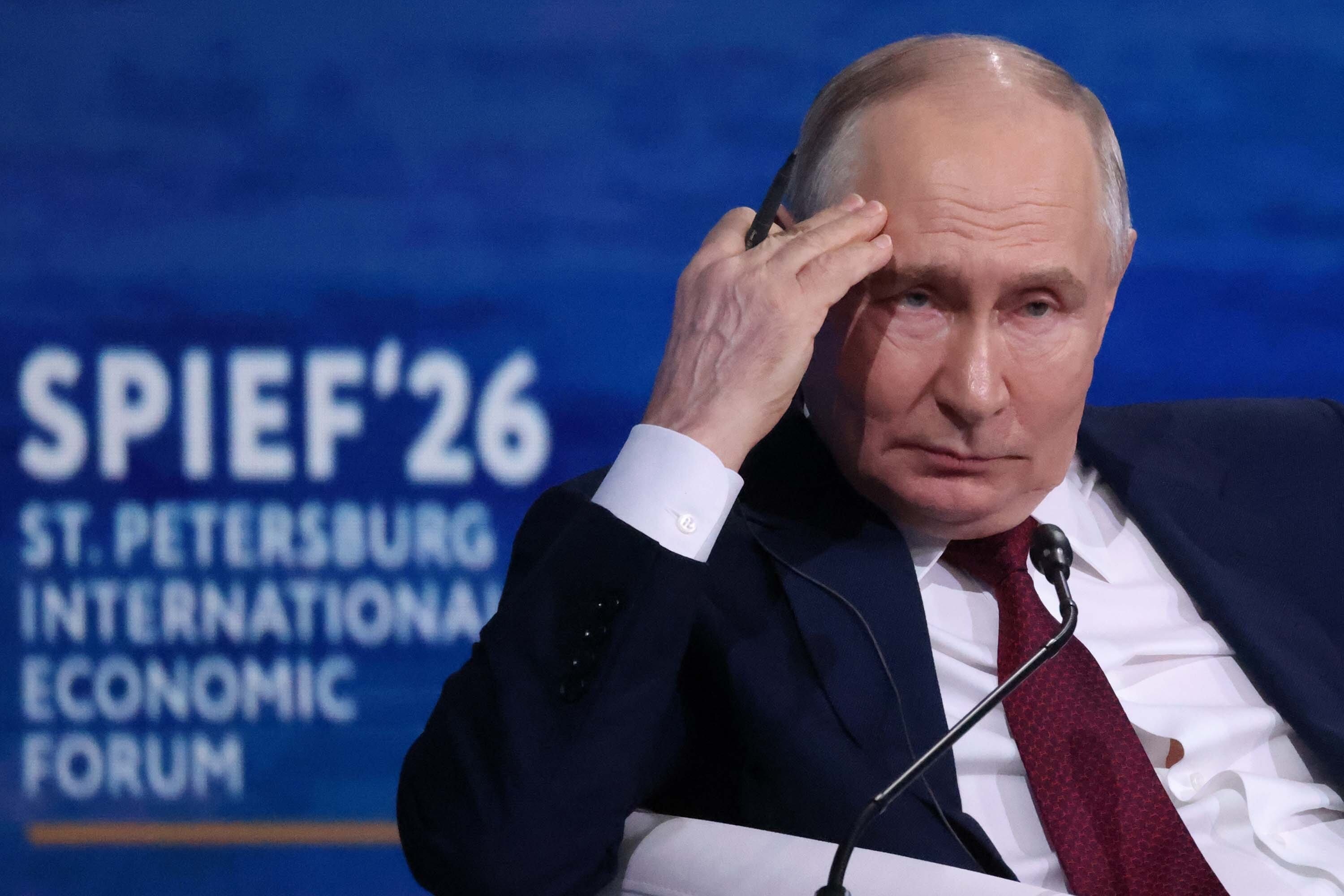
RUSSIAN PUNDITS AND JOURNALISTS ABROAD HAD CHOICE WORDS to describe the just-concluded St. Petersburg International Economic Forum: “A freak show.” “A fake.” “A Potemkin village.” For that matter, even the quasi-dissident Russian businessman Dmitry Potapenko, who still lives in Russia and was in attendance at the event, remarked in a YouTube interview that there was “more cringe” (yes, “krindzh” is now a Russian word) than usual—perhaps the perfect way to describe this year’s installment a once-prestigious event dating back to 1997.
For striking examples of krindzh, look no further than the American guest list, where the big names were conspiracy-theory blogger Candace Owens (who is known for many things, but the one Russian commentators found especially juicy was her crusade to prove that French First Lady Brigitte Macron is a man) and “influencer” Andrew Tate, who is also known for many things, especially multiple charges of human trafficking and sexual assault, including against minors. Even many Kremlin loyalists were annoyed by Tate’s presence—among them Ekaterina Mizulina, a prominent crusader for “traditional values” and for a “safe Internet” (i.e., censorship), who grumbled that Russia has enough of its own “dubious bloggers” and doesn’t need to import them. For some reason, no one pointed out that the forum’s American lineup included a convicted child molester, former United Nations weapons inspector Scott Ritter, who spoke on a panel and shared his wisdom that “today Europe is a rabid dog.”
By some unfortunate oversight, the American contingent did not include “royalist” philosopher-blogger Curtis Yarvin (a.k.a. Mencius Moldbug), who would have been right at home at this carnival of fools as a great fan of Vladimir Putin. The forum thus had to make do with homegrown Russian fascist freaks Alexander Dugin and Konstantin Malofeyev, the Russian Orthodox tycoon who played a major role in funding the “separatists” in Ukraine’s Donbas region in 2014. Malofeyev presented a report on Russia’s future development, in which the “optimistic scenario” included a nuclear strike, the collapse of the European Union, and the total subjugation of Ukraine—either via annexation or via transformation into a “buffer zone” or a new “East Slavic state”—by 2036. By 2050, in this “positive” scenario, Russia also becomes the principal guarantor of “global security and justice.” (That’s a lot like Yarvin’s fantasies.)
Is this an official Russian position? Not quite, especially since it comes wrapped in a lot of crankery that’s a little too nuts even for the Putin regime in 2026: Achieving the optimistic scenario, Malofeyev posited, required not only open embrace of “autocracy” as well as “de-Westernization,” but also de-urbanization, i.e., a program to move millions of Russians from the cities to the countryside where they would become self-sustaining farmers. Surreally, this neo-medievalism at the forum went hand-in-hand with a lot of talk about the need for Russia to keep up with cutting-edge technology in robotics and artificial intelligence.
THE “POTEMKIN VILLAGE” MONIKER bestowed on this year’s St. Petersburg forum by Nina Khrushcheva, professor of international affairs at New York City’s New School for Social Research (and great-granddaughter of the late Soviet leader Nikita Khruschev), was especially apt. Traditionally, the forum was a showcase both for Russia’s economic achievements and for its respectability as an economic and political participant in the global community—a country that, as Khrushcheva put it, doesn’t get relegated to the “little kids’ table” but sits with the grownups.
Today, it’s a showcase for a business-as-usual fiction. In reality, Russia’s international isolation is such that it has to value its friendship with North Korea. The grownups—France’s Emmanuel Macron, Britain’s Keir Starmer, Germany’s Friedrich Merz—are in London meeting with Putin’s arch foe, Ukrainian President Volodymyr Zelensky. Even the Putin-friendly Trump is keeping his distance. True, Rodney Mims Cook Jr., the recently installed chair of the United States Commission of Fine Arts and, coincidentally, the guy overseeing Donald Trump’s White House ballroom project, was at the forum on what he claimed was a quasi-official visit supported both by Trump himself and by the State Department. But Secretary of State Marco Rubio, who seems to be getting in touch with his inner Russia hawk lately, effectively disavowed Cook’s jaunt, telling the House Foreign Affairs Committee that he was “unaware” of it.
As for the Russian economy, perhaps the most telling thing about the forum was not who was there, but who wasn’t: regular attendee Elvira Nabiulina, the governor of Russia’s Central Bank. Nabiulina was originally scheduled to speak on two panels—one of them on economic growth—but vanished from the line-up at the last minute. The fact that officials gave two different explanations for her removal—that she was sick, and that she was attending an advisor’s funeral—did not help dispel suspicions that Nabiulina either decided to skip the forum because she was unwilling to paint a rosy picture befitting the Potemkin village, or was uninvited for the same reason.
And then there was Putin’s appearance with a rosy narrative, both about the economy and about the war in Ukraine, that even most pro-Kremlin bloggers aren’t buying anymore. His assertion that Russia is “calmly and steadily moving” toward accomplishing its objectives in Ukraine prompted political analyst (and erstwhile Kremlin advisor) Stanislav Belkovsky to quip that Putin’s aides might have accidentally given him the talking points for the spring of 2022. Veteran Russian journalist Yevgenia Albats, now living in New York, remarked that Putin’s appearance was emblematic of his “utter failure”—an “un-respected dictator” reduced to dependency on China, North Korea, and Iran, and a man who looked like “an aging, insecure loser.”
To make matters worse, Zelensky chose the St. Petersburg forum as the backdrop for an open letter to Putin proposing face-to-face talks and an end to the war, with a cessation of hostilities along current battle lines. The letter reminded Putin of a lot of unpleasant things: catastrophic Russian losses on the battlefield, economic problems, growing discontent among a war-weary population, the upcoming anniversary of the 2023 mutiny of Yevgeny Prigozhin—and Putin’s own age: “After 26 years in power, age is beginning to take its toll,” Zelensky wrote. Putin, 73 to Zelensky’s 48, was rattled enough to mention the reference to his age when discussing Zelensky’s letter at the forum; he decried it as “rude” and “boorish.” (“You didn’t read the first version,” quipped the irrepressible Zelensky in response.) Putin pointed out, in a likely nod to 79-year-old Trump, that other leaders his age or even older are doing just fine. He also testily rejected the peace proposal, urging Russian troops to fight on. And he seems to have reverted to treating Zelensky as He-Who-Must-Not-Be-Named, referring to him as “that gentleman” and “the author of that letter.”
When asked whether Putin felt humiliated—both by the krindzh at the forum and by Zelensky’s letter—Khrushcheva replied that he probably did not, since he lives in his own reality. Yet one may wonder if that bubble was at least briefly pierced by two massive Ukrainian drone strikes in and near St. Petersburg during the forum—not on the day of Putin’s appearance, but on the forum’s opening and closing days. Targets included an oil terminal and a navy base; the huge billows of black smoke rising over the city could be seen from the forum’s location—a striking reminder of the extent to which Putin can no longer control what happens on his own turf during his flagship event. As one Ukrainian social media poster put it: “The Ukrainian delegation put a spark in the forum.”