

In the Grim Darkness of the Far Future, There Is Only Culture War
How a forty-year-old satire of fascism became a meme for Trump, a flashpoint over women in sci-fi, and—for some fans—an actual political ideal.

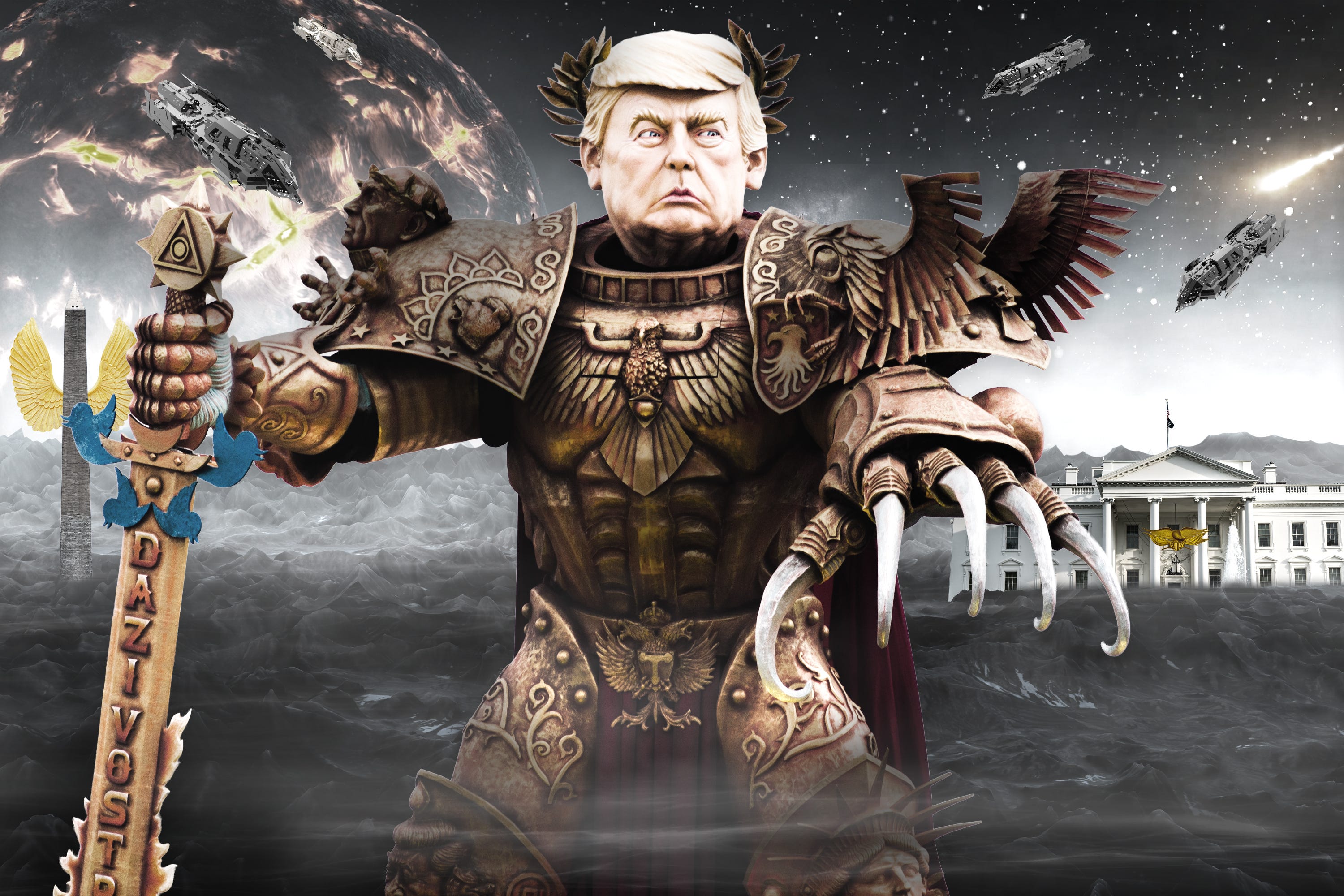
IN FEBRUARY 2019, Italian artist Fabrizio Galli debuted an animatronic papier-mâché statue of Donald Trump. The 65-foot-tall Trump likeness was bedecked with golden armor and wielded a fiery sword with Twitter’s blue bird logo floating around the hilt. Galli had crafted the statue for the Tuscan city of Viareggio’s longstanding annual carnival, famous for its giant statues, floats, and artworks.
Trump “brandishes this weapon of the economy,” Galli said. The blazing sword says dazi vostri, Italian for “your taxes” or “your tariffs,” which Galli intended as a comment on the dark reality that, in his mind, Trump was “trying to destroy nations with the economy instead of nuclear missiles. This is one of the strongest actions, let’s say, that powerful people like Trump can use.”
Galli depicted Trump as the God-Emperor of Mankind, a central figure in the mythos of the wildly popular Warhammer 40,000 universe of tabletop games, books, and other media. Galli was far from the first to make this connection. For years, online meme culture among both Trump supporters and critics has portrayed him as the Emperor, with the earliest examples emerging a decade ago during his first successful presidential campaign.
Warhammer 40,000 (40k, as fans style it) is a futuristic science-fiction game with a parodically dystopian universe. The setting is the far future of our world—the year 40,000 C.E., as it were—where a fascistic interstellar human empire struggles to survive in a hostile galaxy populated by freakish alien threats, all of them turbocharged riffs on a range of classic fantasy and sci-fi tropes.
It’s also bombastic and intentionally, deeply satirical.
Take a look at the playable menagerie. There are haughty, ethereal Tolkienesque elves, flying planet-sized space ships. Orcs (or, rather, “Orks”) are present, too, charging heedlessly into battle atop ludicrously bolted-together war machines while shouting in stereotypical Cockney accents. (“We gotz nowhere to run ladz, and neiver do dey!” goes a typical quote.) There are the Necrons, who resemble Skeletor; the parasitic planet-engulfing swarm known as the Tyranids; and still other “Xenos” that differ in large and small ways from these primary species. Amid them all, the million-world-strong Imperium of Man barely survives a long series of perpetual “one minute to midnight” crises that feature strange psychic magic, ancient aliens, and a parallel universe of malevolent gods and their corrupted heretic followers—literal agents of Chaos embodying humanity’s greatest fears.
The Imperium is “ruled” by the all-powerful God-Emperor, who has been trapped on Earth in a state of semi-death for over ten thousand years. (Humans with psychic powers are enlisted to help artificially maintain his mind at the cost of their lives, which are extinguished by the demands of their spooky service.) In his long limbo, the Imperium has become even more of a ramshackle, Gothic nightmare than it was when he was out and about.
Under the Imperium’s xenophobic theocracy, whole planets are dedicated to the rote monastic copying of religious texts to the Emperor. Following a war with hostile AI, STEM has been deemed a forbidden branch of knowledge, but tech-priests, who struggle to understand the machines they use, offer prayers and perform rituals to keep the lights on and engines running, never knowing why their actions are effective. A secretive Inquisition meanwhile ferrets out witches and political dissidents, condemning whole worlds to destruction at any hint of the encroachments of Chaos, which takes the form of heresy to the Emperor. “Innocence,” as one of the popular catechisms in the setting goes, “proves nothing.”
And finally, Space Marines, the most well-known characters from the 40k universe in the wider popular culture and the crown jewel of Warhammer’s intellectual property, wear massive battlesuits adorned with “purity seals”—fluttering scraps of paper inscribed with prayers and oaths and affixed with stamps of wax—as they venture out to fight crusades among the stars.
40k’s deep ambiguity makes it a compelling setting for gaming—but it also offers the online right a perfect set of tools for prosecuting its own irony-poisoned meme crusade. What exactly do they want to express when they depict Trump as the God-Emperor of Mankind? If you have to ask, they might joke, the Inquisition could show up on your doorstep.
WARHAMMER 40,000 IS A PROPERTY of the British company Games Workshop; it was first released in 1987 as a sci-fi sequel to the company’s popular fantasy battle game, Warhammer. Many of 40k’s foundational themes deliberately evoked the political and socioeconomic tumult of the 1980s and the late Cold War as Margaret Thatcher restructured the British economy along neoliberal lines. Some of the earliest editions of both the original Warhammer and 40k made their contemporaneous satire explicit. One of the mightiest and bloodthirstiest and most human-hating Orks in the 40k universe is called Mag Uruk Thraka, for goodness’ sake.

In 40k, whole worlds are destroyed by a casual “Exterminatus” order that cauterizes threats to the Imperium with nuclear fire. The real-world English industrial town Birmingham, degraded by Thatcher’s policies in our timeline, became the name for a dark, backwards industrial planet in 40k’s distant future; it receives so few visitors that “its inhabitants have become linguistically and culturally isolated.” The punk rock and the counterculture movements of the Seventies and Eighties were a major influence on the art of Warhammer and have remained a constant undercurrent for its unique hyper-Gothic medieval futurism.
All of which is to say, Warhammer has always been political.
Since its humble beginnings, it has also become a cultural juggernaut. In fact, its influence on science-fiction and fantasy culture is hard to overstate. You might have heard the term “grimdark,” which describes a range of sci-fi and fantasy subgenres featuring relentlessly bleak, hopeless story settings. The portmanteau comes directly from Warhammer’s infamous epigraph: “In the grim darkness of the far future, there is only war.”
Between its fantasy and 40k iterations, Warhammer boasts millions of players and enthusiasts. The property has expanded from the original tabletop games to now encompass gaming conventions, hundreds of books, dozens of video games, and a recently inked deal with Amazon to produce featured shows in the setting, overseen in part by former Superman star (and avowed Warhammer-enthusiast) Henry Cavill, whose ability to deliver is already receiving critical scrutiny from other celebrity fans of the franchise. Its rising popularity generated nearly $600 million for Games Workshop last year—almost ten times the value of the United Kingdom’s entire coal-mining industry nowadays—while the brand has become a common visual and cultural reference in media and online communities across the political spectrum. There’s even an academic conference dedicated to exploring Warhammer’s global impact sponsored by the Frankfurt Institute for Advanced Studies.
BUT AS IT’S GROWN, Warhammer has become embroiled in some of the wider cultural flashpoints that have rocked Western countries over the last decade.
Changes to the 40k story and lore, such as updates to women-led factions and a diversification of racial and ethnic appearances for the humans and superhumans in the setting, have led to fierce debates among fans. Many worry that their beloved games—historically nerdy and male-coded—have been corrupted by a slew of Xenos-like outside threats, ranging from DEI initiatives to transgender rights. Many fervent fans decry the rise of what they call “Wokehammer.”
Some of the most contentious debates center on the addition of women into the playable Space Marine and Adeptus Custodes factions, two of the most popular and—in the case of the Space Marines—iconic armies in the 40k universe.
While two all-female factions have already long existed in the 40k universe, and several other armies have female leaders or soldiers, the hulking warrior-monk Space Marines have traditionally been all men. (Of course, it would be more grimly and darkly accurate to say they have all been posthuman men, given the genetic alterations and relentless indoctrination required.) But for years, 40k fans and community members have argued with one another about whether, in order to expand the fanbase, 40k lore should be changed to allow women to become Space Marines, too.
There has been consistently strong opposition to this idea. And in truth, opening the ranks of the Space Marines to women would represent a dramatic change in the lore that would need to be worked back into a body of rulebooks, novels, and media spanning four decades of production. Small lore changes and retcons happen fairly frequently, but Games Workshop usually takes great care to make changes discreetly. And as with many hobbies, Warhammer is full of dedicated enthusiasts who will quite seriously argue about whether a space elf’s particular gun or an alien’s emblem in a promotional poster is the wrong model. More significant changes will naturally provoke strong responses.
In spite of all this, some changes in this area have already been made. Like the Space Marines, the Adeptus Custodes are also posthuman warriors, but the elite cadre of guardians has a unique portfolio: to protect the God-Emperor himself. Games Workshop introduced female Custodians in 2024, altering the setting’s story to declare that actually, female Custodians have always been around. They argued that the strange and mysterious Custodes creation process leaves plenty of wiggle room in the lore, so opening the Adeptus Custodes’ ranks to women is an easy change that provides players more options for customizing their figurines and games.
The negative reactions were immediate and torrential.
LOCAL FIGHTS OVER GENDER DIVERSITY in some of Games Workshop’s marquee properties have taken place against a larger backdrop of the society-wide debate over transgender rights in the U.K. The high-pitched reaction to adding women to Adeptus Custodes began to orient itself around the physical appearance of the genetically altered female Custodians, with some detractors mockingly saying the Custodes resembled stereotypes of masculine-looking transgender women.
Warhammer’s long rise to the heights of pop-cultural recognition and enjoyment has blurred the lines between mainstream and nerd-niche. Its fandom has partially bifurcated in online spaces, which is visible in arguments on dueling conservative and leftist subreddits, and on competing YouTube channels where popular content creators offer deep dives into the setting’s lore—and often into the associated politics, as well. One right-wing Warhammer YouTuber, “Arch Warhammer,” has notably made joint videos with far-right fitness guru “the Golden One” Marcus Follin in which the two lament the decline of Western culture in their respective media spheres.
Elements of far-right politics in both the United States and the United Kingdom have surged in Warhammer communities. Some fans feel that their hobby has come under unwelcome external scrutiny and even attack, and seek to preserve it against alleged cultural interlopers by upholding what they see as the old ways. (Of course, the Warhammer franchise is certainly not unique when it comes to these sorts of dynamics.)
But there is an element of irony to this rearguard action. Many if not most of these contemporary 40k fans themselves first came to the property as a world unto itself, without learning about or experiencing the specific links to the culture and society of Britain in the 1980s, and so they often miss or neglect the original satire. In extreme cases, the fascistic lore of the setting has lost its critically mocking valence entirely. So it is that far-right political ideologues can make fond reference to 40k’s obviously dystopian and brutally theocratic human society, framing it as a model to emulate rather than a warning of the sort of future the logic of fascism betokens.
For example, here is Matthew Heimbach, a white supremacist and cofounder of neo-Nazi group the Traditionalist Worker Party, crediting his initial interest in fascism with Warhammer’s depiction of Space Marines crusading against heretics and mutants:
As I fell in love with the lore of the Warhammer 40k universe, I realized that this fanaticism is exactly what is needed in the modern era. Instead of worship of the Emperor, we must fanatically follow Jesus Christ and His Church with the same zealousness of the Imperial Inquisitors. Heresy among the Church must be rooted out under all circumstances with the same dedication the Imperium has for cleansing it. I adopted the Imperial Librarian mantra of “An open mind is like a fortress with its gates unbarred and unguarded” in my everyday life exposure to satanic culture. The truth of “Damnation is Eternal” from the Imperial Cult puts into perspective the reality of our choices on this earth.
The Imperium’s depiction in the setting does have a normative aspect, of course—but Heimbach has confused the negative for the photo, turning a gothic exaggeration of Catholicism into a real-life claim about Christianity. This is not the first time right-wingers have overlooked fairly overt satire in media.
To be sure, in tabletop wargaming’s long history, there have always been communities that evince sympathy to fascism. Some have celebrated historically repressive regimes from our world—the Southern Confederates or the Nazis, for example. It’s a hobby that inevitably glorifies war, as the lovingly painted soldiers, weapons, and battlegrounds attest.
While these problems are typically addressed practically by self-sorting player bases, the fascist fan problem has occasionally gotten bad enough to warrant a response from the custodians of the intellectual property. In November 2021, Games Workshop issued a statement against hate groups and individuals who espouse extremism attending gaming events. The statement reminded fans and players not just of the satirical nature of the setting—“There are no goodies in the Warhammer 40,000 universe,” it says—but of the nature of satire itself. (“For clarity: satire is the use of humour, irony, or exaggeration, displaying people’s vices or a system’s flaws for scorn, derision, and ridicule. . . . The derision is in the setting’s amplification of a tyrannical, genocidal regime, turned up to 11.”) It came about, in part, as a response to women-led petitions from Warhammer fans who argued they faced consistent online persecution and negativity at live events.
But notwithstanding Games Workshop’s statement, Warhammer’s uniquely compelling grim and dark story makes it an environment that will always have an attraction for people who hold—or are open to—extreme views. By its very nature, the setting encourages strong thematic engagement among its hobbyists, who spend untold hours carefully daubing models to create their own uniquely visceral armies, which hail from factions intended to represent grotesque (and grotesquely amusing) exaggerations of real-world cultures and popular media.
But the antidote for this unwellness might be derived from the nature of Warhammer itself. As someone who has been a Warhammer hobbyist for fifteen years, I can confidently say that the game (and universe its creators have developed) is also incredibly fun. It’s a game, after all—one intended to be played between people rather than enjoyed solo. And while the year 40,000 might be extremely grim and dark, a Friday night in 2026 spent with other players at your local board-game shop sounds like a great time. There might be hostile aliens on the table facing off against your Space Marines, but when it comes to the person sitting across from you, the category of Xenos stops making sense.
 | A guest post by
|
I’ve always found it amusing that a certain segment of the 40k community convinces themselves that if they were to inhabit the grim dark future, they wouldn’t end up as servitors. 😂