

What a ‘Blockade’ in the Strait of Hormuz Really Means
It’s not as easy as it sounds.

I STARTED MY ARMY CAREER IN TANKS, so when President Trump announced on Sunday that the U.S. Navy would begin a “blockade” of the Strait of Hormuz, I started calling up some old naval officer friends, some American, some allies. They are all professionals who spent their careers commanding ships in waters like the Strait of Hormuz. I asked them to explain, in terms I would understand as an Army guy, what our Navy is dealing with when facing Iran—not in naval jargon, but in language a former tanker could grasp.
What they provided was instructive. And sobering.
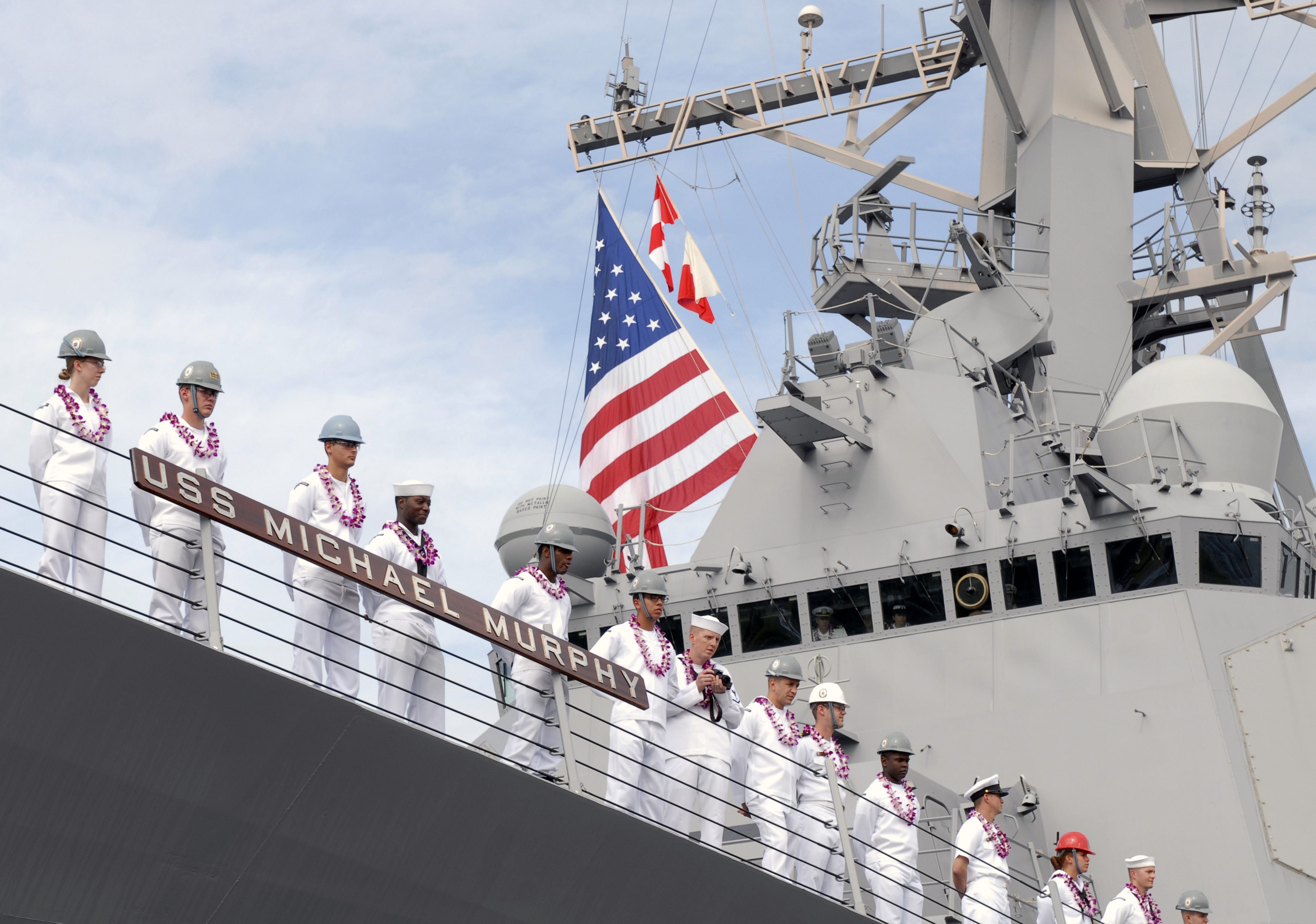
While I was quizzing these old men of the sea, it was reported that two U.S. Navy destroyers—USS Michael Murphy (DDG-112) and USS Frank E. Petersen Jr. (DDG-121)—were entering the Strait of Hormuz to clear mines. To me, that sounded strange. Even an Army officer knows destroyers aren’t designed for counter-mine operations. (Ships that are designed for counter-mine operations usually have “minesweeper” somewhere in their name, just as ships designed to carry lots of aircraft are called “aircraft carriers.”)
Certainly, those two Arleigh Burke–class destroyers are among the most capable in the world for what they are designed to do, but they are not minesweepers. They don’t creep along the surface looking for contact mines, nor do they have the unique capability to find and classify acoustic signatures from mines laid on the sea floor. A destroyer’s role is different—and essential. They collect intelligence on the enemy, provide air and missile defense, control the battlespace in coordination with aircraft, and protect higher-value forces. Most importantly, they enable the smaller, specialized units that conduct mine countermeasures to do their job.
I asked my navy friends: Was the movement of the Michael Murphy and the Frank E. Petersen Jr. the start of something more expansive?
Their answer was yes. In Army terms, destroyers are not the engineers who breach the obstacle. They are the force that secures the breach so the engineers can accomplish the mission.
They added that for decades, the U.S. Navy has worked with and depended heavily on allies for mine countermeasure capabilities, especially in constrained environments like the Persian Gulf. The Royal Navy had maintained mine warfare ships forward deployed in Bahrain. The French Navy fields highly capable minehunters and divers. The Royal Netherlands Navy and Belgian Navy are leaders in unmanned mine countermeasure systems. The German Navy and Italian Navy bring deep experience in complex littoral operations. These allied contributions are essential to clearing and maintaining safe passage. If those nations hesitate to join a blockade effort—as all of them have for political, legal, or strategic reasons—the burden on U.S. forces increases significantly.
Last week, the sailors I talked to describe a blockade of the Strait of Hormuz—what sounds like a single, decisive task—as an extremely complex mission. I immediately made the connection to what they were saying, because in the Army, when a division receives a mission, it doesn’t just “attack” or “defend.” It gathers intelligence, plans breaching operations, conducts shaping actions, suppresses enemy capabilities, protects its force, sustains itself, and maneuvers—all at once. The naval equivalent follows the same logic.
First, they suppress the threat: Iranian fast attack craft, coastal missile batteries, drones, submarines, and—critically—mines. If the enemy can continue to lay mines, you are not solving the problem; you are chasing it.
Second, they protect the force. That is where destroyers like Michael Murphy and Frank E. Petersen Jr. play their central role—providing layered air and missile defense, anti-surface warfare, and command and control across the maritime battlespace.
Third, the hard part, they interdict shipping. A blockade is not a line on a chart; it is a continuous process of identifying vessels, stopping them, boarding them, inspecting cargo, and diverting traffic. Depending on the mission, a blockade could require ships, helicopters, boarding teams, aircraft overhead, and persistent presence.
And throughout all of this, the men and women on these ships deal with the vast expanse of the ocean and attempt to control their area of operation.
My saltwater friends also pointed out the difference between the president’s social media posts and the actual military mission that is already taking shape in the Middle East. What the president described in public sounded like a full closure of the strait. What’s actually happening, per reports—and therefore presumably what the president actually ordered—is a more limited effort: blocking access to Iranian ports while allowing neutral shipping to transit the strait. That distinction matters.
A blockade of Iranian ports along the Strait of Hormuz is difficult, but manageable. A full blockade of the strait—controlling all movement through one of the world’s most critical chokepoints—is something else entirely, with a much greater resource bill.
Current reporting suggests the United States has about fifteen warships in the region, including aircraft carrier strike groups and their associated destroyers, cruisers, and logistic vessels, as well as amphibious ships. If the mission is limited to blocking Iranian port traffic, that’s a credible starting force. In practical terms, such a mission requires an air umbrella, several destroyers or cruisers for defense and command-and-control, patrol vessels for interdiction, an amphibious platform for boarding operations, mine countermeasures assets, logistics ships, air cover and reconnaissance, and persistent intelligence coverage.
So far, President Trump sounds happy with this limited “blockade”: He announced Monday afternoon that “34 Ships went through the Strait of Hormuz yesterday [Sunday], which is by far the highest number since this foolish closure began.” That compares with close to 140 ships that transited the waterway on most days before Operation Epic Fury.
If the mission expands to a full blockade of the Strait of Hormuz, the resource requirements grow significantly. The mission would need to maintain outer screens in the Gulf of Oman and the Persian Gulf, control traffic lanes within the strait, continue mine-clearing operations, and escort or manage neutral shipping, all while defending against missiles, drones, submarines, and mines.
That means multiple aviation nodes, a larger surface combatant force, dedicated mine countermeasure units, submarines, replenishment ships, and continuous intelligence, surveillance, and reconnaissance support. This sounds like a sustained maritime campaign over months. It would not look like a wall of ships. It would be layered: an outer interception zone, a middle layer providing surveillance and defense, and an inner layer focused on mines and immediate threats. Merchant shipping would be managed through reporting points, inspections, and controlled transit.
I asked, does the United States have the forces in the area to do this?
For the narrower mission—probably yes, at least initially. As always, the question isn’t just “can we do this” but “what does it cost” in terms of strain on sailors and their families, wear and tear on equipment, expenditure of munitions and money, political costs, and the opportunity costs of other missions these ships could be performing.
For a sustained, full-spectrum blockade of the strait itself, especially without allies, whether we have the necessary force is far less certain.
Politically, “blockade the Strait of Hormuz” sounds decisive. Operationally, it means sustained sea control, mine countermeasures, logistics, intelligence integration, and escalation management against an adversary that doesn’t need to defeat the U.S. Navy to complicate the mission. Iran only needs to replace mines in the water, threaten shipping, and keep the cost of oil and other commodities high.
When Trump was reportedly considering ground operations in Iran, I wrote that the troop-to-task ratios were scary—some of the objectives in public conversation would have required very large forces to accomplish. The ship-to-task analysis looks similar here: Cutting off some Iranian ports from the strait looks straightforward; completely controlling the strait would require thousands of sailors, dozens of ships, and continuous operations in a confined, contested environment.
Professionals in this kind of fight focus on two things: the obstacles and the number of merchant ships that slow them down, and the partners needed to overcome them and gain control.
Right now, both matter more than ever.