

What a Russian Army Collapse Might Look Like
The Ukrainians are trying to break the Russian military—and they just might do it.

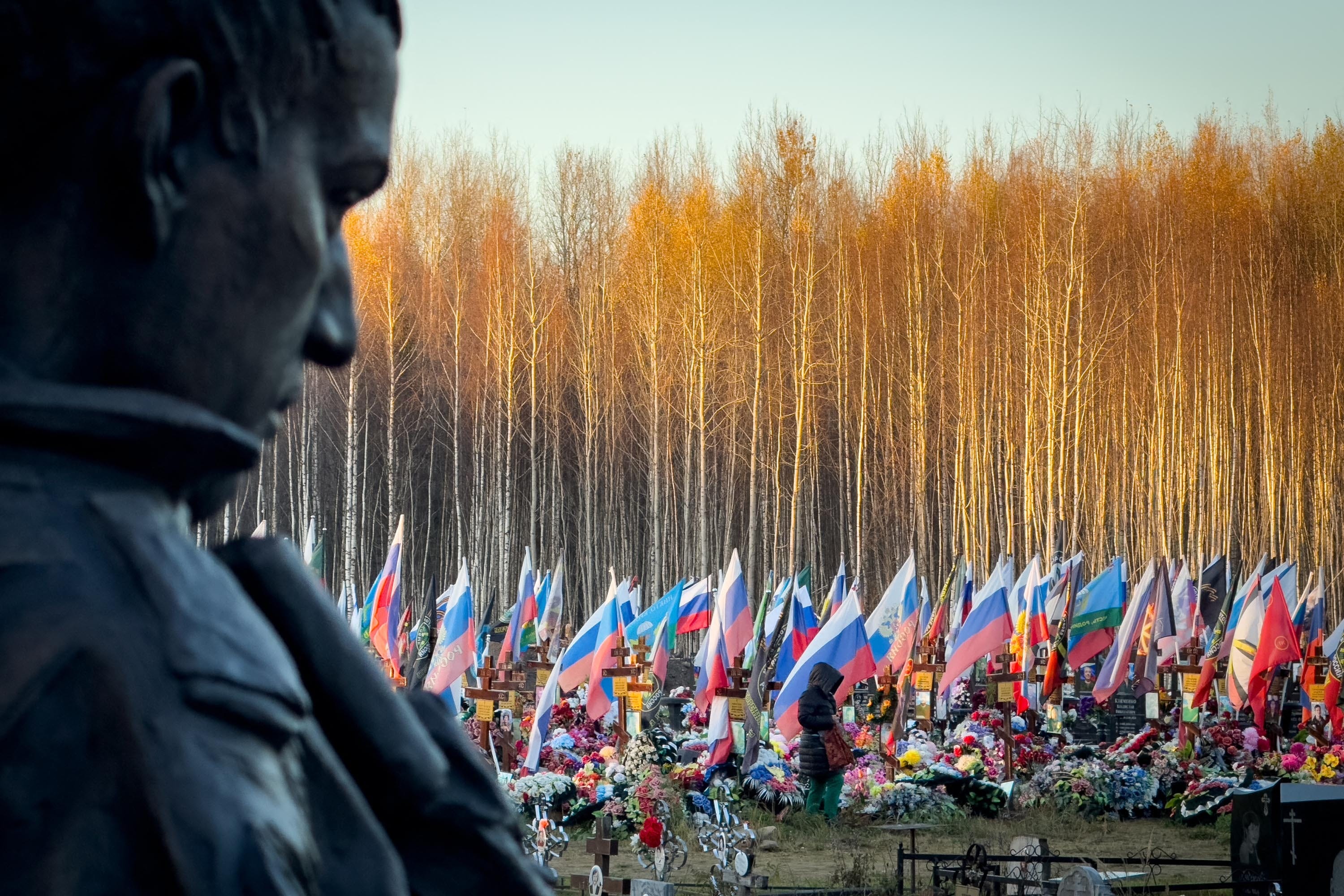
HEMINGWAY FAMOUSLY OBSERVED in his 1926 novel The Sun Also Rises that one goes bankrupt “gradually and then suddenly.” The same can be said of armies. Sometimes they’re routed in great, decisive actions, like the French in 1940, but often their ability to fight is eroded slowly over time by many factors, so gradually as to be almost imperceptible, before reaching a tipping point where the illusion of strength shatters all at once.
The war in Ukraine—just counting the high-intensity phase of it since the full-scale Russian invasion in February 2022—has been going on longer than World War I, and seems likely to surpass World War II in duration. Until this spring, the general consensus was that the war was in a perpetual stalemate of drones, trench warfare, and attrition that would go on, for all intents and purposes, forever. Many of those who subscribed to the theory of perpetual stalemate concluded that the only way for the war to end was for Ukraine to capitulate and cede all the territory it had lost (plus perhaps some more) to the Russians. Yet history teaches that as long as a country has the will to continue to fight, it will find a way to do so until it either loses the will or fighting becomes materially impossible.
For years, casual and expert observers alike assumed that if one of the armies in Ukraine were to collapse—to suddenly lose the wherewithal to fight—it would be the Ukrainians. But now it seems more likely to be the Russians. And that’s no accident, as it appears the Ukrainians’ theory of victory is not that they will drive the Russians from their land in great, sweeping offensives like those of late 2022 but that they will break the Russian army’s back by attacking its logistics, its manpower, and its will to fight.
What if the fate of Ukraine isn’t a perpetual attritional stalemate? What causes an army to collapse, and an invading tide to reverse itself? Here are four historical examples that might be instructive today.
The Russian Army in 1917
Russia suffered horrific casualties and numerous defeats during World War I, starting with the battle of Tannenberg in 1914. Russian peasant conscripts were poorly trained and poorly equipped, and the tsarist economy was not sufficiently industrialized to match that of Germany. Russian logistics, particularly railways, were ill equipped to move what troops and matériel they did have where they needed to be in a timely manner and in sufficient quantities.
About a year after the war began, with shocking defeats and even more shocking casualty lists, Tsar Nicholas II took personal command of the army, stocking his command staff with loyalists, cronies, and relatives. He embraced magical thinking about the mystical connection between the tsar and the people and believed that his personal command of the forces would lead to a boost in morale sufficient to ensure victory.
The decision backfired. The war continued to go poorly, the losses continued to mount, and there was no one for the people to blame but the tsar.
Nicholas was unsuited to supreme command during a modern war. Not only did he lack a mastery of industrial manufacturing, wartime economics, logistics, and strategy, but he chose underlings based more on their personal proximity to him and his court than their expertise. When his government was overthrown in a popular revolt in 1917, much of the army deserted.
The interim government that followed the Romanov dynasty was able to amass enough force to mount one last offensive—the so-called Kerensky Offensive in the summer of 1917—but when that failed, Russian soldiers lost all faith and quit fighting en masse.
The German Army in 1918
After Bolshevik Russia signed the Treaty of Brest-Litovsk in December 1917, surrendering huge swaths of land and people to the Germans and all but ending the war in the east, Germany raced somewhere between 600,000 and 800,000 troops from the Eastern Front to the Western Front. Here they launched an offensive in hopes of finishing the war before American troops could make it across the Atlantic and augment the French and British military structure. The resulting spring offensive of 1918 was initially a success: German forces pushed close to Paris, roughly equaling their furthest advance of the war—but they outran their logistics and failed to break the French logistics before American forces arrived to help stabilize the lines and eventually push the front lines back toward the pre-war border. In the end, Germany suffered nearly a million irreplaceable casualties while leaving its army exhausted.
Behind the German lines, the economy was in tatters. The allied naval blockade of Germany had forced the introduction of ersatz (“substitute”) goods, often of inferior quality, both for industrial inputs and individual consumption: synthetic rubber, coal-tar industrial lubricants, “coffee” made from acorns, “tea” made from catnip, paper instead of cotton, “eggs” made from corn, and so on. When German workers went on strike in early 1918, the high command ordered that strikers immediately be conscripted and sent to the front. That helped ameliorate neither overall morale nor the growing problem of hunger.
Exhausted and demoralized German troops faced hordes of fresh Americans who brought the industrial and agricultural capacity of the United States with them. After four fruitless years of fighting in France, German troops began surrendering at the Battle of Amiens in August 1918, believing that the war was lost, and the quickest way to end it and live was to capitulate.
The Japanese Burma Area Army in 1944
By the standards of World War II, Burma was a backwater, constantly starved of men and matériel. Political infighting between the United States, Great Britain, and Chinese Nationalists under Generalissimo Chiang Kai-Shek left the northern region of Burma a mess that no one wanted responsibility for. The Japanese objective in the theater was to prevent the Allied forces—especially British Indian forces—from invading the Japanese-held territories in Southeast Asia, which they were unprepared to do, while the Allied objective was to prevent the Japanese from invading and conquering India, which they didn’t intend to do either. Still, between 1941 and 1944, Japan steadily drove Commonwealth troops back toward the Indian border.
Then, in early 1944, Lt. Gen. Renya Mutaguchi, who believed he was destined to win the decisive campaign of the war, launched what may have been the most ill-considered offensive in history: Operation U-Go. He sent out 90,000 men to conduct a four-month long campaign—but with only twenty days of supplies on hand. He wrongly assumed they could simply live off the land as they advanced. These starving and diseased Japanese troops were decisively defeated at the Battles of Kohima and Imphal, where most of them died in wave after wave of doomed attacks. In the end, only 12,000 of these troops lived to see Japan again: a breathtaking 87 percent casualty rate. The Japanese Burma Area Army never recovered and spent the rest of the war retreating.
The failure of Japan in Burma was caused by poor leadership at all multiple levels: primarily Mutaguchi’s arrogance and delusions of world-historical grandeur, but also the Japanese high command’s lack of oversight and failure to rein in his foolhardy plans. At an operational level, failure to plan for adequate logistical support doomed U-Go as much as it’s overly ambitious premise.
The South Vietnamese Army in 1975
As part of the 1973 Paris Peace Accords, the United States withdrew its forces from South Vietnam. In December 1974, North Vietnam began sending troops into South Vietnam preparatory to the 1975 spring offensive. In March 1975, South Vietnamese leadership realized that they could not effectively hold the Central Highlands and ordered a withdrawal to a more defensible line farther south.
The result was a chaotic rout in which both civilians and military personnel clogged a solitary highway running south. Despite pleas from the South Vietnamese government, the United States refused to intervene. North Vietnamese troops retained the support of China and the Soviet Union.
Though South Vietnamese troops rallied somewhat, the capital of Saigon (now Ho Chi Minh City) fell to North Vietnamese troops on April 30, 1975. The mayhem as the city fell produced images of desperate American and Vietnamese civilians boarding helicopters on the roof of the U.S. embassy to escape the onrushing Communist regime. Forty-six years later, a similar scene played out in Kabul, Afghanistan.
The collapse of South Vietnam was primarily due to severe equipment and fuel shortages following heavily slashed U.S. aid, cascading logistical failures, and the fatal blunder of their ill-conceived retreat from the Central Highlands. South Vietnamese political and military leadership suffered from deeply ingrained corruption, and its heavy reliance on American-style warfare became impossible to sustain without American logistics and firepower to back it up. Even the threat of spending years in brutal North Vietnamese re-education camps was not enough to compel South Vietnamese troops to fight to the last man in service of a despised, corrupt, unpopular regime.
ALL OF THESE ARMIES STARTED OUT in positions of strength. Tsarist Russia had the largest standing army in Europe in 1917. Germany had numerical superiority and the best designed trench system on the Western Front in early 1918. Japan had more front-line troops in Burma at the end of 1943 than the British, and those troops were battle-hardened and well-trained compared to the Allied troops, who were ill-prepared for jungle warfare. South Vietnamese troops outnumbered their North Vietnamese counterparts four to one on paper, and were fighting to avoid ending up in concentration camps.
But the biggest army does not automatically win. All of these armies fell apart in a matter of months due to some combination of poor leadership, lack of logistic support, exhaustion, corrupt regimes, failed offensives, and broken morale.
None of these factors acts alone. Bad leadership can lead to bad logistics and failed offensives. Corrupt regimes can produce low morale and poor leaders. Lack of logistic support leads to cold, sick, starving, demoralized soldiers, and so on.
The conventional wisdom about the Russo–Ukrainian war has become that it is an attritional stalemate, where the front lines are unlikely to move again without some massive external force. This reading of the situation may be due in part to projection and extrapolation bias. Projection bias leads people to assume that the future will look exactly like today; extrapolation bias leads people to assume that if a trend has been going up (or down), it will continue to do so in a straight line indefinitely.
Russia displays many of the characteristics common to armies that fail. Poor leadership: Putin demands constant advances, while being fed lies by his underlings who are afraid of admitting failure. Corruption is endemic to every aspect of Russian life, and money in the military budget often doesn’t end up where it needs to be. Even when it isn’t diverted to vanity projects, it often is used in head-scratchingly ineffective ways, like the $50 million Oreshnik ballistic missile used to destroy a parking garage two weeks ago. Russia has also blown up the same McDonald’s in Kyiv four times now, and it brings into question the effectiveness of their targeting strategy and munitions allocation.
Troop morale is terrible; commanders constantly extort money from their troops. Russian soldiers are punished with violence, rape, torture, starvation, and occasionally murder, with predictable effects on combat effectiveness. The Russian tactic of the past year of sending in small infiltration teams to constantly probe Ukrainian defenses has resulted in extremely high losses and minimal territorial gains. There is no real hope (or intention of) a combined-arms breakthrough. The Russian spring offensive of 2026 has failed, and those creeping gains have effectively flatlined.
There have been constant reports of troops being shot when they attempt to retreat. Now, despite massive economic incentives to sign a military contract, Russia is struggling to replace their losses. Additionally, Russian soldiers don’t seem to be buying into the narrative that they’re liberating Ukraine—which may make them wonder whether it’s worth fighting in the first place.
Lastly, Russian logistics are suffering. After Russia mostly solved the HIMARS/GMLRS problem with better electronic warfare, their rear areas were generally safe from interdiction. Now, however, Ukrainian FPV drones are striking military transport vehicles 150 kilometers from the front. When the Russians send convoys at night to avoid Ukrainian drones, the Ukrainians simply use their drones to lay mines on the highways. The frequency of these strikes has been growing geometrically since January, and civilian fuel in Crimea is either rationed or gone completely. Russian “milbloggers” are starting to panic about the logistics of the Russian Army in southern and southeast Ukraine.
It is impossible to say if the Russian military will collapse; it has so far confounded all previous predictions that it would. However, many of the conditions for collapse have been in place for a long time, and the most important one (logistics) is now trending in the wrong direction.
It does seem, however, that military collapse is the Ukrainian theory of victory. They have publicly announced that their goal on the front lines is not to gain territory but to kill more soldiers than the Russians can replace, which is an attack against both Russian morale and the labor-starved Russian economy. Ukrainian long-range strikes against Russian energy infrastructure similarly attacks two of the factors that keep armies in the field: logistics and productive domestic economies. The more spectacular Ukrainian strikes—such as the recent strikes in the Moscow region and in St. Petersburg just as the St. Petersburg International Economic Forum was opening, are designed to weaken Russian morale and raise questions in the minds of Russian leaders, civilians, and soldiers about what the “special military operation” is really accomplishing. The Ukrainian assassination campaign against Russian general officers is similarly designed to erode morale, and to degrade leadership—though as always, the best guarantor of poor Russian leadership is Vladimir Putin’s health.
 | A guest post by
|