What If We’d Never Broken Away From the Brits?
On the 250th anniversary of independence, an edgy thought experiment about our nation’s founding.

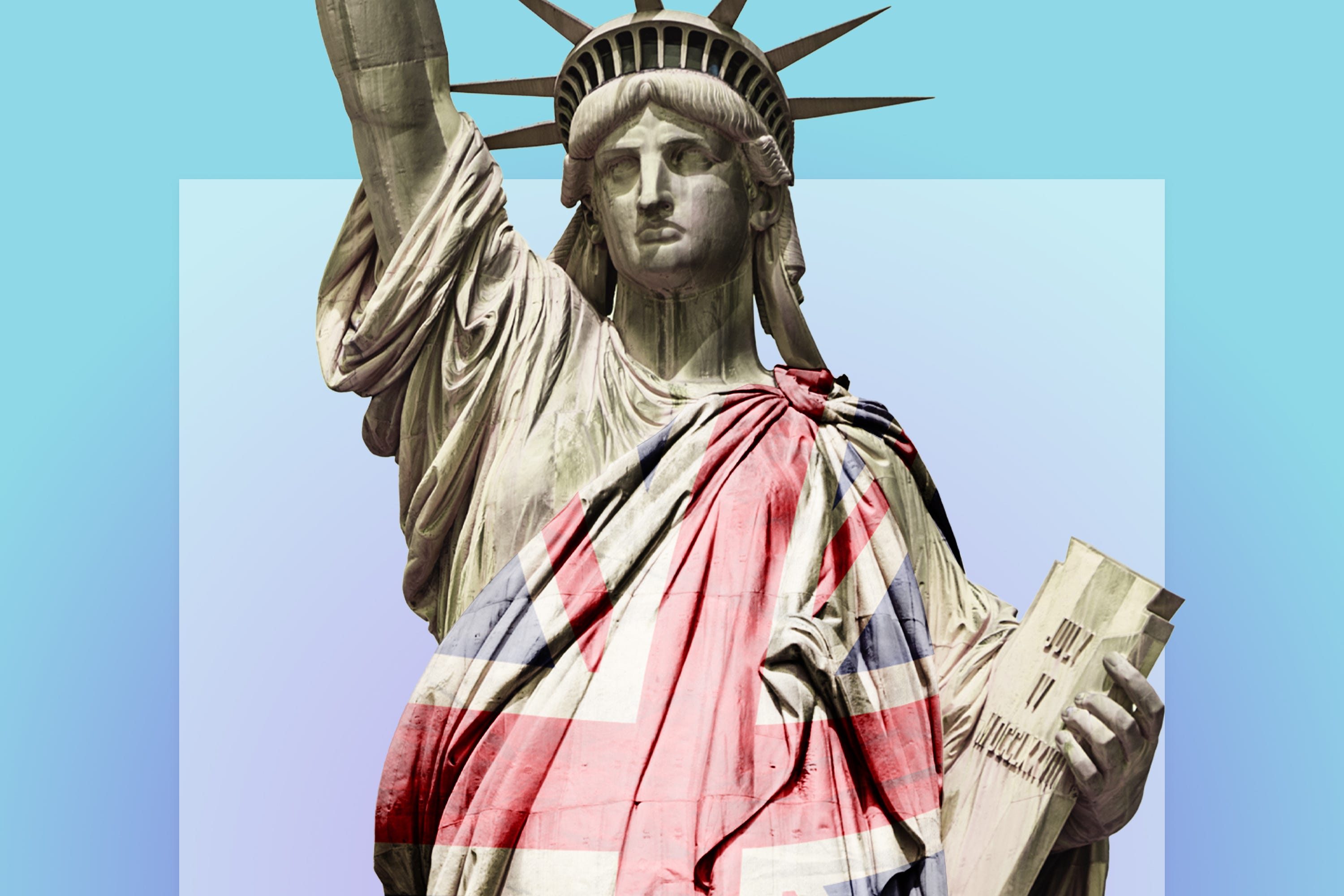
MILLIONS OF US WILL SPEND SATURDAY lounging around a grill, eating ice cream, and watching fireworks. The Fourth of July is our midsummer festival in red, white, and blue. It is less fraught than preparing Thanksgiving dinner, much cheaper than Christmas, and far less stressful than the last-minute Halloween scramble to find the right costume.
You don’t have to like turkey, feign holiday cheer, or go hyperglycemic on candy corn to get into the Spirit of ’76. You just sit in a lawn chair under a sprinkler with a beer. This year, you don’t even have to learn to pronounce semiquincentennial, or even know what it means, to celebrate the holiday.
But what if this Saturday were not the commemoration of the quarter-millennium birthday of the world’s most famous democracy? What if John Adams had been told to let the adults in the Assembly Room in the Pennsylvania State House handle the volatile situation? What if, in other words, there had never been a United States of America?
Counterfactual history is a sport historians love to hate. Asking one what would have happened if Hitler had been assassinated in 1933 is like asking a weatherman precisely where the hurricane will come ashore. There are simply too many variables for any human brain—or even the smartest AI assistant—to crunch.
But editing history’s script is not only fun but useful. Answering what-ifs can root out our lazy assumptions, upset our comfortable myths, and puncture our fatalistic sense that the world is the way it is because of the way it was.
So, then, consider what might have happened if John Hancock had never set his quill to that large piece of parchment (which, to be factual, he did on August 2, not July 4), or if that parchment had never been marked up in the first place. What would we be?
In a word: Canada.
That is, we would be the United States, but with more equitable health care, the metric system, a shared capacity to sing the original lyrics to the tune of “My Country, ’Tis of Thee,” and a far deeper appreciation for the sport of cricket. We would still be a free and independent nation, but one founded without the devastation of whole cities, the divisions that wrenched apart families, and the loss of more than 50,000 lives.
All that’s needed for this to be real history is a little sleight of hand.
LET’S RETURN TO THE START of 1776. Most members of Congress did not have independence on their radar. The whole point of establishing the assembly in Philadelphia and the Continental Army was not to create a new nation founded on radically new principles. The purpose was to make the British repeal what the colonists called the Intolerable Acts.
There was ample precedent. A decade before, street protests and economic boycotts twisted Parliament’s arm, leading to the nullification of the hated Stamp Act. But by early 1775, that approach had failed to move the needle. Killing a few redcoats seemed the next obvious step to get London’s full attention.
Fast-forward to the spring of 1776. Despite the bloodshed at Lexington and Bunker Hill the previous year, Congress remained deadlocked over whether to push for fresh peace talks or throw in the British Empire’s towel altogether.
It wouldn’t take much to tip the scale toward negotiations.
Imagine that, on the night of May 6, Thomas Jefferson’s always-frail wife again fell ill, forcing the Virginia delegate to postpone indefinitely his planned trip to Philadelphia. Or imagine that George Washington quit in frustration after trying to reform an army he described as “without Order, Regularity & Discipline” and “no better than a Commission’d Mob.”
You could also envision that the voluble Adams tragically suffered a deadly apoplectic fit after a long day exhorting his colleagues, as had another portly member, Hancock’s predecessor Peyton Randolph. Instead of Jefferson’s stirring words about life, liberty, and the pursuit of happiness, we would instead know by heart the famous words of Pennsylvania’s John Dickinson—not spoken to the assembled members of Congress as part of a political speech, as happened in our real past, but instead intoned over the plain wooden coffin of his nemesis from Massachusetts.
“We are not ready for a Rupture,” Dickinson said. “It is Our Interest to keep Great Britain in the Opinion that We mean Reconciliation as long as possible.” The cause of liberty, he added, “should breathe a sedate, yet fervent spirit, animating them to actions of prudence, justice, modesty, bravery, humanity and magnanimity.”
Dickinson’s eloquent call for a conciliatory approach may have won the day, then, overcoming the grumbles of the independence-backers, who found themselves divided and dispirited after the sudden loss of their spokesman. And thanks to negotiations undertaken in our counterfactual world by a congressional delegation secretly sent to Halifax, Nova Scotia in June—and a few well-placed bribes made by the same—the British naval commander may have postponed the impending invasion of New York.
With Boston already evacuated and the British fleet’s disastrous loss at Charleston, the rebellious colonies were, in our real past, suddenly all but redcoat-free.
IMAGINE, THEN, A HISTORY OF THE EVENTS that might have followed this opportune moment:
That fragile peace in the summer of 1776 gave two Whig factions in Parliament time to strengthen and broaden their coalition with anxious London business interests smarting from the colonists’ boycott. When word of the Halifax bribery scandal reached London, the uproar forced the resignation of Lord North and put King George III on the defensive.
His militant policies discredited, the monarch had little choice but to offer the prime minister position to Edmund Burke, the Whig leader deeply sympathetic to the American cause. He and his supporters seized the moment, repealing some of the Intolerable Acts and approving a commission to recognize and meet with Congress to hash out an understanding on the rest.
In a sumptuous ceremony at Buckingham House in London, Benjamin Franklin, representing the Americans, signed the final agreement with Burke, and the king gave his reluctant royal assent. These Articles of Reconciliation averted what some historians believe might have devolved into a bloody and costly civil war.
The American Parliament, as the Continental Congress was redubbed, was granted authority over most domestic matters—including the sticky issue of taxation—while London retained oversight of international trade and diplomacy. The Great Accord, as the July 4, 1777, document was popularly known, remains a day of thanksgiving and celebration on this side of the Atlantic.
The agreement slowed the colonists’ westward rush, since London continued to discourage conflict between white settlers and the indigenous peoples under the king’s protection. The Iroquois’ Haudenosaunee Confederacy cannily took advantage of the colonial crisis in the 1770s to negotiate with Siouan, Muskogean, and Algonquian speakers to build a powerful Indian coalition to counter colonial expansion.
Their formidable military and diplomatic efforts, quietly supported by London, did not halt the Anglicization of the west, but they did prevent widespread violence, forced removal, and outright genocide of native peoples. Tribal leaders made marriage with leading colonial settlers a binding way for the latter to obtain land, blunting the onslaught by creating a dense web of relations.
The indigenous communities west of the Mississippi, guarded by a revitalized series of British frontier forts, also drew enslaved people from the colonial plantations to the east, frustrating efforts by white planters to make their vision of a vast ‘cotton kingdom’ in the South come true.
Meanwhile, the Whig victory in Parliament amplified the voices of those on its fringes who argued for extending Enlightenment ideas of liberty and religious toleration, including loyal American subjects like Jefferson and James Madison. At the same time, the ascendant Quakers in Pennsylvania and New England partnered with Britain’s nascent abolitionists to combat the evils of slavery. The institution remained the fuel of the British Empire’s economic engine until its abolition in 1833.
Ultimately, of course, Adams had his way and colonial independence was achieved, though thankfully through a peaceful and gradual process that avoided a devastating war. The 1931 Statute of Westminster granted the American colonies the ability to negotiate their own foreign treaties, and in 1982, they severed all legal ties with Britain while maintaining old affections, a grand cultural inheritance, and elements of civic ritual rooted in the earlier order.
Today, as we counterfactual Americans prepare to mark 249 years of the Great Accord by stocking up on cask ale and sausage rolls before the annual cricket match between Britain and America, let’s take a moment to honour those who rejected violence for negotiation, those who chose diplomacy over the blunt barrel of a musket. We can pause between innings to feel pride for both stripes and for the Union Jack that jointly adorn our flag.
Not a bad alternative past, eh? Happy Fourth.
Andrew Lawler is a journalist and author. His latest book is A Perfect Frenzy: A Royal Governor, His Black Allies, and the Crisis that Spurred the American Revolution. For more, see www.andrewlawler.com.