When Conscience Conflicts With Commission
An Air Force major’s recent protest in uniform provides an occasion to clarify the purpose and value of professional discipline in the military.

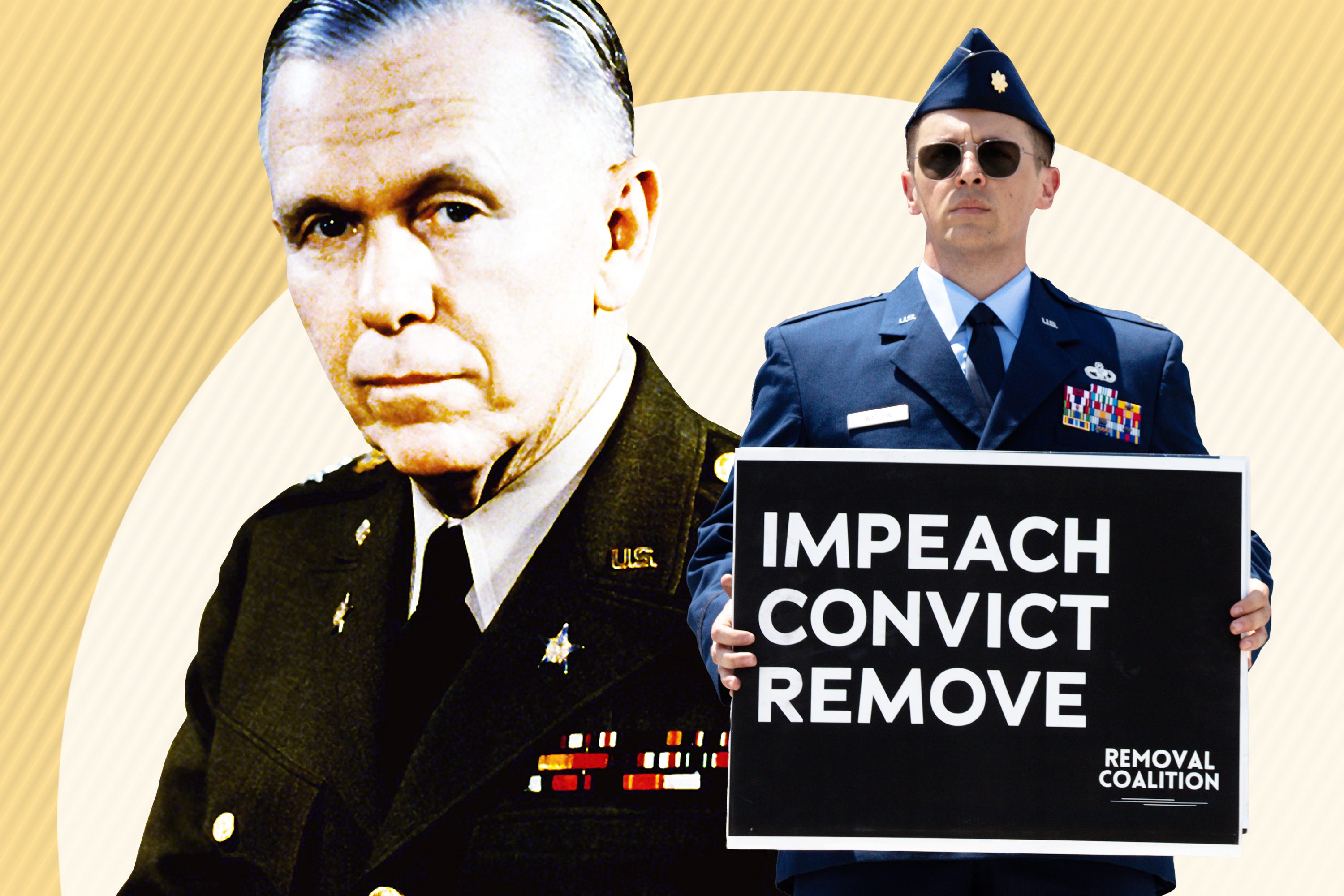
REPORTS SUGGEST MAJ. JASON WATSON struggled with his decision; he understood there could be serious professional consequences. Nevertheless, on July 1 he appeared on the steps of the United States Capitol wearing the uniform of an active-duty Air Force officer and called for the impeachment of President Donald Trump and Vice President JD Vance. Over the past few days, many Americans have praised Maj. Watson’s conscience and his courage; others have condemned his actions. The Air Force has announced an investigation that will determine whether his conduct violated military law or regulations. That process ought to proceed fairly and deliberately, without political interference or premature conclusions.
Regardless of how Maj. Watson’s individual case is ultimately resolved, the public debate surrounding it reveals that many Americans do not understand the obligations of military service in a constitutional republic. Much of the discussion has centered on whether he had a moral obligation to speak. While that is an understandable question, it is not the only one. The more important question is whether an active-duty officer may use the authority and symbolism of the nation’s military uniform to advocate for a partisan political outcome. On this, the American profession of arms has been remarkably clear and consistent for generations.
Personally, I do not question Maj. Watson’s sincerity or his struggle with the decision. Every commissioned officer should wrestle with questions of conscience. Throughout my career, I expected fellow professionals to think deeply about the moral implications of military service, their expression of beliefs, and their actions. This sort of critical reflection is necessary: Soldiers are required to question unlawful orders, seek legal advice when confronted with ethical dilemmas, and possess the moral courage to stand against actions that violate the Constitution, the law, or the values of the profession. Conscience is not merely compatible with military service, it is indispensable to it.
But conscience alone has never been the standard by which commissioned officers are judged. Professional responsibility is. Because that distinction—between personal beliefs and the commitments of military service—has defined the American profession of arms since the founding of the republic. American citizens are entirely free to disagree about whether a president deserves impeachment, but military personnel—especially officers—are not free to employ the prestige of the uniform to advocate that position publicly.
During more than three decades in uniform, I commanded at every level—from tank companies eventually up to the United States Army Europe. At each one of those commands, political neutrality was an essential element of military professionalism. Every election cycle brought reminders from every level of commanders and Department of Defense directives governing political activity. Young lieutenants and privates learned that they retained the right to vote, contribute to political campaigns, write their elected representatives, and privately hold whatever political opinions they wished. But they also learned there were clear lines they could never cross while serving in uniform.
These boundaries are not to protect presidents from criticism. They are a bedrock of American civil-military relations, designed to protect the Constitution from any risk or perception that the U.S. military had become a political force. We did not teach these principles because a certain party leader occupied the White House. We taught them because every officer serves the Constitution first, and also because civilian control of the military depends upon armed forces whose loyalty is beyond political question.
One of the officers who occupies a key position in the pantheon of apolitical advocates and one who most influenced my own understanding of that obligation was General George C. Marshall. Marshall certainly held personal political opinions. There is proof he privately disagreed forcefully with President Franklin Roosevelt on many occasions, and later did the same while serving President Harry Truman, and then others after retiring from the Army. But while wearing the uniform, Marshall never sought to enlist the public in political disagreements. His influence came from offering candid military advice in private, then faithfully executing lawful decisions once civilian leaders had made them. Marshall understood that the Army’s credibility depended not upon winning political arguments but on earning the confidence of the American people through disciplined professionalism.1
Wearing the uniform is also central to this current discussion. Had Maj. Watson appeared in civilian clothes, speaking only as a private citizen without comment on his rank or position in the Air Force, the legal and professional analysis would be very different. Instead, he chose to appear in uniform. Because of that decision, to most Americans, he is no longer simply Jason Watson; rather, he appears to represent the United States Air Force itself.
The uniform does not belong only to the individual wearing it. It also represents every airman who has earned the privilege of wearing it before him, every airman serving beside him today, and every young American who will wear it tomorrow. It represents thousands of officers and enlisted personnel whose political views undoubtedly span the entire American ideological spectrum. Some may agree with Maj. Watson’s views; others certainly do not. Appearing in uniform inevitably invites the public to associate the institution with the individual’s political advocacy—precisely why the Department of Defense has long prohibited active-duty service members from engaging in partisan political activity while in uniform. The restriction protects the institution and the Constitution, not any politician on any given day.
Some citizens have written to me commending Maj. Watson as exceedingly brave, suggesting he should perhaps even be viewed as a whistleblower. That argument misunderstands both military law and the purpose of whistleblower protections. Congress established those protections to encourage service members to report fraud, abuse, waste, violations of law, or dangers to public safety through designated constitutional channels, such as inspectors general, members of Congress, and other authorized authorities. Those protections exist because institutions must never punish individuals for exposing genuine wrongdoing through lawful means.
Maj. Watson’s public advocacy for the impeachment of the commander-in-chief while wearing the nation’s uniform is something entirely different. It is not a question of whether Maj. Watson believed he was acting morally. The issue is whether he chose a method long prohibited because it risks undermining public confidence in an apolitical military institution. Sincerity does not transform political advocacy into a protected action.
Others have suggested to me that if an officer sincerely believes the president is violating the Constitution, citing as an excuse that, because we are in “different times,” speaking out publicly becomes a moral obligation. That argument also misunderstands the profession. Military officers are never expected to abandon their conscience, and there are mechanisms in place to raise concerns and report misconduct. And if they feel they cannot, in good conscience, continue serving, they should resign their commissions and continue their protest as civilians. Those mechanisms exist precisely because the profession recognizes that officers will sometimes confront profound ethical dilemmas.
What the profession does not permit is using the authority of the uniform itself as part of a political platform. The First Amendment does not cease to exist at the entrance to military installations, but officers must voluntarily accept professional restrictions on how they exercise certain constitutional rights. The nation gives military officers responsibilities unlike those of any other profession: command over Americans’ sons and daughters, stewardship of enormous public resources, access to the nation’s most sensitive secrets, and, when necessary, the lawful application of deadly force. In return, officers accept obligations that extend beyond those imposed on ordinary citizens.
Those obligations are sometimes uncomfortable, occasionally requiring extraordinary personal restraint. They may even demand officers remain publicly silent when they feel strongly about political events unfolding around them. That silence should never be mistaken for indifference or cowardice. More often, it reflects a conscious commitment to preserving the institution they have sworn to serve.
Some readers will undoubtedly disagree with this proposition because they admire the moral courage that they believe Maj. Watson displayed. I understand that reaction. Moral courage is one of the military profession’s defining virtues. Yet moral courage does not exist independently of professional judgment. Every profession establishes ethical boundaries governing how its members exercise their responsibilities. Doctors may not violate patient confidentiality because they believe doing so serves a greater good. Judges may not campaign publicly on behalf of litigants whose cause they personally support. Journalists must not fabricate evidence in pursuit of a story they believe is true. Likewise, military officers may not employ the prestige of the uniform to advance partisan political objectives, regardless of how sincerely they hold those convictions.
THE AMERICAN MILITARY has earned extraordinary public trust over nearly two and a half centuries. That trust has survived wars, political crises, social upheaval, and changes in administrations. Part of what sustains that trust is that the public has consistently believed that its armed forces belong to the nation rather than to any political party or ideology. Such confidence has not emerged by chance. It has been built through generations of officers and enlisted personnel who understood that the uniform represented something larger than themselves.
I do not know what disciplinary action Maj. Watson ultimately may face, nor should anyone outside the military justice process presume that outcome. He deserves the same fairness, due process, and careful consideration afforded every American service member. The investigation will determine whether his conduct violated any one of several articles of the Uniform Code of Military Justice, Department of Defense policy, or Air Force regulations. That final determination belongs to commanders and military legal authorities—not to anyone who recommends how the military should act as a profession.
The vital issue of civil-military relations is why Maj. Watson’s story matters. It is not ultimately about one Air Force officer, one president, or one political controversy. It is about preserving a constitutional tradition and a professional military ethos that has distinguished the American armed forces since the beginning of our republic. The cloth of our country is not the service members’ to use for personal political convictions, no matter how deeply they are held. It belongs to the republic, and the first duty while wearing the uniform is to ensure that every American, regardless of party, belief, or ideology, continues to feel confident that it always will.
Not only did Gen. Marshall abstain from political argumentation in public and discourage other officers from political activity, but he insisted so strictly on professionalism and on the proper relationship between the uniformed military and the civilian political leadership that he rejected Roosevelt’s overtures of chumminess, refusing social invitations to the White House, refraining from laughing at FDR’s jokes, and referring to FDR only as “Mr. President,” in turn asking that FDR refer to him by title as well.
My father spent 22 years in the military, and two of my brothers served. So when I saw the photos of Maj. Watson standing in uniform and holding the impeach sign, I understood that he was putting his career and maybe his freedom on the line (wasn’t sure if a military court would sentence him to jail time). Had he stood in civilian clothes and done the same thing, he’d have been dismissed by MAGA and Trump supporters as “just another kook with Trump Derangement Syndrome.” It was the uniform that made the protest so powerful. Hundreds of thousands of us understood he would pay a heavy price for protesting while wearing it. While I understand Gen. Hartlings’ (and the military establishment’s) reasoning on why service members are not allowed to publicly express political views while in uniform, I don’t really agree that others would see the uniform and believe that it meant everyone serving in the entire US Air Force wants Trump impeached. In other words, I didn’t see his being in uniform as signifying the entire Air Force was behind Maj. Watson. To me, Watson being in uniform signified that he felt so deeply that Trump is destroying the country he swore to defend that he was willing to sacrifice an 18-year career and - possibly - his freedom to urge Congress to impeach Trump. I felt like he was saying to Congress that someone has to have the courage to stand up and do what is right even if it means putting yourself and your career in peril. Wearing the uniform was a personal sacrifice. That is why I deeply admire what he did.
Sadly General, and I say this with all due respect, trump and the GOP's use of our military for purely political and personal reasons, makes your point moot. Being a veteran, I totally agree with you but sadly our opinions, based in military law and tradition, no longer matter. trump's disgusting use of our military for political and personal use has opened the barn door and the horse has bolted. With the DoD being run by an incompetent White Christian Nationalist who has purged the military of the senior officers who still honor their oath, I can see how the Major has lost faith in the institution and felt he had to make a statement that not all the military are bootlicking sycophants. I believe others will protest in a more silent way by letting their commissions or their enlistments expire. I fear our military is going to lose a lot of experience, competence, and allegiance to our Constitution.