

The 2026 Midterms Are Critical. But 2032 Could Be Existential.
If Democrats don’t lock in key strategic successes soon, after the next census they could face a long stretch in the wilderness.

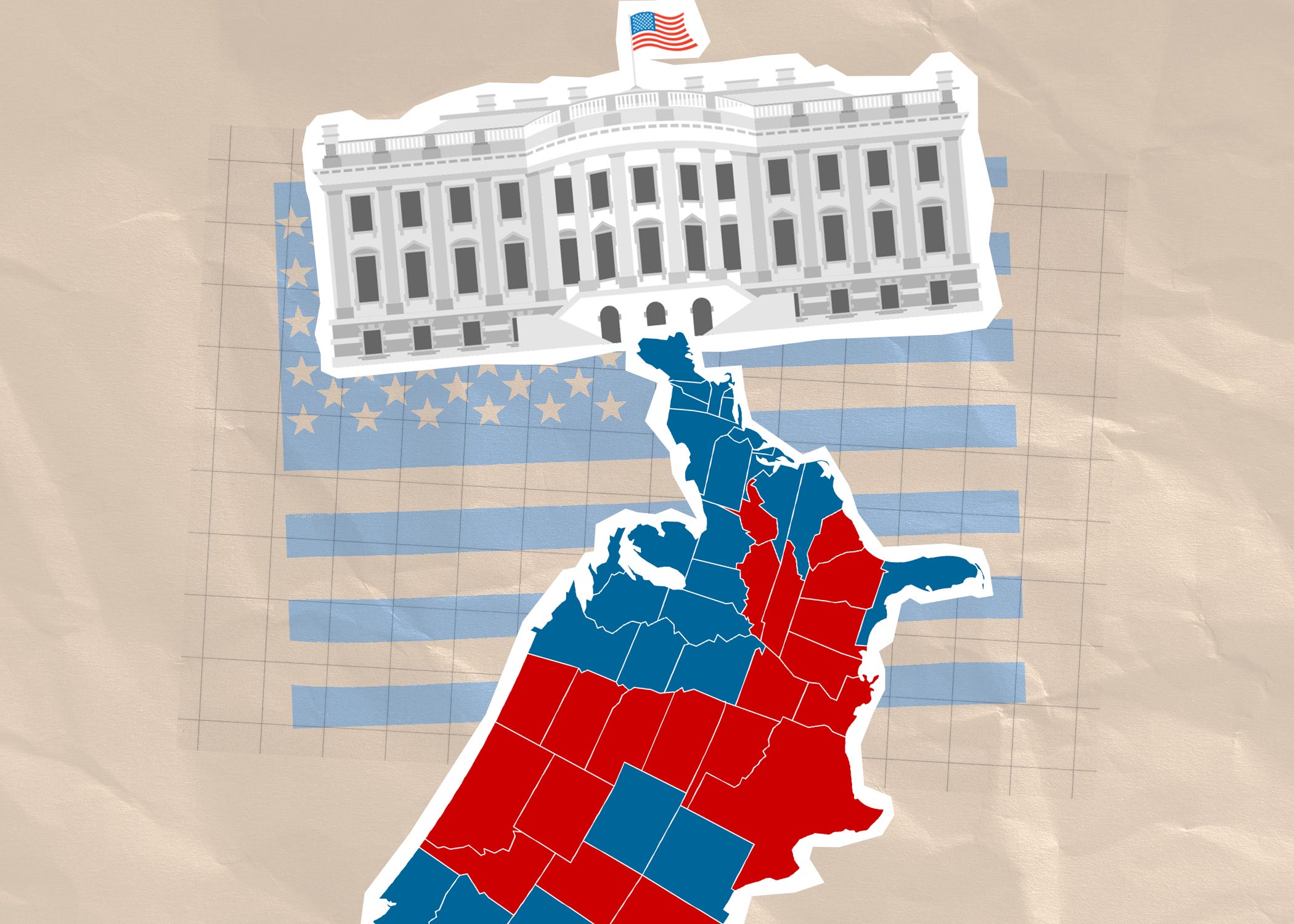
IT MIGHT FEEL LIKE AS A COUNTRY we’re currently flying at 30,000 feet with the plane on fire. But as a longtime Democratic operative, I can’t stop thinking about where the plane might be six years in the future.
Why is 2032 keeping me up at night? Because as Americans move to warmer climates, somewhere between eight and twelve congressional seats will move from states Democrats traditionally win to states Republicans traditionally win. It will put whatever success we Democrats have this cycle at permanent risk. And it means that we can’t make everything—this election included—just about President Donald Trump.
Yes, Democrats have no bigger need this year than to win back the House in order to provide a critical check on the Trump administration. But what we also need to do this year is take advantage of the unique opportunity that Trump has given us to massively (dare I say bigly) expand the map and compete in places that even just two years ago were unthinkable. We need to think beyond this cycle.
Because if we don’t, we’re screwed.
The 2032 Cliff
THE CURRENT BASIC MATH for a Democrat to win the Electoral College, and with it the White House, is pretty simple: Win the reliably “blue” states, plus the “blue wall” states of Michigan, Pennsylvania, and Wisconsin and you’re president.
But this all changes in 2032. With those eight to twelve congressional seats moving from “blue” and “blue wall” states to redder regions, that same path to 270 Electoral College votes now lands you somewhere around 260.
Sure, in 2020, the map expanded a bit when my old boss, Joe Biden, won Arizona and Georgia. But we won those two states by fewer than a combined 23,000 votes that year. Before that, Georgia had voted for a Democrat for president only one other time since 1980, and Arizona only voted Democratic one other time since Harry Truman won the state in 1948. As for North Carolina, a state that feels tantalizingly close each cycle, it has only voted for a Democratic nominee for president twice since Lyndon Johnson won it in 1964: Carter in 1976, and Obama in 2008—the latter by about 14,000 votes.
Think of it another way. The three states most likely to be the tipping point for Dems in 2032 have each voted for the Democratic nominee only once this century, and by a combined margin of roughly 35,000 votes. And the options to flip states beyond these three are even bleaker: My home state of Florida? Texas? Ohio? Kansas?
You get the point.
But the challenge in the presidential math is like child’s play compared to the math for the House of Representatives.
Florida and Texas are expected to gain eight new seats between them after the 2030 census. These are states that have GOP trifectas that will control redistricting.
Other states that could see new seats include Utah, Arizona, Georgia, and North Carolina. How many legislative chambers do you think Democrats control in these four states? If you guessed zero, you nailed it.
On top of this, we have an additional problem: Our coalition is geographically shrinking. Our voters are increasingly living in more compact urban areas while Republican support is growing most everywhere outside of suburban counties with high college-education rates.
In other words, when states draw districts, the GOP already has a built-in advantage because its voters are more spread out.
Hang with me as I nerd out for a second to explain how this works:
According to the most recent Cook Political Report ratings of districts, Democrats hold 59 seats where they have a partisan advantage of more than 20 points, compared to the GOP with 35. By comparison, the GOP controls 167 seats where their partisan advantage is between 5 and 20 (compared to 108 for Democrats).1
This demonstrates the compactness of our coalition geographically. And to understand how challenging this is, give yourself this thought experiment: If Dems had to pick up eight to ten seats in Florida, Georgia, and North Carolina—even in this very favorable electoral climate—to win the majority in Congress, could we do it? Realistically, we all know the answer is no.
It wasn’t that long ago that Democrats controlled competitive seats in places like Montana and even Tennessee. But today, you can drive more than 1,600 miles from Spokane, Washington to Davenport, Iowa without going through a single Democratic district. The long drive you could take to stay in Democratic-controlled territory is confined to New England or along the Pacific coast.
To maintain control of the House after the next census, we are going to have to win more (and potentially create more) competitive seats in states where Republicans will control the map-making.
That’s incredibly daunting.
But it’s not impossible.
Why? Because Trump is giving us an opening.
The Economist has been tracking Trump’s numbers every week since the inauguration. And as prices have continued to rise, voters have demonstrated frustration with his presidency. In just thirteen months, Trump’s net approval has gone down among all voters by 18 points. Trump has also seen precipitous drops in his support among Hispanic voters, young voters, moderate voters, and independents.
It’s promising political terrain for Democrats. But it’s not a given we will benefit from it.
According to a recent NBC News/Wall Street Journal poll, Americans hold a more positive view of ICE than they do of the Democratic party right now. Democrats have a net approval lower than Trump’s (by 10 points).
There is one other key detail in the poll that is worth highlighting: A plurality of voters consider themselves either somewhat or very conservative (37 percent), more than those who consider themselves moderate (34 percent) or somewhat or very liberal (29 percent).
Republicans don’t need a majority of moderates to win, but Democrats do. To win those voters back to our side, we have to take advantage of Trump’s broken promises on the economy, closing the trust gaps on the major issues.
To understand the challenge, and how to solve it, I am going to take you on a trip. Grab a jacket.
IT WAS A COLD AND SNOWY NIGHT in Macomb County in suburban Detroit—particularly for a Florida Man who only packed a heavy hoodie. This is a county that voted for Obama twice, but in 2024 gave Trump 55.8 percent of its vote—more than it had given him in the previous two elections or Obama in either 2008 or 2012.
Just a few weeks after President Trump took office for the second time, I had traveled north to spend two nights listening to 2024 Trump voters. These weren’t the type of Trump voters that CNN loves to interview in rural diners. Most of them had supported Barack Obama, and in many cases, Joe Biden in 2020.
These voters were clear-eyed about Trump. They didn’t agree with him on everything and they weren’t looking forward to a return to the drama that drove the news in his first term.
But even with those concerns, they believed Trump would make their own personal financial situation better. Moreover, they expected it. At the same time, they thought my party didn’t get it—that Democrats had lurched left and lost touch.
That night in Macomb County, I felt like I was reliving a lot of my own childhood in Kankakee, Illinois, a small town south of Chicago whose economic fortunes were directly tied to the manufacturing boom in America that led so much of the Midwest’s economic prosperity in the twentieth century.
I remember the labor contract disputes that led to plants closing and my friends’ parents losing their jobs, as factories moved to states with lower wages. In the end, my parents left too, and each time I returned, I came back to a town largely frozen in time.
So why were these voters open to Obama just a few election cycles ago? For one, Obama was laser-focused on the economy. He talked about middle-class tax cuts, and fighting companies who offshored jobs. He used health care to talk about economic anxiety in a way that many felt. He also took on the issue of immigration from the vantage point of economic populism, arguing that the United States should crack down on companies that were profiting from knowingly hiring people in the country illegally.
The Trump voters in that Macomb County room, just like so many others I’ve heard in focus groups, say the same thing: Obama was the last Democrat who truly understood their lives. When asked what Dem they would vote for, they often said “someone like Obama,” before going on to call Democrats too “woke,” too “weak,” and too focused on niche social issues. They said we could not be trusted on immigration and crime, and that we did not seem to understand the reality of the economic situation facing everyday Americans.
These same voters were extremely clear about the issues that motivate them and the messages that reached them. They want candidates to understand the ways in which the modern economy has proved challenging: giving opportunity to more people to change their station in life but with a cost—less security for an already pinched middle class.
They were not looking for a bridge back to the Democrats, unless Trump breaks his promise to them.
And . . . he has.
A Marshall Plan for the Democrats
TRUMP HAS GIVEN DEMOCRATS an opportunity to win not just the 2026 midterms but to get in place for the more existential challenge of the post-2030 redistricting. But the next six years still require solving three problems:
Rebuilding the Democratic brand in places that may not have seen candidate messaging in years;
Building a farm team for Congress in those areas; and
Where possible, impacting legislative control on redistricting.
These aren’t problems that will be solved with a silver bullet, or some app, or AI optimization, or a $20 million effort to find better podcasters. Nope, these problems will only be solved with two basic things: rooting our national message in the concerns of the median voters where we need to win, and investing real money in communities we have walked away from.
First, our brand. For Democrats to win in places where we’ve been losing, we must redefine how voters view us on issues such as the economy and immigration.
Voters were very clear in post-2024 surveys: They thought we had moved too far from the mainstream. Honestly, even our own base thinks this. We must re-establish ourselves as a party of strength, a party that takes on Washington to improve the economics of middle-class families, and a party that supports common-sense solutions on immigration.
We need to never again adopt “Abolish ICE” messaging. We don’t even need more studies. We just need to listen to what voters are telling us. When voters tell us that they both disapprove of Trump’s handling of immigration and yet they don’t trust us to handle immigration, they are saying that they want Democrats to start talking about how to strengthen the border and make communities safer without allowing armies of masked men to detain and deport people on a whim.
The original Obama frame on immigration was classic sticks and carrots. Toughen up at the border, make people in the country illegally pay a fine and go to the back of the line, crack down on companies that are profiting off hiring people in the country illegally over Americans, while at the same time creating pathways to residency and more opportunities for people from Latin America to immigrate legally. Test that approach in any lean-GOP district in America and I guarantee you it’s still very popular.
We also need to do a better job of leaning into hard issues and ignoring consultants who suggest we should talk only about issues where Democrats have an advantage. Take crime for example: Of the last two presidents, only one substantially increased funding for community policing, and only one tried to cut funding for policing—and I bet most Americans would reverse which was which.
And we have to stop walking into every trap and taking every piece of bait on cultural issues. A Democrat who is running in a rural Southern district is likely going to talk about guns differently from one running in Brooklyn—and that has to be okay.
New messaging like this will take the fight to the Republicans, something Democrats have for too long been afraid to do. The two most successful Democratic politicians of my lifetime—Obama and Bill Clinton—both played on the GOP side of the field all the time, including on immigration. We won’t win if we don’t try.
But creating a broader map over the long term is not just about issues. It’s about investments. Let’s say I had $100 million to spend this year. Here is what I would do.
First, I would put significant resources in the next tier of congressional races in rapidly growing states. This means investing significantly in lean-red districts in both Florida and Texas. There are real opportunities in places like Alaska, Montana, Iowa, Tennessee, and Ohio—not to mention in more competitive states like Arizona and North Carolina.
Much has been written about Mary Peltola in Alaska and Rob Sand in Iowa, both phenomenal candidates whom Democrats can build around. But there are so many more great people who have stepped up to run.
Take North Carolina’s 11th Congressional District, a seat in the western part of the state, where voters are still struggling to recover from Hurricane Helene. The Democratic candidate, Jamie Ager, is a fourth-generation cattle farmer whose family was rocked by the hurricane. How did Trump respond? He gave $40 billion to Argentina for their cattle industry, while guys like Jamie struggled to build back from a storm FEMA has largely ignored. After just two quarters, Jamie already has more cash on hand than his Republican incumbent opponent.
Or Florida’s 7th district, where Bale Dalton is challenging Cory Mills, a member of Congress who has faced assault allegations, running in a district Trump won by 10 points on the all-important I-4 corridor. Dalton, a veteran, and former NASA leader, is the type of candidate who can compete in a district that Democrats held as recently as 2020, and in the type of seat we will need to win in the post-2030 map.
To get to a majority in 2032, we are going to have to win a share of seats like these, and now is the time to make sure our messages are being heard in these communities. Even if some Democratic candidates lose in tough races this cycle, there is real long-term value in the message investment, as well as in building political infrastructure.
I would also invest down the ballot and in state parties in the new battlegrounds: Arizona, Georgia, North Carolina, and, yes, Texas and Florida. Even if the latter two aren’t particularly competitive at the top of the ticket, growing the bottom of the ticket is vital for long-term success. But most of the Democratic parties in these states don’t have anywhere near the kind of political infrastructure needed to succeed, and what infrastructure does exist tends to live and die around election time. Even dropping in just half a dozen community and digital organizers in each of these states and letting them do their work over the next four years after 2026 will have massive dividends.
There is an example of this working: 2005 and 2006. Over those two years, the DNC invested in staff all across the country with Howard Dean’s “50-State Strategy”—and kept their foot on the gas, even when races came calling for money. Many people, me included, questioned the efficacy of spending everywhere in a cycle where we had a chance to make serious gains in the House and Senate. But those investments not only led to huge gains in ’05 and ’06 but laid the critical groundwork for Obama’s mandate in ’08 as well. (And I’ve written about what happened in my state when those investments disappeared.)
I have no doubt the money will be there for individual congressional races, but we need to have the discipline to commit to spending a small percentage of the billions that will get raised and spent this cycle on the very non-sexy work of political organizing deep down the map.
Doing this will also help solve a secondary problem: We don’t have a good career ladder for young operatives outside of blue states and D.C. The reality is many smart young operatives are willing to go work in tough places, but there just aren’t many year-round jobs or opportunities for growth. By investing in longer-term infrastructure with an eye for 2032, we would give a number of young people an opportunity to build real relationships and skills in these communities where we need to be more competitive, and build something special over multiple cycles.
Finally, Democrats must try to win a state legislative chamber or two in states set to gain congressional seats. There aren’t a lot of great opportunities, but there are still three remaining cycles to try to flip a chamber in one of these states. There is a pathway now in Arizona. Where possible, we should also look at constitutional or legislative citizen initiatives to create more rational and fair redistricting policies in states where the GOP controls the map-drawing pens. And while winning more seats in places like the Texas or Georgia statehouse won’t get Democrats close to a majority, we have to start chipping away if we want to have any prayer of impacting 2030 redistricting.
NONE OF THE ABOVE is meant to diminish the work Democrats must do in 2026. Winning back the House and, if possible, the Senate are the most important immediate objectives for the party—and the country.
But I do believe we can—we must—walk and chew gum at the same time, and what Trump has done is allow us to re-engage the voters who have left us. It’s an opportunity we might not see again for many years—and likely the best one we will get before the reality of 2032 takes hold.
Competing across the map and down the ballot in states where we have to improve is an opportunity to hit the reset button. If we can pull it off, we can set ourselves up for a decade or more. It’s too dark to think about what happens if we don’t.
Democrats’ disadvantage due to living in cities is the result of political choices by Republican-controlled state legislatures—it’s not a mathematical rule. As Virginia’s proposed congressional map demonstrates, lines can be redrawn to favor either party, because members of Congress represent people, not land.
 | A guest post by
|