About Those Women Fleeing the Misogynistic Right
And the story of my own wakeup call.


RIGHT-WING MISOGYNY, often taking the form of antifeminist extremism, has created an extremely toxic climate among MAGA and “New Right” types—and some women have had enough. A long New York magazine feature article last week on women “defectors” from the right sparked a controversy about the extent of the misogyny problem—and, as often happens in such debates, the rebuttals dismissing the issue as made up tended to prove the case.
The most viral response to Sam Adler-Bell’s article came from the right’s regnant female misogynist, Helen Andrews, whose “Great Feminization” theory of Western decline posits that women’s large-scale entry into public life and institutions is a “potential threat to civilization.” Not surprisingly, Andrews thinks Adler-Bell’s piece confirms her point, because one of its principal sources—a onetime antifeminist blogger who finally got alarmed by the increasingly overt misogyny in her political environment and began to drift away—is anonymized and identified only by the pseudonym “Anna.”
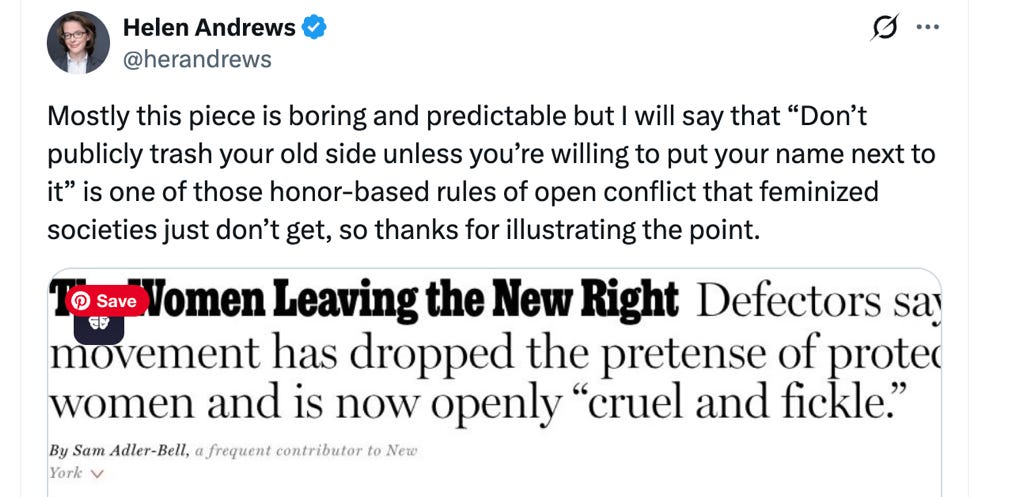
The “publicly trashing your old side” clause is a convenient way to sidestep the ubiquity of anonymous discourse on the right.
I myself had mixed feelings about “Anna’s” anonymity, since the piece reveals that she spent “several years a celebrated pundit of the New Right” and that, after distancing herself from the movement’s belligerent misogyny, she has occasionally critiqued it under her real name. Granting anonymity to a source is one thing; allowing an acknowledged public figure to speak out anonymously is another. But it also needs to be noted that “Anna,” who has several children, wanted anonymity because she fears retaliation. Given the far right’s level of vitriol and history of harassment toward perceived opponents, that’s not so unreasonable.
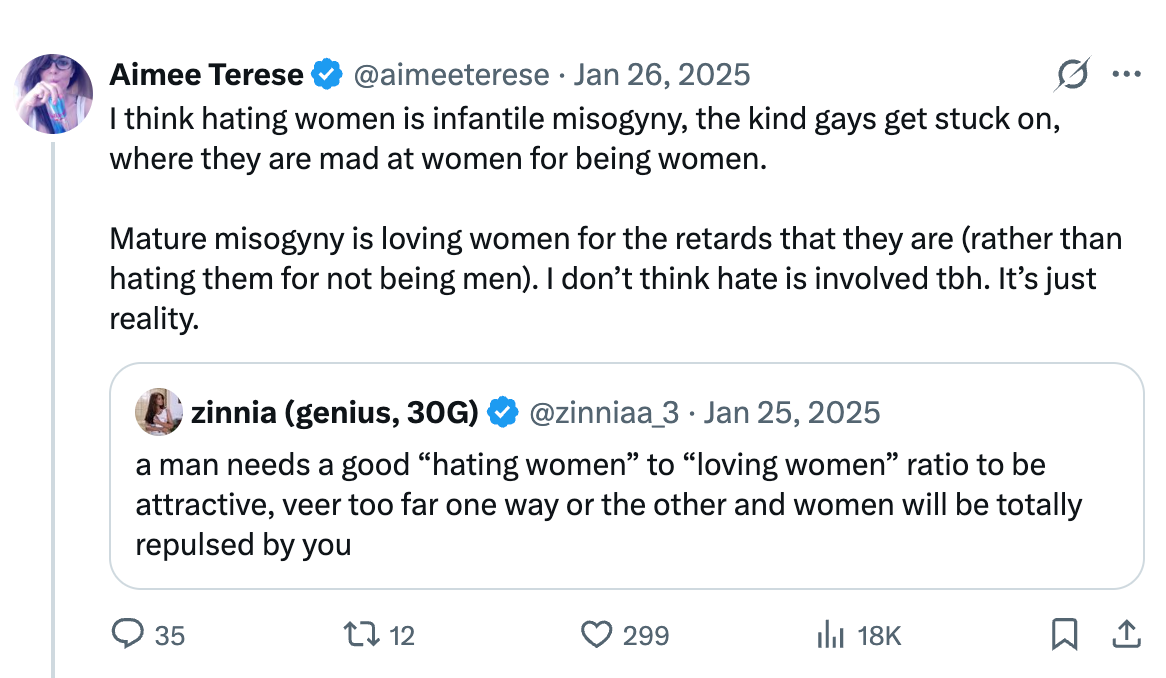
A number of people on X—such as far-right pundit and self-proclaimed proud misogynist “Aimee Terese”—have hypothesized that Adler-Bell’s piece is entirely fictitious.

In reality, the other “girls” are mentioned by name, and one, writer and former podcaster Alex Kaschuta, is also extensively interviewed. But even that aside, most of what the article says—that increasingly militant misogyny has become a social currency on the far right in recent years and its less extreme forms are also being legitimized in more mainstream right-wing quarters—is readily discoverable by looking at social media and at right-wing punditry.
Nick Fuentes, who declared in a notorious recent video clip that “women exist for sex” and for breeding—and who routinely attacks women as innately selfish, greedy, mindless, and basically subhuman—is not quite a respectable member of the right today but no longer a pariah, either. Aimee Terese, who thinks that Fuentes-style overt woman-hating is “infantile” and “socially inept,” pitches benign misogyny as the alternative.
Is it really a revelation that women who move in far-right circles must prove their “based” bona fides by going along with performative woman-bashing—or even by voicing “Repeal the Nineteenth” slogans as an I’m-not-like-other-girls badge? (These interactions were depicted in a post from nearly a year ago by the controversial pundit and reformed far rightist Richard Hanania titled “The Based Ritual.”) And is it really a shock that, as “Anna” and Kaschuta report, these attitudes often enable abusive behavior by right-wing men—whether it’s openly sexist invective toward women who dare to disagree with them or exploitation of their own wives as domestic servants?
As more evidence of the mainstreaming of misogyny, Adler-Bell points to the controversy over the Heritage Foundation’s recent hiring of Boise State political scientist Scott Yenor to head its Center for American Studies—and the backlash against a critique of Yenor penned for the Atlantic by analyst Henry Olsen, himself on the right and a Donald Trump supporter.
In fairness, Adler-Bell almost certainly overstates the case when he refers to “Yenor’s push for coverture 2.0.” (Coverture, largely dismantled in the nineteenth century, was a doctrine that deprived married women of virtually all legal autonomy.) Nothing in Yenor’s writing suggests that he is seeking such a push, even if his 2025 Claremont Institute paper “Not Enough Good Men” refers to women’s suffrage and equal property rights in an unmistakably snarky tone as a “feat of social engineering.” What he does advocate is undoing civil rights laws that keep businesses and other institutions from supporting “traditional sex roles” through preferential treatment for male breadwinners.
Yenor’s praise for “tradwives,” including women who work but prioritize home and motherhood, seems light years away from the poisonous invective of a Fuentes or an Andrew Tate. But this benevolence quickly drops away when it comes to overly feminist or careerist women: “Medicated, meddlesome and quarrelsome” is how Yenor described them (twice!) in a notoriously vitriolic speech at the 2021 National Conservatism Conference. In the same speech, he also stressed that women should not be encouraged to enter science and engineering programs, law, or medicine, that societal efforts should instead be focused on promoting male achievement, and that “if every Nobel Prize winner is a man . . . it’s kind of a cause for celebration.” Yet, when Olsen reasonably asked whether Heritage wants to be associated with such views of women, anti-woke activist Christopher Rufo accused him of trying to “purge” Yenor for “not upholding the principles of human-resources feminism”—and insisted that it was absolutely fine to argue for legalized discrimination in favor of married men with families. (So much for meritocracy!)
At the time, Yenor’s supporters also included Claremont Institute fellow Inez Stepman, who explicitly took the view that opposing civil rights protections against sex discrimination was a fully defensible conservative position. Now, Stepman not only dismisses the New York article on women and the far right as a smear job but, like Andrews, sees in it a validation of misogynistic stereotypes: See, women just can’t help taking everything personally and getting censorious!

Conservatives have rightly pointed out that progressive rhetoric about “toxic masculinity” and white male privilege alienated some men from the Democratic party. But apparently, if you’re a woman who objects to far more vile language about women and bristles at calls for taking away your voting rights, you’re just proving that women are a thin-skinned and humorless lot.
THE NEW YORK ARTICLE notes that “Anna” was initially drawn to antifeminism as a rebellion against “the overweening, haughty moralism of Peak Woke” which she encountered in college in 2010s—and which Adler-Bell, himself a progressive, acknowledges was a real problem. Her “contrarian streak,” he writes, drew her to right-wing outlets.
I can relate to that story: During the same era, I was a strong critic of “social justice” politics and of the prevailing brand of feminist discourse, whose toxicity was acknowledged even by some left-of-center feminists. For a while in the mid-2010s, I was sympathetic to right-coded rebellions against speech-policing and identity politics—though I did caution early on that such anti-“political correctness” revolts were likely to be magnets for actual misogynists and racists. At times I was, as I admitted in a later mea culpa, too willing to let slide sexist provocations of the “just kidding—or maybe not” Schrödinger’s troll variety.
My wakeup call came in the spring of 2016 when some prominent anti-PC warriors jumped on the bandwagon of the openly and shockingly racist, antisemitic, misogynistic “alternative right.” Around the same time, I participated in a joint event on “free speech” with Canadian “influencer” and provocateur Lauren Southern at the University of Michigan at the invitation of a campus conservative group. My alarm bells went off when I heard Southern tout not only race science but male superiority among “facts” forbidden by the “PC police”: “Proper methodology,” she claimed, shows “a male advantage in general intelligence,” supposedly related to “brain size” and at least partly responsible for “universal male dominance in society.” At the post-event dinner, everyone at the table—Southern and the four or five students from the group that had hosted us, one of them a woman—dropped gleeful hints about their involvement with the alt-right. I had seen enough.1
We can debate how harshly one should judge young people whose annoyance with toxic speech and behavior on the left drove them to embrace the even more toxic right and who took a long time to cut themselves loose from it. Cults are insidious, especially when one becomes financially and socially dependent on them, as “Anna” was for several years. The more important point is that today, toxic misogyny on the right—paired with glorification of a macho caricature of masculinity—is rampant and far more mainstream than it was in mid-2010s. While Adler-Bell’s article has some minor inaccuracies,2 it certainly doesn’t exaggerate the problem.
If anything, Adler-Bell is sometimes too kind—as when he credits Tucker Carlson with “tak[ing] pains to distinguish himself from Fuentes’s hatred” during their two-hour lovefest in October and depicts Carlson’s recent anti-feminist sniping as a new development. In fact, these tirades go pretty far back: In a 2019 segment, Carlson asserted that feminism is “at war with nature” and has “changed our society more for the worse” than anything else. In 2021, he even managed to blame the U.S. failure in Afghanistan on alleged attempts to impose “neoliberal” feminism (meaning initiatives promoting education, jobs, and health care for women and girls). In the conversation with Fuentes, Carlson fully agreed that equality and careers for women are woke absurdities; he just thought that Fuentes’s anti-woman rants were letting men off the hook for their failures of masculine leadership. “If you believe in the patriarchy, as I fervently do,” Carlson said, “then you think that men should lead. . . . Maybe the job is to make a girl happy and all this nonsense ends.”
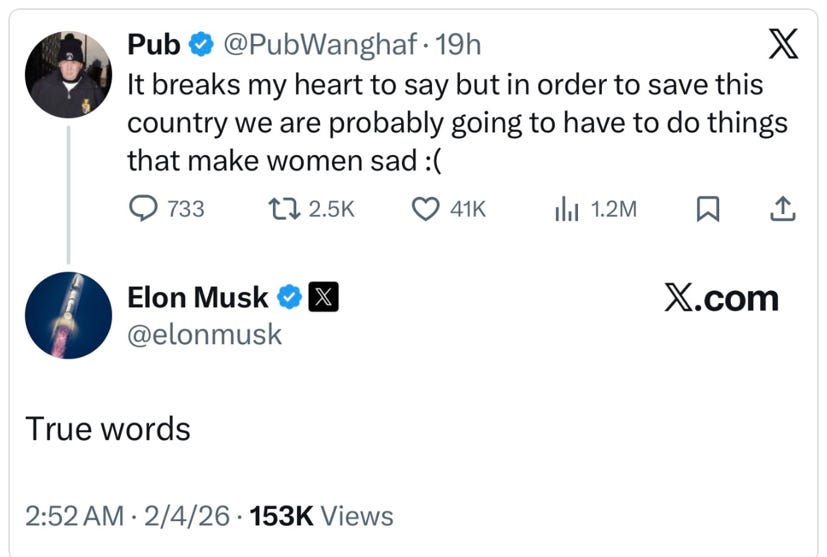
These days, even far-right discourse on issues that have nothing to do with feminism or sex roles is often inflected, if not saturated, with hostility and contempt toward women. It’s become a right-wing axiom, for instance, that opposition to anti-immigration policies and heavy-handed deportation tactics is driven by women’s “suicidal empathy”—even though the actual gender gap in opinions on illegal immigration and immigration enforcement is quite small. It’s hard to say exactly what Elon Musk meant when he seconded a viral X post about having to “do things that make women sad” in order to “save this country”—banning abortion? conducting mass deportations with sufficient inhumanity?—but the level of normalized misogyny is shocking.
And, while some conservative women—and men, like Henry Olsen—are pushing back on this rhetoric without leaving the right, the hardcore MAGA camp resists any correctives.3
HOW MUCH DOES RIGHT-WING MISOGYNY endanger women’s rights on a practical level? Stepman shrugs off “Repeal the Nineteenth” talk as “jokes and bar chatter” because there are no actual initiatives to repeal women’s suffrage—which, luckily, is a protection mechanism against its own abolition. Yenor’s fantasies of making it legal to discriminate against women in the workplace in order to promote a male-provider ethos also have little chance of being enacted: Even the recent Heritage report on “saving the family,” which takes some jabs at feminism for its critiques of women’s domestic roles, doesn’t propose any actual measures that would discourage women’s careers or privilege male breadwinners. One could even point out that, despite Donald Trump’s well-known penchant for sexualized misogyny, his administration is not churning out antifeminist rhetoric the way it churns out racialized nativist propaganda against “third world” immigration. (Maybe Republicans know they can’t afford to squander the female vote the way they have apparently squandered Hispanic and Asian-American votes during the past year.)
Yet, without invoking Handmaid’s Tale-style dystopias, far-right misogyny does have real-life effects under the second Trump administration—especially in the Department of Defense, where Pete Hegseth has selectively purged high-level female leaders and axed an advisory committee on women in the military created in the very “woke” era of 1951. (He also recently had pastor Doug Wilson, a pro-patriarchy, anti-women’s suffrage Christian nationalist, lead a prayer service and deliver a brief sermon at the Pentagon.) The push to root out “DEI” resulted, as recent depositions of DOGE staffers showed, in the cancellation of grants for research that focused on “voices of females”—such as female Jewish survivors of Nazi forced labor camps. And while laws against sex discrimination may not be in danger of repeal, they are not likely to be vigorously enforced when the Trump Department of Justice and the Department of Education’s Office of Civil Rights are focused primarily on “reverse discrimination” against whites and gender identity policies seen as injurious to women and girls.
And even more worrying are the long-term cultural effects of a movement that we know has a sizable following among young Republican activists, including congressional staffers. In a 2024 poll of young adults from the Institute of Politics at Harvard’s Kennedy School, a third of Republicans agreed that “women’s emotions make it more challenging to lead effectively,” while nearly half felt that “women are too promiscuous these days.” A more recent survey confirms that “Generation Z” and millennial Trump voters, men and women alike, are far more likely to be hostile to sexual equality than all Americans and even than older Trump supporters. More than a quarter of younger Trump voters agreed that in a relationship, “the man should lead, and the woman should follow”; their older counterparts were in line with Americans in general on this question, with about one in ten agreeing. The poll survey also reflect the new right’s obsession with masculinity framed in explicit opposition to “soft” and “feminized” culture: 49 percent of younger Trump voters, compared to 39 percent of older ones, felt that “American culture today is too feminine [and] needs more masculinity.” (Interestingly, female Trump voters are notably less enthusiastic on this point: 59 percent of young pro-Trump men but only 35 percent of the women endorsed the statement.)
Assuming that American democracy survives this moment, the new misogyny will be one of the forms of cultural damage to undo. We can only hope that the pushback will not be another cycle of collective blame and toxic polarization, but a rediscovery of our common humanity.
For instance, it mentions blogger Hannah Cox as one of the “New Right” defectors when Cox has always been an anti-MAGA, anti-alt-right classical liberal.
A case in point: First Things, the conservative magazine on religion and public life, recently ran blogger Helen Roy’s critical review of a new book that excoriates attempts to fuse Christianity and feminism, treats all feminism as demonic, and defends patriarchy as a natural hierarchy. Federalist editor-in-chief Mollie Hemingway responded with a snide dismissal, praising the rejection of feminism and noting that it “enrages some who still cling to the sad ideology and its false promises”—even though Roy’s critique couldn’t have been more thoughtful or less “enrage[d].”