
Programming note: The president has just started a press conference. We’re watching and we plan to do a livestream if he says something noteworthy. Check the homepage.
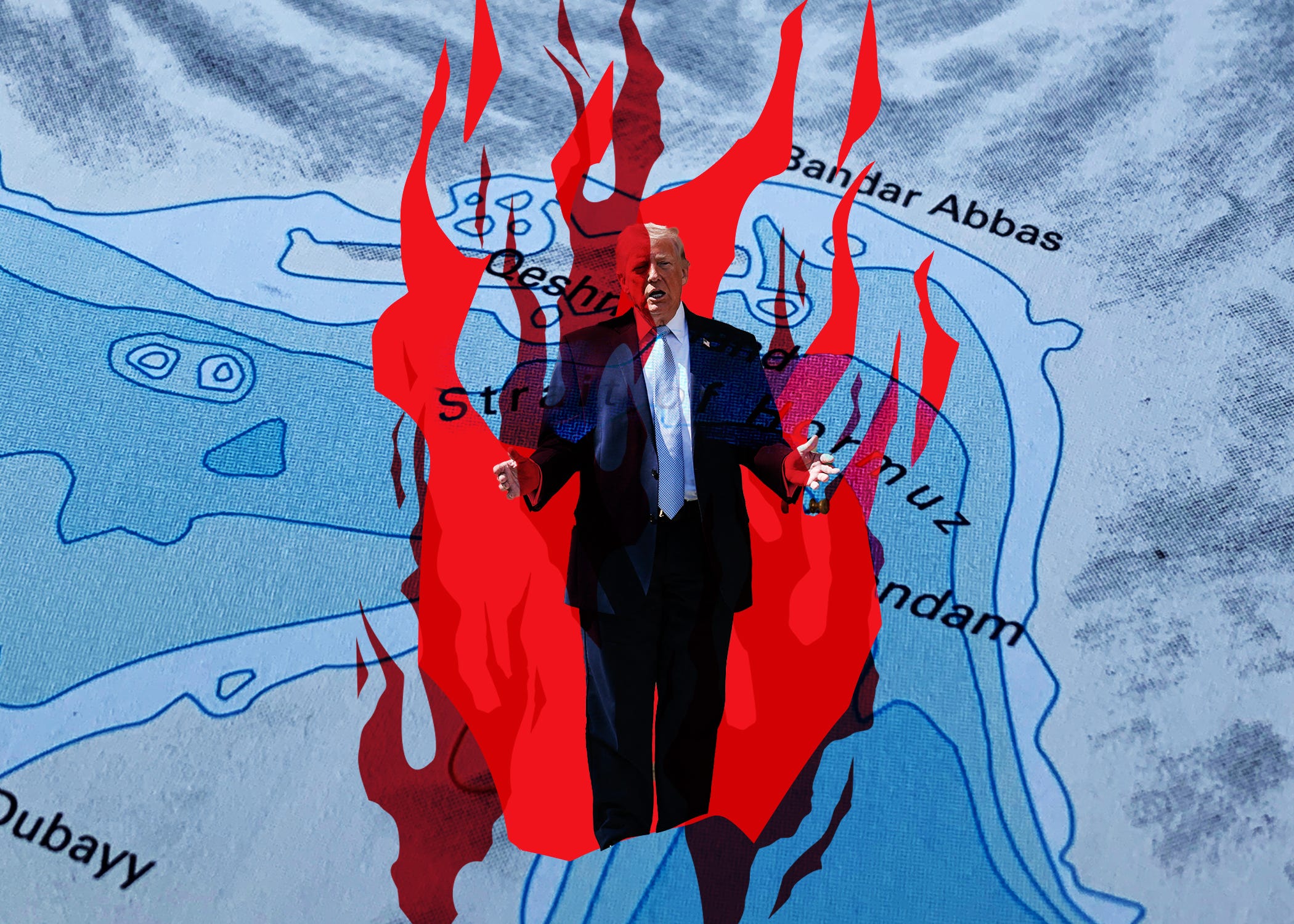
1. The Timeline
Last week President Trump said that he didn’t care whether or not the Strait of Hormuz was reopened because it wasn’t America’s problem.
On Sunday he demanded the strait be reopened in two days or he would begin a campaign of war crimes against Iran.
Which is it?
That’s a trick question, obviously. The answer is the former; or maybe the later. Or both. Or neither.
I don’t know about you, but until recently I had forgotten that President Trump originally demanded the Iranian regime accede to “unconditional surrender.”

That’s so far in the rearview that literally no one ever brings it up anymore.
Why haven’t reporters asked Trump why he’s negotiating about opening the Strait of Hormuz when he originally said that nothing short of “unconditional surrender” would be accepted? When you start radically revamping your win conditions, doesn’t that mean that you’re losing?
But of course it’s not that simple. This isn’t really about “winning” and “losing.” Because when you put all of Trump’s shifting demands, conditions, and timelines together in one place and just read them chronologically, you get a picture of either a degenerate bullshitter, or a man who’s lost his mind.
Here are all of the war demands made (so far) by the president of these United States.
February 28: “Our objective is to defend the American people by eliminating imminent threats from the Iranian regime, a vicious group of very hard, terrible people. Its menacing activities directly endanger the United States, our troops, our bases overseas, and our allies throughout the world. . . .
“[T]o the great proud people of Iran, I say tonight that the hour of your freedom is at hand. Stay sheltered. Don’t leave your home. It’s very dangerous outside. Bombs will be dropping everywhere. When we are finished, take over your government. It will be yours to take. This will be probably your only chance for generations.”
March 2: “I don’t want to see it go on too long. I always thought it would be four weeks. And we’re a little ahead of schedule.”
March 4: “One of the things I’m going to be asking for is the ability to work with them on choosing a new leader. . . . I’m not going through this to end up with another Khamenei. I want to be involved in the selection.”
March 5: “We want to go in and clean out everything. . . . We don’t want someone who would rebuild over a ten-year period.”
March 5: “They are wasting their time. Khamenei’s son is a lightweight. I have to be involved in the appointment [of the next Iranian leader].”
March 5: “We’re going to have to choose that person along with Iran. We’re going to have to choose that person.”
March 6, 8:50 a.m. EST: “There will be no deal with Iran except UNCONDITIONAL SURRENDER!”1
March 6, at some point after 8:50 a.m. EST: “Unconditional surrender could be that [the Iranians] announce it. But it could also be when they can’t fight any longer because they don’t have anyone or anything to fight with.”
March 6, 1:43 p.m. EST: Karoline Leavitt says, “What the president means is that when he, as commander-in-chief of the U.S. Armed Forces, determines that Iran no longer poses a threat to the United States of America, and the goals of Operation Epic Fury has been fully realized, then Iran will essentially be in a place of unconditional surrender, whether they say it themselves or not.”
March 7: “He’s [Iranian national-security official, Ali Larijani] already surrendered to all of the Middle Eastern countries.”
March 7: “We don’t need people that join Wars after we’ve already won!”
March 11: “We’ve won. Let me tell you, we’ve won. You know, you never like to say too early you won. We won. We won the—in the first hour, it was over. But we won.”
March 13: “The Fake News Media hates to report how well the United States Military has done against Iran, which is totally defeated and wants a deal - But not a deal that I would accept!”
March 14: “The United States of America has beaten and completely decimated Iran, both Militarily, Economically, and in every other way, but the Countries of the World that receive Oil through the Hormuz Strait must take care of that passage, and we will help — A LOT! The U.S. will also coordinate with those Countries so that everything goes quickly, smoothly, and well. This should have always been a team effort. . .”
March 21: “If Iran doesn’t FULLY OPEN, WITHOUT THREAT, the Strait of Hormuz, within 48 HOURS from this exact point in time, the United States of America will hit and obliterate their various POWER PLANTS, STARTING WITH THE BIGGEST ONE FIRST!”
March 23: “I HAVE INSTRUCTED THE DEPARTMENT OF WAR TO POSTPONE ANY AND ALL MILITARY STRIKES AGAINST IRANIAN POWER PLANTS AND ENERGY INFRASTRUCTURE FOR A FIVE DAY PERIOD.”
March 23: “We are very intent on making a deal with Iran.”
March 23: “They [Iran] want very much to make a deal. We’d like to make a deal, too.”
March 24: “You know, I don’t like to say this — we’ve won this, because this war has been won, the only one that likes to keep it going is the fake news.”
March 25: The Trump administration crafts a fifteen-point peace plan. Conditions include:
Dismantling of nuclear facilities in Natanz, Isfahan, and Fordow
Handover of Iran’s stockpile of enriched uranium
Limits on the range and number of Iran’s missiles
Reopening of the Strait of Hormuz.
March 26: “I am pausing the period of Energy Plant destruction by 10 Days to Monday, April 6, 2026, at 8 P.M.”
March 30: “[I]f the Hormuz Strait is not immediately ‘Open for Business,’ we will conclude our lovely ‘stay’ in Iran by blowing up and completely obliterating all of their Electric Generating Plants, Oil Wells and Kharg Island (and possibly all desalinization plants!). . .”
March 31: “I had one goal: They will have no nuclear weapon, and that goal has been attained.”
March 31: “We’ll be leaving very soon. And if France or some other country wants to get oil or gas, they’ll go up through the strait and—Hormuz Strait. They’ll go right up there, and they’ll be able to fend for themselves. I think it’ll be very safe, actually, but we have nothing to do with that. What happens in the strait we’re not going to have anything to do with.”
April 1: “[T]he countries of the world that do receive oil through the Hormuz Strait must take care of that passage. They must cherish it. They must grab it and cherish it. They can do it easily. . . . Go to the strait and just take it, protect it, use it for yourselves. Iran has been essentially decimated. The hard part is done, so it should be easy. And in any event, when this conflict is over, the strait will open up naturally. It will just open up naturally.”
April 4: “Remember when I gave Iran ten days to MAKE A DEAL or OPEN UP THE HORMUZ STRAIT. Time is running out - 48 hours before all Hell will reign down on them.”
April 5, 8:03 a.m. EDT: “Tuesday will be Power Plant Day, and Bridge Day, all wrapped up in one, in Iran. There will be nothing like it!!! Open the Fuckin’ Strait, you crazy bastards, or you’ll be living in Hell - JUST WATCH! Praise be to Allah.”
April 5: “If they don’t come through, if they want to keep it closed, they’re going to lose every power plant and every other plant they have in the whole country.”
This isn’t just about dunking on Trump. It’s about understanding just how weak America’s position is right now. The walls are closing in not just on Trump, but on the old global order.
We’ll talk about that in a second. But if this sort of thing is useful to you, I hope you’ll consider joining the Bulwark+ community.
If we want a better media, we have to build it. Together.
2. Dept. of WTF
This is a world leader negotiating against himself.
The enemy must surrender unconditionally.
Actually, unconditional surrender is something only the president can declare with his mind.
We want a deal.
We must select the next leader.
Okay, you picked the one guy I said was unacceptable.
We won; the war is over. They surrendered.
You must do what we say in the next two days, or we’ll escalate the war.
They want a deal, but I’m not ready to accept.
Open the Strait of Hormuz, or else.
Do whatever you want to the strait. We don’t care. It’s not our problem.
Open the Strait of Hormuz, or else.
Do what we say in ten days, or we’ll escalate the war.
Make a deal or we’ll start doing war crimes, like Putin.
Meanwhile, the Iranian regime has absorbed a tremendous amount of punishment while quietly achieving its two strategic aims. It has preserved continuity and enforced closure of the strait.
The Iranians are the ones methodically and proportionally escalating. The Iranians are the ones refusing (publicly) to negotiate. And why would they? From their perspective, the American president is out of his GD mind and all they have to do is hold out until the domestic political fallout makes his position unsustainable.
At which point one of two things will happen. Either:
(1) Trump will give them enough of a bribe to get them to open the strait, he’ll declare victory, and leave. Or,
(2) Trump will declare victory and leave without opening the strait. Which will shift the locus of the entire global political order several thousand miles eastward. At which point I promise you that the Chinese and the Europeans will figure out a new system for governing the oil supply through the strait. And this new system will be hostile to American interests.
The best-case scenario left is for Trump to cave and give the Iranians whatever they need to open the strait and end the war. The price will be steep. The cost to America will be significant. The Islamic Republic will become even more entrenched and its influence will grow.
But at least the damage to America will be capped.
If we wind up with Door #2, then this war could become our Suez Crisis.
Not that it matters, but purely as an academic question I’m interested in what you think about that timeline of Trump’s positions.
Is this a category difference from how erratic he was four years ago? A decade ago?
The $64,000 question is whether the Iran war is merely a case of reality finally catching up with a bullshit artist, or if the American president has become either a madman or a dementia patient.
I’m curious about your thoughts on this. Please don’t be glib. It’s a serious question.
3. War Crimes
Just Security’s Margaret Donovan and Rachel VanLandingham have an excellent piece on Trump’s proposed war crimes:
[T]he president’s statements place servicemembers in a profoundly challenging situation. As former uniformed military lawyers who advised targeting operations, we know the presidents’ words run counter to decades of legal training of military personnel and risk placing our warfighters on a path of no return.
Iranian power plants and other critical civilian infrastructure are protected from attacks by the law of war the United States helped craft after World War II. Such an object can lose its protection only if it is used for military purposes by the enemy and its destruction “offers a definite military advantage.” Even then, such an object can be attacked only if, after a case-by-case rigorous analysis, the “concrete and direct military advantage anticipated” outweighs the civilian suffering that is expected to result. (Geneva Convention Additional Protocol I art. 52, art. 57; DOD Law of War Manual, § 5.6, § 5.12).
Despite those well-settled legal parameters, President Trump has repeatedly threatened to obliterate such infrastructure without regard to the law’s high demands. His comments are blatant expressions that he is willing to turn the United States into a rogue State like Iran and Russia, one that rejects the fundamental legal restraints that protect innocent non-combatants like children, and the Iranian civilian population itself.
While our Commander-in-Chief threatens to “obliterate” “each and every one of their electric generating plants,” U.S. military commanders have been approving strike packages, wrestling with how to transform Trump’s dangerous bombast into lawful targets.
Asking our military professionals—lawyers and commanders alike—to grapple with the president’s erratic behavior is enormously consequential. U.S. military commanders have sworn to obey the Constitution and only those orders from their superiors that are lawful. Threats to bomb Iran “back to the Stone Ages” and to show “no quarter, no mercy” are plainly illegal. Trump’s outrageous statements gravely threaten our military professionals’ bedrock moral and legal principles, ones enshrined in the law of war that they’ve been trained to follow their entire careers.
Read the whole thing. The most consequential passage is this one:
[T]he public record of intent to commit war crimes puts soldiers at risk of later liability. In any future war crimes or U.C.M.J. investigation—for which there may be no statute of limitations—their actions will be judged based on the reasonably available information at the time of the strikes. See, e.g., Executive Summary of the Investigation of the Alleged Civilian Casualty Incident in the al Jadidah District, Mosul, May 8, 2017. Long after the Secretary of Defense receives his anticipated pardon from the president, it is not unlikely that both his and Trump’s expressly stated intent to commit acts that amount to clear war crimes and to dispense with “stupid rules of engagement” may be considered evidence of notice and scienter on the part of servicemembers’ during any future congressional or criminal investigations.
I do not envy military professionals who may be ordered to commit crimes by the commander-in-chief. Like Mike Pence, they may find themselves in a situation where they must either obey the president or the law—and there will be consequences no matter what.
But it seems important that the United States be fully committed to enforcing the full weight of legal consequences in the future, all the way down the chain. In the same way that every employee of DHS should be on the hook for any crimes committed during the Trump administration, so should members of the military.
Because if we turn back this authoritarian attempt and do not pursue full legal accountability for everyone who was complicit in it, then we will find ourselves confronted with another attempt.
There can be no free shots.
Correction (April 6, 2026, 2:30 p.m. EDT): As originally published, the entries for March 6 were timestamped with “EDT” even though Daylight Saving Time did not begin until two days later.
As we watch in horror as the the commander-in-chief cycles rapidly between declaring premature victory, negotiating with himself, and threatening undeniable war crimes in the Strait of Hormuz, I'm starting to wonder if we need to prepare ourselves for the inevitable pivot. When the geopolitical reality of this manufactured Iranian crisis fully collides with the President’s actually cognitive state. I really think we are going to see momentum build for the 25th Amendment. My biggest concern is pretty weird considering how terrible everything is. My concern is the Republicans who have enabled every atrocity, every constitutional violation, and every act of institutional vandalism will suddenly begin to murmur about his "declining faculties." They will perform grave concern. With the timing of a poorly rehearsed magic trick, they will discover that the man they elevated and empowered is conveniently "unfit."
I dont think we can accept this. I think if we do allow this to be framed as a return to sanity we lose the nation forever. The 25th Amendment gambit is not a reckoning; it is an escape hatch. It is the party apparatus constructing a medical fiction to justify removing a liability without ever having to confess what he was, what they knew he was, and what they enthusiastically helped him do. They do not get to claim that his malice, his incompetence, and his flagrant disregard for the constitutional order were unexpected developments. These were the advertised features. Every Republican who blocked certification, who lied about election fraud, and who looked the other way while he stripped the guardrails from our democracy chose this malfunction because it was useful to them. Permitting them to use a procedural off-ramp allows co-conspirators to step off the train one stop before it hits the wall and reenter public life as responsible actors.
JVL rightly questions whether the President is a madman, a dementia patient, or just a bullshit artist finally trapped by reality. To me, the distinction is clinically interesting but practically irrelevant. What matters is the diagnostic measurement of his capacity. The man currently threatening to obliterate civilian power plants possesses the impulse control of a toddler, the strategic vision of a cracker, and the ethical framework of Jimmy the loan shark. He is, by every measurable standard, the least qualified human being to ever operate the American state apparatus. Yet, he nearly destroyed it. If a man this historically inept can drag the republic to the brink of catastrophe through blundering incompetence, imagine what a disciplined authoritarian, one capable of maintaining a coherent lie for more than a single news cycle, will do with the blueprint he leaves behind.
We do not need a national therapy session designed to absolve the voting public that endorsed this project, nor do we need a clever procedural mechanism that lets the saboteurs pretend the sabotage never happened. The only acceptable outcome is a brutal, comprehensive reckoning. That means absolute admission of what was done, relentless prosecution of the officials who broke the law, and structural reform with the teeth to permanently bar from the factory floor every engineer who signed off on the modifications that brought us to the edge of destruction. Anything less is just a new coat of paint on a condemned building, and the permanent loss of this country.
"The best-case scenario left is for Trump to cave and give the Iranians whatever they need to open the strait and end the war. The price will be steep."
Absolutely right! But that is the best case scenario for the US. It is not the best case scenario for Bibi Netanyahu. Will Bibi allow his junior partner in this war to do it? I doubt it.