Why Amazon’s Push Into Christmas Music Just Feels a Little…Off
The retail and entertainment giant and a new old-fashioned holiday tradition.

I’VE NOTICED SOMETHING CURIOUS, listening to Christmas music on my Amazon Echo: the “Amazon Music Original” Christmas songs. I say “curious” and not “surprising,” because of course an Amazon device is going to push Amazon-published music, much of which is exclusive to Amazon’s platforms, at least initially (you’d think this might raise some sort of antitrust issue, but who’s looking?).
What’s curious about it to me is not the economics of streaming platforms and exclusive content. Rather, it’s the fact that Amazon has published and distributed more than fifty Christmas songs, a streak that began in 2014 but truly took off in 2018 with Katy Perry’s Amazon exclusive “Cozy Little Christmas.” That’s a lot of cultural production in a rather fallow time for decent holiday music.
Of course, Christmas and holiday releases have been standard for recording artists for decades, but at the same time, the canon of Christmas songs has remained stubbornly old-fashioned. Listen to mainstream radio around the holidays, and you’ll still hear plenty of Nat King Cole, Frank Sinatra, Elvis, Gene Autrey, Andy Williams, Ray Charles, and Bing Crosby—the only time you’ll probably ever hear them on those stations. Yes, later generations are represented—there’s that Paul McCartney song, that Stevie Wonder song, and the vocal stylings of Mariah Carey and Michael Bublé—but the number of new, original songs (not covers) that get airtime is surprisingly small in comparison to the lingering olds.
Of course, the point of Amazon exclusives is to entice listeners to pay for Amazon Music streaming, so you won’t hear most of these songs on the radio. But it strikes me that Amazon is nonetheless resurrecting something of a dormant American cultural tradition. It’s a kind of full-circle moment, seeing a company that has redefined the commercial aspects of American life doing something distinctly old-fashioned; something that, in a more diverse, and perhaps lonelier, country, feels like a throwback.
So: Are they actually any good?
I’m not interested in the covers of classic songs here, of which Amazon has put out many (and of which the quality is mostly fine—like most of the covers of classic tunes you’ll hear on the radio). Let’s focus just on the original songs, and whether any of them seem like new classics, or not.
Unfortunately, some are rather blah. Katy Perry’s entry, which is among the most-played, is one of those unsubtly “political” Christmas songs, this time against consumerism (“I don’t need diamonds, no sparkly things / ’Cause you can’t buy this a-feeling”). She addresses the phrase “you’re the reason for the season” to her beau, making clear that the renunciation of consumerism has nothing to do with the religious meaning of Christmas, and then, to make a rhyme work, sings “we don’t need to keep up with the Jones” instead of “the Joneses.” (As with several of these songs, Perry’s was made available on other platforms after a year of having been an Amazon exclusive.)
Some of them are passable but uninteresting rehashes of typical Christmas imagery, with little originality. For example, Carrie Underwood’s “Favorite Time of Year” and Dan + Shay’s “Pick Out a Christmas Tree.” I suppose it has nothing to do with the fact they’re released by Amazon, but the writing feels rushed or imperfect, like a product brought to market quickly.
Carrie Underwood belts out “It’s music to my ears” to sum up a long list of things she’s just rattled off, none of which have anything to do with music, or with hearing anything—“stockings on chimneys, angels on the trees, sugar and cinnamon” and other seasonal summonings. (It’s almost as if someone decided that if Rodgers and Hammerstein’s “My Favorite Things” could come to be treated as a Christmas song, that was a formula worth copying.) And if you close your eyes, you can almost hear Underwood singing the line “All I want for Christmas is you” instead of “Christmas is my favorite time of year.”
Meanwhile, Dan + Shay sing, of the freshly cut Christmas tree, “And when we get back home, plug it in and watch it glow.” Did you pick an electric, artificial tree from the farm outside the snowy little Hallmark downtown?
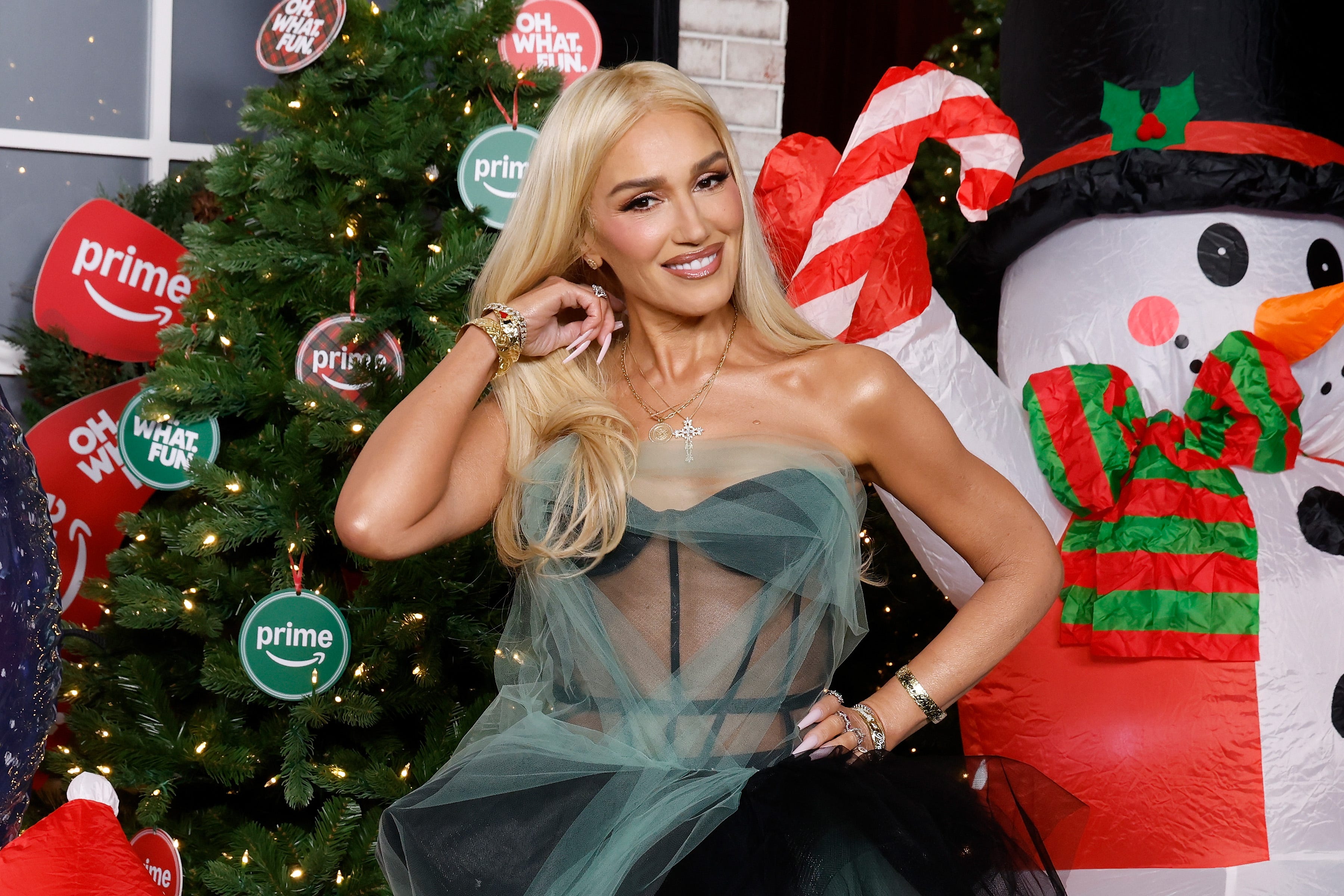
Gwen Stefani’s “Shake the Snowglobe,” released last month (in connection with a new movie from, of course, Amazon MGM), seems like a fine enough “I’m going crazy at Christmastime” attempt, but it sounds like the Waitresses’ “Christmas Wrapping” with fewer, less-clever words, and more noise. I really wonder if the reviewer who praised its “inescapable and infectious chorus” was listening to the same song.
“Shake the Snowglobe” and “Pick Out a Christmas Tree” also truncate the verses towards the middle of the song, so that the repetition of the chorus ends up overwhelming the song. It’s awkward to listen too, almost like playing a video game released before it was quite finished.
Sam Ryder’s “You’re Christmas to Me” is not bad, but it’s one of those songs that sounds like you’ve heard it before. The same is true of Marco Mengoni’s new “Coming Home” (could it be that it sounds a tad like Kenny Loggins’s “Celebrate Me Home”?).
One of the best of them is Laufey’s “Christmas Magic,” which is quite nicely done. But it’s kept from being perfect by the slightly weird lyric “it’s the best kind of sorcery I know,” referring back to Christmas magic. Sorcery? (It makes slightly more sense because it appears—for 30 seconds, barely audible in the background—in the ‘what if Santa Claus really exists?’ Christmas flick Red One. Distributed by, you guessed it, Amazon MGM.)
MOST OF THESE SONGS are just missing something; some musical or lyrical aspect that stops them being great. But then, I suppose, most of the original Christmas songs ever written have been forgotten.
One reason most of these songs—and a lot of recent Christmas songs in general—are not very good, aside from simply not sounding very nice: many either repeat the nostalgic tropes that have been done better, or they chuck out the earnest nostalgia of the classic Christmas canon but don’t do anything interesting with what’s left.
For a counterexample to that, consider the 1994 song that keeps bringing Mariah Carey more than $2 million every holiday season. “All I Want For Christmas Is You” did something interesting, and it may have been the first Christmas song to do it (well, okay, actually, not): rattle off all of the typical Christmas symbols (sleigh bells, reindeer, Santa, snow, etc.) for the purpose of emphasizing that those things were not what she wanted. That’s interesting! But a lot of newer Christmas songs with a tinge of cynicism have done exactly the same thing, and once you see the gimmick, it doesn’t work so well.
Time to put my (Christmas) cards on the table: In my opinion, the best of the post-1994 new Christmas songs is probably Ariana Grande’s 2014 “Santa Tell Me.” It’s perfectly produced and actually pleasant to listen to, which is more than you can say for a lot of these noisy Amazon songs. And its subject matter is mature but earnest (“I won’t have sex with a guy who won’t commit to me”), a combination our society could use so much more of. It’s something of an original thought for a mainstream Christmas song, and it is executed very well.
Only time will tell whether Amazon has meaningfully added to that old-fashioned canon of popular Christmas music. My guess is that most won’t be remembered a few decades from now. But Amazon does deserve credit for having produced a number of decent “Christmas music on the radio” tunes, and injected some new energy into something timeless.
I’m sure Dolly Parton has original Xmas songs, but I can’t think of any. What I like about her stuff is how original her voice can make a song I’ve heard by 100 other artists sound.
I always appreciate when the Bulwark has your writing. Everyone should give your substack a look. Your views on a single building or a mall or just random things are always interesting and a wonderful diversion from politics.
My favorite new Christmas record is J D McPherson’s “Socks!”:
https://youtube.com/playlist?list=OLAK5uy_l4rKAWgX9RWQtU-XdqWZo6a3yxm10h-6c&si=9qTVzozQBTSybre0