The Decline and Fall of Christianity in America
If we imagine religion as a technology, argues Notre Dame sociologist Christian Smith, we can better see the cause of its decline: obsolescence.

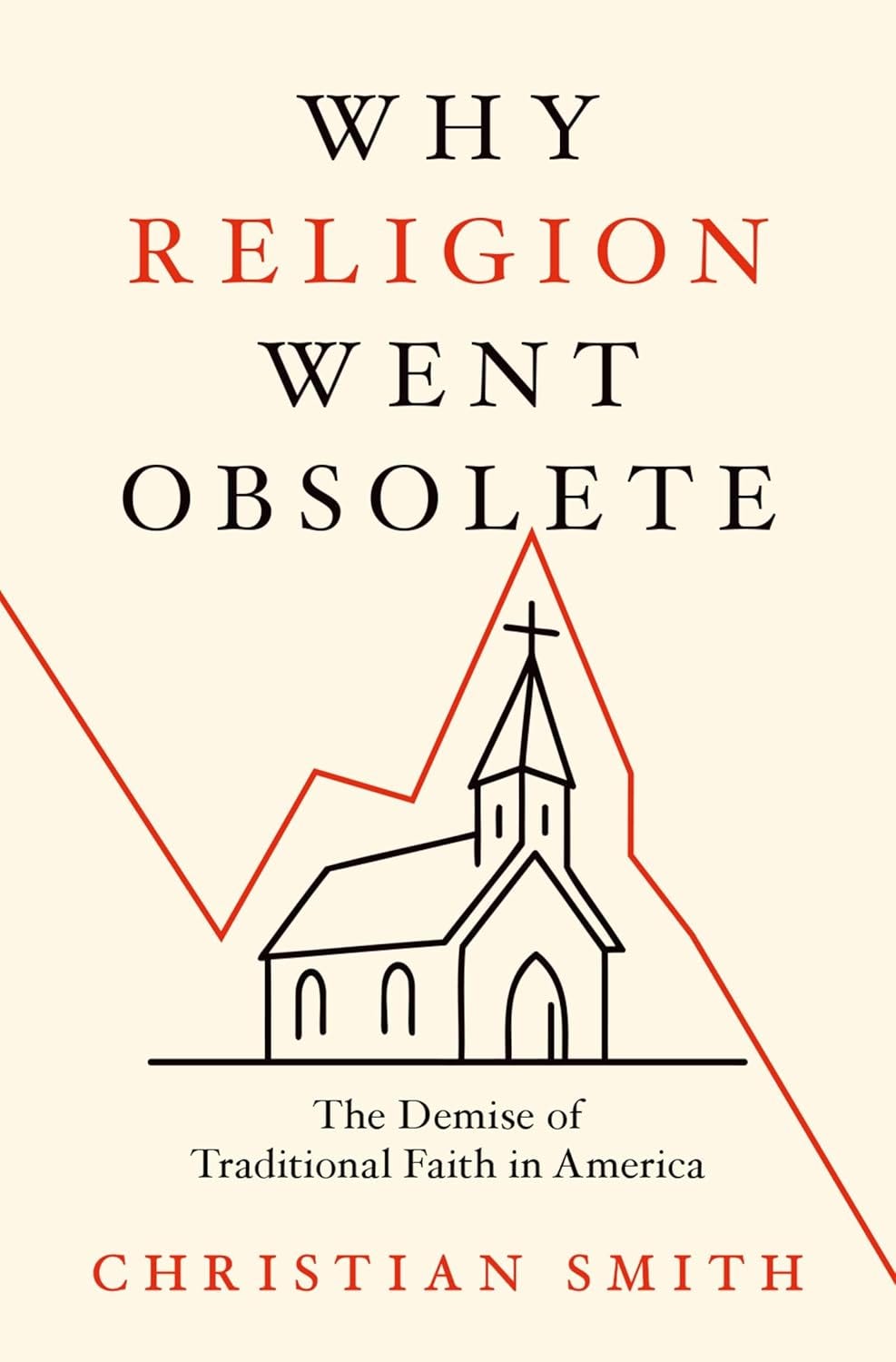
Why Religion Went Obsolete
The Demise of Traditional Faith in America
by Christian Smith
Oxford University Press, 440 pp., $34.99
WHILE TOURING THE UNITED STATES in the early 1830s, French aristocrat and author Alexis de Tocqueville observed that the American republic depends on the mores of the American people to survive, and that these mores were largely the result of “religion and liberty [becoming] . . . intertwined.” So, what happens to those mores—and our democracy—when Americans decide they have no more practical use for religion?
For decades, “vibe shifts” and “quiet revivals” notwithstanding, religion in America has been on a downwards trajectory. Belief is in decline, as are belonging in religious communities and institutional trust. Weekly church attendance, once a normative part of respectable American life, has collapsed. Gallup data from 2020 revealed that, for the first time in U.S. history, fewer than 50 percent of Americans belonged to a church, synagogue, or mosque. Confidence in organized religion has also plummeted dramatically, as clergy, once among the most trusted professionals, seem increasingly to be the targets of suspicion.
This spiritual downtick has spawned endless charts and data-driven debates, with scholars pinning the blame for it on everything from economic comfort and fraying family ties to shifting demographics. But sociologist Christian Smith, the William R. Kenan, Jr. Professor of Sociology at the University of Notre Dame, believes that these reams of stats, while helpful, do not capture what’s really going on. Something more fundamental is at work: For a growing number of Americans, traditional religion, particularly Christianity, has simply become obsolete.
Smith’s judgment of obsolescence does not imply that most people have come to view religion as false or disproven, brought down by critics. It’s more that religion simply no longer fits into the rhythms and values of modern life in America. The story he tells is about the growing sense of the superfluity of traditional religion—the assumption that it lacks practical utility, has lost its moral authority, and is increasingly out of sync with the cultural and social realities of the country today.
Key to the argument is Smith’s characterization of “traditional religion,” by which he means:
religious groups that have existed for multiple generations; that have established practices, doctrines, organizational structures, and cultures that are solidified in authoritative texts; and that would not be considered novel, fringe, or “alternative” by the mainstream population. Specifically, I include in this category mainline Protestantism, Roman Catholicism, Black Protestantism, white evangelical Protestantism, most Pentecostal charismatic churches, Eastern Orthodox churches, Judaism, the Church of Jesus Christ of Latter Day Saints (LDS or Mormons), and most religious sects and denominations that have separated from the above traditions and organizations over doctrinal and lifestyle differences as long as they remain subcultural and not countercultural (e.g., Adventists and Holiness churches).
Some might wonder why these particular religious formations enjoy Smith’s attentions instead of others, given the religious diversity of the United States and its sizable Muslim, Hindu, and Buddhist populations, as well as other religious communities that are smaller but no less distinctive. Smith does not wish to impugn any believing person’s devotion, but he does wish to prioritize communities that have a certain amount of cultural influence—and so, he has written his book about the religious traditions and communities that have played central roles in shaping mainstream American public life; they are predominantly Christian.
Americans have always been practical, as Tocqueville also reported, so it is fitting that technology, grounded as it is in meeting practical needs, provides the conceptual model for Smith to explain both religion’s decline in the United States and the way he expects it may carry on even in diminishment. “Existing electric typewriters can still type letters as well as they ever did. Most people just prefer computers,” he writes. “Analogously, traditional religion still works well for some Americans. Most people simply prefer alternatives.”
So what are the alternatives that Americans have been picking up to replace outmoded faith? Smith mentions plenty: New Age practices like astrology and crystals, which convey order without also imposing moral restrictions; market-driven values such as careerism, consumption, and the drive to have digitally curatable experiences; the endless, buzzing, reality-displacing stimulations of digital entertainment; and the sacralization of politics, which now provides meaning, belonging, and even a sense of transformation.
Notice some items that are missing from this list: secular humanism, atheism, anti-theism. Smith does note the “Four Horsemen” of the “New Atheism” as they ride furiously by—chasing pre-existing trends, it turns out, and not running down the Lord himself. Religion, that is to say, has not been supplanted by an intellectual paradigm of unbelief so much as a new set of pursuits that promise to deliver some of the same goods that religion does—fulfillment, identity, and a sense of transcendence, to name a few—but in ways that are more compatible with contemporary American mores.
WHAT PUSHED RELIGION into obsolescence? Smith doesn’t offer one answer, but instead offers an account of “two decades of converging perfect storms”—the 1990s and 2000s—to explain the development. His main points are these: The rise of consumer culture made personal choice and subjective experience the highest goods, degrading values like communal norms and institutional loyalties in the process. The deinstitutionalization of marriage and family (as indicated by lower marriage rates, more cohabitation, and diverse family structures) helped undermine religion’s traditional functions when it comes to both shaping morality and replenishing the population of the faithful in the pews. Meanwhile, the digital age decentralized authority, democratized information, and enabled new forms of identity and belonging beyond religious institutions, opening up alternatives to religion that had not existed before. Suddenly, traditional religion wasn’t just competing with rival faiths but with the sensibility of the early internet: moral relativism and “live and let live” was an ethos available to anyone with a dial-up connection.
While many of these underlying factors took decades to develop, Smith argues they were jointly catalyzed in what he calls the “Millennial Zeitgeist”: Millennials did not simply reflect these cultural changes, but actively embraced them and accelerated their uptake into American culture more generally. Coming of age in a world shaped by the digital revolution, economic instability, expanding personal freedoms, and pervasive pluralism, Millennials entered adulthood at a time when traditional religion no longer seemed necessary or compelling. Smith describes this cohort as individualistic, anti-institutional, relativistic, fluid, multicultural, and consumerist—traits whose collective effect was to make this group less receptive to the authority, exclusivity, and the discipline of organized religion.
While Smith’s story culminates with Millennials—the fulcrum year for his analysis is 1991, when survey data show a sharp generational drop in religious affiliation and attendance that, for the first time, did not reverse as people got older—he notes that prior generations made important preliminary contributions: Boomers set the stage for religion’s decline, and Gen X marked the first major generational break away from faith. Millennials inherited larger cultural tendencies from these earlier generations.
Yet the Millennials’ generational ethos has profoundly reshaped the religious landscape. And they have not abandoned it as they’ve grown up. Despite early hopes that aging Millennials might return to the church, they’ve largely stayed away. Historically and demographically, Smith sees less of a swerve on this matter than a watershed: He argues that Generation Z is already inheriting and reinforcing the same ethos and, with it, the concomitant stance towards religion. And as Millennials begin raising their own children outside of religious traditions, we should expect this trend to continue and grow.
IF HAVING FAITH IS AN EXPRESSION, fundamentally, of trust, religion has a built-in vulnerability right where it has received some of its hardest blows. Trust in institutions (government, media, and especially religion) began steadily eroding in the 1960s. Scandals like the falls of several high-profile televangelists and the abuse crisis in the Catholic Church had already shattered much of the public’s confidence by the time Millennials began to come of age in the late 1990s. While 9/11 may have deepened suspicions of religion, especially in its fundamentalist expressions, Smith emphasizes that for that generational cohort, the suspicion was already there. Many were raised by skeptical parents who sought to provide their children with sturdier supports for life than they felt religion could afford. And as Smith points out, some saw no need for religion because, good liberals that they were, they found their values already inscribed in American culture more generally—and religion didn’t offer them anything they didn’t already have.
This is the dynamic Smith sees at work in the spectacular collapse of mainline Protestant churches. Denominations like the Episcopal Church, the United Methodists, and the Presbyterian Church (USA) have positioned themselves at the vanguard of progressive causes: ordaining women and then appointing them to the highest denominational offices, affirming same-sex marriage and transgender identities, supporting abortion access, and championing social justice causes. Given these moral affinities, one might expect people who belong to the Millennial and Gen Z cohorts—generally well attuned to cultural and social liberalism—to fill up these progressive pews. Yet mainline congregations have suffered the sharpest declines of all.
Smith sees this collapse as a consequence of “cultural victory and organizational defeat,” a notion borrowed from research by N.J. Demerath, a late peer of Smith’s in sociology. The big-picture story is that by advancing values like individual autonomy, pluralism, and tolerance during the era in which mainline churches presided over the mainstream of American culture, those churches helped to remake that culture in their own image—and the scale of their success made them redundant. Smith quotes Demerath, who wrote, “Liberal Protestants have lost structurally at the micro level precisely because they won culturally at the macro level.”
Ironically, Millennials and Gen Z who have grown up to share the values these churches once fought for now “see no point to the religious part,” Smith writes. Younger Americans may like much what these churches stand for, but the particulars of church history, liturgy, and theology that once framed those values now seem “irrelevant and dated” to them—more cultural technologies that are becoming obsolete.
WHILE THE MAINLINE PROTESTANT churches continue their demographic freefall, Smith writes, conservative and evangelical churches are quietly grappling with a subtler but fundamentally similar crisis: their dissipation into the larger cultural conservatism that once fueled their growth.
For a time, evangelicals appeared to be thriving, absorbing former mainliners, building megachurches, and boasting higher birth rates. Yet, Smith contends, this apparent strength is largely illusory. Though they have different religious and spiritual themes than do their mainline counterparts, evangelicals place a similar emphasis on individualism, and the “personal relationship with Jesus” at the heart of so much evangelical expansion has also encouraged fragmentation, consumerism, and disengagement, turning religion into a simple matter of personal preference with little room for communal commitment. As Smith puts it, “evangelicalism’s ‘me-and-God’ mentality has thus been turned against not only evangelicalism but also traditional religion generally.”
Meanwhile, cultural and doctrinal civil wars within denominations have repeatedly fractured congregations and communities, alienating and exhausting many former evangelicals who might otherwise have stayed. And even the much-touted demographic advantage of higher birth rates has not insulated evangelical and conservative churches from decline: Smith notes that differences in family formation and fertility between evangelicals and mainliners have narrowed and are no longer enough to offset generational losses. Like their more liberal counterparts, conservative Christians today are delaying marriage, having fewer children, and prioritizing careers and mobility over long-term rootedness in local congregations. Smith writes: “as the traditional American family goes, so goes traditional religion.”
Finally, the rise of the Christian Right has, in Smith’s view, transformed evangelicalism from a vibrant populist religious movement into the religious wing of a belligerent populist political movement, giving it a highly politicized and increasingly mistrusted institutional reputation—particularly among younger Americans. Culture-war issues will certainly win over some, but not all—and in any case, not enough to prevent decline, in Smith’s view. Conservative churches have become ensnared in the same no-win situation of the mainliners of the last generation: Their pursuit of cultural relevance and power has bred suspicion and fatigue, pushing Millennials and Gen Z even further away. Smith sees a larger recursion in this: “what happened to evangelicalism parallels what happened to mainline Protestantism: cultural success leading to organizational decline.”
His conclusion is that the forces hollowing out American religion are ecumenical. Conservative churches aren’t on a different narrative path from that of the mainline; they’re just a few chapters behind in the same story.
SOBER-MINDED BUT NEVER cynical, Smith does not blame religious leaders for the failures of their churches or celebrate their retreat from American life. He remains committed to his analysis instead: What he observes is a cultural shift shaped not by deliberate choices or individual failures, but by the slow, cumulative force of social, cultural, demographic, and technological change. For church leaders and believers, Smith offers little comfort but much-needed clarity: The cure for what ails us isn’t better marketing or a new, trendy program. For people like me, the ultimate lesson of Why Religion Went Obsolete is that there are no shortcuts to renewal.
But the needs that drive people through the local church door—those haven’t changed. And “obsolete” is not the same as extinct. Some Americans will continue to seek out deeper wells to quench their spiritual thirsts, especially if they come to feel their preferred religion alternative is not healthy for their souls. Whether Christianity can adapt, revive, or reinvent itself remains to be seen. But so long as Americans continue searching for meaning, community, and a story bigger than themselves, the last word on religion in America cannot be written.
After all, as the Good Book says, “at the present time there is a remnant.”
 | A guest post by
|