An International Folk-Horror Double Feature
The Japanese and British isles bring us ‘Under the Blossoming Cherry Trees’ and ‘The Appointment.’


ONCE AGAIN, IT IS HALLOWEEN. I hope you have big plans to drink adult beverages from cups with pictures of spiders on them. Or, barring that, perhaps you’d rather run a double feature of terrific, yet obscure, horror movies from around the globe. If those happen to be your exact plans but you somehow have yet to land on the films to be screened, allow me to offer a couple of recommendations.
The first is Masahiro Shinoda’s Under the Blossoming Cherry Trees (1975). Shinoda, who passed away in March, is probably best known for the films Double Suicide and Samurai Spy, but he also worked frequently in the folk-horror tradition. Based on a short story by Ango Sakaguchi, Shinoda’s film plants us, at first, in modern Japan, amid the parties and festivals celebrating the annual blossoming of the cherry trees. A narrator warns the viewer not to be fooled by this, as centuries ago the land dominated by these trees was avoided by travelers, who would add days to their journey out of the belief that walking under the blossoming cherry trees would drive a person mad. Indeed, we see a lone figure in feudal Japan walking amid the trees as cherry blossom petals shower down, sending the bewildered man into spasms of panic, as he tries to flee the disease encroaching on his mind.
Going into this film, knowing only what I’ve just told you, you might assume that the horror of the story stems from a character driven to madness by the cherry blossoms. But somehow, no. Heinous acts are committed by our two lead characters while they are well outside the influence of those trees. Our lead, the otherwise unnamed Mountain Man (Tomisaburô Wakayama), is introduced as he marauds through the mountains, attacking and unhesitatingly, remorselessly murdering innocent travelers. When he murders the servants and husband of our co-lead, a beautiful woman (Shima Iwashita), a romance of sorts is born. Quite unconcerned by the violent death of her husband, the woman is drawn to the Mountain Man’s rough, primitive masculinity, and agrees to become his wife. Then, he takes his new bride to his shambles of a home in the mountains, where his many other wives—clearly kidnap victims, like this new beautiful woman—await him. The Mountain Man, noticing a potential awkward moment, insists they are his ex-wives, but the bride orders her husband to kill them all. And so for the next few minutes, quite a ways away from the cherry trees, the dangers of which the Mountain Man has already explained to his new bride, we watch him, panic-stricken but driven insane by lust like a James M. Cain character, running around and slaying his many wives, who attempt to flee in terror. All of them are killed but one, a childlike young woman (Hiroko Isayama), whom the new bride—who needless to say has been delighted by all of this—says can live and be her servant. And so it is.
Shinoda’s marriage of the cherry blossoms’ natural beauty with an otherworldly menace is remarkable. The cherry blossoms in this film are as beautiful as any cherry blossoms ever depicted on film, but in Shinoda’s hands, the weight of threat presses down just at the sight of them.
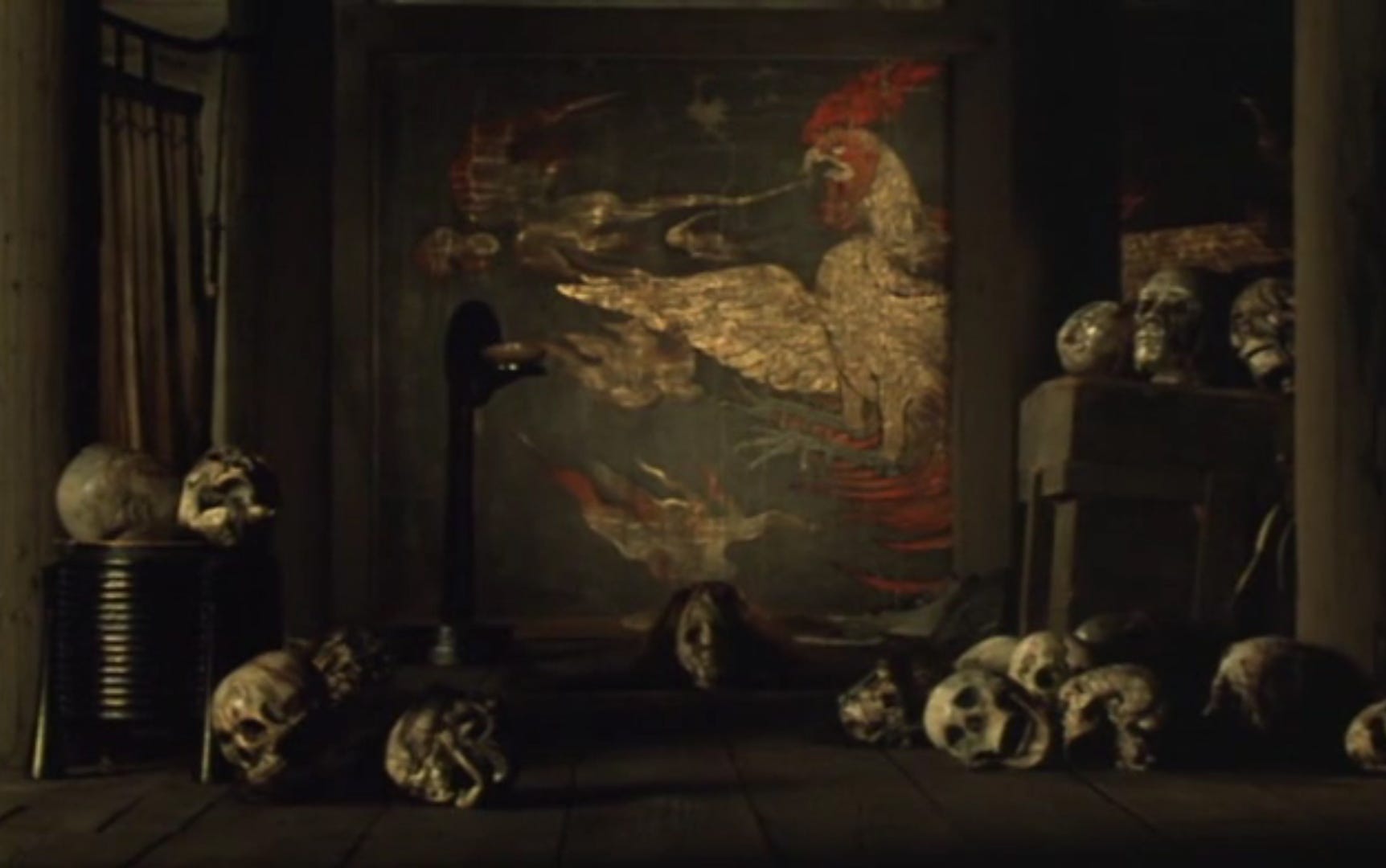
This is achieved through the juxtaposition of those images with some of the most appalling and depraved behavior I’ve seen depicted in a film. I’ve seen awful behavior depicted more graphically, but no behavior that was more hateful. Moving even further away from the cherry trees, the trio relocates to the capital, from which the new bride came and to which she longs to return. The Mountain Man eventually agrees, though he hates what passed then for modernity, and wanted only to live in the mountains. Once there, the new bride begins making demands, and what she wants most of all is decapitated heads. She wants “fat, disgusting” heads, and she makes requests—the heads of five dancers, for example. And the Mountain Man obliges, leading to some truly berserk sequences involving the new bride and her collection of rapidly decaying heads (a certain gallows humor is being employed here).
Not that this leaves the Mountain Man unaffected. This is an interesting thing about the film, in that it presents the audience with a character who is morally irredeemable from the start, and pushes even him past the point of inhuman selfishness into a kind of moral numbness that signals, he finally realizes, the soul he didn’t know he possessed has withered away. And again, most of this is separate from those cherry trees, which only really return to pay off their threat at the end in a mysterious, effective, and chilling way.

LINDSEY C. VICKERS IS A CURIOUS FIGURE in the world of horror cinema. A second-unit director or first assistant director on any number of horror films, such as And Now the Screaming Starts, Vampire Circus, and Blood From the Mummy’s Tomb, he has only two credits as a writer-director: the short film The Lake (1978), and his only feature, The Appointment, from 1982.
After a suitably ominous prologue, which details the inexplicable disappearance of a young violin prodigy named Sally Fremont as she was walking home from school through a wooded pathway, the film then proceeds to set its plot, if that’s the word for it, in motion from a launching point better suited to a slightly more-touching-than-usual sitcom episode: a busily employed father named Ian (a typically excellent Edward Woodward) must break it to his daughter Joanne (Samantha Weysom) that he will not, after all, be able to attend her big violin recital tomorrow, because he’s been called away for work. Joanne, an alarmingly spoiled young girl whose attachment to her father borders on the unhealthy, and perhaps crosses it, takes this badly, and it leads to a series of confrontations between father and daughter, as Ian, once the more solicitous of the two parents—despite warnings from his wife Dianna (Jane Merrow)—has reached the end of his tether with his selfish daughter and begins snapping at her, and calling her out on her behavior. All of this, in turn, leads to bouts of sleeplessness, and dreams of Ian being in terrible car accidents—these dreams being had by both Ian and Dianna—and three black dogs, appearing to throw themselves, snarling, at the windshield of a car.
What follows this is all a little bit hard to parse. But it involves a few things it’s necessary to note: one is this attraction, of a sort (and of what sort?) between daughter and father, and whether or not it’s reciprocated. It seems to not be, on Ian’s part, but there’s a scene, fraught with tension helped along in no small part by Trevor Jones’s effectively melodramatic score, where Ian is in the hallway outside his daughter’s bedroom, his hand hovering over the handle. On the other side, we see Joanne watching the door, a light grin on her face, seemingly aware that he’s out there. All of this reminded me of nothing so much as Edward Woodward’s similar scene in The Wicker Man, where his pious character is frozen on the other side of the wall from a writhing Britt Ekland. I don’t know that the film means to go that far in its implications, but something is going on there. (And for the second time in Edward Woodward’s career as the tragic hero of strange British folk-horror films, his fate involves apples.)

There’s also the question of the nature of Joanne. Selfish and childish, yes, all normal and to be expected, but there is a sinister quality to her, as if she knows more than she lets on, and is capable of more than anyone could even guess. All of this relates, we must remember, to that prologue, and the missing girl, the violin prodigy, and how much should we take into account Joanne’s own violin talents? A lot, probably! But where that leads, in terms of horror ideas, traditional ones at least, tend to be dead ends. The concept of possession springs to mind at first, but that doesn’t pan out logically, even considering the very broad suspend-your-disbelief logic of the supernatural. Also unavoidable, at least as a thought, is the appalling notion that perhaps after a certain point, what with all that dreaming, what eventually transpires, in all its madness, is, also, merely all a dream. And how infuriating would that be? But it’s not. Again, for a variety of reasons, that wouldn’t make any sense.
No, what does eventually transpire, via the film’s shot choices, editing choices, and special-effects choices during the film’s climax, points to a kind of domestic surrealness that is becoming one of the few types of horror that matters to me. Or, let’s not limit it to “domestic”; let’s say “everyday.” Existential horror, in other words.
This film was originally recommended to me by a friend who knew of, and shared, my affinity for the stories of Robert Aickman, because he thought The Appointment, in its subject and tone and inexplicability, was reminiscent of the great horror writer. And he was right, but this time around I also thought of Ramsey Campbell, and how, in “The Puppets,” he’s able to extract horror fiction from the human fact of immaturity (then again, in “Ringing the Changes,” Aickman could find it in the tensions of a strained marriage). But that’s the kind of horror that matters to me most, because that’s what it feels like these days: the kind that asks the question What exactly is going on here? and answers with Nobody fucking knows.
 | A guest post by
|