‘Avatar: Fire and Ash’ Review
‘Avatar’ by way of ‘Apocalypto.’

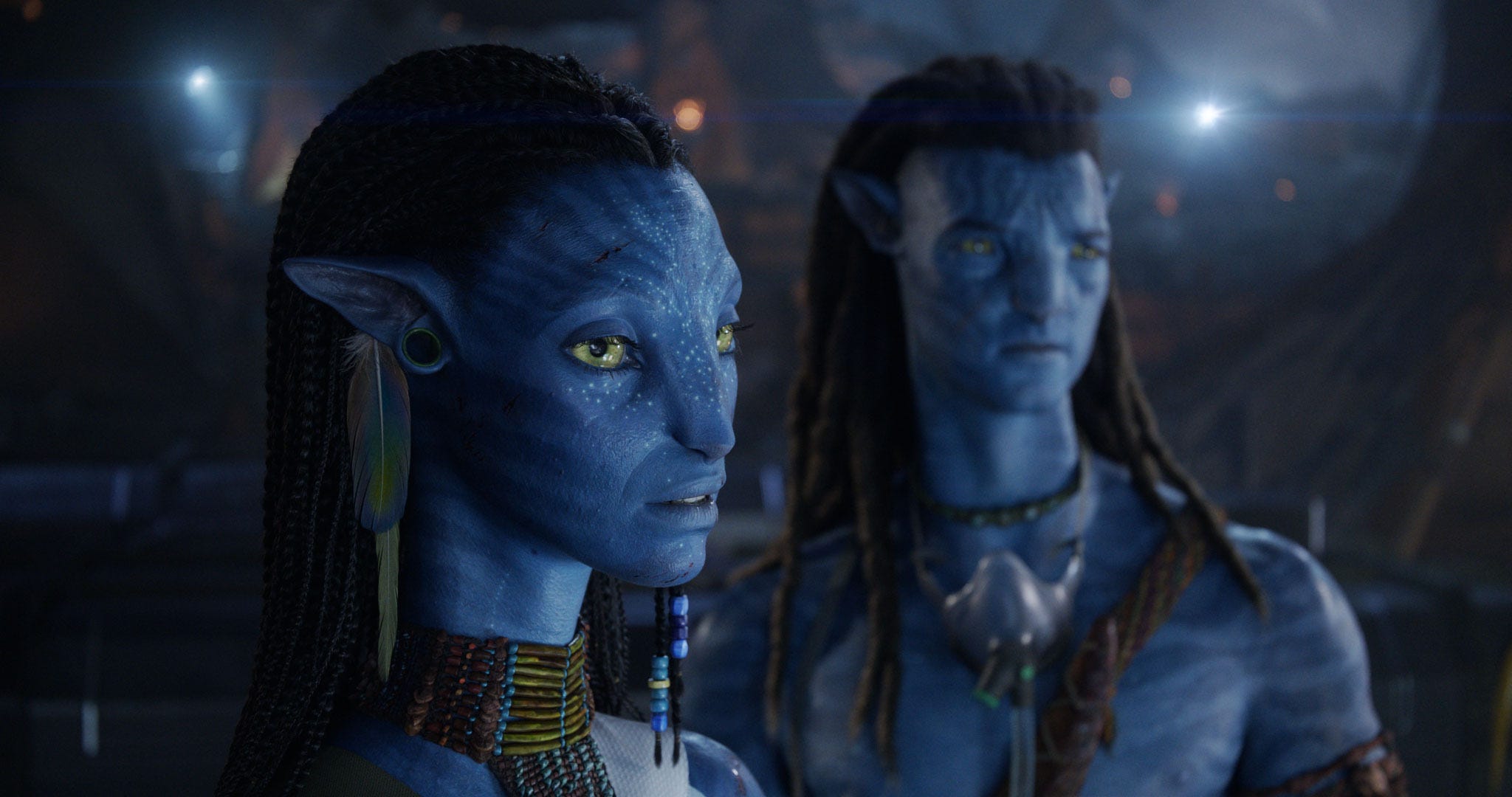
I was expecting a lot of things from Avatar: Fire and Ash—the fully immersive 3D world; the bridging of the Uncanny Valley; the bloat and the woo-woo mysticism that infects all of the films in James Cameron’s series about the world of the lithe, blue-skinned aliens—but I wasn’t expecting the movie to, at times, so clearly resemble Mel Gibson’s 2006 classic action-chase flick, Apocalypto.
Fire and Ash picks up more or less right where The Way of Water left off: Jake Sully (Sam Worthington), Neytiri (Zoe Saldaña), and their kids are living with the water tribe and trying to figure out what to do with their adopted human son, Spider (Jack Champion), who cannot breathe the air. The humans are once again hunting the giant whales of Pandora for their delicious brain juices, while the Na’vi-fied Col. Quaritch (Stephen Lang) searches for Sully and Spider, his biological son.
Jake and Neytiri decide that Spider cannot stay with them—they do not have easily obtained replacement parts for his mask in their beachfront hideaway—so the family decides to hitch a ride with some traveling traders to stash him somewhere else. It is on this journey that the family first encounters the fire-wielding Mangkwan clan and a raiding party led by Varang (Oona Chaplin), which attacks the traders and slaughters all they find.
Avatar: Fire and Ash has a number of problems: It’s a million hours long; while the High Frame Rate (HFR) 3D is fascinating, we’ve seen it before and thus it is not the quantum leap forward that The Way of Water was; the family melodrama at the heart of the film is broadly sketched and deeply uninteresting; and the plot is largely a rehash of the second entry in the series with some callbacks to the first for good measure. But every time Varang and Quaritch are on the screen, separately or together, the thing sparks to life in a very real and powerful way.
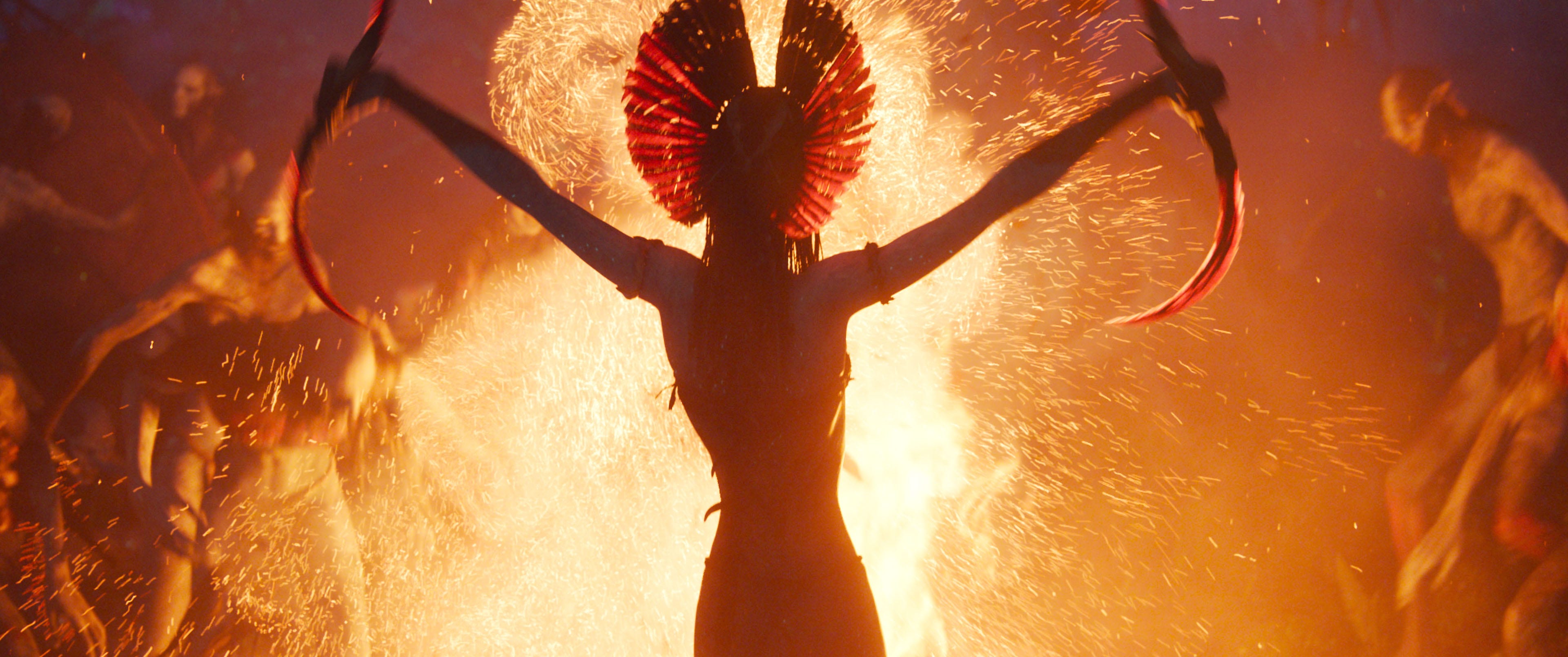
The Mangkwan represent the darker side of the Native/Mesoamerican cultures that Cameron has, ah, borrowed from so liberally in these films. These fire warriors scalp their victims, severing the tendril-like ponytails that allow the Na’vi to communicate with the Gaia-like planet goddess Eywa. They consume a hallucinogenic beverage that leaves them in thrall to Varang, a fire witch. And Varang wants to cut out the hearts of her enemies as part of a blood sacrifice.
These are some bad hombres, is what I’m saying, and they have the blood-red face paint and the uncivilized tendencies to prove it. Much of the first hour of this film is concerned with the Mangkwan raid on the trading party and their chase of Sully’s kids through the Pandoran forest, a sequence that can’t help but call to mind similar sequences in Apocalypto, another movie in which forest-dwelling innocents are hunted by savage, body-arted practitioners of blood sacrifices who consume mind-altering substances.
There’s a great sequence in which Quaritch consumes some of this ayahuasca-like substance and sees an explosion of colors, flames jumping out of reality and into his brain. It’s just an amazing few minutes to watch, the sort of pure spectacle that is sui generis to these films. Cameron has concocted a tremendous combination of photorealistic motion-capture, HFR 3D, and the 12 squillion1 shades of color that the Dolby Atmos Theater can project to create something truly trippy.
Indeed, my biggest complaint about Avatar: Fire and Ash is that this movie is, somehow, 195 minutes long2 and 194 of those minutes aren’t spent with Quaritch and Varang. Lang and Chaplin are having more fun than anyone else in the film as the Army colonel gone native and the fire-devil; Lang, in particular, has really taken to the role of Quaritch, always good for a quip and a snarky aside, lending the role a sort of rigid physicality that’s often absent from the other Na’vi. Their pairing and her clan’s insane beliefs are the only things that are new in this movie, and thus the only things that are of particular interest. Everything else is a rehash, everything else is something we’ve seen before.
And yes, it feels a little weird to dismiss something as incredibly constructed as Fire and Ash as “something we’ve seen before,” because there is literally no one else making stuff that looks as good as this movie looks. But that’s the simple truth: We’ve seen the war whales, we’ve seen the pterodactyl knockoffs, we’ve seen Eywa’s spirit world. It’s just not that interesting! And for the love of God, I don’t need to spend another second of my life with Spider, who spends the whole film channeling an annoying kid from a 1980s skater movie and uttering profundities like “Oh shit.”
Avatar: Fire and Ash is a profoundly impressive technical accomplishment. But these movies just aren’t as profound as Cameron clearly believes them to be.
Approximate value.
Right around the 135-minute mark, Spider makes a crack about really needing to pee, which is the cruelest thing James Cameron has ever done on film.
“Has there been a franchise that makes more money that has less of a cultural impact than Avatar?” -Tom Scharpling on The Best Show 12/16/25
I'm recalling the turn of phrase that was the kiss of death at student film screenings.
"It looked fantastic."