Bombs Won’t Win the War on Drugs
The military can interrupt the supply, but it can’t do anything about the demand.

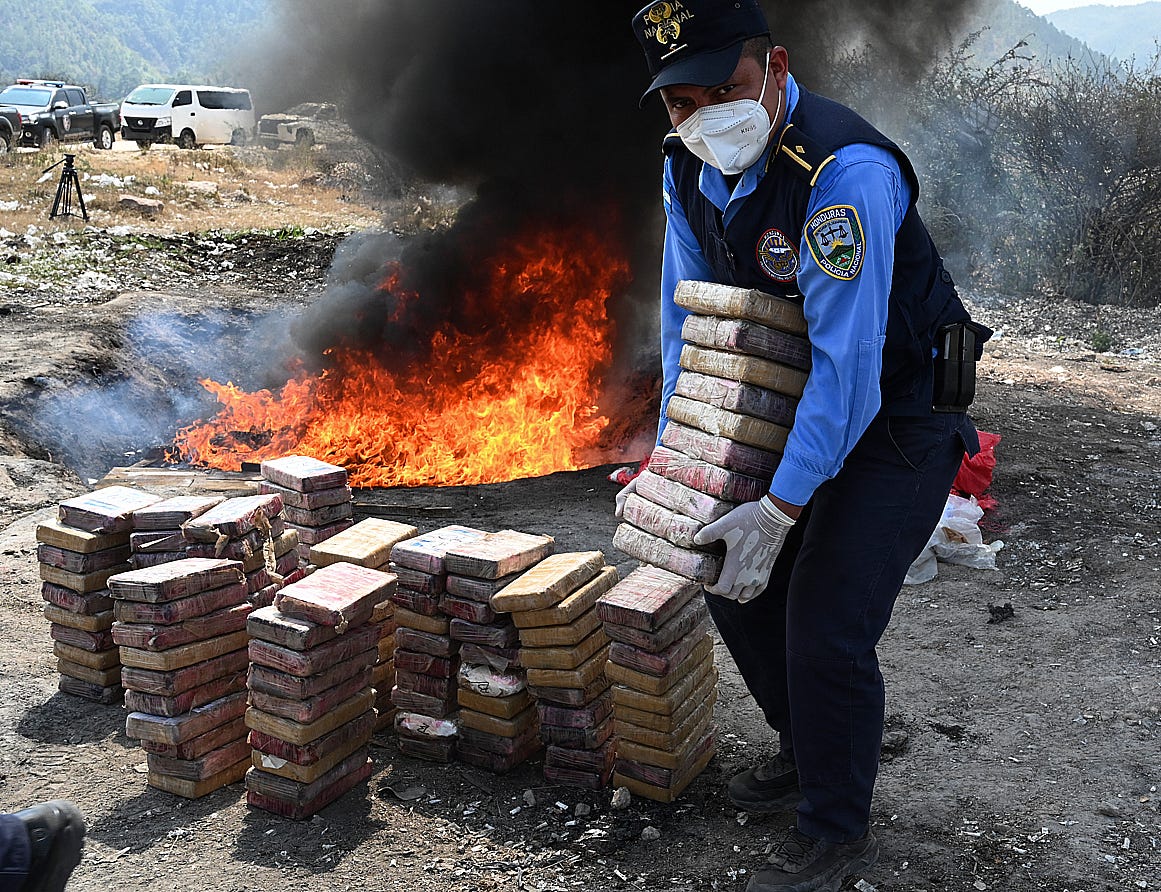
THE NEW YORK TIMES REPORTED LAST FRIDAY that Donald Trump has ordered U.S. military forces to fight Mexican and Venezuelan drug cartels. Such an order would hardly be unprecedented in world history, yet there are good reasons most countries avoid using military force to address their drug problems.
The United States has plenty of its own experiences using the military against drug traffickers to draw on, but none as disastrous as China’s attempt to curb opium in 1839.
Chinese viceroy Lin Zexu set out to rid his country of the scourge of British opium. He had moral clarity, imperial authority, and a deep sense of urgency: The British were supporting an illegal opium trade into China, which was undermining China’s sovereignty and immiserating many of its people. “If the traffic in opium were not stopped,” he warned, “a few decades from now we shall not only be without soldiers to resist the enemy, but also in want of silver to provide an army.” He trapped British opium traders in port, confiscated their contraband, and destroyed it both on land and on their ships.
It was a bold move to choke off the supply of a dangerous narcotic. It was also a diplomatic disaster. Britain seized on Lin’s actions as a pretext for war. The First Opium War ended with China’s defeat, the forced reintroduction of opium, and humiliating concessions that left the country worse off than before.
I used this example in a March 1990 Military Review article, “Narcoterrorism: The New Unconventional War,” written while I was a major at the U.S. Army’s School of Advanced Military Studies. Back then, the United States was gripped by the crack epidemic, Colombian cartels dominated the headlines, and some in Washington were urging the use of the military to attack the drug trade at its source. Even though “China’s modern ‘century of humiliation’ was ushered in when it lost a fight to a threat identical to the one we are facing,” I wrote,
The United States must adapt its Armed Forces for operations against narcoterrorism. . . . Doing anything less would tarnish the ideals of our profession. It is not a mistake to apply conventional forces to this type of unconventional war, but we must apply those forces with intelligence and imagination. Our nation’s survival depends on it.
My focus in that piece was the supply side—using military capabilities to dismantle production and transit networks abroad. Being a naïve young officer, I did not meaningfully address the demand side: the millions of Americans willing to buy drugs, and how their appetite drives the entire trade. Even now, that demand remains the economic engine of the crisis, and it’s far harder to shut down than any cartel lab.
TRUMP’S IDEA OF USING America’s military strength to attack the supply side of the drug trade has visceral appeal. It certainly did for me when I advocated a similar policy 35 years ago. The cartels are heavily armed, brutal, and sophisticated. Fentanyl deaths in the United States are killing Americans. And the U.S. military, on paper, has unmatched capabilities to hit these networks.
But as I cautioned in 1990, “military forces cannot act alone in eradication efforts. The State Department, DEA, . . . CIA . . . USAID . . . ambassadors and many other interested agencies must act together with host nation organizations.” That remains true today—though USAID has been reduced to a shell of its former self, which will make it more difficult to transition economies currently dependent on drug production to transition to other industries.
In any operation inside Mexico, or any other country, U.S. forces would have to be part of a host-nation–led multinational force—invited, integrated, and under a framework that respects a foreign nation’s sovereignty. Anything less would almost certainly fail diplomatically and could fail strategically.
More broadly, using the military as the Times report suggests Trump has ordered is fraught with legal and political problems. At home, the Posse Comitatus Act limits the role of federal military forces in domestic law enforcement. Soldiers cannot, without explicit congressional authorization, search, seize, or arrest suspects on U.S. soil. In 1990, I put it plainly: “For the military to assist law enforcement officials, Congress must make it acceptable and legal for military units or personnel to arrest, search, seize and detain suspected drug smugglers.” That hasn’t changed—and Congress still has not given it that authority.
On the other side of the border, the legal ground is even shakier. Sending U.S. troops into Mexico without its consent would violate international law and rupture relations. Mexican leaders from across the political spectrum have made clear that any unilateral U.S. military action would be seen as an attack on their sovereignty.
The Trump administration has designated several Mexican and Venezuelan cartels as foreign terrorist organizations, but that status only applies to American domestic law. It makes it a crime to aid these organizations and allows the government to freeze their assets, but it doesn’t provide a casus belli under international law. And if the administration were to attack them anyway, military operations would still be bound by the law of armed conflict—requiring proportionality, distinction between combatants and civilians, and accountability for every use of force. As a colleague sardonically asked me when I was writing my 1990 article, “What rights does a drug smuggler have when he’s facing the wrong end of a .50 caliber machine gun?” The answer, then and now, should be clear: He still has rights.
The U.S. military is trained to fight the nation’s enemies—uniformed combatants in recognized conflicts. As decades of recent experience have shown, the military is less effective at fighting irregular groups of non-state combatants, especially when asked to do it with insufficient diplomatic, economic, and intelligence support. Criminal organizations would strain the military operationally, doctrinally, and morally even more than Islamist terrorist groups did: A cartel operative may be a shooter one day and a civilian the next.
Placing soldiers in situations where they are pulling triggers against criminals, rather than battlefield enemies, changes the nature of the mission and the psychology of those carrying it out. It risks eroding the clear moral distinction between combat and policing, something essential to our military’s professional ethic and to public trust.
This is why, if U.S. troops were ever committed to a counternarcotic campaign, it must be in close partnership with host-nation forces who have the legal mandate for law enforcement and internal security. The mission and the rules must be theirs; our role would be to support and strengthen, not supplant.
In my original article, I described how U.S. surveillance aircraft, special operations units, and mobile light infantry might be part of the force used to disrupt drug processing sites, interdict shipments, and support host-nation forces. Those capabilities remain potent. The question is not whether the military can disrupt cartel operations—it can—but whether doing so will deliver lasting results.
History offers a warning. In the 1980s, “Operation Blast Furnace” saw U.S. forces help destroy Bolivia’s cocaine labs. For four months, the cocaine industry there was essentially paralyzed. Then the cartels adapted, shifted production, and the flow resumed.
Supply-side strikes, whether in South America or across our southern border, are temporary unless paired with sustained demand-reduction at home and stronger governance abroad. Plan Colombia, the fifteen-year effort to help Colombia defeat its cartels and insurgents itself, is a better model for fighting narcotics syndicates than Operation Blast Furnace. Notably, it focused less on the military and kinetic action than on foreign aid, training, and diplomacy.
IT’S TEMPTING TO FRAME THE DRUG CRISIS as a fight against “them.” But we can’t avoid talking about us. If tens of millions of Americans are willing to pay for illegal drugs, someone somewhere will find a way to supply them.
Demand reduction is slower, messier, and less dramatic than a military raid. It requires public health programs, addiction treatment, education, community investment, and political leadership. But without it, military strikes are just sweeping water out of a flooded house while the pipe is still gushing.
From the Opium Wars to today’s cartel fight, the lessons aren’t complicated: Unilateral military action in another country without consent can backfire catastrophically. Destroying drugs is easier but less permanent than diminishing demand. Any U.S. military role must be as part of a host-nation–led, multinational force. Posse Comitatus is not a loophole—it’s a safeguard against the militarization of domestic policing. Rules of engagement and the laws of armed conflict apply, even to drug smugglers. Soldiers should not be tasked in ways that blur the line between combat and policing without clear legal authority and oversight.
There’s no doubt that narcoterrorism is an unconventional war. It runs through jungles abroad and streets at home. The military can be part of the solution—but only as one piece of a broader, lawful, diplomatically sound, and host-nation–driven strategy.
Otherwise, we risk repeating Lin Zexu’s mistake: striking at the symptom, misjudging the strategic context, and ending up worse off than when we began.
 | A guest post by
|