Can Lawsuits Tame This Rogue Presidency?
From Day One of Trump 2.0, the defenders of democracy have turned to the courtroom.

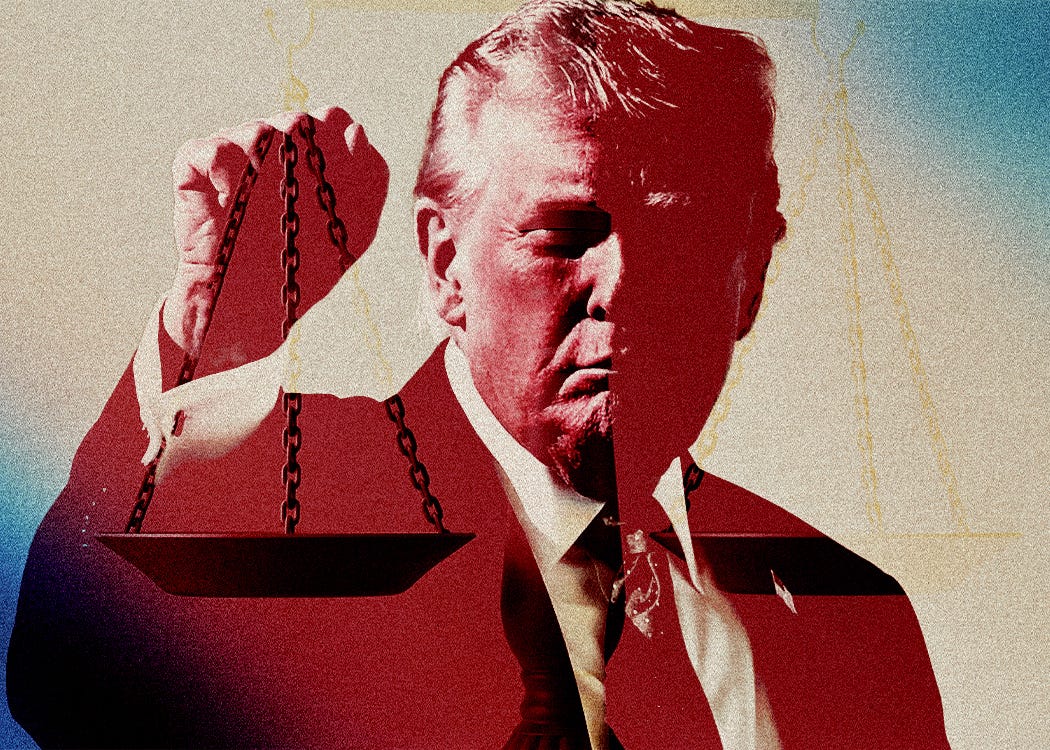
THE STATE OF THE UNION IS “GOLDEN,” Donald Trump boasted last week. He must have meant to say gilded, as in robber barons, corruption, and gaping economic inequality.
But let’s not argue. We can all agree at least on this: The state of America today is litigious.
Lawsuits are one of the only ways to hold the line against a regime bent on frog-marching our country back to the late nineteenth century—the actual Gilded Age, before women’s suffrage and the civil rights movement—or even further into the past, perhaps to the 1700s, when Edward Jenner discovered that a cowpox injection could prevent smallpox, and we were literally a nation of immigrants. Hundreds of lawsuits have been piling up since Trump’s executive-order dump on the first day of his second term.
These lawsuits and legal complaints are a sinkhole of time and money that we’ll never get back. But they are essential, as are the countless lawyers, watchdog groups and others flooding the courts to defend—even save—American rights, freedoms, laws, values, science, and modernity itself.
If you want to keep up, or try to, there are a few outlets tracking the explosion of litigation against the second Trump administration. JustSecurity.org is following 670 lawsuits as of this writing, just over four hundred days into Trump 2.0, and puts the overall case status score at plaintiffs 223, government 111, with others pending, closed, or tied. The New York Times tracker differs in the details, but it’s in the same ballpark: over 650 lawsuits against the administration. And of course, we the taxpayers are footing the bill for the government’s defense.
The categories on the two trackers underscore both the sweep and the details of what’s at stake. The Times lists access to federal property, the Alien Enemies Act, birthright citizenship, climate and environment, DOGE, firings, funding cuts, immigration, tariffs, trans rights, and a catchall label for “dozens of other suits.” Just Security’s list is even more overwhelming, with scores of granular subcategories under ten main categories—civil liberties and rights; government grants, loans, and assistance; diversity, equity, inclusion, and accessibility; environment; removal of information from government websites; federalism; immigration and citizenship; international institutions; trade law; and transparency.
Put “DHS” in the search box across the entire tracker, and you’ll come up with more than 120 results. The “federalism” category includes lawsuits filed by states, counties, cities, school boards, mayors, governors, and many others. And the boring-sounding “structure of government” sub-list is like a guide to the DOGE nuclear strike on the federal government—including, but not limited to, the actual or attempted dismantling of AmeriCorps, the Consumer Financial Protection Bureau, the National Institute for Occupational Safety and Health, Head Start, the National Endowment for the Arts, the National Endowment for the Humanities, and the U.S. Agency for International Development.
‘Yo is this DEI?’
NO ASPECT OF U.S. LIFE has escaped Trump’s heedless, self-dealing rule-by-chaos. You can see it in just a few of the lawsuits filed in February alone:
Seventeen major health and environmental groups sued the Environmental Protection Agency for revoking a 2009 finding that carbon dioxide and other pollutants endanger human and planetary health; it was that finding that made CO2 subject to EPA regulation.
The 17,000-member Authors Guild filed a lawsuit that uncovered the shocking way more than 1,400 grants from the National Endowment for the Humanities were killed. Techdirt writer Mike Masnick summarized the process this way: “two ignorant DOGE bros cancelling humanities grants based solely on ‘yo is this DEI?’ ChatGPT prompts.”
FedEx sued the Trump administration for a “full refund” of all tariffs it had paid the U.S. government after the Supreme Court ruled last month that they were illegal.
A former Yosemite park ranger and bat biologist filed a First Amendment lawsuit after being fired for hanging a transgender flag on the world’s largest granite monolith, El Capitan.
Two Maine immigration observers filed a First Amendment suit seeking class-action relief against Trump administration retaliation for their recording and observation activities.
Fourteen Democratic attorneys general and Pennsylvania Gov. Josh Shapiro sued the federal government over a new childhood vaccine schedule that “stripped seven vaccines . . . of their universally recommended status.” The suit asked the court to “set aside both the new immunization schedule” and the panel of appointees that approved it, arguing that Health and Human Services Secretary Robert F. Kennedy Jr. named them illegally.
Trump’s constant and intentional overreach beyond legal and constitutional bounds guarantees that lawsuits come for almost everything he does or tries to proclaim. Sometimes almost instantly.
On Day One in office, Trump signed an executive order to abolish the “birthright citizenship” guarantee in the Fourteenth Amendment. On Day Two, nearly two dozen Democratic attorneys general from blue states and the District of Columbia filed legal challenges in Boston and Seattle. And they weren’t even first.
The American Civil Liberties Union beat them to it, arguing in a lawsuit filed two hours after Trump issued the order that it flouted the Constitution, congressional intent, and Supreme Court precedent. A year into his second term, the ACLU docket totaled 239 legal actions and 139 lawsuits—and nearly two-thirds of its cases “succeeded in delaying, diluting, or defeating the Trump administration’s policies.”
Staggering corruption and profiteering
THE ACLU AND DEMOCRATIC AGs are frequent challengers to Trump, his henchpeople, and their view of the U.S. government and Constitution as teardowns. But they’re far from alone. There’s a phalanx of groups and individuals in the fight—among them Protect Democracy, Citizens for Responsibility and Ethics in Washington (CREW), Public Citizen, Lawyers Defending American Democracy, and veteran election attorney Marc Elias, chair of the Elias Law Group.
The blue-state attorneys general filed 71 cases against Trump in 2025. California, which led or was part of 114 lawsuits against Trump in his first term, has already been involved in 57—more than half that—in the first thirteen months of his second. Elias is currently handling 85 voting and election cases in forty states—“the largest litigation docket we have ever carried as a firm”—with more expected as Trump tries to control and manipulate midterm elections likely to end his grip on Congress. That’s already more than the roughly 65 cases Elias handled for Joe Biden’s campaign after the 2020 presidential election, when Trump and his allies filed flimsy challenges to Biden wins in multiple key states.
Like the ACLU, CREW sued Trump on Inauguration Day 2025—arguing along with other groups that DOGE was “unlawfully” established, operating unauthorized and unchecked under unelected, unaccountable leaders, and needed to be pulled “into the light” or shut down.
The group also sued Trump on Inauguration Day 2017 for “taking benefits and payments from foreign and domestic governments” in violation of the Emoluments Clauses of the Constitution. “Only Trump losing the presidency and leaving office ended these corrupt constitutional violations and stopped these groundbreaking lawsuits,” then-executive director (now CEO) Noah Bookbinder said in January 2021.
CREW has had the grueling task of monitoring Trump administration ethics, or lack thereof. The group documented an unprecedented 3,740 conflicts of interest in Trump’s first four years. Now, in a February 24 report devastating in its detail, CREW concluded that “the level of corruption and profiteering [has] already far surpassed the already ignominious standard he set in his first term.” Or, in a word, “staggering.”
Fifty-five officials from 21 countries made 60 visits to Trump properties in Trump’s first year back in office, posing potential Foreign Emoluments Clause violations and potential threats to our national security. . . . Eight foreign governments hosted or sponsored five events at Trump properties, posing similar Emoluments Clause risks. Entities from the United Arab Emirates have hosted or sponsored the most.
Trump is making billions off conflicts of interest like these, CREW noted, along with his cryptocurrency business and twenty-two Trump-branded foreign development projects.
Sounds like we need new lawsuits. And we do. But it’s sobering that Trump ran out the clock on CREW’s original first-term Emoluments Clause lawsuit from his first day (when it was filed) to the day he left office, and there’s no reason to think a second round would be different.
It’s also troubling that the legal system is unlikely to provide relief in Trump’s war on Iran. Congress has the constitutional power to declare war and/or authorize the use of force, and over the past half century, members occasionally have sued presidents for ignoring that. But they haven’t fared well. In a 2019 legal analysis of U.S. military action against Iran, updated in 2025 and republished last week, Just Security concluded that a more effective way for Congress to stop an unauthorized war is to cut off money to pay for it.
 | A guest post by
|