Chuck Norris, 1940–2026
Action icon and early internet meme dead at 86.

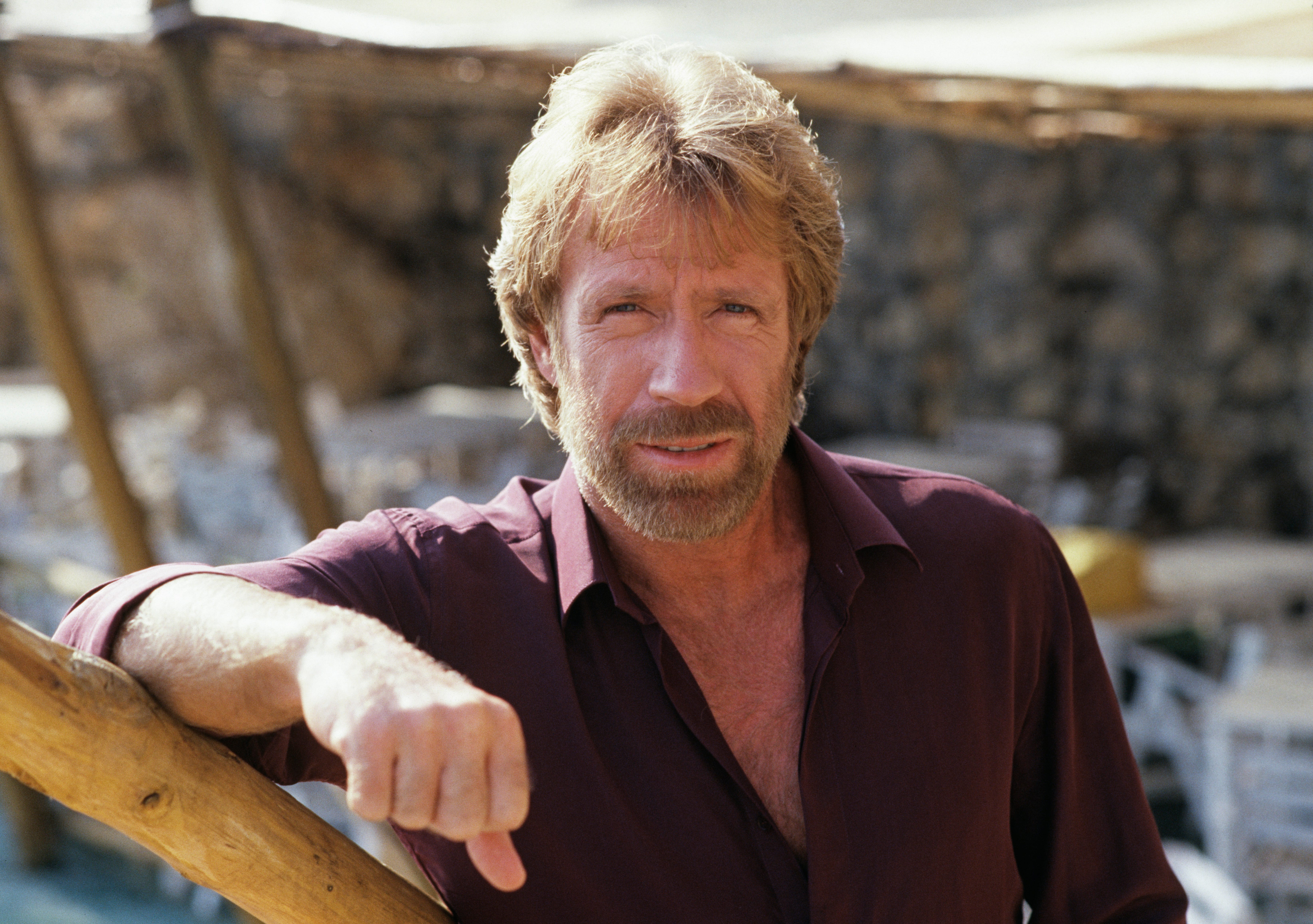
IF YOU HAD HBO IN THE LATE 1980s and early 1990s, odds are good you were never more than a few hours away from a certain type of film. They were straightforward, pleasing pictures: a laconic, sandy-haired American dispensed justice with a minimum of wit and a maximum of roundhouse kicks. Rarely much longer than 105 minutes, you didn’t need to watch them from start to finish; they were almost designed to be watched in bits and pieces. You could pick up the plot as you went: Odds are there were some bad guys in black pajamas and a soldier (or a girl) who needed to be rescued, and only one man capable of doing the job.
Chuck Norris was an early king of home video. A pioneer of VHS classics with escalating numeral modifiers—Delta Force 2: The Colombian Connection, Braddock: Missing in Action III—and a mainstay on pay TV, his films were the sort of silly fun that rarely could withstand the scrutiny of a major theatrical release but were right at home on the small screen. And then, even smaller screens, as Chuck Norris found an odd second life as one of the early internet memes, a sort of Bunyan-esque character on the American scene whose very name became a watchword for comical toughness.
Part of that legend springs from the fact that Norris was the real deal. Unlike so many of the names that eclipsed him in terms of pure international stardom—Schwarzenegger, Stallone, Willis, etc.—Norris was, in fact, a skilled fighter. This is why he was chosen to partake in a showdown against Bruce Lee in The Way of the Dragon. He was the perfect foil for Lee: a burly, hirsute American who was a legit fighter and a renowned martial artist, having trained in Tang Soo Do while serving in the Air Force. After returning to the United States, he would become one of the most renowned martial artists in the country, winning tournaments and opening a chain of stores.
You can see his skill in the fight with Lee thanks to the decision to shoot it in a way that allows the audience to see both of their bodies in motion. Contrast the medium-distance, full-body slo-mo shots in this fight to so much of modern filmmaking, with its hyper-edited quick-cut style designed to simulate speed and impact. You didn’t need any fancy camera work or special effects here. Norris was the special effect.1
But he had to figure out how to maximize that effectiveness. It seems simple now, but he had to learn that less is more—and he learned it from a master of the form.
“I wrote it with too much dialogue, and critics crucified me on it,” Norris told Nick De Semlyen, author of The Last Action Heroes: The Triumphs, Flops, and Feuds of Hollywood’s Kings of Carnage. “I took Steve McQueen to see it and he said, ‘Let me give you some advice. Give your co-stars all the BS dialogue and only speak when there’s something important to say.” It’s good advice—Norris was not likely to win any awards for his line deliveries or win any debates by flapping his lips. But McQueen’s pointer could, occasionally, be taken to absurd lengths.
Invasion USA is one such absurdity: One of the most expensive films in the Cannon2 canon, the film is borderline incoherent, with Norris frequently appearing out of nowhere to deliver nearly spectral justice on a band of Soviet-Cuban guerrillas attempting to destabilize the United States by , for some reason, invading America through Miami. But he shows up, kicks ass, and the film has, oddly, had an outsized impact in the world.
“Invasion USA became an underground sensation in Romania, with bootleg videos of the film passed around and helping to fuel the 1989 uprising” against Nicolae Ceauşescu, de Semlyen notes in his book. According to James Bruner, who worked on the film with Norris and director Joseph Zito, “They use the poster, to this day, in Romania when they protest against the government. . . . Ultimately, action movies are about freedom. Overcoming evil, in whatever form it may be.”3
Over the years, Norris has transcended his junk-action reputation and entered the rarefied air of cult fascination. Invasion USA is available via deluxe 4K from boutique home video publisher Vinegar Syndrome; I speak from experience when I say it’s a great gift for America’s aging dads. Sidekicks has also been released by VS in its ultra-collectible format, and that’s a movie I’ve always had a soft spot for: It’s Baby’s First Norris film, and I mean that as a compliment. Norris plays a sort of mythic figure in the mind of Barry (Jonathan Brandis), a young man suffering from asthma who hopes to learn karate in order to fend off his bullies. It’s a ridiculous movie on multiple levels (the villain, played by Joe Piscopo, is at one point costumed as a Fu Manchu–style antagonist in one of Barry’s numerous dream sequences), but I love it as you can only love a movie you encountered at age 10 on HBO.
Norris’s greatest success was probably in Walker: Texas Ranger, a procedural that ran for eight seasons on CBS before entering syndication immortality. But he arguably found a bigger surge of fame as one of the early internet memes, a sort of parodic tough-guy bit emblemized with the moniker “Chuck Norris Facts.” Some examples cribbed from Wikipedia: “When the bogeyman goes to sleep every night, he checks his closet for Chuck Norris”; “Chuck Norris has a polar bear rug at home. It’s not dead, it’s just afraid to move”; and “Chuck Norris once killed two stones with one bird.”
What can I say: The internet used to be fun.
And so did the movies. This is the simplest Chuck Norris fact of all: He made movies that were entertaining and exhilarating, and he did so without pretension or an embarrassed metatextual wink. Just quick hands, quicker feet, and an Uzi or two thrown in for good measure.
The closest American actor we have to Norris now is Scott Adkins, another man we often think of as a human special effect. [He’s British, not American. —SB]
Cannon was the cheapo-action brand par excellence of the 1980s and a key figure in Norris’s history, given how many of the films that he made for Cannon’s Golan and Globus producing team.
Joseph Zito, not Chuck Zito. Apologies to both men.